Fatigue After 40: Sleepy and Tired Are Not the Same Thing
Short answer
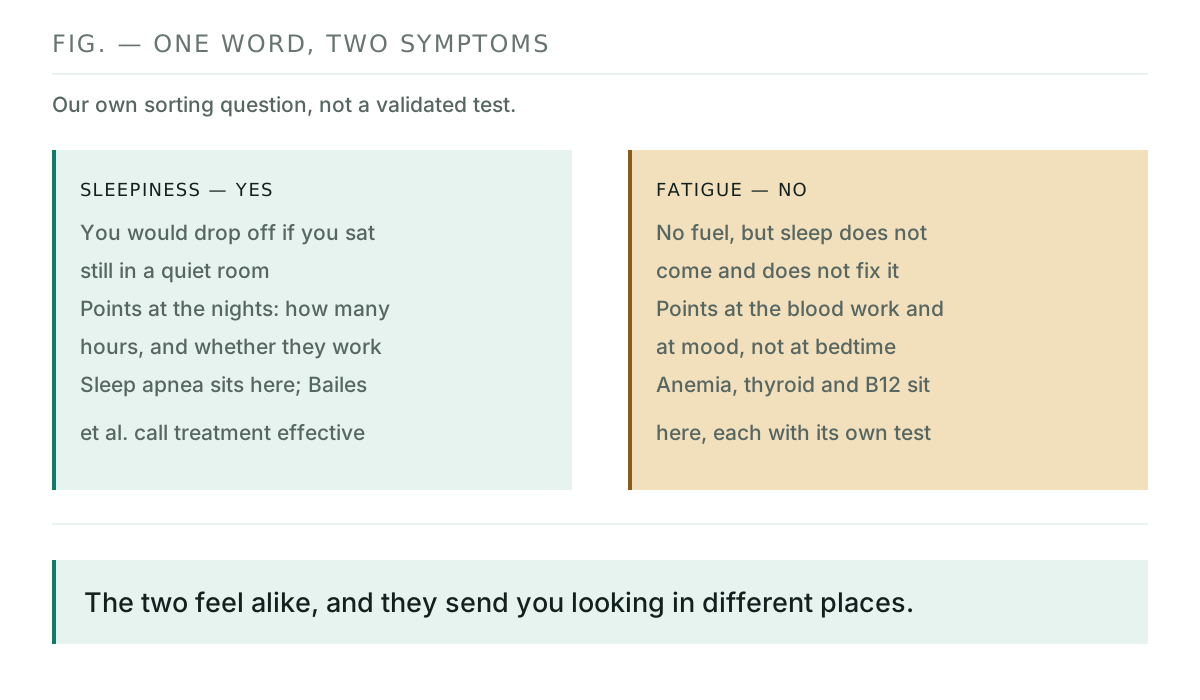
Fatigue and sleepiness feel similar and mean different things. Sleepiness is a tendency to fall asleep; fatigue is having no fuel while sleep neither comes nor helps. Researchers call them distinct but routinely confused. Sorting which one you have is what decides where to look next.
This is the first article in a new section, and it is the map for the ones that follow. Being tired after 40 is the complaint that sends men looking in the most directions at once — sleep, hormones, blood, mood, age — and the reason that search usually goes badly is not that the answer is exotic. It is that the question is two questions wearing one word.
English gives us "tired" for both of them. So does ordinary conversation with a doctor. The distinction below is not a technicality: it is the single piece of sorting that decides whether the useful next step is a sleep study or a blood draw.
We earn nothing from any of this. There is no supplement, test kit or clinic being sold on this page, which is the only reason an article about tiredness can end without recommending something to swallow.
Two symptoms wearing one word
The confusion is not just a lay problem. A group of researchers set out to build measurement scales that could tell the two apart, and opened by describing the state of the field: sleepiness and fatigue "are conceptually distinct but pervasively confounded in research, measurement instruments, clinical settings, and everyday spoken language."
Read that list again, because it is unusually candid. Not just everyday speech — the research, the questionnaires and the clinic too. If the instruments used to study tiredness blur the two, then a man describing his own tiredness in a ten-minute appointment has very little chance of being sorted correctly by accident.
The researchers built two short scales from existing questionnaires and reported that they "are only minimally correlated and represent separate constructs." Their stated clinical payoff was the ability to identify "sleepiness which is not fatigue, a construct closely related to primary sleep disorders, such as sleep apnea/hypopnea syndrome, for which there is both available and effective treatment." Bailes et al., Journal of Psychosomatic Research, 2006
That last clause is the reason this matters rather than being a vocabulary lesson. One of the two symptoms has a common cause with a treatment that works. Calling it by the other symptom's name is how men spend two years trying to fix the wrong thing.
The question that sorts them
There is a practical version of the distinction, and it takes one question: if you sat still in a quiet room with nothing to do, would you actually fall asleep?
If the honest answer is yes — you nod off in front of the television, in a meeting, in the passenger seat — that is sleepiness. Your body is taking sleep because it is owed sleep. The question that follows is about your nights.
If the honest answer is no — you feel wrung out, you would lie down gratefully, but sleep would not come, and when it does come you wake up no better — that is fatigue. The nights may be fine. The question that follows is about everything else.
Plenty of men have both, and the question still works: it tells you which one is loud enough to chase first. What it is not is a diagnosis. It is a sorting step that decides which door to knock on.
If it is sleepiness: look at the nights
The least interesting explanation is also a very common one, and the CDC puts a number on how widespread it is. Its stated benchmark is that "the recommended amount of sleep for adults is at least 7 hours each day." In the 2022 data on insufficient sleep among adults — not reaching that 7 hours — the percentage was highest in several groups, including men at 37% and adults aged 45 to 64 at 39%.
Worth being precise about those two figures, because it is tempting to multiply them and wrong to: 37% is men of all ages, and 39% is adults aged 45 to 64 of both sexes. The CDC does not publish a figure for men in that age band specifically. Neither number is small, and short sleep is worth settling before anything else, because no blood test will show it and no supplement will fix it.
When the hours are there and the sleepiness is not, the question becomes whether the nights are working rather than how long they are. That is the territory our sleep section already covers in detail: how much sleep you actually need after 40, what separates snoring from sleep apnea, and what it means when a partner reports you stop breathing. We are not going to repeat it here.
One thing is worth repeating, though, because it is the payoff of the whole distinction: sleep apnea is the example those researchers gave of a primary sleep disorder sitting on the sleepiness side — a class, in their words, "for which there is both available and effective treatment." If your answer to the sorting question was yes, that is the branch to rule out first.
If it is fatigue: a longer list, and a test for parts of it
Fatigue has no single home. MedlinePlus defines it plainly — "fatigue is a feeling of weariness, tiredness, or lack of energy" — and then gives a list of causes that spans medical conditions, treatments and habits. Among the medical problems it names are anemia, thyroid disease, diabetes, heart, liver and kidney disease, infections, sleep apnea, stroke, depression and anxiety. Among the habits: not sleeping enough, late nights, too much alcohol, too much caffeine, and both too little and too much exercise.
A useful feature of that list is that some of it is measurable and some is not. Anemia, thyroid disease and vitamin B12 status are blood tests. Mood, alcohol, caffeine and training load are conversations. The articles that follow this one take the measurable ones in turn.
There is one boundary worth drawing now, because it is the most common wrong turn for men in this age group. Fatigue is on the symptom list for low testosterone, and our article on those symptoms goes through what the evidence does and does not support. It is one of the doors on this corridor. It is not the corridor.
What the blood tests actually find
Here is the number that reframes the whole experience of going in about tiredness, and almost nobody is told it beforehand.
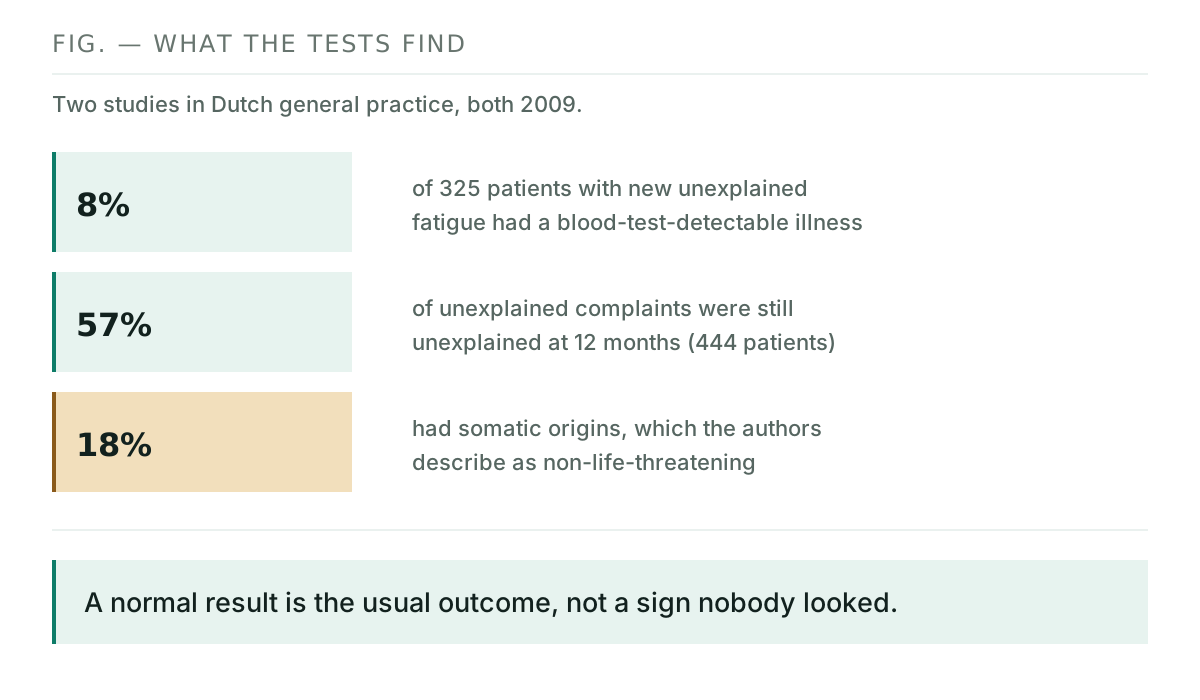
The VAMPIRE trial was a cluster randomised trial across the practices of 91 GPs in the Netherlands, enrolling patients with new unexplained fatigue and randomising their doctors to order blood tests immediately or four weeks later. Of the 325 patients analyzed, "eight per cent of patients had a somatic illness that was detectable by blood-test ordering." The authors open by stating the reason plainly: "because of the low prior probability of underlying somatic pathology, the positive predictive value of abnormal (blood) test results is limited in such patients." Koch et al., British Journal of General Practice, 2009
Eight percent. Which also means that in more than nine of every ten patients in that trial — a group that was 71% women, mean age 41 — blood testing did not turn up a somatic illness. Note that this is not the same as the answer lying somewhere else; often, as the next section shows, there is no answer at all. That is not a reason to skip the tests — the 8% includes conditions worth catching, and the following articles in this section are about exactly those. It is a reason to walk in with the right expectation.
Why asking for more tests can make things worse
The intuitive response to an 8% yield is to test harder. VAMPIRE tested that intuition directly, comparing a limited set of blood tests against an expanded one, and the result ran the other way: "the number of false-positive test results increased in particular in the expanded test set."
The authors' conclusion is unusually direct for a trial paper: the results "support restricting the number of tests ordered because of the increased risk of false-positive test results from expanded test sets."
A false positive is not a harmless extra data point. It is a slightly abnormal number on a panel that was never indicated, which produces a repeat test, then a referral, then months of attention pointed at something that was never causing the tiredness. The wide panel feels thorough and behaves like noise.
The trial also tested whether waiting four weeks before drawing blood changed anything, and found that "test postponement did not affect the distribution of patients over the two-by-two tables," while noting that "patients rarely re-consulted after 4 weeks."
What happens when nothing is found
A companion cohort study by the same research group followed what happens next, and it is the part men are least prepared for — worth saying plainly that this is the same team rather than independent corroboration. Sixty-three GPs enrolled 444 patients presenting with a new unexplained complaint — 70% of them unexplained fatigue — and tracked them for a year.
At 12 months, "43% of the patients suffered from their initial complaints" and "fifty-seven percent of the UCs remained unexplained." The complaints "had (non-life-threatening) somatic origins in 18% of the patients." The authors also report that quality of life "was often poor at presentation and tended to remain poor."
Two things follow from that, and a third that does not. More than half of these new unexplained complaints — of which fatigue was much the largest group, though the paper does not report the 57% for that subgroup alone — had no name even after a year. And when a physical cause was found, the authors characterize those causes as non-life-threatening.
What does not follow is the cheerful reading, and it is worth naming because it was in an earlier draft of this article. The abstract reports that 43% still had their complaint at twelve months; it says nothing about the other 57% having recovered, and the authors' own summary runs the other way: "a large proportion of newly presented UCs remained unexplained and unresolved," with quality of life that "tended to remain poor." Treating the complement of 43% as recovery would be inventing a result.
The honest limits of all this
The sorting question at the heart of this article is a practical simplification, and it is worth saying what it is built on. The scales paper that separates sleepiness from fatigue is small: 19 people with chronic fatigue syndrome, 14 with narcolepsy and 11 controls, with the findings then "replicated and validated in a sample of 128 older individuals complaining of daytime sleepiness and/or fatigue." That is enough to establish that the two are distinct constructs, and the authors do report replicating their scales. But their instrument is nine items across two scales. The one-question version in this article is ours, not theirs, and it has not been validated against anything.
The numbers on testing come from Dutch general practice, from one randomised trial and one cohort study by the same group, whose patients were 71% and 73% women, with a mean age of 41 and a median of 42. This site is written for men over 40. A yield of 8% in that population is the best honest anchor available for what a fatigue workup usually returns, but it is not a figure measured in men our readers' age, and it should not be read as one.
The studies are also from 2009. The underlying logic — low prior probability, limited positive predictive value, more tests producing more false positives — is not the sort of thing that expires, but the exact percentages come from a particular health system at a particular time.
Finally, nothing here is a reason to wait it out. MedlinePlus gives a threshold that is deliberately low: "If you have been feeling tired for weeks, contact your health care provider." An article explaining that most tests come back normal is not an argument for skipping the appointment. It is an argument for going in without expecting the blood to answer it.
What to do with this
- Answer our sorting question honestly first. Would you fall asleep sitting still in a quiet room? Yes points at the nights. No points everywhere else. It is a way of describing the symptom more precisely, not a validated test.
- If it is sleepiness, count the hours before anything else. Per the CDC, 37% of men and 39% of adults aged 45 to 64 were not getting the recommended 7 hours in 2022.
- Say which one you have at the appointment. "I fall asleep during the day" and "I have no energy but I can't sleep" start two different investigations.
- Do not push for the widest possible panel. VAMPIRE found more false positives in the expanded set and concluded in favor of restricting tests.
- Go in after weeks, not after years. MedlinePlus sets the threshold at weeks, and that holds whichever of the two symptoms it turns out to be.
The most useful thing a tired man can bring to an appointment is not a list of supplements he has tried. It is a clear answer to one question about whether he would fall asleep sitting still — because that answer, more than a list of what he has already tried, points at where the looking should start.
Key takeaways
- Sleepiness and fatigue are, per Bailes et al. (2006), "conceptually distinct but pervasively confounded in research, measurement instruments, clinical settings, and everyday spoken language."
- Our sorting question — a plain-language shortcut of ours, not a validated tool: would you actually fall asleep sitting still in a quiet room? Yes means sleepiness; no means fatigue.
- Identifying "sleepiness which is not fatigue" matters because it is "closely related to primary sleep disorders, such as sleep apnea/hypopnea syndrome, for which there is both available and effective treatment."
- CDC: the recommended amount of sleep for adults is at least 7 hours a day; in 2022, 37% of men and 39% of adults aged 45 to 64 were not getting it.
- VAMPIRE (BJGP, 2009), 325 patients with new unexplained fatigue, 71% women and mean age 41: "eight percent of patients had a somatic illness that was detectable by blood-test ordering."
- Wider panels are not better: "the number of false-positive test results increased in particular in the expanded test set," and the authors concluded in favor of "restricting the number of tests ordered."
- In a 444-patient cohort by the same group, 70% presenting with unexplained fatigue and 73% women, "fifty-seven percent of the UCs remained unexplained" at 12 months and 18% had non-life-threatening somatic origins.
- MedlinePlus: "If you have been feeling tired for weeks, contact your health care provider."
Where to go from here
This is the first article in the energy section. All eleven are now published:
- Anemia — the tiredness that shows up in a routine blood count, and why in a man it obliges a search.
- Vitamin B12 — who is actually short of it, who is just taking it, and the newer question of whether high doses are free.
- Hypothyroidism — the normal range moves with age, and treating the mildest version did not change how a large trial's patients felt.
- Caffeine — the daily lift is mostly withdrawal relief, not a boost above normal, and it can still cost you sleep six hours later.
- Brain fog — reported in a dozen unrelated conditions and defined inconsistently even by researchers, with a surprisingly specific fingerprint from sleep loss.
- Magnesium — common shortfall, rarely true deficiency, and the standard blood test is a poor way to check it.
- Vitamin D — the Endocrine Society withdrew its own cutoff in 2024 and now advises against routine testing for most adults, but still recommends it for three specific groups.
- CoQ10 — the best evidence isn't an energy study at all, it's a two-year heart-failure trial that cut deaths and hospital stays.
- Creatine — sold for muscle, but the newest trials test sleep-deprived brains instead, where a single dose blunted the cognitive crash.
- Ashwagandha — real trial evidence for cortisol and stress, not the same thing as the "more energy" pitch on the bottle, plus a liver warning most marketing skips.
In the meantime, the two sections this one borders on: sleep for everything on the nights, and testosterone for the hormone question.
Frequently asked questions
What is the difference between sleepiness and fatigue?
Sleepiness is a tendency to fall asleep; fatigue is a lack of energy that sleep does not resolve. Researchers writing in the Journal of Psychosomatic Research describe them as "conceptually distinct but pervasively confounded in research, measurement instruments, clinical settings, and everyday spoken language."
How do I tell which one I have?
Ask whether you would actually fall asleep if you sat still in a quiet room with nothing to do. If yes, that is sleepiness and the nights are the place to look. If you feel drained but could not drop off, that is fatigue, and it points elsewhere. This one-question version is our own plain-language shortcut, not a validated screening tool.
How often do blood tests find a cause for fatigue?
Not often. In the VAMPIRE trial, which analyzed 325 patients presenting with new unexplained fatigue in Dutch general practice, "eight percent of patients had a somatic illness that was detectable by blood-test ordering." Note the sample: 71% women, mean age 41.
Should I ask for a bigger panel of blood tests?
The evidence points the other way. VAMPIRE found that "the number of false-positive test results increased in particular in the expanded test set," and its authors concluded that the results "support restricting the number of tests ordered."
What if the tests come back normal?
That is the common outcome rather than a failure. In a cohort of 444 patients with new unexplained complaints, 70% of them fatigue, fifty-seven percent remained unexplained at 12 months, while the complaints had non-life-threatening somatic origins in 18%. That cohort was 73% women, median age 42.
When should I see a doctor about being tired?
MedlinePlus gives a simple threshold: "If you have been feeling tired for weeks, contact your health care provider." Weeks, not days, and regardless of which of the two symptoms it turns out to be.
Sources
- Bailes et al., Journal of Psychosomatic Research, 2006 — Brief and distinct empirical sleepiness and fatigue scales
- Koch et al. (VAMPIRE), British Journal of General Practice, 2009 — Ordering blood tests for patients with unexplained fatigue in general practice: what does it yield?
- Koch et al., Family Practice, 2009 — The course of newly presented unexplained complaints in general practice patients: a prospective cohort study
- MedlinePlus (National Library of Medicine, NIH) — Fatigue
- Centers for Disease Control and Prevention — Adults Sleep Facts and Stats

Male Health Guide Editorial Team
We write about the health problems men over 40 actually search for at 3 a.m. — and we say plainly when the evidence for a popular product is thin. We do not invent credentials and we do not publish sponsored copy as editorial. Read more about how we work.
Medical disclaimer: This article is general information about fatigue and is not medical advice. The sorting question in it is a way to describe a symptom more precisely, not a diagnostic test. Persistent tiredness deserves a clinician who can take a history and examine you.