Ashwagandha: The Cortisol Evidence and the Liver Warning
Short answer
Ashwagandha has real trial evidence for lowering cortisol and perceived stress, and some support for sleep, according to NCCIH — but that differs from the "more energy" pitch on most bottles, and the trials are still few. A genuine, if rare, liver injury signal has emerged that most marketing skips, and men with hormone-sensitive prostate cancer should avoid it specifically.
Ashwagandha has had the kind of year that makes an editorial team suspicious on principle: search interest climbing, bottles appearing in every supplement aisle, and a marketing story — "ancient herb, modern stress" — that is compelling enough to not ask what was actually measured in a lab.
This article covers what was actually measured, in the trial most of that marketing leans on; why "lowers stress" and "gives you energy" are not the same finding, even when they get sold as one; the testosterone question, covered more fully elsewhere on this site; and a safety signal — a real, if rare, link to liver injury — that most of the marketing skips entirely.
What ashwagandha actually is
Ashwagandha (Withania somnifera) is a plant used in traditional Ayurvedic medicine, also known as Indian ginseng. The National Center for Complementary and Integrative Health (NCCIH) notes it is commonly promoted for stress and anxiety, sleep, male infertility and athletic performance.
Many clinical trials have looked at ashwagandha, per NCCIH, but most have had small sample sizes and used a variety of different preparations — which matters more than it sounds, because a result from one specific extract at one specific dose does not automatically transfer to a different product on a different shelf.
The trial that built its reputation
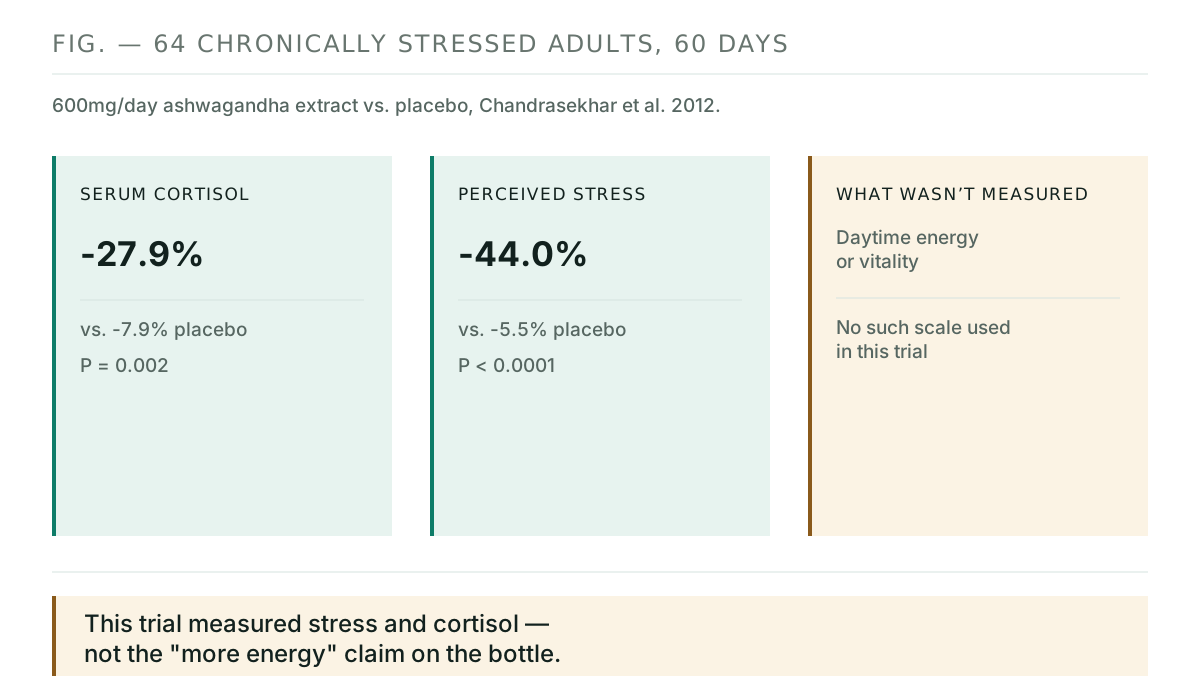
A 2012 randomized, double-blind, placebo-controlled trial enrolled 64 adults with a history of chronic stress. Half took 300mg of a high-concentration ashwagandha root extract twice daily — 600mg total — and half took placebo, for 60 days.
After 60 days of treatment, a reduction of 27.9% from baseline was observed in the Ashwagandha group [in serum cortisol]. In contrast, a reduction of 7.9% was observed in the placebo-control group... The difference... was statistically significant (P=0.002). On completion of 60 days of treatment, there was only a 5.5% reduction in baseline [Perceived Stress Scale] scores in the placebo group, compared to 44.0% in the Ashwagandha group... highly statistically significant (P<0.0001).
Chandrasekhar et al., Indian Journal of Psychological Medicine, 2012The same trial found similarly large, statistically significant improvements on two other standard stress-assessment scales, the General Health Questionnaire-28 and the Depression Anxiety Stress Scale. Adverse events were mild and similarly common in both groups — nasal congestion, constipation, cough and cold, drowsiness and decreased appetite in the ashwagandha group, nothing the authors linked to a known mechanism of the drug.
This is one well-conducted trial with a modest sample, not a settled finding from dozens of large studies. It is also, honestly, the trial behind most of the specific numbers you will see quoted elsewhere — which is worth knowing before treating any single percentage as gospel.
Why "less stressed" and "more energy" aren't the same claim
NCCIH's own summary of the evidence is narrower than most marketing: research shows some ashwagandha preparations may be effective for insomnia and stress, while evidence is unclear about its effects on anxiety specifically. There is no mention of daytime energy or vitality as its own measured outcome — because the trials, including the one above, were not designed to measure it.
That distinction matters for this site's whole Energy section. A herb that genuinely lowers cortisol and improves sleep could plausibly leave a chronically stressed man feeling less depleted during the day — but that is an indirect, downstream effect, not the same thing as a direct energy boost, and it is a different mechanism than the one this site's caffeine article describes, where most of the day-to-day lift turns out to be withdrawal relief rather than a true boost above baseline either. Two different supplements, two different reasons the "more energy" story oversells what was actually tested.
The sleep evidence, more cautiously stated
Sleep is the one area besides stress where NCCIH is willing to say "may be effective" rather than "unclear." Among its cited references is a 2021 systematic review and meta-analysis specifically on ashwagandha and sleep — included in NCCIH's reference list as part of the evidence behind that conclusion, though this site has not independently read the full study and is relying on NCCIH's summary judgment of it, not quoting its numbers directly.
If sleep itself, rather than a supplement for it, is the actual problem, this site's sleep section covers the full range of causes and treatments in more depth than any single herb article can.
The testosterone question, covered elsewhere
NCCIH notes there is some limited evidence that taking ashwagandha for 2 to 4 months may increase testosterone levels and sperm quality. This site covers that specific question in real depth — four separate human trials, including the one that found no effect in stressed men specifically — in testosterone booster supplements: what each one does. Repeating that analysis here would just be the same evidence twice; this article's job is the stress, sleep and safety side of the same herb.
The liver warning most marketing doesn't mention
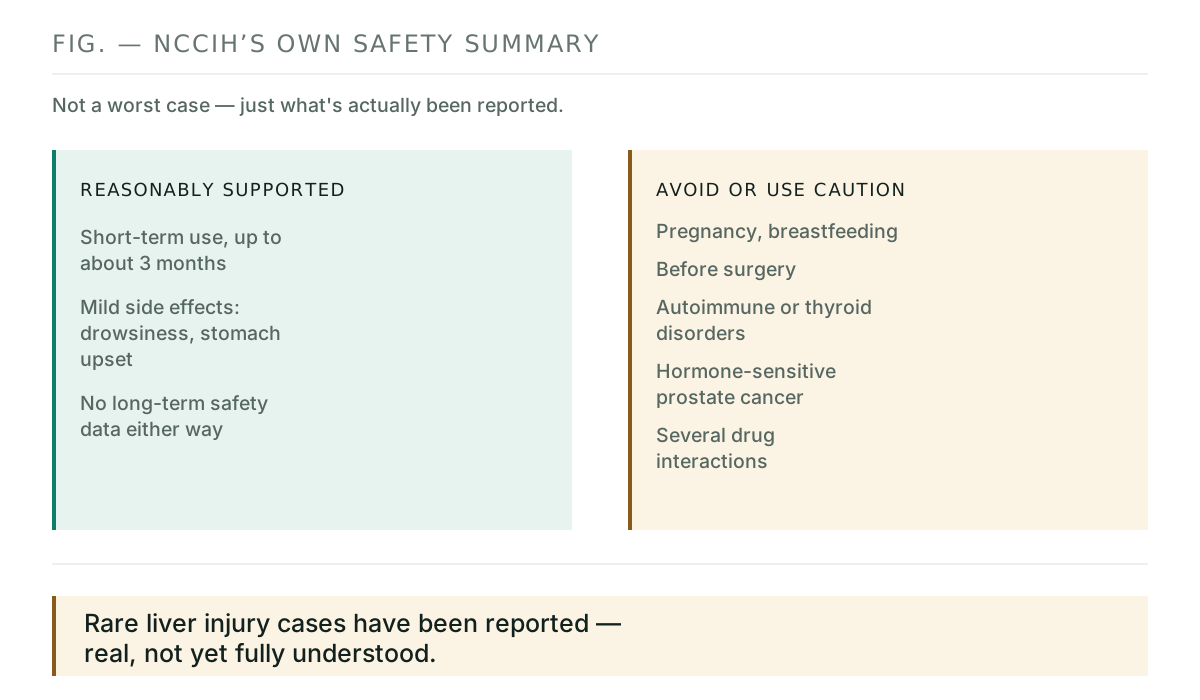
This is the part a lot of ashwagandha content skips entirely, and it is not a fringe concern. NCCIH states it plainly: although it is rare, there have been a number of cases that link liver injury to ashwagandha supplements. The Netherlands' national pharmacovigilance center, Lareb, put a number on part of that signal — after an initial 2023 warning, it received eight new reports of suspected liver toxicity linked to ashwagandha products in the time since, and stated plainly that although liver toxicity with ashwagandha-containing products appears to be rare, it is important to be aware of the risk.
Lareb is also honest about a specific limitation: herbal products often contain more than one herb, and sometimes contain ingredients not listed on the label, or are contaminated — so for any individual report, it cannot be ruled out that something else in the product, not the ashwagandha itself, caused the liver injury. That is not the same as the risk being imaginary — it is a real, accumulating signal that simply has not been nailed down to a precise rate yet.
NCCIH's broader safety read: ashwagandha may be safe when taken short-term, up to about three months, the same window covered in most of the positive trials. There is not enough information to draw conclusions about longer use either way — which cuts against treating it as a supplement to take indefinitely just because a 60-day trial went well.
Who should avoid it, or be cautious
NCCIH is specific here, and some of it applies directly to this site's own readers. Avoid it during pregnancy or breastfeeding, before surgery, and if you have an autoimmune or thyroid disorder. Because ashwagandha may increase testosterone, NCCIH states that people with hormone-sensitive prostate cancer should avoid its use — a direct, specific caution for exactly the kind of reader who already has a prostate-cancer history and might otherwise reach for it as a harmless stress supplement.
NCCIH also lists real drug interactions: medicines for diabetes and high blood pressure, immunosuppressants, sedatives, anti-seizure medications and thyroid hormone medication. None of this makes ashwagandha dangerous for most healthy men taking it short-term — it makes it a supplement worth mentioning to a doctor or pharmacist before starting, the same way any new medication would be, rather than something to add quietly because a friend recommended it.
What this actually means for you
- Know which claim you're testing. The trial evidence is strongest for stress and cortisol, with sleep a step behind and daytime energy not directly measured at all. Decide which problem you're actually trying to solve before buying a bottle.
- Match the dose and duration to what was actually studied. The clearest positive trial used 600mg a day, split into two doses, for 60 days — not a single capsule taken once and judged the next morning.
- Treat three months as the edge of what's known to be reasonably safe. Beyond that window, per NCCIH, the safety data simply runs out.
- Check the exclusion list against your own situation first. Pregnancy, upcoming surgery, autoimmune or thyroid disease, hormone-sensitive prostate cancer, and the specific medication classes above are reasons to ask a doctor before starting, not reasons to assume it is automatically off the table.
- If it's raised testosterone you're actually after, read the fuller, four-trial picture in testosterone booster supplements before deciding ashwagandha is the ingredient that gets you there.
Key takeaways
- A 2012 trial found ashwagandha cut cortisol 27.9% and perceived stress 44% versus placebo in chronically stressed adults — one solid trial, not a settled consensus.
- NCCIH's evidence summary covers stress and insomnia, not daytime energy directly — the two get marketed as the same thing when they aren't.
- NCCIH states a number of liver injury cases have been linked to ashwagandha, rare but real; the Netherlands' Lareb logged 8 new reports after its 2023 warning.
- Men with hormone-sensitive prostate cancer should avoid it specifically, because it may raise testosterone — a direct caution from NCCIH.
- Safety data covers roughly 3 months of use; the clearest positive trial used 600mg/day split in two doses for 60 days, not occasional use.
Where to go from here
If ashwagandha is what brought you here, these pages cover the surrounding ground:
- Fatigue After 40: Sleepy and Tired Are Not the Same Thing — the guide to the whole section.
- Caffeine: The Boost Is Mostly Withdrawal Relief — another popular pick-me-up with a narrower real effect than advertised.
- Magnesium: Common Shortfall, Rarely True Deficiency — the same honest-evidence treatment for a different supplement.
- Testosterone Booster Supplements: What Each One Does — the full ashwagandha-and-testosterone picture, with four trials.
- Sleep section — if poor sleep, not a missing supplement, turns out to be the real target.
Frequently asked questions
What is ashwagandha, and what is it actually used for?
Ashwagandha (Withania somnifera) is an herb used in traditional Ayurvedic medicine. NCCIH says it is commonly promoted for stress and anxiety, sleep, male infertility and athletic performance. Research shows some ashwagandha preparations may be effective for insomnia and stress, though evidence is unclear about its effects on anxiety specifically, according to NCCIH.
Does ashwagandha really lower cortisol?
In the trial most of the marketing is built on, yes. Sixty-four chronically stressed adults took 300mg twice daily for 60 days; the ashwagandha group's cortisol fell 27.9% versus 7.9% for placebo, a statistically significant difference. It is one trial, with a modest sample, not a settled consensus across dozens of studies.
Does ashwagandha give you more energy during the day?
That is not what the strongest trials actually measured. NCCIH's review finds evidence for insomnia and stress, not for daytime energy or vitality as a distinct outcome. Less stress and better sleep can indirectly leave you feeling less depleted, which is a different claim than a direct energy effect.
Is the liver warning something to take seriously?
It is real and worth knowing, while staying proportionate. NCCIH states that although rare, a number of cases link liver injury to ashwagandha supplements, and the Netherlands' pharmacovigilance center reported eight new cases in the roughly two years since its first 2023 warning. Long-term safety beyond about three months has not been established either way.
Does ashwagandha raise testosterone?
There is some limited evidence that taking it for 2 to 4 months may increase testosterone levels and sperm quality, per NCCIH. This site's testosterone booster supplements article covers four separate human trials on that specific question in depth, including one that found no effect in stressed men.
Who should avoid ashwagandha?
NCCIH advises against it during pregnancy or breastfeeding, before surgery, and for people with autoimmune or thyroid disorders. Men with hormone-sensitive prostate cancer should avoid it specifically because it may raise testosterone. It can also interact with diabetes, blood pressure, immune-suppressing, sedative, anti-seizure and thyroid medications.
Sources
- National Center for Complementary and Integrative Health (NIH) — Ashwagandha
- Chandrasekhar K, Kapoor J, Anishetty S, Indian Journal of Psychological Medicine, 2012 — A Prospective, Randomized Double-Blind, Placebo-Controlled Study of Safety and Efficacy of a High-Concentration Full-Spectrum Extract of Ashwagandha Root in Reducing Stress and Anxiety in Adults
- Netherlands Pharmacovigilance Centre Lareb — More Reports of Liver Toxicity With Ashwagandha
- Male Health Guide — Testosterone Booster Supplements: What Each One Does (companion coverage of the testosterone-specific trials)

Male Health Guide Editorial Team
We write about the health problems men over 40 actually search for at 3 a.m. — and we say plainly when the evidence for a popular product is thin. We do not invent credentials and we do not publish sponsored copy as editorial. Read more about how we work.
Medical disclaimer: This article is general information, not medical advice. We are not doctors, and nothing here diagnoses, treats or cures any condition. Supplements can interact with medical conditions and medications. Please speak to a qualified healthcare professional before starting ashwagandha or any supplement, and never start, stop or change a prescribed medication based on what you read online.