Testosterone Booster Supplements: What Each One Does
Short answer
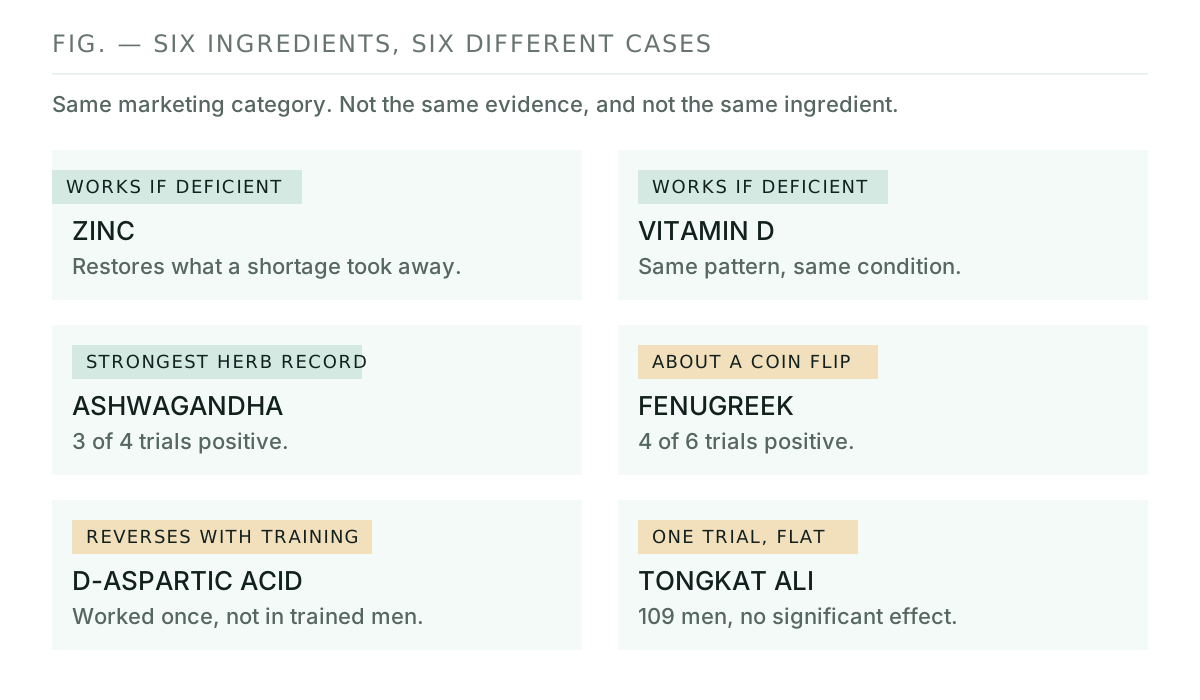
A testosterone booster is usually one of six ingredients. Zinc and vitamin D genuinely raise the number, but only in men who were actually low on them — not beyond normal. Ashwagandha has the strongest trial record of the herbs, three of four studies positive. Fenugreek, D-aspartic acid and tongkat ali are worth trying with modest expectations: the human evidence for each is genuinely mixed, not settled either way.
This is the last article in our testosterone series, and the one we get asked about most. Every ingredient below has real published research behind it — that is exactly what makes the marketing around it so effective, and exactly why the research is worth reading directly rather than trusting the label.
We are not reviewing a product. We are not naming a brand, good or bad. This is six ingredients, evaluated on what was actually measured in men, ingredient by ingredient, because a “testosterone booster” blend is a marketing category, not a clinical one.
We earn nothing from any of this. There are no affiliate links on this site, nothing here is sponsored, and we do not sell a supplement, which is why we can tell you plainly where the evidence is strong, where it is thin, and where it depends entirely on who is taking it.
A “testosterone booster” is usually one of six ingredients, sold six different ways
Open the label on almost any product marketed this way and you will find some combination of zinc, vitamin D, ashwagandha, fenugreek, D-aspartic acid and tongkat ali (Eurycoma longifolia). Doses vary, blends vary, and the same ingredient can come from a standardised, patented extract in one product and a cheap raw powder in another — a detail that turns out to matter more than most labels let on.
We go through each one below in the order the evidence supports, strongest case first.
Zinc raises testosterone — in the men who were actually short on it
Zinc has the cleanest mechanism on this list, and the study behind it is small but unusually direct: it moved the number down, then moved it back up, in the same research programme.
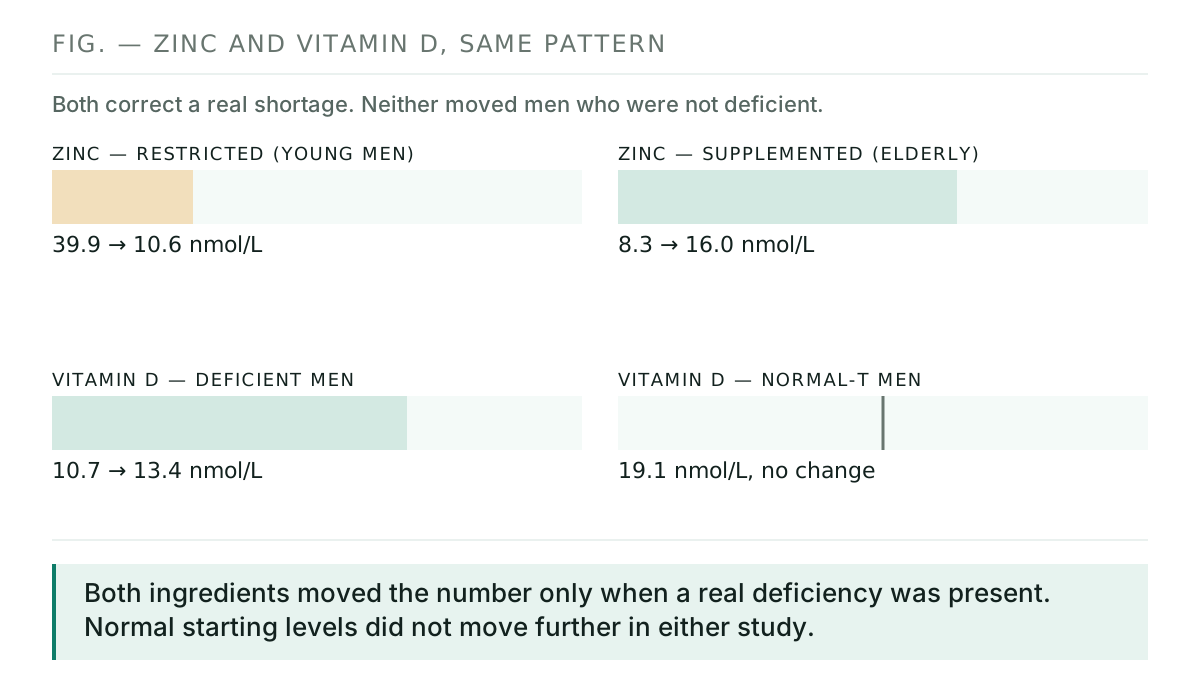
In four young men put on a zinc-restricted diet, testosterone fell from 39.9 to 10.6 nmol/L over 20 weeks. In nine elderly men who were marginally zinc-deficient, 3 to 6 months of zinc supplementation raised testosterone from 8.3 to 16.0 nmol/L. Prasad et al., Nutrition, 1996
Read that carefully: this is a study about correcting a deficiency, not about adding zinc on top of a normal level. Both groups studied were confirmed low. We have not found a comparable trial showing zinc raises testosterone in men whose zinc status is already adequate, and the study samples here are small — four men and nine men. The mechanism is real. The promise on most labels, that any man taking zinc will see a rise, is not what this evidence supports.
Vitamin D does the same thing, for the same reason, and stops there
Vitamin D follows the identical pattern, and it has been tested both ways — in men who were deficient, and separately in men who were not — which makes it the clearest deficiency-dependent case on this list.
In vitamin D-deficient, overweight men on a year-long weight-loss programme, vitamin D supplementation raised total testosterone from 10.7 to 13.4 nmol/L, alongside significant rises in bioactive and free testosterone. In a separate 12-week randomised trial of 98 healthy men with normal baseline testosterone, the same kind of supplementation produced no significant change in total testosterone at all. Pilz et al., Hormone and Metabolic Research, 2011; Lerchbaum et al., JCEM, 2017
The second trial's own conclusion is worth quoting directly: vitamin D treatment had no effect on testosterone in middle-aged healthy men with normal baseline levels. If your vitamin D is already fine, this is the cleanest evidence available that supplementing it further will not move your testosterone. If it is not fine, a blood test tells you that far more reliably than a bottle does.
Zinc and vitamin D are both cheap to test directly. Knowing whether you are actually low, rather than guessing, is the difference between a supplement that has a real chance of doing something and one that is very unlikely to.
Ashwagandha has the strongest trial record of the herbs on this list
A 2021 systematic review pooled every controlled trial of herbs and testosterone in men that it could find. Ashwagandha (Withania somnifera) came out ahead of the others on consistency, though the total evidence base is still small.
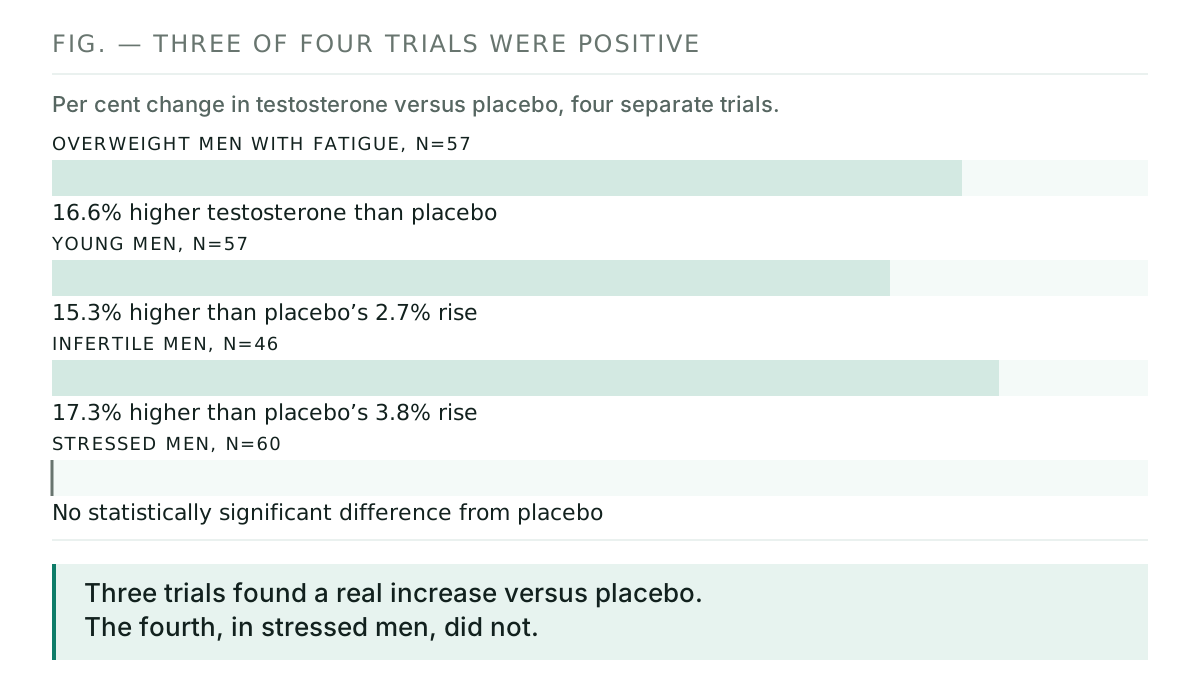
Overweight men with mild fatigue: testosterone rose 16.6 per cent over placebo after 8 weeks. Young men: a 15.3 per cent rise versus 2.7 per cent for placebo. Infertile men: a 17.3 per cent rise versus 3.8 per cent for placebo. A fourth trial, in stressed men, found no statistically significant difference between ashwagandha and placebo. Smith et al., Advances in Nutrition, 2021 (systematic review); Lopresti et al., American Journal of Men’s Health, 2019
Across the whole field of herbs reviewed, the authors found only 6 of 32 studies had a low risk of bias, and most trials were done in men under 40. Ashwagandha is the one with the best batting average of the group — three wins out of four is a genuinely encouraging record for a supplement — but "encouraging" and "settled" are different words, and the review is explicit that further research is required before firm conclusions.
Fenugreek is close to a coin flip, and the coin is sometimes the seller’s
Fenugreek (Trigonella foenum-graecum) has more trials behind it than any other herb on this list, and the results split almost evenly.
Positive results: a 28.0 per cent rise in testosterone versus 5.8 per cent for placebo in 16 healthy men; a 22.7 per cent rise versus a 2.0 per cent fall in 40 young men; a 12.2 per cent rise versus a 6.1 per cent fall in 120 overweight or obese men aged 43 to 70; and a rise in 30 young men. Negative results: no significant difference in total testosterone in 60 healthy young men, and no significant difference in any hormone in 100 men with benign prostatic enlargement. Smith et al., Advances in Nutrition, 2021 (systematic review)
One detail worth knowing before you shop: several of the positive trials used a specific patented, standardised fenugreek extract rather than plain fenugreek seed powder, developed and supplied by the same commercial source. That does not make the positive results untrue — it makes them specific to that extract at that dose, which a generic “fenugreek” line on someone else's label may not match.
D-aspartic acid worked once, in men who were not already training hard
D-aspartic acid is the odd one out on this list — it is an amino acid, not a herb — and it also has the sharpest reversal in the evidence.
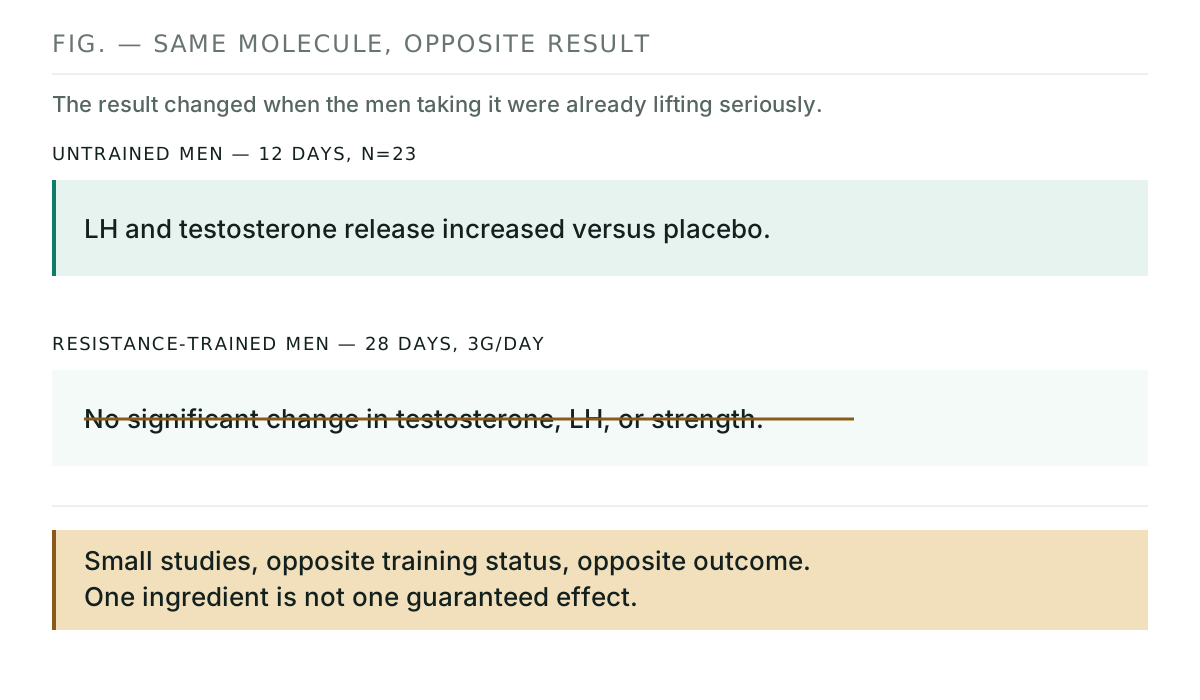
The original study gave 23 men a daily dose of D-aspartate for 12 days and found it enhanced the release of luteinising hormone and testosterone, versus 20 men on placebo. A later trial gave resistance-trained men 3 grams of D-aspartic acid daily for 28 days alongside their normal training, and found no significant difference from placebo in total testosterone, free testosterone, luteinising hormone, or muscle strength. Topo et al., Reproductive Biology and Endocrinology, 2009; Willoughby & Leutholtz, Nutrition Research, 2013
A 2017 systematic review of the whole D-aspartic acid literature concluded that it enhances testosterone reliably in animal studies, but that human studies have “yielded inconsistent results,” and that the human evidence is sparse, limited in number and of variable quality. That is an accurate description of what we found reading the individual trials ourselves. Roshanzamir & Safavi, International Journal of Reproductive BioMedicine, 2017
Tongkat ali has one real trial, and it came back flat
Tongkat ali is the ingredient with the thinnest evidence base of the six, not because it failed repeatedly, but because it has barely been tested at all in a proper controlled trial.
Twelve weeks of daily supplementation with 300 mg of a tongkat ali extract in 109 healthy men, or men with stable chronic conditions, aged 30 to 55, did not significantly increase testosterone concentrations compared with placebo. Smith et al., Advances in Nutrition, 2021 (systematic review)
One trial is not a verdict either way — it is one data point, in one dose, in one population. What we can say honestly is that the single best-designed trial available did not find the effect the marketing describes, and no second trial has yet shown otherwise.
None of these ingredients has been tested as the blend on your label
Every trial above tested one ingredient, alone, at one specific dose, against a placebo. Almost no commercial “testosterone booster” sells one ingredient alone. It sells five or six of them together, at doses the label does not always disclose in full, and that specific combination has essentially never been the thing actually studied.
That gap matters for two reasons. The dose in a six-ingredient blend is often lower than the dose used in the positive trial for any single ingredient in it — there is only so much a capsule can hold. And ingredients have not been tested for how they behave together, which is a safety question as much as an efficacy one, particularly if you take any prescribed medication.
No supplement here needed to prove any of this before going on sale
This is the regulatory fact that explains why the gap above is allowed to exist. In the United States, dietary supplements are not reviewed for effectiveness before they reach a shelf.
FDA is not authorised to approve dietary supplements for safety and effectiveness before they are marketed — in many cases, firms can lawfully introduce a dietary supplement to the market without even notifying FDA.
The manufacturer is responsible for the safety and truthfulness of what it sells, and the FDA's main power is to act after a product is already for sale, if it turns out to be mislabelled or unsafe. That is a materially different standard than the one a prescription testosterone product has to clear, and it is worth knowing before “clinically studied ingredient” on a label is read as “this product was studied.”
What this adds up to, if you are deciding whether to try one
Put together, the honest version of this article is shorter than most marketing around it.
- Test before you buy zinc or vitamin D specifically. Both work when they correct a real deficiency and have not been shown to do anything beyond that — a blood test settles which situation you are in.
- Treat ashwagandha as the herb with the best current record, while remembering three-of-four trials is encouraging, not proven, and the field is small.
- Try fenugreek, D-aspartic acid or tongkat ali with modest expectations if you want to — the human evidence for each is genuinely mixed, not a settled no, and not a settled yes.
- Do not expect a six-ingredient blend to behave like the sum of six single-ingredient trials. That combination was not the thing any study actually tested.
- Retest properly if you want to know whether it worked, the same way you would test before starting: two separate early mornings, as the testosterone test sets out.
And if the number was genuinely low to begin with, a supplement is not a substitute for working out why. Low testosterone after 40 is the place that question starts, and how to increase testosterone naturally covers the behaviour-based levers — weight and sleep — that have larger, more consistent evidence behind them than any single ingredient on this page.
Key takeaways
- Zinc restriction dropped testosterone from 39.9 to 10.6 nmol/L in young men; zinc supplementation raised it from 8.3 to 16.0 nmol/L in marginally deficient elderly men — a deficiency-correction effect, not a general boost.
- Vitamin D raised testosterone from 10.7 to 13.4 nmol/L in deficient, overweight men, but produced no significant change in a separate trial of 98 healthy men with normal baseline levels.
- Ashwagandha has the strongest herb record: 3 of 4 controlled trials found significant increases of roughly 15 to 17 per cent versus placebo; a fourth, in stressed men, found none.
- Fenugreek raised testosterone in 4 of 6 trials and did nothing in 2; several positive trials used a specific patented extract, not plain fenugreek powder.
- D-aspartic acid raised testosterone in a small early study of untrained men but showed no effect in resistance-trained men after 28 days — a 2017 review calls the human evidence "inconsistent."
- Tongkat ali has one real randomised trial, in 109 men, and it found no significant effect.
- The FDA does not approve dietary supplements for safety or effectiveness before they are sold, and no ingredient above has been tested as the specific multi-ingredient blend on a commercial label.
Where to go from here
This closes the testosterone series. These are the pages that come before and after this one:
- Low Testosterone After 40: The Number and What It Means — the guide to the whole subject.
- The Testosterone Test That Actually Tells You Something — how to test before you buy anything, and retest after.
- How to Increase Testosterone Naturally: What Works — the behaviour-based levers with the larger evidence base.
- Testosterone and Sleep: Why the Number Needs the Night — the other free lever, and why it moves faster than any of this.
- Testosterone Replacement Therapy: What Each Form Does — the prescription option, if the number is genuinely low.
Frequently asked questions
Do testosterone booster supplements actually work?
It depends entirely on which ingredient and which man. Zinc and vitamin D have real trial evidence, but only in men who were low on them to start. Ashwagandha has the best record of the herbs, with three of four trials positive. Fenugreek, D-aspartic acid and tongkat ali have genuinely mixed human evidence, worth trying with modest expectations rather than either high hopes or dismissal.
Does zinc increase testosterone?
In men who were zinc-deficient, yes. A study found testosterone fell from 39.9 to 10.6 nmol/L when young men were put on a zinc-restricted diet, and rose from 8.3 to 16.0 nmol/L when marginally deficient elderly men were given zinc supplements for 3 to 6 months. There is no comparable evidence that zinc raises testosterone in men whose zinc status is already normal.
Does vitamin D increase testosterone?
In vitamin D-deficient, overweight men, a year of supplementation raised total testosterone from 10.7 to 13.4 nmol/L. In healthy men with normal starting testosterone, a 12-week randomised trial found no significant effect on testosterone at all. The pattern matches zinc: it corrects a deficiency, it does not add to an already-normal level.
Does ashwagandha increase testosterone?
Three of four clinical trials found a significant increase, ranging from about 15 to 17 per cent versus placebo, in overweight men with fatigue, young men, and infertile men. The fourth trial, in stressed men, found no significant difference. It is the herb on this list with the most consistent positive record, though the total number of trials is still small.
What does the evidence say about fenugreek, D-aspartic acid and tongkat ali?
Genuinely mixed. Fenugreek raised testosterone in 4 of 6 trials and did nothing in 2. D-aspartic acid raised it in a small early study but showed no effect in resistance-trained men taking it for 28 days. Tongkat ali has one real randomised trial, in 109 men, and it came back flat. Worth trying with low expectations, not worth expecting a guaranteed result.
Are testosterone booster supplements FDA approved?
No. The FDA states plainly that it is not authorised to approve dietary supplements for safety and effectiveness before they are marketed, and in many cases a company can put one on sale without even notifying the FDA first. None of the individual ingredients above has been tested as the specific blend and dose sold on any given label.
Sources
- Prasad AS et al. Nutrition, 1996 — Zinc Status and Serum Testosterone Levels of Healthy Adults
- Pilz S et al. Hormone and Metabolic Research, 2011 — Effect of Vitamin D Supplementation on Testosterone Levels in Men
- Lerchbaum E et al. Journal of Clinical Endocrinology & Metabolism, 2017 — Vitamin D and Testosterone in Healthy Men: A Randomized Controlled Trial
- Smith SJ, Lopresti AL, Teo SYM, Fairchild TJ. Advances in Nutrition, 2021 — Examining the Effects of Herbs on Testosterone Concentrations in Men: A Systematic Review
- Lopresti AL et al. American Journal of Men’s Health, 2019 — Hormonal and Vitality Effects of Ashwagandha in Aging, Overweight Males
- Topo E et al. Reproductive Biology and Endocrinology, 2009 — The Role and Molecular Mechanism of D-Aspartic Acid in the Release and Synthesis of LH and Testosterone
- Willoughby DS & Leutholtz B. Nutrition Research, 2013 — D-Aspartic Acid Supplementation Combined With 28 Days of Heavy Resistance Training Has No Effect on Body Composition, Muscle Strength, and Serum Hormones
- Roshanzamir F & Safavi SM. International Journal of Reproductive BioMedicine, 2017 — The Putative Effects of D-Aspartic Acid on Blood Testosterone Levels: A Systematic Review
- U.S. Food and Drug Administration — Information for Consumers on Using Dietary Supplements

Male Health Guide Editorial Team
We write about the health problems men over 40 actually search for at 3 a.m. — and we say plainly when the evidence for a popular claim is thin. We do not invent credentials and we do not publish sponsored copy as editorial. Read more about how we work.
Medical disclaimer: This article is general information about published research on dietary supplement ingredients and testosterone, and is not medical advice. It is not a recommendation to take any supplement, and it does not replace a conversation with a qualified healthcare professional, particularly if you take any prescribed medication.