Testosterone and Sleep: Why the Number Needs the Night
Short answer
Testosterone and sleep are linked at the source: the hormone climbs while you sleep and falls while you are awake, largely regardless of the clock, and that climb needs roughly three unbroken hours. Severe short sleep measurably lowers the number. The claim that one ordinary bad week wrecks it overstates what careful studies found, and sleep apnea does most of its harm by way of weight.
This page sits between two of the three sections on this site. If you arrived from the testosterone section, wondering whether your reading is really a hormone problem or a sleep one, this is the article that connects them. If you arrived from the sleep section, tired and reading about low energy, this explains why a testosterone test keeps coming up and what it can and cannot tell you.
It is not a “boost your T while you sleep” article. There is a real, well-mapped physiology here, and there is also a popular version of it that runs several steps past what the evidence supports. We built this page by reading the studies, and the honest summary has both a firm half and a soft half.
We earn nothing from any of this. There are no affiliate links on this site, nothing here is sponsored, and there is no programme or supplement to sell, which is why this page can tell you plainly which half of the sleep-and-testosterone story is solid and which half is not.
Testosterone and sleep are connected at the source, not at the surface
Most articles treat this as a lifestyle point: sleep well, and your hormones will thank you. The real connection is more mechanical than that. Testosterone in men follows a daily rhythm, high in the morning and low in the late afternoon, and the part of that rhythm that builds the level back up happens during sleep itself.
That is not a figure of speech. It has been tested directly, by taking sleep away from the night and moving it somewhere else.
The hormone follows the sleep, not the clock
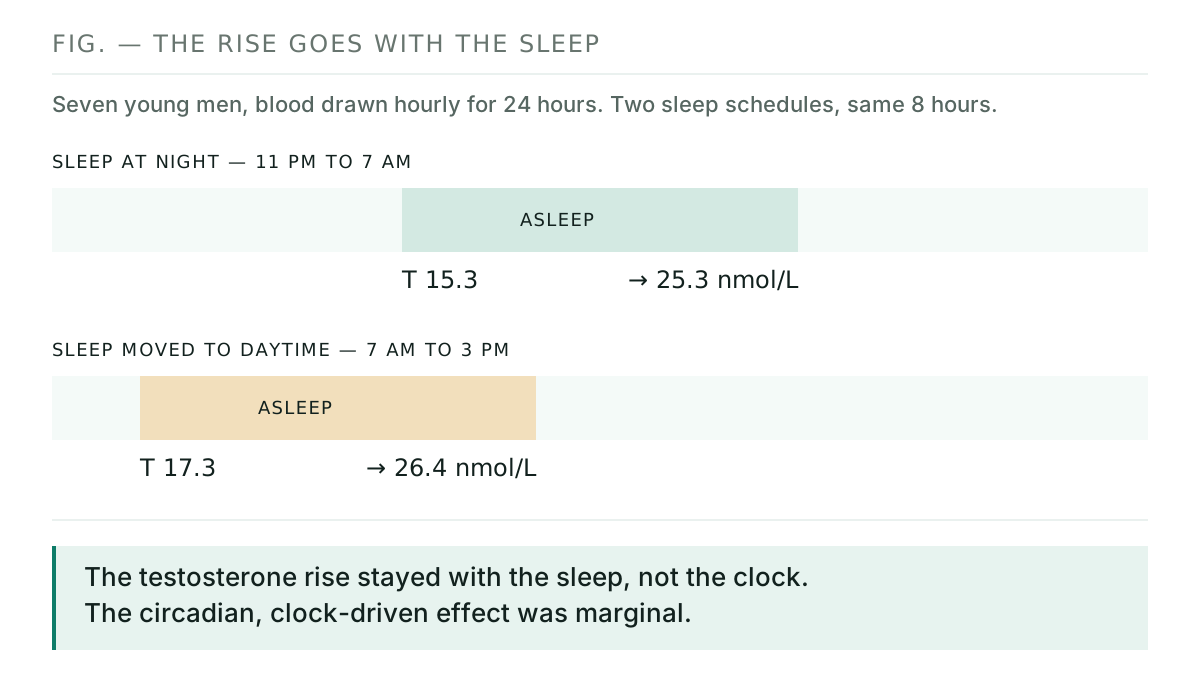
In 2005, researchers at Karolinska ran a small, clean experiment. Seven healthy young men, aged 22 to 32, spent time in a sleep laboratory with blood drawn hourly for 24 hours. In one condition they slept on a normal night schedule, 11 p.m. to 7 a.m. In another, their sleep was shifted wholesale to the daytime, 7 a.m. to 3 p.m., with everything else held constant.
On the night schedule, testosterone climbed across the sleep period from 15.3 to 25.3 nmol/L. On the day-sleep schedule, it climbed across the sleep period from 17.3 to 26.4. Levels fell during the waking hours in both. The circadian, clock-driven component was described as marginal. Axelsson et al., Journal of Clinical Endocrinology & Metabolism, 2005
The conclusion the authors drew is the one sentence worth carrying out of this article: testosterone increased during sleep and fell during waking, while circadian effects seemed marginal. Individual differences between the men were large, but the direction was the same for everyone. Sleep is not a helpful background condition for testosterone production. It is closer to the thing that switches it on.
The rise happens in the first few unbroken hours
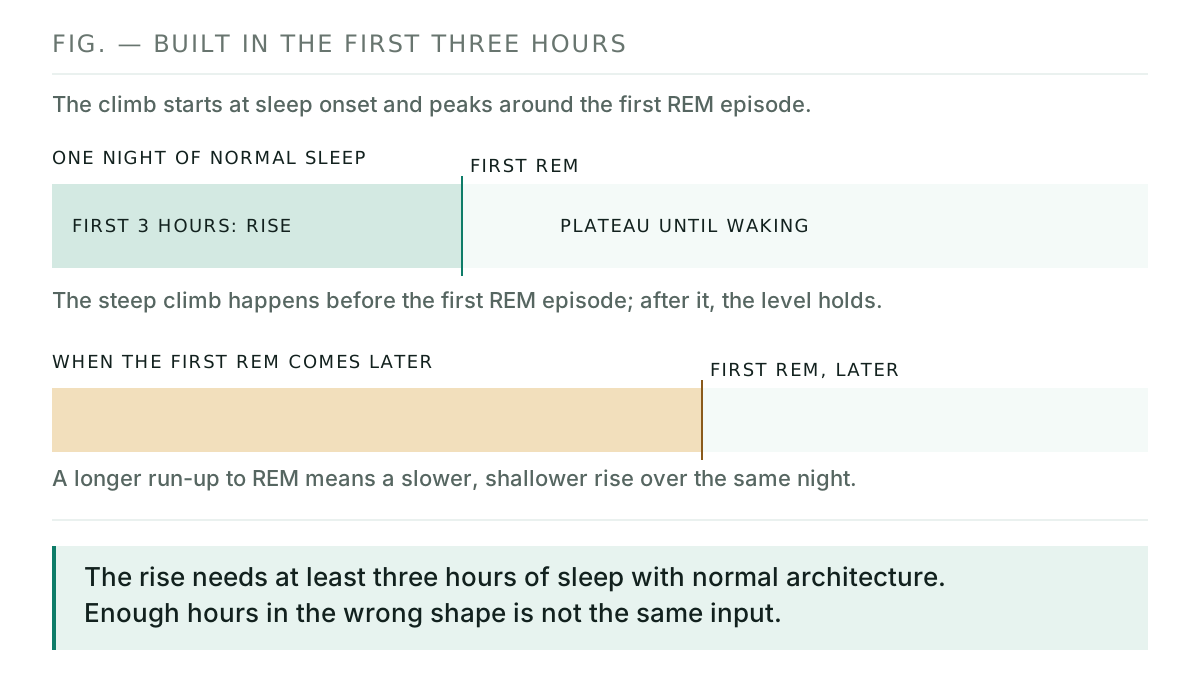
A 2014 review in the Asian Journal of Andrology pulled the physiology together. Its description is specific. Plasma testosterone begins to increase with the onset of sleep and, in young men, peaks at the first REM sleep episode, then holds at that level until waking. The longer it takes to reach REM, the slower the rise.
The review states that the increase in testosterone is sleep-dependent rather than circadian-rhythm-dependent, and requires at least three hours of sleep with a normal architecture. The peak is generally reached during the first three hours of uninterrupted sleep. Wittert, Asian Journal of Andrology, 2014
“Normal architecture” is the part that gets skipped in the popular retelling. It does not just mean enough hours. It means the ordinary progression through the sleep stages, with the first long stretch of deep sleep and the first REM episode arriving roughly on schedule. A night that technically lasts seven hours but never settles into that pattern is not the same input.
A broken night blunts the rise even when the hours add up
The same review is blunt about what interruption does. Total fragmentation of normal sleep architecture throughout the night prevents the increase in testosterone. Not reduces it — prevents it.
That is the mechanism behind a complaint the sleep section deals with from the other end. A prostate that wakes you two or three times, covered in nocturia or insomnia, or the 3 a.m. waking described in waking at 3 a.m. and not getting back to sleep, does not only cost you rest. If the awakenings land in the first few hours, they land on exactly the window this hormone is built in. Two men logging seven hours in bed, one of them solid and one of them chopped into five pieces, are not running the same experiment.
It means a low morning testosterone taken during a bad stretch of broken nights is genuinely hard to interpret. The number can be real and the cause can still be upstream of the testicles.
A genuinely short week does lower the number
So far this is the firm half. Here is where the size of the effect has actually been measured. A 2011 research letter in JAMA put ten healthy young men on 5-hour bedtimes for eight consecutive nights, in a lab, with nothing else wrong.
Daytime testosterone fell 10 to 15 per cent across the week of restricted sleep, with the afternoon reading dropping from 17.9 to 15.5 nmol/L. Self-rated vigour fell from 28 to 19 over the same eight nights. Leproult & Van Cauter, JAMA, 2011
We cover that study in more detail in how to increase testosterone naturally, where sleep comes out as the fastest-acting lever on the list. Nothing here walks that back. Eight nights of genuinely short sleep is a real intervention with a real, measurable effect, and if that describes your last month, it is worth fixing before you read anything into a test.
The everyday version of the claim is weaker than it sounds
The soft half is what happens when you scale that finding down to ordinary life: a few late nights, a stretch of six-hour sleeps instead of seven and a half, the normal wear of a busy few weeks. The internet treats the JAMA result as if it applies linearly all the way down. The review that mapped the physiology does not.
The 2014 review judged the evidence for a direct effect of sleep restriction, or circadian rhythm disruption, on testosterone — independent of an effect on sex hormone binding globulin, and independent of other conditions present — to be equivocal and on balance tenuous. Wittert, Asian Journal of Andrology, 2014
Two things are doing the work in that sentence. One is sex hormone binding globulin, the carrier protein that decides how much of your total testosterone is actually available; we explain it in free testosterone vs total. Some of the movement seen in short-sleep studies is a shift in that protein rather than a change in production. The other is everything else that travels with poor sleep — weight, stress, alcohol, age — which is hard to separate from the sleep itself in the data.
This is not a licence to skip sleep. It is a correction to the dose. The clean effect needs a genuinely short or genuinely broken week; the claim that a couple of rough nights has knocked your hormones down is running ahead of the evidence.
Sleep apnea tracks with a lower level, mostly by way of weight
Untreated obstructive sleep apnea is on every list of things that can push a testosterone reading down, and that much is fair. It belongs there. But the 2014 review is careful about how it belongs there.
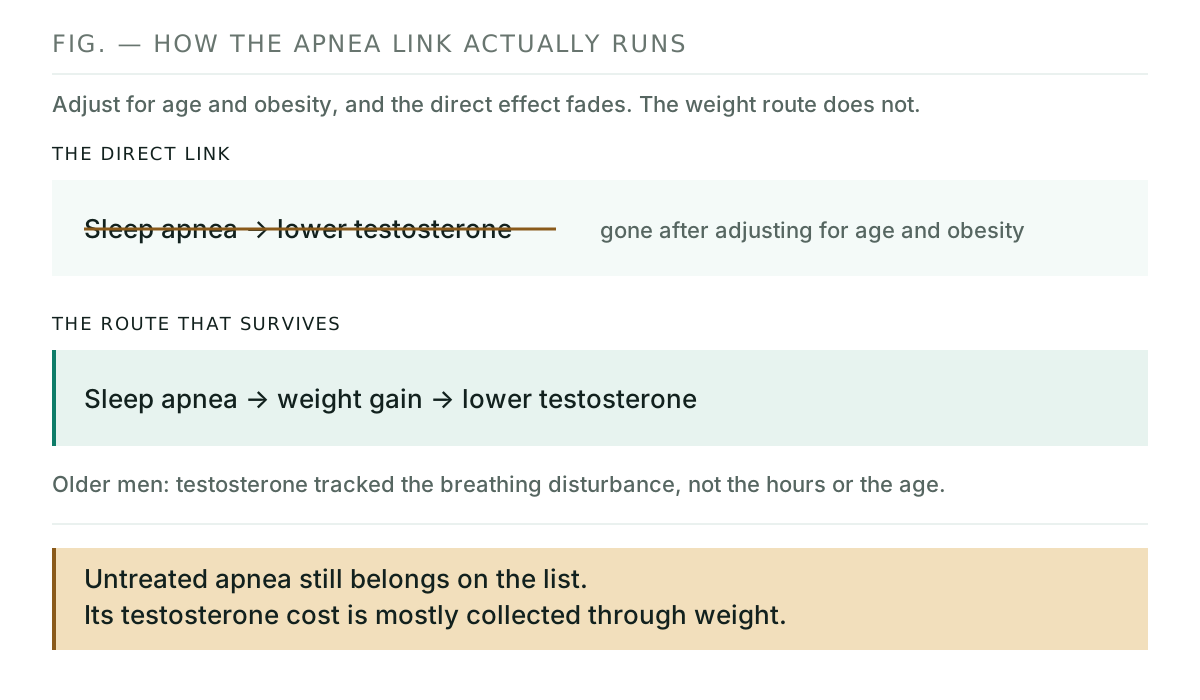
Obstructive sleep apnea appears to have no direct effect on testosterone, after adjusting for age and obesity. However, a possible indirect causal process may exist, mediated by the effect of apnea on obesity.
In other words, once you account for how old a man is and how much he weighs, the apnea itself stops explaining much of the hormone gap. What is left is a plausible chain in which apnea worsens weight and weight lowers testosterone — which is the same weight lever described in the natural-increase article, approached from a different doorway.
A cohort of older men points the same way. In men aged 65 and over, testosterone was unrelated to age or to the duration of sleep, but it was inversely related to the severity of the breathing disturbance overnight — the apnea-hypopnea index and the oxygen desaturation index. And a smaller, carefully measured study of twelve men aged 64 to 74 found that the objectively recorded amount of nighttime sleep independently predicted their morning total and free testosterone. Small studies, pointing consistently: the breathing and the total sleep matter, the calendar age does not.
Treating the apnea does not reliably bring the number back
If apnea lowered the level, treating it should raise the level. It mostly does not, and this is one of the better-replicated null results in the area.
A 2014 pooled analysis of 7 studies and 232 men found no change in total testosterone before and after CPAP, even past three months of use. A 2019 review of 12 studies and 388 men reached the same conclusion, and its authors wrote that the data do not support a direct interaction between apnea and testosterone. Zhang et al., PLOS ONE, 2014; Cignarelli et al., Frontiers in Endocrinology, 2019
None of this is a reason to skip CPAP. It treats the oxygen drops during sleep, which matter for the heart, for daytime alertness and for driving safety, entirely independent of what it does or does not do to a hormone. If you are not sure whether what you have is apnea or ordinary snoring, what separates snoring from sleep apnea is the place to start, and what actually happens at a sleep study covers the test itself.
Which way the arrow points decides what you fix
Put the two halves together and you get the practical question. A man who is tired, flat and carrying a low testosterone reading has at least three stories available, and they lead to different doors.
- Sleep is short or broken, and the hormone is following it. Fix the sleep and retest; the number may recover on its own. This is the case the physiology above makes most likely.
- The hormone is genuinely low at the source, and the poor sleep is partly a symptom. Low testosterone can itself fragment sleep, so the arrow runs both ways. This is the case low testosterone after 40 is about.
- Untreated apnea is driving weight, mood and energy, with the hormone reading a downstream reading. The sleep study is the priority, not the hormone panel.
One more crossing point is worth naming, because it runs in the opposite direction. Starting testosterone therapy can briefly worsen apnea. The 2014 review notes that, apart from a very transient deleterious effect, testosterone treatment does not adversely affect apnea — but “very transient” is not “none,” and it is one more reason the breathing question is worth settling first. We list it among the other timed effects in testosterone side effects.
What to do with this before you test, or before you worry
The evidence points at a short, ordered list rather than a long hopeful one.
- Protect the first three hours. That is the window the rise happens in. A consistent, early, uninterrupted first block of sleep is worth more here than total time in bed.
- Settle the breathing question before the hormone question. If there is snoring, witnessed pauses or heavy daytime sleepiness, a sleep study comes before reading anything into a testosterone panel.
- If your last month was genuinely short on sleep, fix that first and retest. Eight bad nights is enough to move the number; the retest after a good stretch is the one that means something.
- Do not over-read a couple of rough nights. The clean effect needs a sustained deficit, not a bad Tuesday.
- Test properly once the sleep is stable — two separate early mornings at the same lab, as the testosterone test sets out.
If the sleep is genuinely fixed and the number still will not move, that is useful information rather than a dead end. It points back toward the diagnosis in low testosterone after 40 and the symptom picture in which symptoms actually point at it, and away from sleep as the explanation.
Key takeaways
- When sleep was shifted to the daytime in a lab study, testosterone still rose during the sleeping hours and fell during waking; the clock-driven component was marginal.
- The rise is front-loaded into the first three hours of uninterrupted sleep and settles around the first REM episode; a review says it requires at least three hours with normal architecture.
- Total fragmentation of sleep architecture across the night prevents the testosterone rise, not merely reduces it.
- Eight nights of 5-hour sleep dropped daytime testosterone 10 to 15 per cent in young men — the firm, measured effect.
- For milder everyday short sleep, a review judged the evidence for a direct effect independent of SHBG and other conditions to be equivocal and on balance tenuous.
- Obstructive sleep apnea appears to have no direct effect on testosterone after adjusting for age and obesity, with any link running indirectly through weight.
- Two meta-analyses covering 620 men found CPAP treatment was not associated with a significant change in total testosterone.
Where to go from here
This article is the bridge. These are the next steps on each side of it:
- Low Testosterone After 40: The Number and What It Means — the guide to the whole subject, if the reading is the concern.
- The Testosterone Test That Actually Tells You Something — how to test once your sleep is stable.
- How to Increase Testosterone Naturally: What Works — where sleep sits among the levers you can actually pull.
- Snoring or Sleep Apnea? What Separates Them — settle this before you read anything into a hormone panel.
- Sleep After 40: What Changed and What Restores It — the guide that sorts “I slept badly” into five separate problems.
Frequently asked questions
Is testosterone really produced during sleep?
Yes. In a lab study that shifted sleep to the daytime, testosterone rose during whichever eight hours were spent asleep and fell during waking, with only a marginal effect from the time of day. During night sleep it climbed from 15.3 to 25.3 nmol/L; during day sleep, from 17.3 to 26.4.
How many hours of sleep does testosterone need?
A review of the physiology describes the rise as reaching its peak during the first three hours of uninterrupted sleep, at about the time of the first REM episode, and states that the increase requires at least three hours of sleep with normal architecture. The longer it takes to reach REM, the slower the rise.
Does one bad night lower testosterone?
A single night is not where the clean evidence sits. Eight consecutive nights of 5-hour sleep dropped daytime testosterone 10 to 15 per cent in young men. For milder, everyday short sleep, a review judged the evidence for a direct effect, independent of sex hormone binding globulin and other conditions, to be equivocal and on balance tenuous.
Does sleep apnea cause low testosterone?
Obstructive sleep apnea tracks with lower testosterone, but a 2014 review concluded it appears to have no direct effect after adjusting for age and obesity, with any link running indirectly through its effect on weight. An older-men cohort found testosterone was unrelated to sleep duration but inversely related to the severity of breathing disturbance.
Will treating sleep apnea with CPAP raise my testosterone?
Not reliably. Two meta-analyses covering 620 men found CPAP treatment was not associated with a significant change in total testosterone. CPAP remains the correct treatment for the apnea itself, for the heart, alertness and safety, but a hormone rise is not one of its measured effects.
Should I fix my sleep before getting a testosterone test?
Where you can, yes. A reading taken during a stretch of genuinely short or broken nights, or with untreated apnea in the background, is hard to interpret, because low sleep can push the number down without the hormone system being at fault. Settle the sleep, then test on two separate early mornings.
Sources
- Axelsson J, Ingre M, Åkerstedt T, Holmbäck U. Journal of Clinical Endocrinology & Metabolism, 2005 — Effects of Acutely Displaced Sleep on Testosterone
- Wittert G. Asian Journal of Andrology, 2014 — The Relationship Between Sleep Disorders and Testosterone in Men
- Penev PD. Sleep, 2007 — Association Between Sleep and Morning Testosterone Levels in Older Men
- Leproult R, Van Cauter E. JAMA, 2011 — Effect of 1 Week of Sleep Restriction on Testosterone Levels in Young Healthy Men
- Zhang X-B et al. PLOS ONE, 2014 — Efficacy of Continuous Positive Airway Pressure on Testosterone in Men with Obstructive Sleep Apnea: A Meta-Analysis
- Cignarelli A et al. Frontiers in Endocrinology, 2019 — Effects of CPAP on Testosterone Levels in Patients With Obstructive Sleep Apnea: A Meta-Analysis Study

Male Health Guide Editorial Team
We write about the health problems men over 40 actually search for at 3 a.m. — and we say plainly when the evidence for a popular claim is thin. We do not invent credentials and we do not publish sponsored copy as editorial. Read more about how we work.
Medical disclaimer: This article is general information about how sleep and testosterone relate in men, and is not medical advice. It is not a substitute for diagnosis or treatment, and it does not replace CPAP or any other prescribed therapy. Please speak to a qualified healthcare professional about your own situation, and never start, stop or change a prescribed treatment based on what you read online.