Testosterone Side Effects: What Shows Up, and When
Short answer
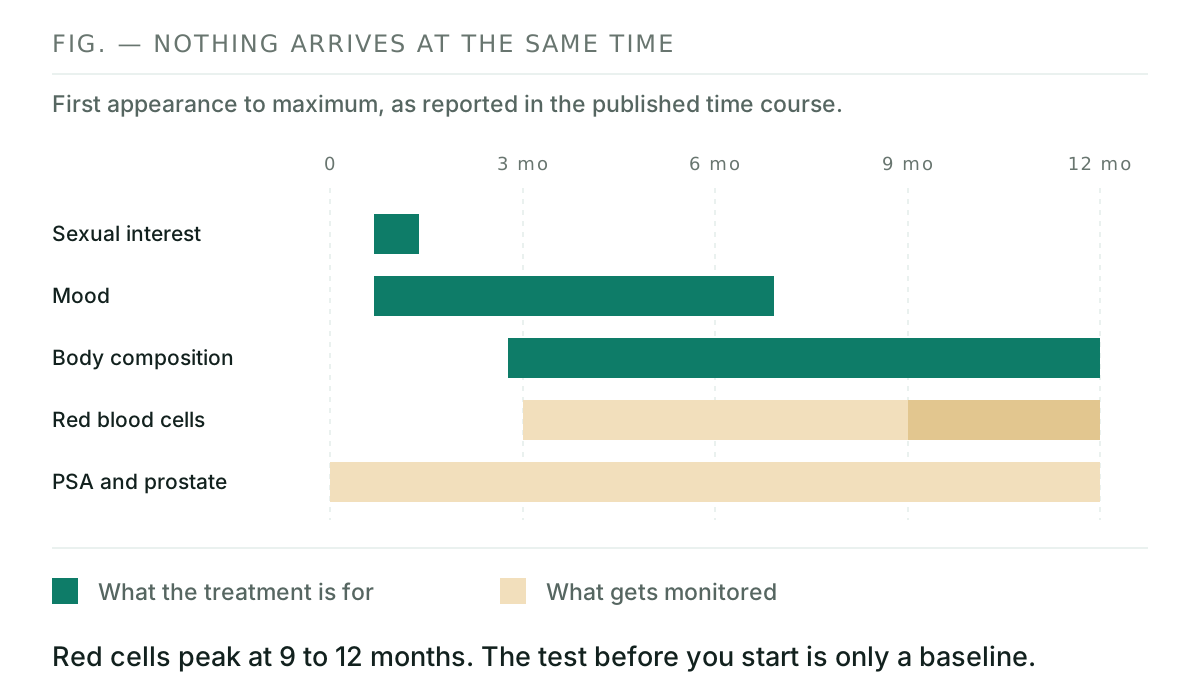
Testosterone side effects do not arrive as one package on day one. They are spread across the first year, and knowing the order changes what you watch for and when. The blood thickening is the one the guideline grades most strongly, it becomes measurable at about three months, and it peaks at nine to twelve.
Almost every list of side effects for this treatment is organised the same way: by category. Blood-related, prostate-related, skin, mood, fertility. It is how a package insert is written and it is how a pharmacology textbook is arranged, and for the man who has just been handed a prescription it is close to useless.
He does not have a category question. He has a calendar question. He is in week three, or month four, or year two, and he wants to know what belongs to now — what he should be watching for at this point, what has already had time to happen, and what is not due yet.
So this page is arranged by the clock. The material is the same guideline and the same research everybody else is citing; the ordering is what makes it usable.
We earn nothing from any of this. There are no affiliate links on this site, nothing here is sponsored, and we do not sell treatment or testing, which is why this page can describe the monitoring schedule rather than a version of it that suits someone's business.
Why the clock is the right way to organise this
There is a published review that did exactly this work for the effects of treatment, asking from the literature how long each one takes to appear and how long until it reaches its maximum. Its findings are the backbone of this article.
| What changes | First appears | Maximum |
|---|---|---|
| Sexual interest | 3 weeks | Plateau at 6 weeks, no further increase expected |
| Quality of life | 3–4 weeks | Maximum benefits take longer |
| Depressive mood | 3–6 weeks | 18–30 weeks |
| Lipids | 4 weeks | 6–12 months |
| Inflammation | 3–12 weeks | — |
| Fat mass, lean mass, muscle strength | 12–16 weeks | Stabilise at 6–12 months, marginal gains over years |
| Red blood cell production | 3 months | 9–12 months |
| Erections and ejaculation | May require up to 6 months | — |
| Glycaemic control | 3–12 months | — |
| PSA and prostate volume | Marginal rise | Plateau at 12 months |
| Bone | 6 months | Continues at least 3 years |
Two things stand out immediately. The first is how far apart these are: a man judging the treatment at week four is looking at sexual interest and mood, and nothing else on that list has had time to move. The second is that the two entries which matter most for safety — red cells and PSA — both sit late, at three months and twelve months.
That is the practical case for the calendar. A side effect you are told about on day one, and which cannot appear before month three, is one you will have stopped thinking about by the time it is due.
The first six weeks: mostly effects, not side effects
The early window is dominated by what the treatment is for rather than by what it costs. Sexual interest appears at about three weeks and plateaus at six, with no further increase expected beyond that. Quality of life shifts at three to four weeks. Mood becomes detectable at three to six weeks, though its maximum is much later, at eighteen to thirty weeks.
The guideline's counselling statement covers the same ground from the other direction. Patients should be informed that therapy may result in improvements in erectile function, low sex drive, anaemia, bone mineral density, lean body mass and depressive symptoms.
If sexual interest is going to move, the evidence says it has largely moved by week six. A man who reads that as “it will keep building” and waits another three months before saying anything has lost three months. The right time to report that nothing changed is early, not late.
Set against that, the guideline's neighbouring statement is candid about where the evidence is thinner: it says patients should be informed that the evidence is inconclusive as to whether therapy improves cognitive function, measures of diabetes, energy, fatigue, lipid profiles and quality of life measures. Energy and fatigue sit in that second list, which is covered in more detail in which symptoms actually point at it.
Three to twelve months: the blood thickens, and this one is measured
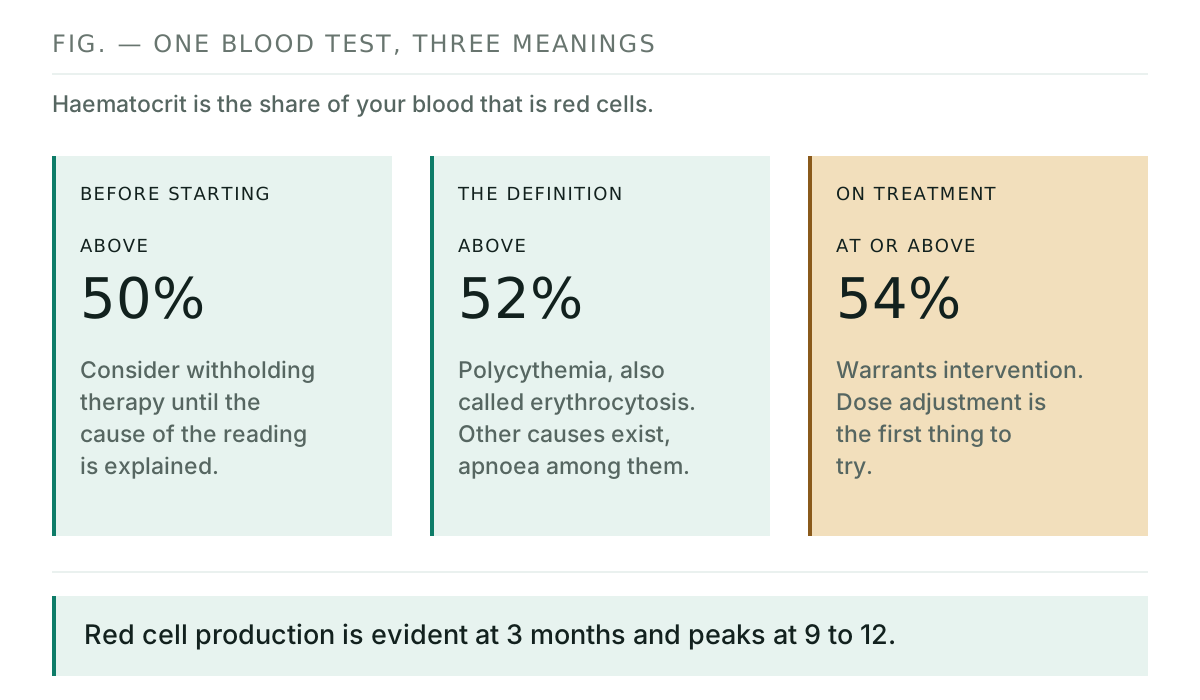
This is the side effect the AUA grades most strongly, and the only one that has a mandatory blood test attached to it before the first dose. Statement 11 is a strong recommendation at the highest evidence grade: prior to offering testosterone therapy, clinicians should measure haemoglobin and haematocrit and inform patients regarding the increased risk of polycythemia.
Polycythemia, sometimes called erythrocytosis, is generally defined as a haematocrit above 52 per cent. It simply means a higher proportion of the blood is red cells. The guideline lists its other causes too, and one of them is worth noting for anybody who has read our sleep section: hypoxia, including chronic obstructive pulmonary disease, obstructive sleep apnoea and tobacco use.
Before starting, if haematocrit exceeds 50 per cent, clinicians should consider withholding therapy until the cause of the high reading is explained. Above 52 per cent is the general definition of polycythemia. While on therapy, a haematocrit of 54 per cent or above warrants intervention, and dose adjustment should be attempted as first-line management. American Urological Association, Testosterone Deficiency Guideline
Now put that against the clock. Effects on red cell production are evident at three months and peak at nine to twelve. So the blood test taken before you start is a baseline, not a reassurance, and the reading that actually tests for this problem is the one taken months later.
There is one more detail in that passage worth carrying, because it connects to the article next door. In men with a raised haematocrit and a low or normal on-treatment testosterone level, the guideline suggests measuring SHBG and a free testosterone level using a reliable assay. That is one of the few places where the free number is specifically asked for — the reasoning is in free testosterone vs total.
The one risk finding that comes with a date on it
Most of the safety literature here produces null results, which is genuinely reassuring but makes for vague writing. There is one exception with a specific time window attached, and it deserves to be reported precisely rather than either buried or inflated.
The guideline's own position, statement 19, is that patients should be informed there is no definitive evidence linking testosterone therapy to a higher incidence of venothrombolic events. It notes that since the FDA warning of June 2014, four large observational studies were conducted and none showed an association.
Against those null findings, a population-based case-control study using a UK clinical database of 19,215 patients with confirmed venous thromboembolism showed an increased risk in the first 6 months of therapy. The guideline describes the size as low in absolute terms, while noting it raises concern for men already at increased risk before starting. American Urological Association, Testosterone Deficiency Guideline
Both halves of that belong together. Four studies found nothing; one large one found a small signal confined to the opening months. The honest summary is that this is the period the data points at, and that the absolute numbers are small.
If you already have a personal or family history of clots, that is the specific thing to raise before the first prescription rather than after it, because the window in question opens immediately.
The prostate: what rises, when it stops, and what it does not mean
This is the fear that brings most men to this page, and the evidence on it is more settled than the anxiety suggests. The AUA makes it a strong recommendation that clinicians inform patients of the absence of evidence linking testosterone therapy to the development of prostate cancer.
What does happen is smaller and has an end point. PSA and prostate volume rise marginally and plateau at twelve months; the review is explicit that further increase beyond that should be related to ageing rather than to the therapy. So a rise in the first year is expected, and a continuing climb in year three is a different conversation.
This is why the baseline matters so much. Statement 12 says PSA should be measured in men over 40 before therapy begins, to exclude a prostate cancer diagnosis. Without that first figure, a later result has nothing to be compared against, and an ordinary treatment-related rise is indistinguishable from something that needs attention.
If you have never had one and are not sure what the number would mean, PSA levels by age covers how to read it, and it is genuinely worth reading before the appointment rather than after the result.
Two related positions round this out. Men with a history of prostate cancer should be informed that there is inadequate evidence to quantify the risk-benefit ratio, which is the guideline declining to guess. And estradiol should be measured before starting in men who present with breast symptoms or gynaecomastia.
Fertility is not a rare complication, it is the mechanism
Of everything on this page, this is the effect most often described too gently, and the guideline does not describe it gently at all. Statement 16 is a strong recommendation at the highest grade: the long-term impact of exogenous testosterone on sperm production should be discussed with patients who are interested in future fertility.
Statement 23, at the same grade, goes further: exogenous testosterone therapy should not be prescribed to men who are currently trying to conceive. And statement 10 asks for a reproductive health evaluation before treatment in men interested in fertility.
The guideline says clinicians may use aromatase inhibitors, human chorionic gonadotropin, selective estrogen receptor modulators, or a combination, in men with testosterone deficiency who want to maintain fertility. If this applies to you, it is a question to ask before the first prescription, not a reason to assume nothing can be done.
The reason this sits differently from the other items is that it is not an unlucky reaction. It follows from how the treatment works, and it is foreseeable, which is exactly why the guideline puts the burden on the conversation happening in advance.
The cardiovascular question, and what changed after the guideline
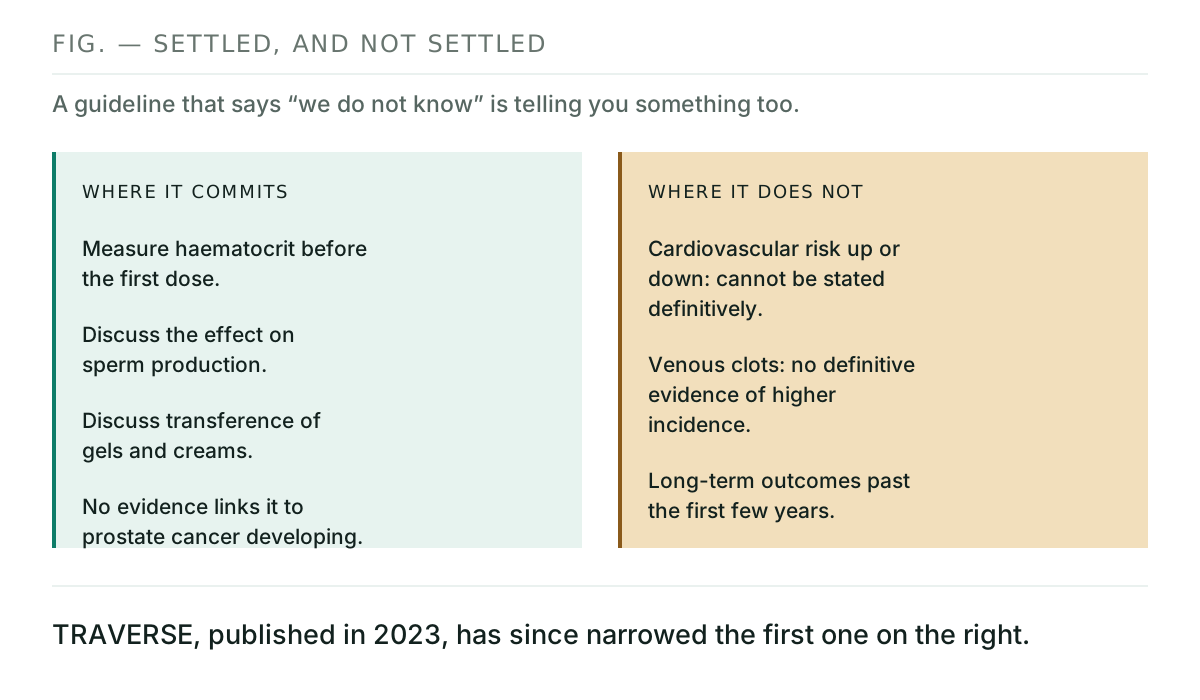
The 2018 guideline is careful here, and its care is worth quoting rather than summarising. Statement 20 says clinicians should counsel patients that, at this time, it cannot be stated definitively whether testosterone therapy increases or decreases the risk of cardiovascular events — heart attack, stroke, cardiovascular death or all-cause mortality.
Alongside it sits statement 13, which is easy to miss and points the other way: clinicians should inform testosterone deficient patients that low testosterone is itself a risk factor for cardiovascular disease. That is a strong recommendation. So the untreated state is not a neutral baseline in this comparison.
Since the guideline was written, the largest trial designed to answer this reported. TRAVERSE enrolled 5,246 men aged 45 to 80 with existing cardiovascular disease or at high risk, all with two fasting testosterone levels below 300 ng/dL, and followed them for a mean of 33 months.
Primary cardiovascular events occurred in 182 men, 7.0 per cent, on testosterone and 190 men, 7.3 per cent, on placebo, a hazard ratio of 0.96. The authors concluded that testosterone therapy was noninferior to placebo with respect to the incidence of major adverse cardiac events. Lincoff et al., New England Journal of Medicine, 2023
One more timing rule belongs here, and it is easy to overlook because it is short. The guideline says therapy should not be commenced for a period of three to six months in patients with a history of a cardiovascular event.
The side effect that happens to somebody else
This one is unique on the list because the person affected is not the patient, and the guideline grades it as strongly as anything in the document. Statement 26, a strong recommendation at grade A: clinicians should discuss the risk of transference with patients using testosterone gels and creams.
Transference means the medication moving from your skin to another person's by contact — a partner, a child, anyone in close physical contact. It is not a dosing error or a rare event; it is a property of applying a hormone to the outside of your body and then touching people.
It is also the single clearest reason why the choice of formulation is a practical decision rather than a pharmacological one. What each route does, and what it demands of the household around it, is set out in testosterone replacement therapy: what each form does.
What the monitoring schedule is actually for
Everything above turns into three appointments. The guideline's follow-up statements are brief, and read against the timeline they stop looking like bureaucracy.
- Before the first dose: haemoglobin and haematocrit, PSA if you are over 40, estradiol if there are breast symptoms, and a reproductive evaluation if fertility matters to you.
- An initial follow-up level after an appropriate interval, to confirm the dose landed where it was aimed — the target being the middle third of the normal range, not the top.
- Levels every 6 to 12 months thereafter, which is also the window in which the red cell effect reaches its peak.
- A conversation about stopping at three to six months if the level has normalised but the symptoms have not improved. The guideline expects this to be discussed rather than left running.
That last point is the one most likely to be skipped, and it is the one that protects you from an open-ended prescription that is not doing anything. If your level is now normal and you feel no different, the guideline's position is that stopping belongs on the table.
If you have not started yet and are still working out whether the diagnosis is solid, the order to read is how the test has to be done, then what the number means against a reference range, then the guide to the whole subject.
Key takeaways
- Effects arrive at different times: sexual interest at 3 weeks plateauing at 6, mood at 3–6 weeks, body composition at 12–16 weeks, bone from 6 months onward.
- Red blood cell production is evident at 3 months and peaks at 9–12 — so the pre-treatment blood test is a baseline, not a clearance.
- Haematocrit above 50 per cent before starting means considering withholding therapy; above 52 is the definition of polycythemia; 54 or above on treatment warrants intervention, dose adjustment first.
- The one dated risk signal for clots is in the first 6 months, at an additional 10 cases per 10,000 person-years, against four large observational studies that found no association.
- PSA and prostate volume rise marginally and plateau at 12 months; further increase after that is attributed to ageing rather than to the therapy.
- The AUA makes it a strong recommendation to inform patients of the absence of evidence linking therapy to the development of prostate cancer.
- The effect on sperm production is a mechanism, not a rare complication: therapy should not be prescribed to men currently trying to conceive.
- TRAVERSE, published after the guideline, found primary cardiovascular events in 7.0 per cent on testosterone against 7.3 per cent on placebo, concluding noninferiority.
Where to go from here
Side effects only matter once the diagnosis is solid. These are the pages either side of this one:
- Testosterone Replacement Therapy: What Each Form Does — the routes, and the transference question.
- Low Testosterone After 40: The Number and What It Means — the guide to the whole subject.
- Free Testosterone vs Total — including where the free number is genuinely asked for.
- PSA Levels by Age — the baseline taken before therapy in men over 40.
- Snoring or Sleep Apnea? What Separates Them — untreated apnoea appears in the guideline's own list of causes of a raised haematocrit.
Frequently asked questions
What are the side effects of testosterone therapy?
The one the guideline grades most strongly is polycythemia, a thickening of the blood, which is why haemoglobin and haematocrit are measured before the first dose. Others that carry formal counselling statements are the effect on sperm production, a marginal rise in PSA and prostate volume, and transference of gels and creams to another person by skin contact.
How soon do testosterone side effects start?
They are spread across the first year rather than arriving together. A review of the time course found effects on red blood cell production evident at 3 months and peaking at 9 to 12 months, while PSA and prostate volume rise marginally and plateau at 12 months. The one dated risk signal for clots sits in the first 6 months.
Does testosterone therapy thicken your blood?
It can, and this is the reason for the blood test before you start. Polycythemia is generally defined as a haematocrit above 52 per cent. If it exceeds 50 per cent beforehand, the guideline says clinicians should consider withholding therapy until the cause is explained; on treatment, 54 per cent or above warrants intervention, with dose adjustment tried first.
Does testosterone therapy cause prostate cancer?
The AUA makes it a strong recommendation that clinicians inform patients of the absence of evidence linking testosterone therapy to the development of prostate cancer. Separately, PSA should be measured in men over 40 before therapy begins, to exclude an existing diagnosis rather than because the treatment is expected to cause one.
Does testosterone therapy affect fertility?
Yes, and this is a mechanism rather than a rare complication. The guideline grades as a strong recommendation that the long-term impact of exogenous testosterone on sperm production be discussed with men interested in future fertility, and says therapy should not be prescribed to men currently trying to conceive.
Is testosterone therapy bad for your heart?
The 2018 guideline said it could not be stated definitively whether therapy increases or decreases cardiovascular risk. In 2023 the TRAVERSE trial followed 5,246 men at cardiovascular risk for a mean of 33 months and found primary events in 7.0 per cent on testosterone against 7.3 per cent on placebo, concluding noninferiority to placebo.
Sources
- American Urological Association — Testosterone Deficiency Guideline (statements 9–20, 23, 26, 27, 29–31)
- Saad et al., European Journal of Endocrinology, 2011 — Onset of Effects of Testosterone Treatment and Time Span Until Maximum Effects Are Achieved
- Lincoff et al., New England Journal of Medicine, 2023 — Cardiovascular Safety of Testosterone-Replacement Therapy (TRAVERSE)
- MedlinePlus (National Library of Medicine) — Testosterone Levels Test
- StatPearls (National Library of Medicine) — Physiology, Testosterone

Male Health Guide Editorial Team
We write about the health problems men over 40 actually search for at 3 a.m. — and we say plainly when the evidence for a popular product is thin. We do not invent credentials and we do not publish sponsored copy as editorial. Read more about how we work.
Medical disclaimer: This article is general information about the recognised effects of testosterone therapy and is not medical advice. It is not a reason to start, stop or change any prescription, and it cannot account for your own history or the other medicines you take. If you are on treatment and something has changed, speak to the clinician who prescribed it rather than acting on a timeline written for everybody.