The Testosterone Test That Actually Tells You Something
Short answer
A testosterone test only means something if it was taken early in the morning and repeated on a second morning. Guidelines call for two measurements on separate occasions, because results in the same man can swing enormously between draws — and an afternoon reading is a different measurement, not a slightly worse one.
A great many men have already had this test. They asked for it during a routine visit, gave blood on the way home from work, got a number back, and either stopped worrying or started. Both of those reactions were built on something that may not have been solid enough to hold them.
This is not a criticism of anyone's doctor. It is a gap between what a busy appointment can arrange and what the guideline actually specifies, and it is one of the few places in medicine where the patient knowing one detail changes the quality of the answer he gets.
We earn nothing from any of this. There are no affiliate links on this site, nothing here is sponsored, and we do not sell testing of any kind, which is why this page can tell you that the test you already paid for may need doing again.
The hour of the draw changes the number
Testosterone is not a level that sits still while you go about your day. Among men with traditional sleep patterns, peak values occur around 3 to 8 a.m., and the fall from that peak is front-loaded: 32 to 39 per cent of the whole day's decline happens within the first thirty minutes of waking.
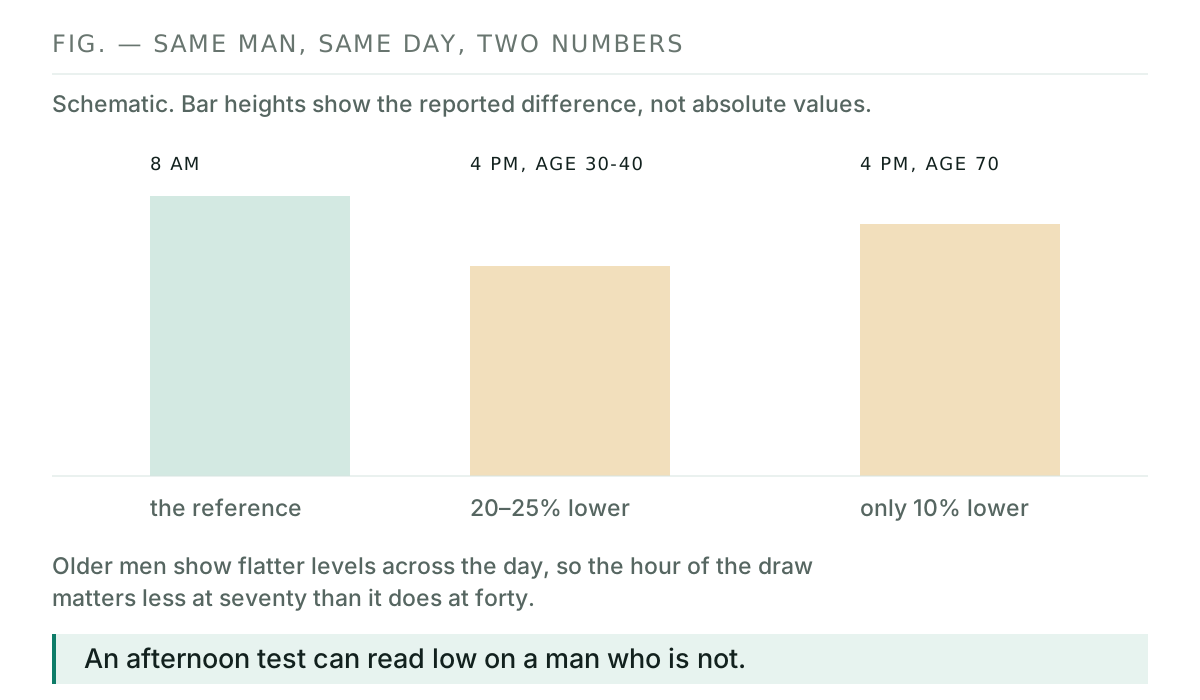
The size of the effect across a working day is large enough to move a man across the line that decides everything. Total testosterone values obtained at 4 p.m. in men aged 30 to 40 were 20 to 25 per cent lower than measurements taken at 8 a.m.
Afternoon values in men aged 30 to 40 ran 20 to 25 per cent below the 8 a.m. figure. In men aged 70 the same comparison showed only a 10 per cent decline, because levels flatten out across the day with age. American Urological Association, Testosterone Deficiency Guideline
That second sentence is worth holding on to, because it cuts against the intuition. The older you are, the less the clock distorts your result. A 42-year-old who tests after lunch is being measured at the worst possible moment; a 72-year-old doing the same is being measured at a fairly ordinary one.
MedlinePlus describes the practical version of this: the sample is usually taken in the morning, between 7 and 10, because during those hours levels are typically at their highest. That is the window to ask for.
One test is a snapshot, not a measurement
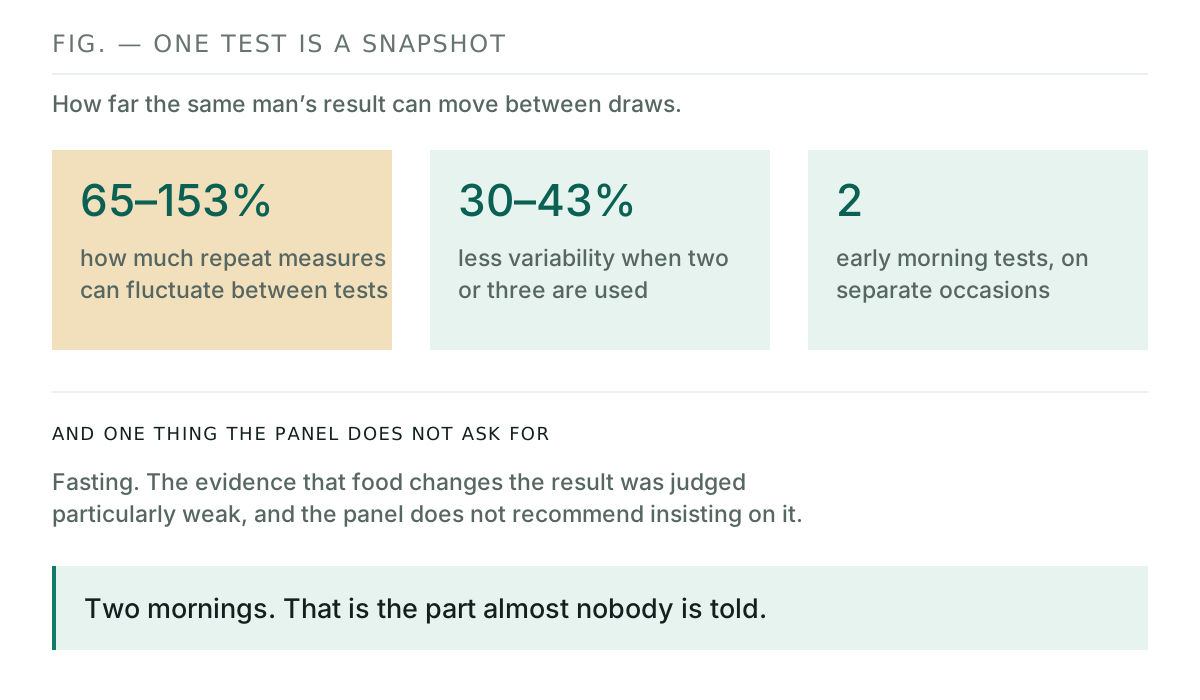
The strongest statement in this part of the guideline is about repetition, and it carries the highest grade the document awards. The diagnosis of low testosterone should be made only after two total testosterone measurements are taken on separate occasions, with both conducted in an early morning fashion.
The reason is not caution for its own sake. Intra-individual variability in this measurement is substantial: repeat measures can fluctuate by 65 to 153 per cent between tests depending on the assay used, and using two or three measures reduces that variability by 30 to 43 per cent.
Sit with that first number for a second. It means a single result is compatible with a very wide range of true values, and that two honest results from two competent laboratories can disagree sharply without either being wrong. A man told he is low on the strength of one draw has been told something the evidence cannot support.
The guideline also handles the awkward case directly. If a patient's first test is 300 ng/dL and the second is normal, the clinician should use judgement about whether a third test is needed as a control. There is no defined optimal interval between the two.
The instruction you were probably given, and do not need
Here is where popular advice and the guideline part company, and it is worth knowing because it removes an obstacle rather than adding one. A great deal of writing about this test tells men to fast beforehand, and quite a lot of clinics repeat it.
The panel looked at this. While some literature suggests that food ingestion might affect testosterone levels, it judged the evidence particularly weak, and it does not recommend that clinicians insist on fasting prior to testing.
The confusion has a respectable source: research trials often fast their participants to remove one more variable, and the TRAVERSE trial, for instance, enrolled men on the basis of two fasting testosterone levels below 300 ng/dL. A design choice inside a trial is not the same as a requirement for your appointment.
It makes the two-morning rule far easier to follow. If fasting were required, two early appointments on separate days would be a real imposition. Without it, the only thing you have to arrange is the hour.
What total testosterone is, and what free means
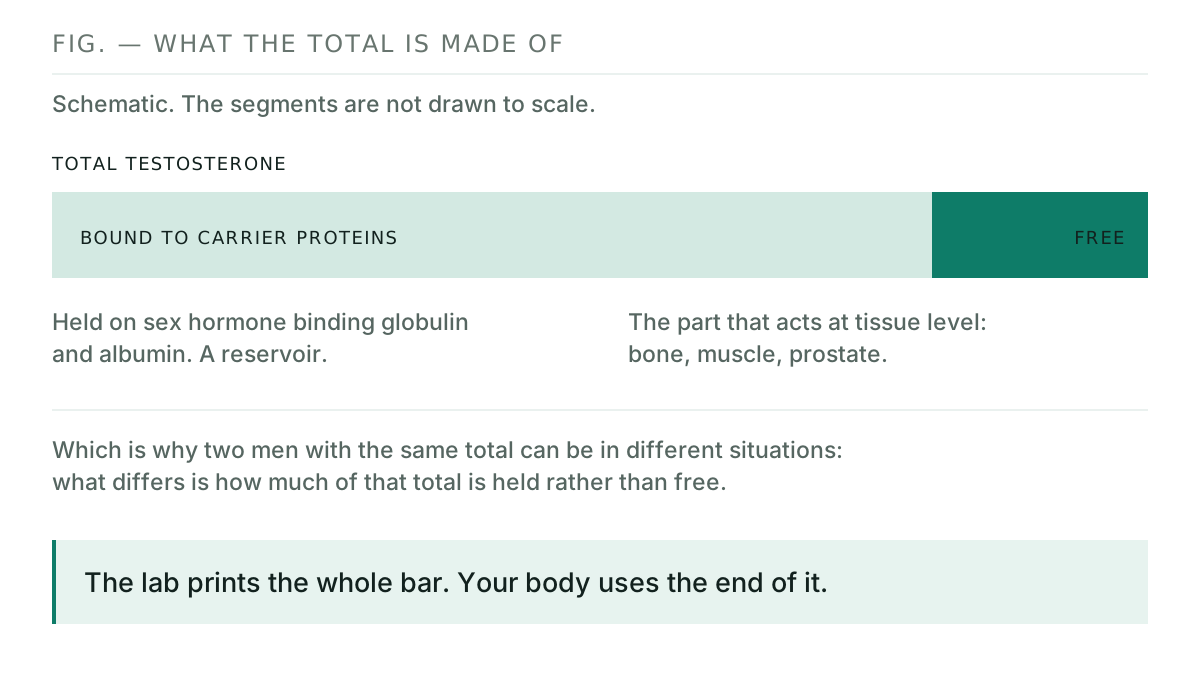
The number on your result is almost always total testosterone, and that word is doing real work. Most testosterone circulates bound to plasma proteins such as sex hormone binding globulin and albumin, and the majority of that protein-bound hormone represents an excess reservoir rather than the active fraction.
Small amounts of free testosterone act at tissue level — in the seminal vesicles, bone, muscle and the prostate gland. So the figure your doctor reads includes a large stored portion and a small working portion, and it does not tell you how that split falls in you specifically.
We are going to be careful about how far we take that, because it is easy to oversell. The AUA cut-off is written against total testosterone, not free, so total is the number the diagnosis is built on. Free testosterone is a further question that belongs with the further tests below, not a substitute for the main one.
The tests that come with it, and what they separate
A testosterone result on its own tells you the level. It does not tell you where a low level came from, and that second question is the one that decides what happens next. The guideline answers it with more blood work rather than more opinion.
In patients with low testosterone, clinicians should measure serum luteinising hormone, and that is a strong recommendation. Serum prolactin should be measured in patients with low testosterone combined with low or low-normal luteinising hormone. Patients with persistently high prolactin of unknown cause should be evaluated for endocrine disorders.
| What is measured | What it is asking | Grade in the guideline |
|---|---|---|
| Total testosterone, twice, early morning | Is the level actually low | Strong recommendation |
| Luteinising hormone | Is the instruction from the brain arriving | Strong recommendation |
| Prolactin, if LH is low or low-normal | Is something upstream interfering | Strong recommendation |
| Haemoglobin and haematocrit | Baseline before any therapy begins | Strong recommendation |
| PSA, in men over 40 | Baseline before any therapy begins | Clinical principle |
If you have never had a PSA and are not sure what the number would mean, PSA levels by age covers it, and it is worth reading before rather than after.
What to settle before you test at all
There is a version of this appointment that wastes everybody's time, and it is the one where a man tests during a period when his level was always going to read low for reasons that have nothing to do with his hormone system. Testing then measures the circumstance rather than the man.
Acute illness is the obvious one. Untreated sleep apnoea is the one nobody mentions: if somebody has told you that you stop breathing at night, what separates snoring from sleep apnea is worth settling first, because it belongs to the group of things that push a level down without the hormone system being at fault.
The same goes for a stretch of badly broken nights. Our sleep guide sorts that complaint into its five separate problems, and if one of them is yours, it is cheaper to fix that first than to interpret a hormone reading taken in the middle of it.
If you are already on treatment, the rule changes
Everything above is about establishing a diagnosis. Once a man is actually on testosterone therapy, the purpose of testing changes from finding out whether the level is low to checking whether the dose has landed where it was aimed, and the schedule is different.
The guideline expects an initial follow-up total testosterone level after an appropriate interval, to ensure that target levels have been achieved, and then testosterone levels measured every 6 to 12 months while on therapy. Dosing is meant to reach the middle third of the normal reference range rather than the top of it.
If you are on a prescription and have not had a level checked in over a year, that is a gap worth raising. What the monitoring is for, and what else belongs in it, is covered in testosterone replacement therapy: what each form does.
How to read what comes back
When the results arrive, the temptation is to look at one figure and compare it with a range printed beside it. That is the least informative way to read the page, and it is how most men end up either falsely reassured or unnecessarily alarmed.
- Check the collection time first, not the value. If it was not early morning, the number is provisional whatever it says.
- Check whether there are two of them, from separate days. One is a snapshot.
- Look for luteinising hormone. If nobody measured it and your testosterone is low, the question of why has not been asked yet.
- Do not read the reference range as a verdict. The cut-off supports a diagnosis; symptoms are the other half of it.
- Ask what the plan is if the second test disagrees with the first, because it may, and that is expected rather than alarming.
What that adds up to is not a demand for more medicine. It is five questions that take two minutes, and they are the difference between a number and an answer. What the number means once you have it properly is covered in the guide to low testosterone after 40.
Key takeaways
- Peak testosterone occurs around 3 to 8 a.m., and 32 to 39 per cent of the day's decline happens in the first thirty minutes after waking.
- Afternoon values in men aged 30 to 40 ran 20 to 25 per cent below the 8 a.m. figure; at 70 the gap was only 10 per cent.
- MedlinePlus puts the usual collection window between 7 and 10 in the morning.
- Two measurements on separate early mornings is a strong recommendation — the highest grade in the guideline.
- Repeat measures in the same man can fluctuate 65 to 153 per cent; two or three reduce that variability by 30 to 43 per cent.
- Fasting is not required: the panel judged that evidence particularly weak and does not recommend insisting on it.
- Luteinising hormone is the test that separates a problem in the testicle from a problem in the signal, and it is a strong recommendation whenever testosterone is low.
Where to go from here
Once the measurement is solid, the question becomes what it means and what follows:
- Low Testosterone After 40: The Number and What It Means — the guide to the whole subject, and where this test fits in it.
- Testosterone Replacement Therapy: What Each Form Does — what happens if the answer is yes.
- PSA Levels by Age — the other baseline taken before therapy in men over 40.
- Snoring or Sleep Apnea? What Separates Them — worth settling before you test.
- Sleep After 40 — if broken nights are the background to all of this.
Frequently asked questions
What time of day should a testosterone test be taken?
Early morning. Peak values occur around 3 to 8 a.m., and MedlinePlus says the sample is usually taken between 7 and 10, when levels are typically highest. The AUA guideline requires both measurements to be conducted in an early morning fashion.
Do I need to fast before a testosterone test?
The AUA panel does not recommend that clinicians insist on fasting. It judged the evidence that food ingestion affects testosterone to be particularly weak. Some trials fast their participants for consistency, which is where the belief comes from, but the guideline does not require it of you.
How many testosterone tests do I need?
Two. The guideline says the diagnosis should be made only after two total testosterone measurements taken on separate occasions, both early morning, and grades that a strong recommendation. Using two or three measures reduces the variability between results by 30 to 43 per cent.
Why did my two results come back so different?
Because that is normal. Repeat measures in the same man can fluctuate by 65 to 153 per cent between tests depending on the assay used. It is the reason the guideline asks for more than one, rather than a sign that a laboratory made a mistake.
Should I ask for free testosterone as well as total?
Most testosterone circulates bound to sex hormone binding globulin and albumin, and only a small free fraction acts at tissue level. The guideline works from total testosterone for the cut-off, and adds further tests such as luteinising hormone to work out where a low reading comes from.
What else should be measured alongside testosterone?
In patients with low testosterone, the guideline says clinicians should measure serum luteinising hormone, a strong recommendation. Prolactin should be measured when luteinising hormone is low or low-normal. That is what separates a problem in the testicle from a problem in the signal.
Sources
- American Urological Association — Testosterone Deficiency Guideline
- MedlinePlus (National Library of Medicine) — Testosterone Levels Test
- StatPearls (National Library of Medicine) — Physiology, Testosterone
- Lincoff et al., New England Journal of Medicine, 2023 — Cardiovascular Safety of Testosterone-Replacement Therapy (TRAVERSE)
- MedlinePlus (National Library of Medicine) — How to Understand Your Lab Results

Male Health Guide Editorial Team
We write about the health problems men over 40 actually search for at 3 a.m. — and we say plainly when the evidence for a popular product is thin. We do not invent credentials and we do not publish sponsored copy as editorial. Read more about how we work.
Medical disclaimer: This article is general information about how testosterone is measured and is not medical advice. It is not an instruction to order or refuse any test, and it cannot interpret your own results, which need to be read by someone who can see them alongside your history. Please speak to a qualified healthcare professional about your own situation.