Sleep After 40: What Changed and What Restores It
Short answer
Deep sleep falls, the body clock shifts earlier, and the night breaks into more pieces. What does not change is how much sleep you need. The useful question is not “how do I sleep better” but “which of five different problems do I have” — because they have five different answers.
Most men over 40 who sleep badly have been told two things, and both are wrong. The first is that you need less sleep as you get older. The second is that this is simply what happens now, so there is nothing to be done.
Neither survives contact with the evidence. Sleep genuinely changes with age, in ways worth understanding. But the amount you need does not fall, and most of what goes wrong after 40 has a name and, in several cases, a treatment better than the one being advertised to you.
This is the guide to the whole subject. It does not settle any of it on its own — each part has its own page — but it should tell you which part you are in.
What actually changes about sleep after 40?
Three things, and they are separate.
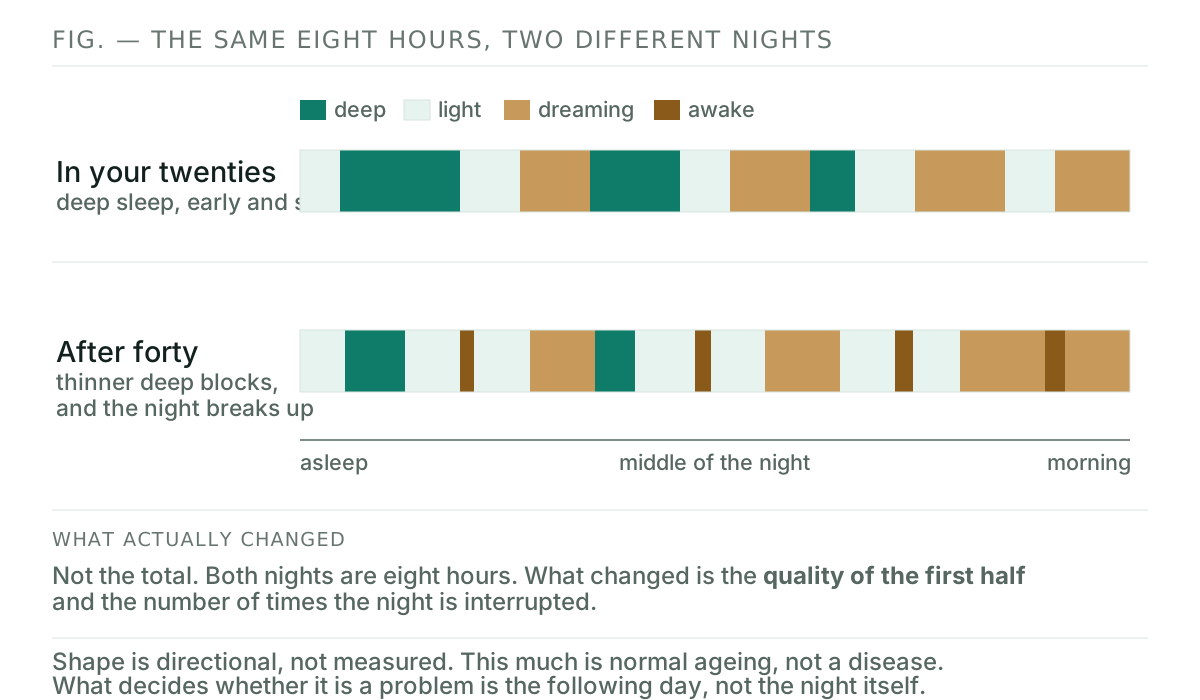
Deep sleep declines. The slow-wave sleep concentrated in the first part of the night — the sort that is hardest to wake someone out of — occupies less of the night than it did at twenty-five. This is the change men feel as “I sleep, but not properly”.
The night breaks into more pieces. Brief awakenings become more frequent. Many are short enough that they are never remembered, which is why a man can report sleeping through and still wake unrefreshed.
The body clock moves earlier. Sleepiness arrives sooner in the evening and the morning waking comes sooner too. This is a shift in timing rather than a loss of sleep, and confusing the two sends a lot of men to a pharmacy for a problem that is not insomnia.
None of this is a disease. It is the ordinary trajectory. What matters is that it lowers the margin: the same eight hours in bed delivers less than it used to, so anything else that goes wrong on top of it shows up faster.
Do you need less sleep as you get older?
No, and this is the most persistent myth in the subject.
Adults over 60 need roughly the same seven to nine hours as adults of any age. Older people commonly get less than that, which is a completely different statement. Getting less and needing less are not the same thing, and treating the first as evidence of the second is how men end up spending years underslept and calling it normal.
There is a related trap in the other direction. Lying in bed longer to catch up tends to make broken sleep worse rather than better, because time awake in bed teaches the body to be awake there. That is counter-intuitive enough that it deserves its own explanation rather than a line in a list, and it has one: how much sleep you actually need after 40 covers the recommended figure, why the need does not fall with age, and why the hours you spend in bed are the wrong number to be counting.
“I slept badly” is five different problems
This is the most useful idea on the page. Almost everything that follows depends on it.
When a man says he is not sleeping, he could mean any of five quite different things, and they do not share a treatment. Sorting out which one you are in does more good than any product you could buy tonight.
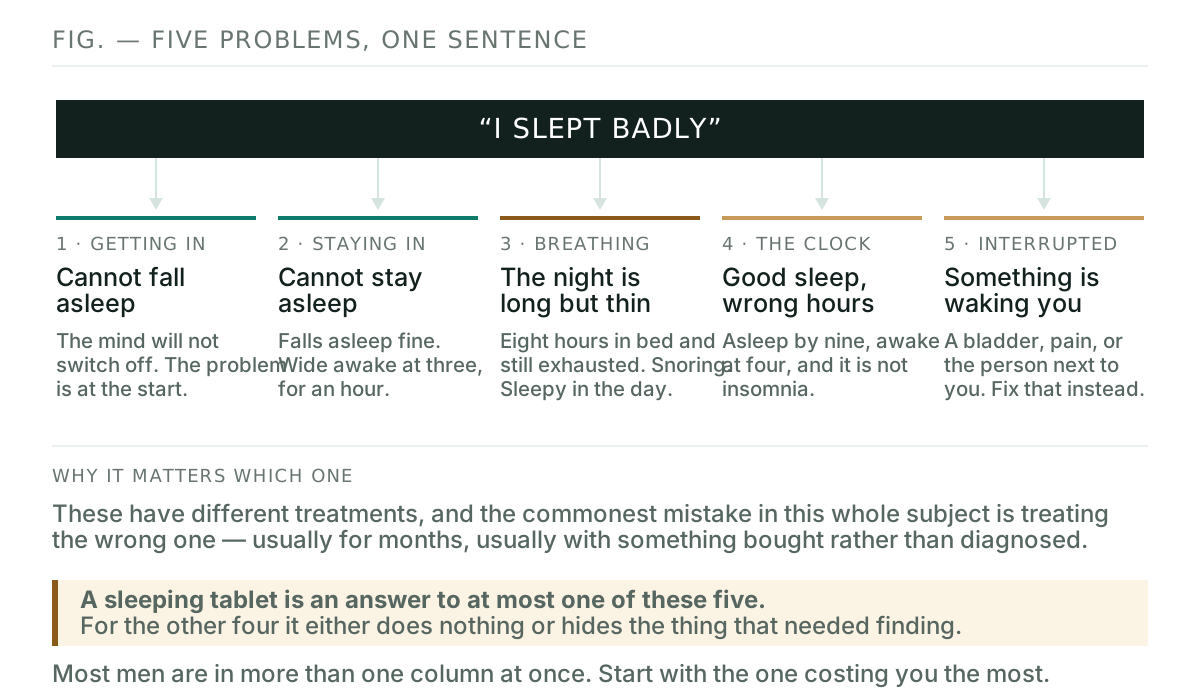
Most men are in more than one column at once. That is normal, and it is not a reason to despair — it is a reason to start with the one costing you the most rather than trying to fix everything on the same night.
1. When you cannot fall asleep
The problem is at the start of the night. The body is tired and the mind will not switch off, or switches off and then restarts the moment the light goes out.
Two things are worth knowing. Taking somewhere around fifteen to twenty minutes to fall asleep is normal, not a failure — and falling asleep the instant your head touches the pillow is not the goal it sounds like. It more often signals that you are already short of sleep.
The second is that lying awake trying harder is the one strategy guaranteed not to work. Effort is arousal, and arousal is the problem. The evidence-based approach here is behavioural rather than chemical, which we come back to below.
2. When you cannot stay asleep
Sleep starts normally. Then, somewhere in the small hours, you are simply awake — often more awake than seems reasonable — and the return takes an hour or does not happen at all.
This is the commonest pattern after 40 and it has real mechanisms behind it: the pressure to sleep has largely been discharged by then, and the body is already beginning its morning preparation. Add a mind that has learned to expect the waking, and the pattern reinforces itself.
Before treating it as insomnia, it is worth ruling out the far more mechanical explanations — which is the whole point of the last of the five.
3. When the night is long but the sleep is thin
This is the one men miss, and it is the one that matters most medically.
Eight hours in bed, no memory of waking, and still exhausted. Snoring that other people complain about. Falling asleep in front of the television, or in a parked car, without intending to. That combination points at breathing rather than at sleep itself.
Sleep apnea is common in men over 40, becomes more common with weight and with age, and is substantially underdiagnosed — largely because the symptom that would identify it happens while you are asleep and is only visible to someone else. It is also linked to blood pressure and heart problems, which is why it is not a lifestyle complaint.
There is one detail with a direct bearing on the rest of this site: interrupted breathing increases overnight urine production. Some men who are certain their prostate is waking them are being woken by their breathing first, and noticing the bladder second.
4. When good sleep arrives at the wrong hours
Asleep in the chair by nine, in bed by ten, wide awake at four. Total sleep is adequate. Nothing is broken. The clock has simply moved.
This is not insomnia, and treating it as insomnia makes it worse. The response that helps is about light and timing — morning light, and resisting the evening doze that steals from the night. A sedative aimed at a timing problem sedates the wrong hours.
5. When something else is waking you
The fifth is the simplest and the most often skipped: the sleep is fine, and something is interrupting it. A bladder. Pain. Reflux. A partner who snores.
For readers of this site the bladder is the obvious candidate, and we have written that one out in full in why you wake up three times a night to pee, which separates the three mechanisms that produce the identical symptom.
The important instruction here is short: if something is waking you, fix that. No amount of work on sleep quality survives an interruption you have not addressed.
What actually works, in order of evidence
Stated plainly, because most pages on this subject do not.
For chronic insomnia, the first-line treatment in the guidelines is not a drug. It is a structured behavioural programme — changing what you do with the bed, the clock and the hours before it — and it outperforms medication over the long term. Almost no man is offered it, which is why it gets a page of its own.
For interrupted breathing, the answer is a test and then a treatment, and neither is guesswork. Nothing bought over a counter substitutes for finding out.
For a shifted body clock, it is light and timing.
For something waking you, it is treating that thing.
Notice how little of that list is a purchase. That is not an accident, and it is the main reason this subject is so badly served by the pages that rank highest for it.
What gets sold, and what the evidence says
We take the same position here that we took on supplements for the prostate, and for the same reason: we earn nothing either way, so we can report the awkward version.
The single most purchased product in this category is not a sedative. It is a hormonal signal that tells the body what time it is. That distinction matters enormously, because it means the evidence is strongest for problems of timing and much weaker for the problem most men buy it to solve.
Prescription sleeping tablets are a different matter. They work, in the narrow sense that they produce sleep. What they carry after 40 is a specific set of costs — next-day impairment, and unsteadiness during exactly the night-time trip to the bathroom that many readers of this site are already making.
The one habit worth examining first
A drink in the evening shortens the time it takes to fall asleep and then costs you the second half of the night, where time spent awake goes up rather than down. Reviews describe a modest decrease in dreaming sleep with a modest rebound later, which is a smaller effect than the popular version of this claim.
It is unusually worth testing because the change costs nothing and the result shows up within days rather than months. The measured detail — including a study where the drink came six hours before bed, cleared before sleep began, and still cost nearly half an hour of extra time awake — is in what a nightcap really costs you. It also compounds with the bladder, a connection we set out in foods and drinks that make prostate symptoms worse, where the mechanism is fluid rather than sleep architecture.
When to stop managing this alone
Some of this is worth a conversation rather than another month of experimenting:
- Anyone has told you that you stop breathing, gasp or choke in your sleep.
- You fall asleep in the day without intending to — particularly while driving, which is not a symptom to sit on.
- Poor sleep has lasted three months or more, on most nights.
- Morning headaches, or blood pressure that has become harder to control.
- Low mood alongside the sleep. The two travel together and each makes the other worse.
The last one deserves saying plainly, because men are less likely to raise it: persistent poor sleep and low mood are so closely linked that treating one without mentioning the other wastes the appointment.
Where to start tonight
Not with a purchase. With a fortnight of writing down four things: when you went to bed, roughly when you fell asleep, what woke you, and how the following day went.
That record does two jobs. It tells you which of the five columns you are actually in — which almost nobody knows by impression — and it is the single most useful thing you can put in front of a clinician if you eventually go. It is the same discipline we recommend for judging whether a supplement is doing anything, and it works for the same reason: memory is not a measurement.
Key takeaways
- Deep sleep falls, the night fragments, and the body clock shifts earlier. That much is normal ageing.
- You do not need less sleep as you age. You get less. Those are different statements and confusing them costs years.
- “I slept badly” is five separate problems with five separate answers. Sorting out which one you have beats anything you could buy tonight.
- A sleeping tablet addresses at most one of the five. For the rest it does nothing or hides what needed finding.
- The first-line treatment for chronic insomnia in the guidelines is behavioural, not chemical — and almost nobody is offered it.
- Interrupted breathing raises overnight urine production, so the bladder is not always the thing that woke you.
- What decides whether broken sleep is a problem is the following day, not the night.
Where to go from here
This guide opens the subject. These go deeper, and they connect to the prostate work already published here:
- Snoring or Sleep Apnea? What Separates Them — the third of the five problems, and the one men miss.
- The Insomnia Treatment That Works Better Than Pills — the first-line treatment almost nobody is offered.
- Waking at 3 a.m. and Cannot Get Back to Sleep — the second of the five, and the commonest.
- Melatonin for Sleep After 40 — a time signal rather than a sedative, and the dose question after 40.
- Why Do I Wake Up 3 Times a Night to Pee? — the three mechanisms behind the commonest interruption.
- Enlarged Prostate After 40 — the complete guide, if the bladder is what wakes you.
- Foods and Drinks That Make Prostate Symptoms Worse — the fluid half of the evening problem.
- Saw Palmetto: What the Cochrane Review Actually Found — how we assess a popular supplement.
- How Long Do Supplements Take to Work? — how to run a two-week test that tells you something.
Frequently asked questions
Why does sleep get worse after 40?
The amount of deep sleep falls, the body clock shifts earlier, and the night breaks into more pieces. Total sleep need does not change. What changes is how easily that total is reached, which is why the same eight hours in bed delivers less than it used to.
Do you need less sleep as you get older?
No. This is the most persistent myth in the subject. Adults over 60 need roughly the same seven to nine hours as adults of any age. Older people commonly get less sleep, but getting less is not the same as needing less, and treating it as normal delays finding the reason.
What is the difference between normal ageing and a sleep problem?
The night itself does not settle it. Lighter, more broken sleep is normal ageing. It becomes a problem when it costs you the following day: sleepiness you did not choose, concentration that has changed, or falling asleep when you did not intend to.
Should I take a sleeping pill for poor sleep?
Sleeping badly is at least five different problems, and a sleeping tablet addresses at most one of them. For the other four it either does nothing or hides what needed finding. The first-line treatment for chronic insomnia in the guidelines is not a drug at all.
Can prostate problems cause bad sleep?
Yes, and the direction is not always obvious. A bladder that wakes you fragments the night. But interrupted breathing also increases overnight urine production, so some men who assume the prostate is waking them are actually being woken by something else first.
How long should it take to fall asleep?
Somewhere around fifteen to twenty minutes is typical. Falling asleep the moment your head touches the pillow is not a sign of good sleep; it more often signals that you are short of it. Lying awake well beyond half an hour, most nights, is worth looking at.
Sources
- National Heart, Lung, and Blood Institute (NIH) — Sleep Deprivation and Deficiency
- National Heart, Lung, and Blood Institute (NIH) — Insomnia
- National Heart, Lung, and Blood Institute (NIH) — Sleep Apnea
- National Institute on Aging (NIH) — Sleep and Older Adults
- MedlinePlus (National Library of Medicine) — Healthy Sleep
- NHS — Insomnia

Male Health Guide Editorial Team
We write about the health problems men over 40 actually search for at 3 a.m. — and we say plainly when the evidence for a popular product is thin. We do not invent credentials and we do not publish sponsored copy as editorial. Read more about how we work.
Medical disclaimer: This article is general information, not medical advice. We are not doctors, and nothing here diagnoses, treats or cures any condition. Do not start or stop any medication based on what you read here. Persistent poor sleep, daytime sleepiness, or being told you stop breathing in your sleep are reasons to see a qualified healthcare professional rather than to self-treat.