How Much Sleep Do You Actually Need After 40?
Short answer
How much sleep you need after 40 is seven or more hours, and that does not change with age. What changes is how much of your time in bed turns into sleep. So the honest question is not how many hours you spent in bed, but how many of them you were actually asleep for.
There is a sentence men over 40 repeat to each other with a certain amount of pride: I only need about five hours these days. It is usually said the way you would report a useful adaptation, like needing less food or feeling the cold less.
It is almost always a description of what someone is getting, not of what they need. Those are two different quantities, and the whole confusion in this subject comes from treating them as one.
We earn nothing from any of this. There are no affiliate links on this site, nothing here is sponsored and we are not selling a mattress, a tracker or a supplement, which is why this article can end without recommending that you buy anything.
The number, and who put it there
In 2015 the American Academy of Sleep Medicine and the Sleep Research Society published a consensus recommendation after a twelve-month project by a panel of fifteen sleep experts. The recommendation is that adults should obtain seven or more hours of sleep per night on a regular basis to avoid the health risks of chronic inadequate sleep.
Two details in that statement matter more than the headline figure.
The first is the floor. The panel concluded that sleeping six or fewer hours per night is inadequate to sustain health and safety in adults. That is not phrased as a suggestion.
The second is what they declined to say. The panel did not place an upper limit on recommended sleep duration. If you have been told that sleeping too long is dangerous, that is not what this recommendation says. The National Heart, Lung, and Blood Institute states the adult range slightly differently — experts recommend that adults sleep between seven and nine hours a night — which is the same territory described from the other end.
Does the need actually fall with age?
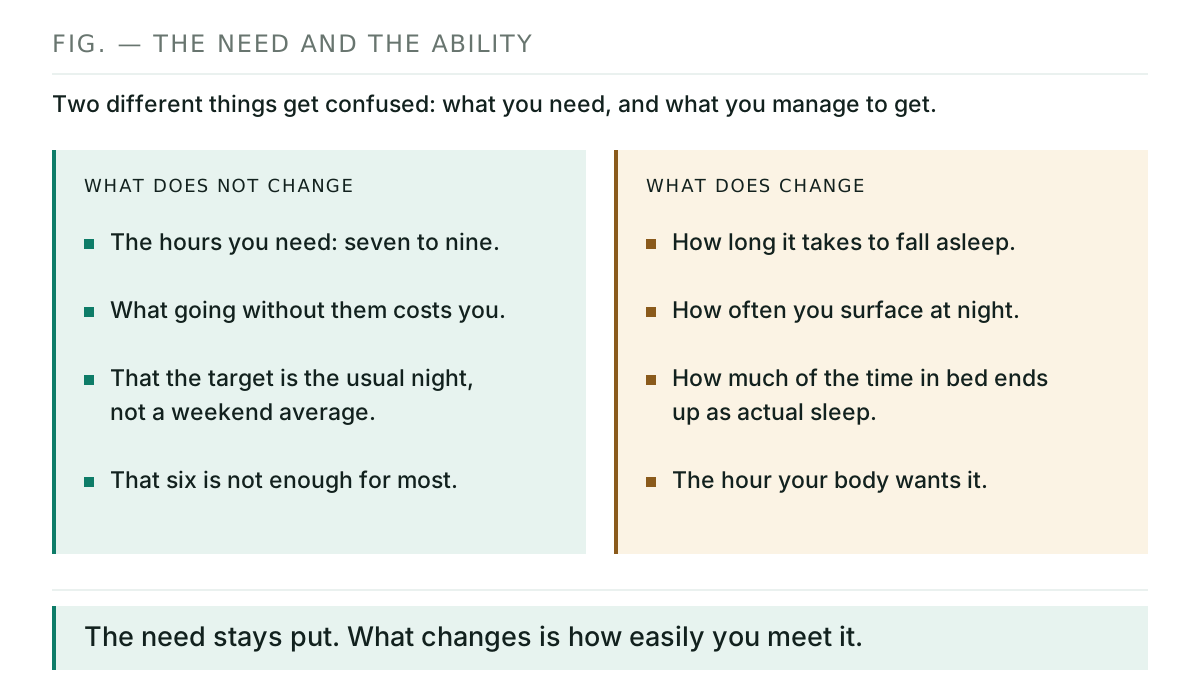
The National Institute on Aging answers this in one line: older adults need about the same amount of sleep as all adults, seven to nine hours each night. Not less. About the same.
What the NIA does describe changing is the timing — older people tend to go to sleep earlier and get up earlier than they did when they were younger. That is a shift in when, not a reduction in how much, and the site covers it as one of the five separate problems in the guide to what changes about sleep after 40.
So where does the belief come from? From the only evidence most men have, which is their own experience of getting less. Sleep becomes lighter, more broken and harder to hold on to after 40. You get less of it. Then the mind does what minds do with an uncomfortable fact and reclassifies it as a preference.
Needing less and getting less feel identical from the inside. Only one of them is happening.
Time in bed is not time asleep
Ask a man how much he slept and he will tell you when he went to bed and when the alarm went off. That is a measurement of the bed, not of the sleep.
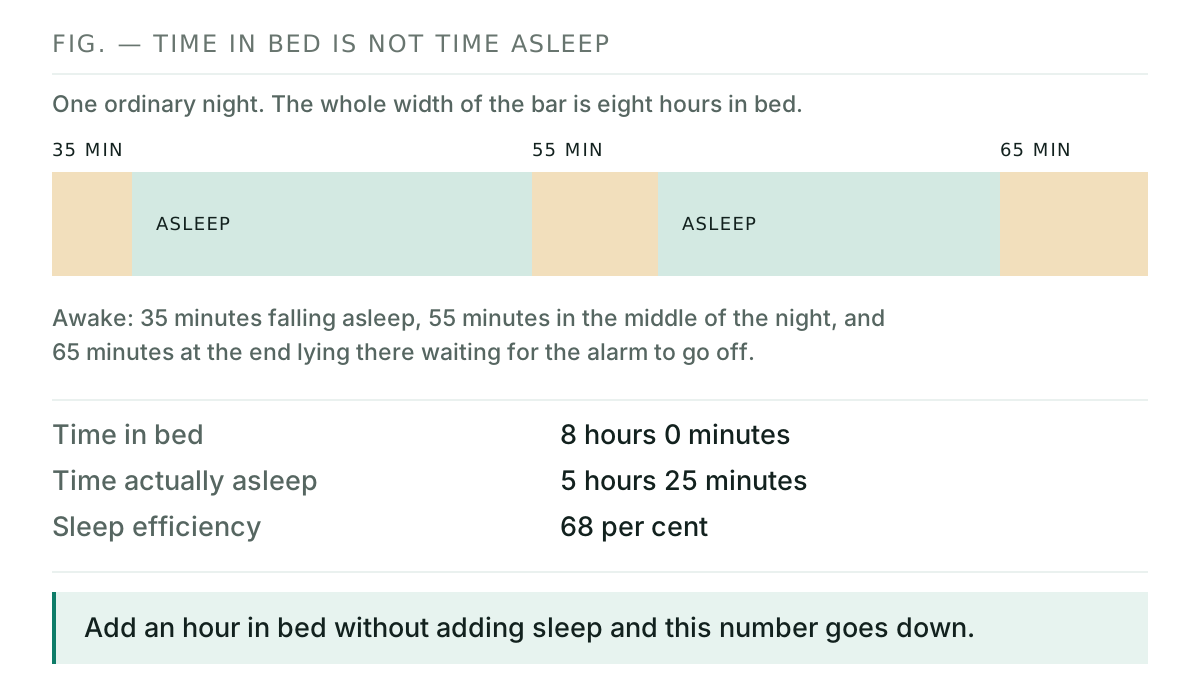
Take the night in the drawing at the top of this article. Lights out at eleven, alarm at seven: eight hours in bed, and most men would report that as eight hours of sleep. Inside it, thirty-five minutes falling asleep, fifty-five minutes awake in the middle of the night, and sixty-five minutes at the end lying there waiting for the alarm to release him.
Five hours and twenty-five minutes. He is nearly two hours short of the recommendation and he is reporting himself as comfortably above it. Nothing about his answer was dishonest. The question he was answering was simply the wrong one.
That gap is the single most common reason a man believes he is fine on his sleep while feeling like he is not.
The measurement that does change
There is a name for the ratio between those two numbers, and it is the most useful piece of arithmetic in this whole subject: sleep efficiency, the share of your time in bed that you actually spent asleep.
Five hours twenty-five inside eight hours is about 68 per cent. A younger man who falls asleep in ten minutes and does not surface until morning is up in the nineties.
This is where age genuinely does something. It takes longer to fall asleep and you surface more often, so given the same time in bed, less of it comes back as sleep. That is a real change and it is worth knowing about — but notice what it is a change in. It is a change in the yield, not in the requirement.
Time in bed is the only number most people track, and it is the one they can control directly. Sleep efficiency is the number that decides whether the time did anything. The uncomfortable part is that raising the first often lowers the second.
Why “eight hours” is the wrong thing to aim at
Eight is a convenient number, and it has been repeated so often that it now functions as a pass mark. Two things go wrong when it is treated that way.
First, both authorities quoted above give a range with a floor, not a target. Seven or more. Seven to nine. Sleeping seven and a half hours and feeling well is not a failure to reach eight.
Second, and more practically, aiming at a number in bed is aiming at the wrong number entirely. A man chasing eight hours of sleep who is running at 68 per cent efficiency needs nearly twelve hours in bed to hit it. He will not get twelve hours. What he will get is a longer stretch of lying awake, which is precisely the thing that makes the next night worse.
Why giving yourself more time in bed backfires
This is the counterintuitive part, and it is the reason the advice you would guess at is usually wrong.
If you are sleeping badly, the instinctive response is to go to bed earlier and give yourself more opportunity. The extra opportunity is almost never taken up as sleep. It is taken up as time awake in bed, which drags the efficiency down and, worse, strengthens the association between being in that bed and being awake.
That association is the engine of long-term insomnia, and it is why sleep clinicians frequently do the opposite of what patients expect and shorten the time in bed deliberately. That technique is part of the behavioural programme guidelines put ahead of medication for chronic insomnia, and the site covers it — including the reason it has to be supervised rather than improvised — in the insomnia treatment that works better than pills.
If you are regularly lying awake for long stretches, more hours in bed is not the fix and usually makes it worse. Fixing the yield comes before extending the opportunity.
“I have been fine on five hours for years”
There is a real version of this, and it is worth being precise about, because the precision is what makes the answer useful rather than preachy.
Natural short sleep is a genuine, inherited trait. A 2021 systematic review in Cureus describes people carrying mutations in genes including DEC2, NPSR1, mGluR1 and the beta-1 adrenergic receptor who sleep roughly four to six hours a night with no negative impact on health and no daytime drowsiness.
The same review is explicit about two things. Short sleep phenotype and deprived sleep are different phenomena. And the trait is not something that can be practised or learned by wanting it: it is described as an intrinsic nature that lasts a lifetime.
Which means the question is not whether you have got used to five hours. It is whether five hours has ever cost you anything. Natural short sleepers are not tired, do not nap, do not sleep longer on holiday and do not lie in at the weekend, because there is nothing to catch up on. If your five hours comes with a habitual afternoon dip, an alarm you fight, or nine hours the moment you are away from work, that is not the trait. That is a deficit you have stopped noticing.
And for what it is worth, you are in a very large group. The CDC's National Center for Health Statistics reported that in 2024, 30.5 per cent of US adults slept less than seven hours on average, rising to 33.4 per cent of adults aged 35 to 49 and 34.5 per cent of those aged 50 to 64 — the two highest bands of any age group.
Weekends, naps and catching up
The obvious next question is whether a long Saturday puts it right. The honest answer is partly, and not completely.
A 2017 review in Frontiers in Neurology concluded that one weekend of recovery sleep may not be sufficient in all people to fully reverse the neurobehavioural impairments seen with chronic sleep loss, and that recovery of vigilance in particular requires longer than one weekend. The same review raises the harder question of whether some effects are lasting rather than reversible, though the strongest evidence on that point comes from animal work rather than from people, and we would not present it as established in humans.
Note also the wording in the AASM and SRS recommendation: seven or more hours on a regular basis. The unit is the ordinary night, not the weekly average. Five hours from Monday to Friday and ten on Sunday is not seven hours a night, however tidily it divides.
None of which is an argument against sleeping in when you are short. It is an argument against relying on it as the plan.
How to work out your own number
Your personal requirement sits somewhere in a range, and there is a way to find it that does not involve a device.
Over a week or two, note four things each morning: roughly when you went to bed, roughly when you fell asleep, when you finally got up, and how you felt by mid-afternoon. That last one is the outcome that matters, because the mid-afternoon slump is where insufficient sleep shows itself most reliably.
Then look for the nights that were followed by a decent day, and read off how much sleep — not time in bed — produced them. Do this on ordinary weeks rather than on holiday, and be suspicious of any answer under six hours until you have checked it against the section above.
One caveat. If you are being woken repeatedly rather than sleeping too little, this exercise will measure a symptom instead of a need. If several trips to the bathroom are involved, the prior question is whether the bladder is what woke you at all, which is the subject of do you wake up to pee, or wake up and then pee.
When short sleep is a symptom, not a habit
Everything above assumes you are sleeping less because of how you live. Sometimes the cause is a condition, and no amount of arithmetic about hours will touch it.
Take it to a doctor rather than to a spreadsheet if you are getting a full night and still exhausted; if you snore heavily, or someone has seen you stop breathing, which is covered in what separates snoring from sleep apnea; if you are falling asleep involuntarily during the day, particularly at the wheel; if you are awake in the small hours several nights a week for months, which is the pattern described here; or if low mood or loss of interest has arrived alongside the sleep problem.
The measurement is worth bringing with you either way. A fortnight of rough figures turns “I do not sleep well” into something a clinician can act on, and it is the same principle behind what actually happens at a sleep study: the night has to be measured, because describing it is not enough.
Key takeaways
- Seven or more hours a night, on a regular basis, is the AASM and Sleep Research Society recommendation for adults. Six or fewer is judged inadequate.
- The panel deliberately set no upper limit. NHLBI puts the adult range at seven to nine hours.
- The NIA states that older adults need about the same amount of sleep as everyone else. The need does not fall after 40.
- Time in bed is not time asleep, and most men report the first while believing they are reporting the second.
- Sleep efficiency is the share of time in bed spent asleep, and that share is what genuinely declines with age.
- Adding time in bed usually lowers efficiency and reinforces lying awake. Clinicians often shorten it instead.
- A weekend does not fully repay it: recovery of vigilance takes longer than one weekend, and the unit is the ordinary night.
- Natural short sleep is inherited and lifelong. Being used to five hours is not the same thing.
Where to go from here
If the number is not the problem, one of these usually is:
- Sleep After 40: What Changed and What Restores It — the guide that sorts “I slept badly” into five separate problems.
- The Insomnia Treatment That Works Better Than Pills — including why shortening time in bed works.
- Waking at 3 a.m. and Cannot Get Back to Sleep — when the hours are there but the night is in pieces.
- Nocturia or Insomnia: Which One Woke You? — if bathroom trips are what is breaking the night up.
- Snoring or Sleep Apnea? What Separates Them — for a full night that still leaves you exhausted.
Frequently asked questions
How many hours of sleep do you need after 40?
The same as any other adult. The American Academy of Sleep Medicine and the Sleep Research Society recommend seven or more hours a night on a regular basis, and the National Heart, Lung, and Blood Institute puts the adult range at seven to nine hours. Turning 40 does not change the figure.
Do older adults need less sleep?
No. The National Institute on Aging states that older adults need about the same amount of sleep as all adults, seven to nine hours each night. What changes is when the body wants that sleep and how easily it holds on to it, which is a different problem from needing less.
Is six hours of sleep enough?
For almost everyone, no. The consensus panel convened by the AASM and the Sleep Research Society concluded that sleeping six or fewer hours per night is inadequate to sustain health and safety in adults. Feeling accustomed to it is not the same as being unaffected by it.
What is sleep efficiency?
The share of your time in bed that you actually spent asleep. Five hours and twenty-five minutes of sleep inside eight hours in bed is about 68 per cent. It is useful because it separates the hours you gave the night from the hours the night gave back.
Can you catch up on sleep at the weekend?
Partly, and not completely. A review in Frontiers in Neurology concluded that one weekend of recovery sleep may not be enough in all people to fully reverse the neurobehavioural effects of chronic short sleep, and that recovery of vigilance in particular takes longer than a weekend.
Does spending more time in bed help you sleep more?
Usually the opposite, if the problem is insomnia. Extra time in bed tends to be spent awake rather than asleep, which lowers the proportion of the night that is sleep and strengthens the association between the bed and lying awake. Sleep clinicians often shorten time in bed instead.
Sources
- American Academy of Sleep Medicine and Sleep Research Society — Seven or more hours of sleep per night: A health necessity for adults
- National Heart, Lung, and Blood Institute (NIH) — How Much Sleep Is Enough?
- National Institute on Aging (NIH) — Sleep and Older Adults
- National Center for Health Statistics (CDC) — Short Sleep Duration and Sleep Difficulties Among Adults: United States, 2024
- Frontiers in Neurology, 2017 — Neural Consequences of Chronic Short Sleep: Reversible or Lasting?
- Cureus, 2021 — A Systematic Review of Natural Short Sleepers’ Genes
- MedlinePlus (National Library of Medicine) — Healthy Sleep
- NHS — Insomnia

Male Health Guide Editorial Team
We write about the health problems men over 40 actually search for at 3 a.m. — and we say plainly when the evidence for a popular product is thin. We do not invent credentials and we do not publish sponsored copy as editorial. Read more about how we work.
Medical disclaimer: This article is general information about sleep duration and is not medical advice. Recommendations describe populations, not individuals, and your own requirement may sit anywhere within the published range. Persistent short sleep or daytime exhaustion can be a symptom of a treatable condition. Please speak to a qualified healthcare professional about your own situation, and never start, stop or change a prescribed treatment based on what you read online.