Melatonin for Sleep After 40: The Dose and the Timing
Short answer
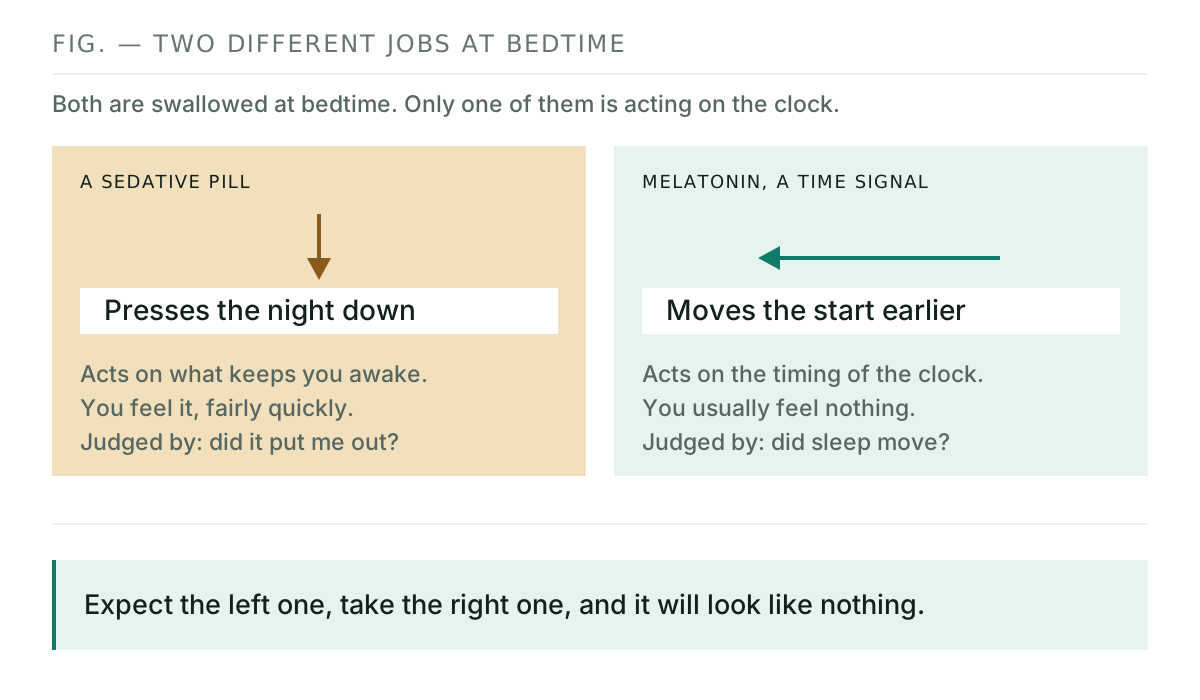
Melatonin for sleep is a clock signal, not a sedative: it tells your body what time it is rather than knocking you out. That is why its evidence is strongest for jet lag and a body clock running late, and why the hour you take it matters as much as the size of the dose.
US sales of melatonin rose by about 150 per cent between 2016 and 2020, according to a study cited by the National Institutes of Health. It is also one of the most misunderstood things on the shelf, and the misunderstanding is not about whether it does anything. It is about what job it was built for, and almost everything men complain about after trying it comes from asking it to do a different one.
The usual story goes like this. A man over 40 starts waking at three in the morning, buys a bottle of 10 mg gummies, takes one at the moment he gets into bed, lies there for an hour feeling nothing in particular, wakes up groggy, and concludes the whole category is marketing. Every step of that is a reasonable thing to do and almost every step is wrong.
This article is about the difference between a hormone that carries a time signal and a drug that pushes you under. Those are two different mechanisms, they are judged by two different results, and only one of them is what is in the bottle.
We earn nothing from any of this. There are no affiliate links on this site, nothing here is sponsored, and we do not sell a sleep product, which is why this page can tell you plainly where the evidence is strong and where it thins out.
What melatonin actually is
Melatonin is a hormone your own brain produces in response to darkness, and its job is the timing of your circadian rhythms — the 24-hour internal clock that decides when you get sleepy, when you wake, and when your body temperature and hormones move. Being exposed to light at night blocks that production.
Read that sentence again with the emphasis on timing. Melatonin is not the substance that makes you sleep. It is the substance that tells the rest of your body that night has started, and the sleep follows from the clock, not from the hormone directly.
The supplement is the same molecule arriving from outside. Supplements can be made from animals or microorganisms, NCCIH notes, but most often they are made synthetically. What you are doing when you swallow one is sending your body a message that says it is dark now — which is useful precisely when your body has the time wrong, and much less useful when your body knows the time perfectly well and something else is keeping you awake.
A clock signal is not a sedative
The practical difference shows up in what you feel. A sedative announces itself: within twenty or thirty minutes you know something has happened, because the drug is acting on the machinery that keeps you conscious. Melatonin does not do that, and men who expect it to do that report, correctly, that they felt nothing.
The NHS puts the working time at around one to two hours, and StatPearls gives the elimination half-life as short too — typically one to two hours, depending on the formulation. So the signal arrives slowly and then leaves. It is not built to hold you down through a night, and judging it on whether it kept you asleep until six is judging a thermostat by how much heat it produces.
| A sedative sleeping pill | Melatonin | |
|---|---|---|
| What it acts on | The systems that keep you awake | The timing of your body clock |
| What you feel | Something, fairly quickly | Usually nothing you can point to |
| Judged by | Did it put me out tonight | Did my sleep move to a better hour over days |
| Best case | A short bridge through a bad patch | A clock that is running late, pulled earlier |
That last row is the whole article in one line. If your night is broken by something other than a misplaced clock — by your bladder, by your airway, by a nervous system that will not settle at three in the morning — then a time signal is being asked to solve a problem it does not touch. Our guide to the five separate problems behind “I slept badly” is the fastest way to find out which one you are in.
Where the evidence is strongest
There are two situations where melatonin is doing exactly the job it exists for, and both of them have the same shape: the clock is in the wrong place and needs moving. This is also where the research is most consistent, which is not a coincidence — matching the tool to the mechanism is usually what makes results reproducible.
Jet lag is the cleanest case, because the clock is unambiguously wrong: your body is still keeping time in the city you left. According to NCCIH, four studies including a total of 142 travelers found melatonin may be better than placebo at reducing overall jet lag symptoms after eastward flights, and two studies including 90 travelers showed the same after westward flights. A larger study of 234 travelers on eastward flights, looking only at sleep quality, found low-quality evidence pointing the same way.
Delayed sleep-wake phase disorder is the other, and it is the one most likely to be sitting under a complaint of insomnia. People with DSWPD typically cannot get to sleep before 2 to 6 a.m. and would rather wake between 10 a.m. and 1 p.m. Their sleep is fine; its position on the clock is not. In 2015 the American Academy of Sleep Medicine recommended melatonin given at specific times for DSWPD — a weak recommendation, with uncertainty about whether the benefits outweigh possible harms.
In a 2018 trial of 307 people with DSWPD, melatonin taken one hour before the desired bedtime, combined with going to bed at a set time, brought sleep onset forward by an average of 34 minutes, with better sleep in the first third of the night and better daytime functioning. Reported by NCCIH, National Institutes of Health
Notice what came bundled with the melatonin in that trial: going to bed at a set time. The signal and the schedule were given together, because a time signal with no schedule behind it has nothing to synchronise to. An earlier review of 52 people with DSWPD found melatonin cut around 22 minutes off the time taken to fall asleep.
There is a third, weaker case. For shift workers, two 2014 reviews summarised by NCCIH found the studies generally small or inconclusive; the first looked at 7 studies with 263 participants and suggested people taking melatonin may sleep about 24 minutes longer during the daytime, which for a night worker is the sleep that counts. Worth knowing if you work nights, but not the same quality of answer as the two above.
What it is usually asked to do instead
Plenty of people reach for melatonin without a flight to catch or a diagnosis in hand. They have ordinary broken sleep, and here the picture is genuinely contested — not settled in either direction. We are going to give you both sides, because a page that gives you only one is choosing for you.
On one side: practice guidelines from the American Academy of Sleep Medicine in 2017 and the American College of Physicians in 2016 concluded there is not enough strong evidence on the effectiveness or safety of melatonin for chronic insomnia to recommend its use. On the other: the American Academy of Family Physicians recognises melatonin as a first-line pharmacological therapy for insomnia. Two respectable bodies, two different readings.
Our own reading is that the disagreement is less mysterious than it looks. Trials of melatonin for general insomnia enrol whoever is sleeping badly — people whose clock is late, people whose clock is fine, people who are anxious, people with an untreated airway problem. A time signal has the most to act on in the first group and the least in the others, and the average across all of them is a number that describes nobody in particular.
Averaging a clock treatment across people who do not have a clock problem produces a small number, and the small number then gets quoted as the effect.
Which is why the useful question is not “does it work” but “is my night a timing problem”. If you fall asleep fine and wake at three, read waking at 3 a.m. and not being able to get back to sleep. If you have never been able to sleep before two, and you sleep well once you are off, that is the pattern melatonin was studied in.
And if the problem has lasted months, the treatment that guidelines put first for long-term insomnia is not a pill of any kind — it is a behavioural programme, set out in the insomnia treatment that works better than pills. The American College of Physicians strongly recommends it as the initial treatment.
The dose almost everyone gets wrong
Doses used in research have ranged from 0.1 mg to 10 mg, StatPearls records, typically given up to two hours before bedtime, and no maximum dose has been established in trials. Walk into an American pharmacy and the ordinary products sit at the top of that range: five and ten milligram tablets and gummies, with the low end of the research barely represented.
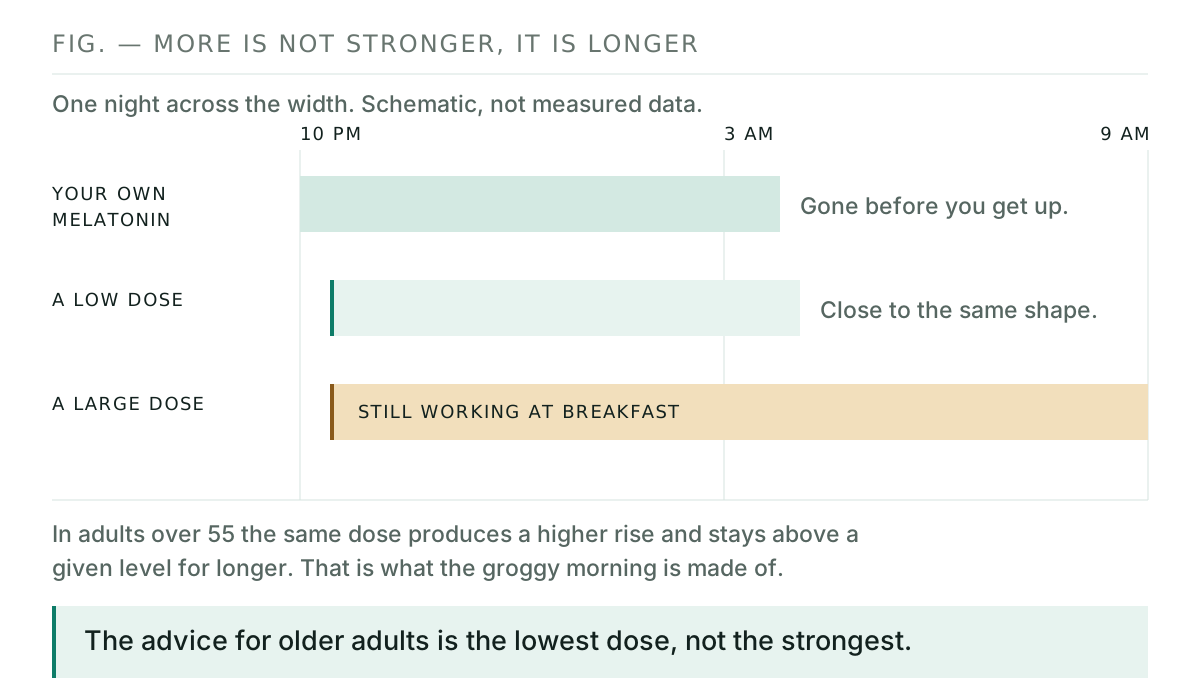
For men over 40 there is a specific reason this matters, and it is the single most useful finding on this page. A systematic review in Drugs & Aging examined melatonin dosing in adults aged 55 and over and found that blood levels rose in a dose-dependent way, with a higher elevation in older adults than in younger ones, and that higher doses stayed above a given threshold for longer.
In older adults, use the lowest possible dose of an immediate-release formulation, to best mimic the normal physiological rhythm of melatonin and to avoid prolonged, supra-physiological blood levels. Vural et al., Drugs & Aging, 2014
NCCIH makes the same point from the other end: melatonin may stay active in older people longer than in younger people and cause daytime drowsiness. That is the groggy morning men describe when they quit. It is not evidence that the substance failed. It is a signal that was still running at nine the next morning, telling a body it was night while the body was trying to work.
There is a second reason the number on the box means less than it appears. The bioavailability of melatonin varies enormously between people and formulations, reported by StatPearls as anywhere from 1 per cent to 74 per cent. Two men taking the identical tablet can end up with very different amounts in the blood, which is one reason trials of it are so inconsistent.
Timing does more of the work than dose
If melatonin carries a time signal, then the hour you take it is not a detail of convenience — it is the active ingredient. This is the part that almost never appears on packaging, and the part that separates the trials that worked from the ones that did not.
The AASM guidance for circadian rhythm disorders is explicitly about strategically timed melatonin: for example one hour before the person’s preferred bedtime, or at a fixed clock time such as 9 p.m. In the 2018 DSWPD trial it was one hour before the desired bedtime, paired with a set bedtime. In none of these is the instruction “take it when you happen to go up”.
Take it at the same clock time every night rather than at whatever hour you go to bed, and give it the one to two hours it needs. Then get the light right: light at night blocks your own production, so a bright screen at 11 p.m. is arguing with the tablet you swallowed at ten.
That last point deserves its own line. Your body already makes this hormone every night, and the most common thing men do in the hour before bed is switch on the one input known to suppress it. Getting the light down works on the same system the supplement is aimed at, which is why the two work with each other rather than against.
Alcohol belongs in the same paragraph. The NHS notes that drinking alcohol or smoking while taking melatonin can stop it working as well as it should — and the wider cost of the evening drink is covered in what a nightcap really costs you, where a drink taken six hours before bed still raised time awake in the night from 39 to 67 minutes.
What is actually in the bottle
In the United States melatonin is a dietary supplement, which means the FDA regulates it less strictly than it would a prescription or over-the-counter drug. In several other countries it is a prescription drug: in the UK it is available on prescription only, and is used mainly for short-term sleep problems in people aged 55 and over.
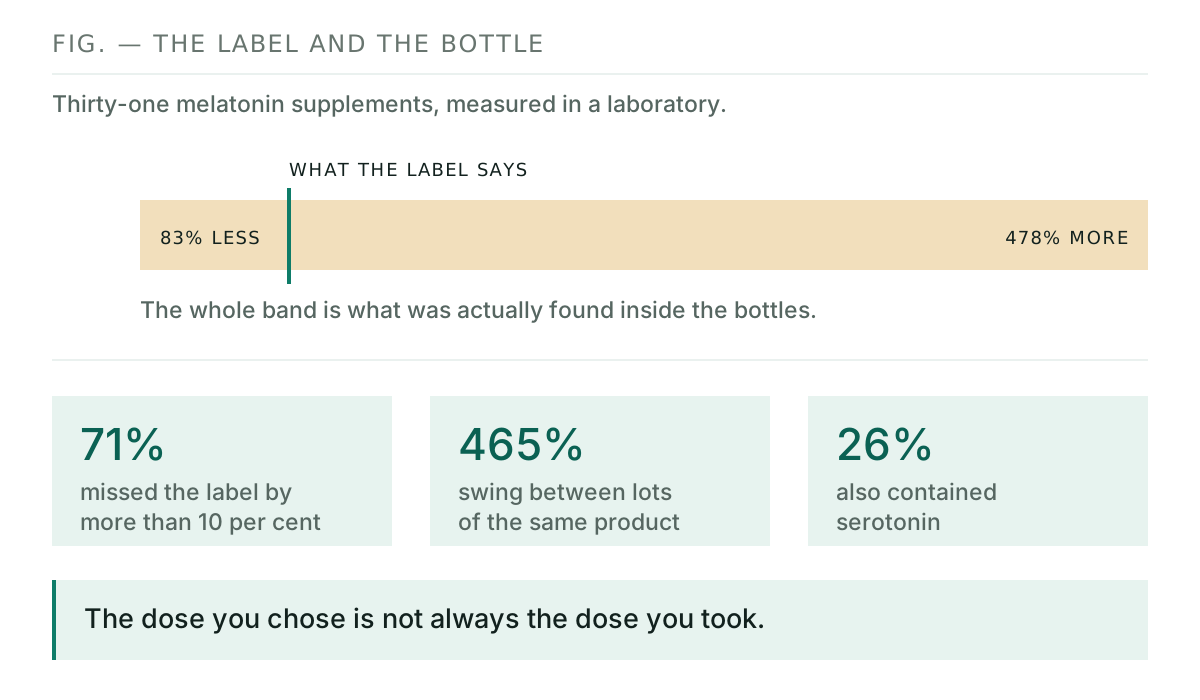
That regulatory gap has a measurable consequence, and it is the reason two men can take “the same” product and have different experiences. A 2017 analysis tested 31 supplements bought from ordinary grocery stores and pharmacies, using liquid chromatography to measure what was really in them.
Melatonin content missed the label by more than a 10 per cent margin in over 71 per cent of the supplements tested, and lot-to-lot variation within a single product reached 465 per cent. Serotonin, a far more tightly controlled substance, was found in 26 per cent of them. Erland & Saxena, Journal of Clinical Sleep Medicine, 2017
Gummies come out worse, and gummies are one of the four formats NCCIH lists as widely available. A 2023 study it cites found 22 of 25 over-the-counter melatonin gummy products inaccurately labeled. One contained no detectable melatonin at all. In the rest, the amount ranged from 74 to 347 per cent of what the label claimed, with most containing more than stated.
There is a practical answer to this, and it is the only product advice on this page. StatPearls gives it directly: one approach to ensure precise dosing is to seek supplements approved by the United States Pharmacopeia, an independent nonprofit, and choosing products labelled USP Verified gives you quality and dosing accuracy. It does not make melatonin work better. It makes the dose you chose the dose you actually take, which is a precondition for any of the rest of this page being useful.
Who should ask a doctor first
Short-term use appears to be safe for most people, with mild side effects reported in studies — headache, dizziness, nausea and sleepiness. The honest caveat is that information on long-term safety is lacking, so “every night for years” is not a pattern anyone has good data on.
Some situations genuinely warrant a conversation first rather than a purchase. NCCIH specifically flags that people with epilepsy and those taking blood-thinning medication need to be under medical supervision when taking melatonin, and the 2015 AASM guidelines recommend against its use by people with dementia.
Two more worth knowing. StatPearls records that around 90 per cent of melatonin is metabolised in the liver, mostly by a single enzyme, which is why it advises caution for anyone with impaired liver function and why it can interact with other medicines that use the same pathway. And it is a hormone, which is a reason to take the dose question seriously rather than treating it as a herb.
If you are already taking a prescription for sleep, do not stack this on top of it without asking — the four classes and what each is meant to do are set out in what each kind of sleeping pill actually does.
The bottle in the kitchen drawer
This one has nothing to do with whether melatonin works and everything to do with keeping a supply of it at home, which is why it belongs on this page rather than being left to a parenting site. Sweet, chewable, unlocked, and sitting in the same drawer as the vitamins.
NCCIH reports that calls to US poison control centres about people aged 19 and under who took melatonin rose from 8,337 in 2012 to 52,563 in 2021, increasing every year over that decade. Most of the calls — 94.3 per cent — were for children aged five and under who consumed it accidentally at home, and 82.8 per cent of those who had taken it had no symptoms at all.
We are quoting the reassuring figure alongside the alarming one on purpose. The overwhelming majority of these children were fine. But the volume of calls is a direct consequence of how many homes now keep a jar of sweets containing a hormone, and it takes ten seconds to move it somewhere a five-year-old cannot reach.
What a sensible trial looks like
If you have read this far and still want to try it, the version below is the one that matches how the research was actually done. It is not more complicated than what most men do; it is just deliberate about the two things that turn out to matter.
- Decide what you are treating. A clock that runs late, or trouble falling asleep at a normal hour, is the case with evidence behind it. Waking at three, or a bladder, or an airway, is a different problem with different answers.
- Start at the lowest dose you can buy, in an immediate-release form rather than extended-release, and resist the instinct to go up if the first nights do nothing.
- Fix the clock time, not the bedtime. Same hour every night, one to two hours before the bedtime you are aiming for — not the one you currently have.
- Give it the schedule to work with. In the trials the melatonin came with a set bedtime and a set wake time. On its own it is a signal with nothing to align.
- Dim the light in that same window, because light at night blocks the hormone you are trying to add.
- Judge it over a week or two, not one night, and judge it on the right result: did your sleep move earlier, and how did the following afternoons go.
And set an end point before you start. In the UK, where this is a prescription medicine, the NHS says it is usually taken for up to 13 weeks, though some people need it for longer — a course rather than an indefinite habit. That framing is worth borrowing even where you can buy it in a supermarket: a defined trial you evaluate honestly is more useful than a jar that stays on the nightstand for three years because you are no longer sure whether it helps.
The fair verdict
Melatonin is a real hormone doing a real job, and the job is timing. Where the clock is the problem — jet lag, a night that starts at two in the morning — it has the evidence behind it and a mechanism that makes sense. Used that way, at a low dose and a fixed hour, it is one of the more sensible things on the shelf.
Where it disappoints is where it was never pointed at the problem: a man whose clock is fine and whose night is broken by his prostate, his breathing or his own nervous system at three in the morning. That is not a failure of the substance. It is a mismatch, and the fix is to identify the mechanism first, which is what the rest of this section is for.
Two decisions change the outcome, and both are about how you use it rather than how much you buy. Start at the smaller amount rather than the bigger one, especially after 40 when it clears more slowly. And take it at a fixed hour with the lights down, rather than at whatever moment you happen to give up on the evening.
Key takeaways
- Melatonin is a hormone released in response to darkness that sets the timing of your body clock — it is a time signal, not a sedative.
- Its evidence is strongest where the clock is the problem: jet lag, and delayed sleep-wake phase disorder, where a 2018 trial in 307 people brought sleep onset forward by 34 minutes.
- For chronic insomnia the bodies disagree — AASM and ACP found the evidence not strong enough to recommend it; the AAFP calls it a first-line pharmacological therapy.
- In adults 55 and over, a systematic review advises the lowest possible dose of an immediate-release form, to avoid prolonged supra-physiological levels.
- Melatonin may stay active longer in older people and cause daytime drowsiness — the groggy morning is usually a dose and timing problem.
- Timing is the active part: research doses are given up to two hours before bed, and guidance for clock disorders specifies a fixed hour.
- Labels are unreliable: content ranged from 83 per cent below to 478 per cent above the label in one analysis, and USP Verified is the practical answer.
- Keep it out of reach of children — 94.3 per cent of poison-centre calls involved children five and under consuming it accidentally at home.
Where to go from here
Melatonin only helps if timing is your problem. These sort out whether it is:
- Sleep After 40: What Changed and What Restores It — the five separate problems behind one complaint, and how to tell which is yours.
- Waking at 3 a.m. and Cannot Get Back to Sleep — the pattern melatonin is least suited to.
- The Insomnia Treatment That Works Better Than Pills — what guidelines put first for long-term insomnia.
- Sleeping Pills: What Each Kind Actually Does — the prescription side, and why it is a bridge rather than a habit.
- Alcohol and Sleep: What a Nightcap Really Costs You — the other thing being taken at bedtime to fix a night.
- Nocturia or Insomnia: Which One Woke You? — if the bladder, and not the clock, is what wakes you.
Frequently asked questions
How does melatonin actually work?
It is a hormone your brain produces in response to darkness, and it helps set the timing of your 24-hour internal clock. A supplement adds that same signal from outside, which is why when you take it matters as much as how much you take.
How much melatonin should an older adult take?
A systematic review in Drugs & Aging covering adults aged 55 and over advised the lowest possible dose of an immediate-release formulation, to mimic the normal physiological rhythm and avoid prolonged, supra-physiological blood levels. Separately, StatPearls records that doses used in research have ranged from 0.1 mg to 10 mg.
When should you take melatonin?
Doses in research are typically given up to two hours before bedtime, and the NHS notes melatonin takes around one to two hours to work. For delayed sleep-wake phase disorder the American Academy of Sleep Medicine supports strategically timed melatonin, such as one hour before the preferred bedtime.
Does melatonin help with jet lag?
This is where the evidence is strongest. NCCIH reports that four studies including 142 travelers found melatonin may beat placebo for overall jet lag symptoms after eastward flights, with two further studies in 90 travelers showing the same after westward flights.
Is melatonin recommended for chronic insomnia?
Bodies disagree. The American Academy of Sleep Medicine and the American College of Physicians concluded there is not enough strong evidence to recommend it for chronic insomnia, while the American Academy of Family Physicians recognises melatonin as a first-line pharmacological therapy for insomnia.
Does the bottle contain what the label says?
Often not. A 2017 analysis of 31 supplements found melatonin content ranging from 83 per cent below to 478 per cent above the labelled amount, and missing the label by more than 10 per cent in over 71 per cent of products. Choosing a USP Verified product is one way to narrow that.
Sources
- National Center for Complementary and Integrative Health (NIH) — Melatonin: What You Need To Know
- Erland & Saxena, Journal of Clinical Sleep Medicine, 2017 — Melatonin Natural Health Products and Supplements: Presence of Serotonin and Significant Variability of Melatonin Content
- Vural et al., Drugs & Aging, 2014 — Optimal dosages for melatonin supplementation therapy in older adults: a systematic review
- StatPearls (National Library of Medicine) — Melatonin
- NHS — About melatonin
- National Institute on Aging (NIH) — Sleep and Older Adults
- MedlinePlus (National Library of Medicine) — Healthy Sleep

Male Health Guide Editorial Team
We write about the health problems men over 40 actually search for at 3 a.m. — and we say plainly when the evidence for a popular product is thin. We do not invent credentials and we do not publish sponsored copy as editorial. Read more about how we work.
Medical disclaimer: This article is general information about melatonin and sleep and is not medical advice, and it is not a recommendation to take melatonin or a dosing instruction for any individual. Melatonin is a hormone and can interact with prescription medicines. Nothing here diagnoses or treats any condition. Please speak to a qualified healthcare professional about your own situation before starting any supplement.