Alcohol and Sleep: What a Nightcap Really Costs You
Short answer
Alcohol and sleep trade against each other across one night. The sedative part is real and lands early. The cost lands later, and it does not need the drink to still be in you: in one study the alcohol was gone before subjects even fell asleep, and they still spent nearly half an hour longer awake during the night.
There is a reason the nightcap survived a century of being told it is a bad idea: it feels like it works. You have a drink, you get drowsy, you go to bed, you go out. The experience is not imaginary and men are not fooling themselves about it.
What alcohol and sleep do to each other in the second half of the night is the part nobody witnesses, because you are asleep for the start of it and have no memory of the middle. This article is about that half, and about how much of the popular version of the story actually survives contact with the measurements.
Some of it does not, in both directions. One of the most repeated claims about alcohol and sleep turns out to be overstated, and one of the most repeated pieces of advice turns out to be weaker than it sounds. We would rather give you the smaller true number than the bigger useful one.
We earn nothing from any of this. There are no affiliate links on this site, nothing here is sponsored, and we are not selling you a sleep product, which is why this page can end without recommending that you buy anything.
Why it feels like it works
Alcohol is a sedative. That part is not in dispute, and the drowsiness you feel after a couple of drinks is real pharmacology rather than suggestion or habit. Any argument that starts by telling a man he only imagines the effect has already lost him, because he can feel it working, and he is right that it is working.
The problem is that the feeling arrives at the front of the night and the bill arrives at the back, and you are unconscious in between. Almost no one connects a 3 a.m. awakening to a 9 p.m. glass of wine, because six hours and a stretch of sleep sit between the two. The cause and the effect never meet in your memory.
That gap is the entire reason this belief is so durable.
The measurement that settles it
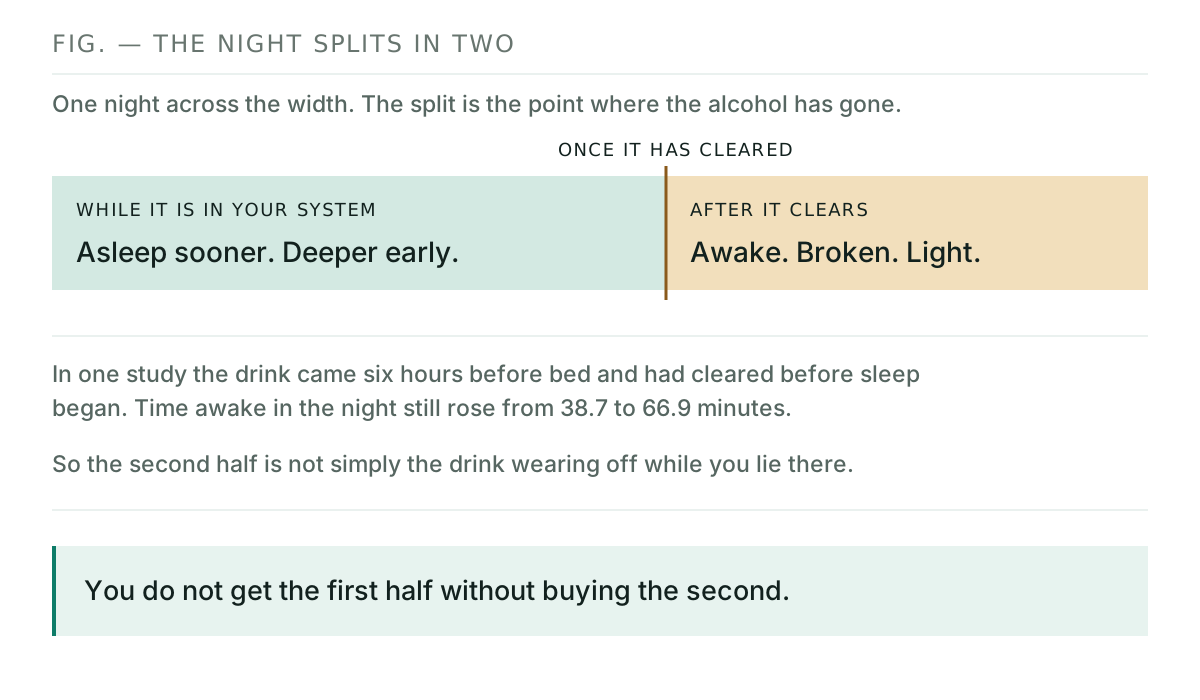
The most useful experiment in this literature is the one that removed the obvious objection. Instead of a drink at bedtime, subjects drank in the afternoon, six hours before bed, and the alcohol had fallen to zero before they fell asleep. If the trouble with a nightcap were simply that the alcohol is still in you at lights out, this design should have shown nothing at all.
For falling asleep, it showed nothing: no difference in how long subjects took to get to sleep, which is what you would expect with none left. But the time spent awake during the night rose from 38.7 minutes to 66.9 minutes, and the 2019 review in Neuropsychopharmacology that collects these studies notes the effect was maximal later in the night.
38.7 minutes awake in the night without it. 66.9 minutes with it — taken six hours before bed and cleared from the blood before sleep even began. Neuropsychopharmacology, 2019
That is the finding worth holding on to, because it survives both of the things men say when this comes up. It is not about being drunk at bedtime, and it is not about drinking a lot. It is about what alcohol does to the rest of the night after it has left.
The night splits in two
The same review describes the pattern behind that result, and it is unusually clean for sleep research. The night does not get uniformly worse after a drink. It gets better and then worse, in that order, and the worse part is the part you are conscious for. That sequence is why the habit is so hard to argue anyone out of.
| Across one night with alcohol | First half | Second half |
|---|---|---|
| Time awake after falling asleep | Tends to decrease | Increases |
| Deep slow-wave sleep | Increases | Deteriorates |
| REM sleep | Modest decrease | Modest rebound |
| What you actually experience | Nothing — you are asleep | Lying awake, and remembering it |
Read the last row again, because it explains the whole misunderstanding. Every column that favours the drink lands in hours you have no access to. Every column that counts against it lands in hours you are awake for and will describe to someone the next morning — except that almost nobody connects the two.
The nightcap does not fail. It succeeds for four hours and then hands the bill to the rest of the night.
What is left once it has gone
The intuitive explanation is that the sedative wears off partway through the night, leaving a nervous system that had been held down and is suddenly no longer being held down. That is the version most articles give, and it is probably part of the story. But the six-hour study above shows it cannot be all of it, because there the alcohol had gone before sleep even started and the second half was still worse.
We are being careful here deliberately. The review describes the pattern reliably and repeatedly across studies. The mechanism behind the pattern is less settled than the pattern itself, and a page that hands you a confident explanation is going further than the evidence does.
What the pattern means for you is straightforward enough regardless. And if the description sounds familiar, it should: it is the same window covered in waking at 3 a.m. and not being able to get back to sleep, where the second half of the night is already fragile after 40. Alcohol does not create that vulnerability. It arrives precisely where it is worst.
The REM claim, and how much of it holds up
You will read almost everywhere that alcohol destroys REM sleep, usually stated without qualification and often as the main reason to stop drinking in the evening. The honest version is smaller than that, and we are going to give you the smaller version, because the strong claim in this subject is somewhere else entirely.
The 2019 review states that intoxicating doses do not suppress REM sleep — they produce a modest decrease, with some modest rebound compensation later in the night. Real, measurable, and considerably less dramatic than the version that gets repeated.
We are pointing this out because a site that overstates the easy case has no credibility left for the hard one. The strong claim in this subject is not REM. It is the second half of the night, and that one holds up.
The part that matters if you snore
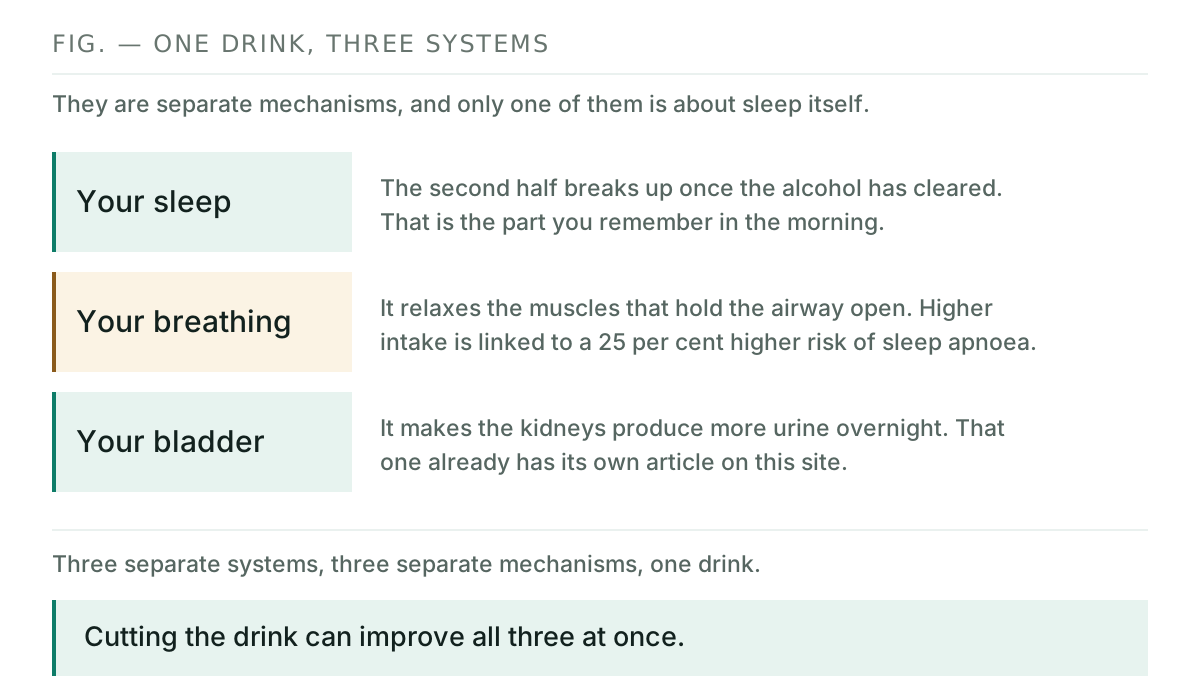
Alcohol relaxes muscle, and that includes the muscles holding the upper airway open while you sleep. For a man who already snores, or whose partner has mentioned pauses in his breathing, that is not a neutral fact about a nightcap — it is a drink acting directly on the part of him that is already the problem.
A 2018 meta-analysis in Sleep Medicine pooled 21 studies and found higher alcohol consumption associated with a 25 per cent higher risk of sleep apnoea (relative risk 1.25). The authors concluded this supports reducing alcohol intake as being of potential therapeutic and preventive value.
They were also candid about the limits, and so are we: they reported evidence of publication bias and low methodological quality in the included studies, and fewer than half adjusted for confounders. Treat 25 per cent as a signal pointing in a direction, not as a settled figure.
If you snore, or someone has told you that you stop breathing, the article to read next is what separates snoring from sleep apnea. Cutting the evening drink is one of the few levers you can pull tonight without seeing anyone.
And the part that sends you to the bathroom
There is a third mechanism, and it is the one readers of this site notice long before they notice anything about sleep architecture: alcohol increases how much urine your body produces overnight. For a man already making two or three trips a night, that is the most immediate and most obvious of the three effects on this page.
We are not going to cover that here, because it already has its own home. The mechanism, the reason beer is worse than the same alcohol in a smaller glass, and what to do about the timing are all in foods and drinks that make prostate symptoms worse and in why you wake up three times a night to pee.
The point worth making on this page is that these are separate mechanisms. A man who drinks in the evening may be woken by a rebound in his nervous system, or by his bladder, or by his airway — and which one it is changes what he should do about it. Working out which of those actually woke you is the subject of nocturia or insomnia: which one woke you.
Does it stop working if you drink every night?
The common claim is that the sedative effect fades within days of nightly use, leaving a drinker with all of the harm and none of the benefit. It is a tidy story and it is the one most articles tell. The review that collects the repeated-night studies is more careful than that, and the careful version is worth having.
In repeated-night studies, the reduction in time taken to fall asleep held across all three consecutive drinking nights, with no clear evidence of adaptation over that span.
Three nights is a short experiment and it does not tell you what months of nightly drinking do. But it does mean the tidy story — that the benefit disappears within days while the harm remains — is not what this particular evidence shows. The more defensible statement is simpler: the front-of-night benefit was small to begin with.
Does drinking earlier fix it?
This is the advice everyone gives, and the evidence above is awkward for it. In that study the drink came six hours before bed and had cleared completely from the blood before sleep began — a bigger gap than almost anyone actually leaves. The second half of the night was still measurably worse. So the tidy version of this advice does not hold.
The honest answer is that earlier is better than later, and earlier is not a free pass. Moving the drink away from bedtime removes the part of the effect that depends on alcohol still being in you at lights out, and that part is real. It does not appear to remove all of it.
Moving the same drink to dinner rather than the last hour before bed is worth doing, and it is the version people actually keep. Just do not expect it to buy the whole night back — the one study designed to test exactly that found it did not.
Why it is not a substitute for treating the problem
A nightcap used occasionally, for pleasure, is one thing. A nightcap used because you cannot sleep is a treatment decision, whether or not it was ever framed as one, and it is worth saying that out loud. Once a drink is doing a job, it is fair to ask how it compares with the things designed for that job.
Long-term insomnia has a first-line treatment in the guidelines, and it is behavioural rather than chemical — set out in the insomnia treatment that works better than pills. Even prescription sleeping medication, which is at least designed for the job, is meant as a bridge of a few weeks rather than a nightly habit, as covered in what each kind of sleeping pill actually does.
A drink is not designed for the job at all. It is being asked to do something it does for four hours and then undoes.
What a fair verdict looks like
Not abstinence, and not permission. Something more useful than either, because both of those answers let you stop thinking. The gain from a drink is real and it is small. The cost is real and it lands where you will feel it. Whether that trade is worth making is a question about your night, not a question about your character.
The gain is real and small: a few minutes, plus some deeper sleep early. The cost is real and lands where you will feel it: a broken second half, a worse airway if yours is already marginal, and more urine to deal with overnight. Whether that trade is worth it is a question about your night, not a moral one.
The honest test takes two weeks and costs nothing. Keep the drinking the same but move it four hours earlier for a fortnight, and note two things each morning: roughly what time you woke in the night, and how the following afternoon went. If nothing changes, you have learned something real about your own sleep. If the second half of your night settles down, you have found a lever that no one had to prescribe you.
And if the nights stay broken with the drink moved or removed entirely, then alcohol was not the problem — which is worth knowing, because it points at the five separate problems behind “I slept badly” instead of at the fridge.
Key takeaways
- A drink taken six hours before bed, cleared before sleep began, still raised time awake in the night from 38.7 to 66.9 minutes.
- The night splits: less wakefulness and more deep sleep in the first half, more wakefulness in the second.
- The effect does not depend on alcohol still being in you at lights out, which is why drinking earlier only partly helps.
- The REM claim is overstated. Reviews describe a modest decrease with modest rebound, not suppression.
- Higher intake is linked to a 25 per cent higher risk of sleep apnoea — a signal, with publication bias flagged by the authors.
- Sleep, breathing and bladder are three separate mechanisms; one drink touches all three.
- Moving the drink to dinner rather than bedtime is still the change that costs least — it just does not buy the whole night back.
Where to go from here
Depending on which of the three mechanisms is actually breaking your night:
- Waking at 3 a.m. and Cannot Get Back to Sleep — the window the rebound lands in, and why it is already fragile after 40.
- Snoring or Sleep Apnea? What Separates Them — if the airway is the part alcohol is making worse.
- Nocturia or Insomnia: Which One Woke You? — how to tell whether the bladder is really what woke you.
- Sleeping Pills: What Each Kind Actually Does — if a drink has quietly become a treatment.
- The Insomnia Treatment That Works Better Than Pills — what guidelines put first for long-term insomnia.
Frequently asked questions
Does alcohol help you sleep?
It helps you fall asleep. What it costs is the rest of the night: in one study where subjects drank six hours before bed and the alcohol had cleared before sleep began, time awake during the night still rose from 38.7 to 66.9 minutes, with the effect worst later on.
Why do I wake up at 3 a.m. after drinking?
Because the second half of the night is where alcohol reliably costs you. Reviews find time awake after falling asleep tends to fall in the first half of the night and rise in the second. After 40 that half is already the fragile one, so the two effects land together.
How many hours before bed should you stop drinking?
Earlier is better than later, but earlier is not a free pass. In the study that tested this directly, subjects drank six hours before bed and the alcohol had gone before they fell asleep, and the second half of the night was still worse. Moving the drink helps; it does not undo it.
Does alcohol destroy REM sleep?
The claim is stronger than the evidence. A 2019 review in Neuropsychopharmacology reports that intoxicating doses produce a modest decrease in REM sleep rather than suppressing it, with modest rebound later in the night. Real, but smaller than the popular version.
Does alcohol make sleep apnea worse?
A 2018 meta-analysis in Sleep Medicine pooled 21 studies and found higher alcohol consumption associated with a 25 per cent higher risk of sleep apnoea. Its authors flagged publication bias and low study quality, so treat it as a signal rather than a settled number.
Do you get used to it if you drink every night?
Not as fast as commonly claimed. In repeated-night studies the reduction in time to fall asleep held across three consecutive drinking nights with no clear evidence of adaptation. Three nights is short, so this says little about months of nightly drinking.
Sources
- Neuropsychopharmacology, 2019 — Alcohol use disorder and sleep disturbances: a feed-forward allostatic framework
- Sleep Medicine, 2018 — Alcohol and the risk of sleep apnoea: a systematic review and meta-analysis
- National Heart, Lung, and Blood Institute (NIH) — Insomnia — Treatment
- National Institute on Aging (NIH) — Sleep and Older Adults
- MedlinePlus (National Library of Medicine) — Healthy Sleep
- NHS — Insomnia

Male Health Guide Editorial Team
We write about the health problems men over 40 actually search for at 3 a.m. — and we say plainly when the evidence for a popular product is thin. We do not invent credentials and we do not publish sponsored copy as editorial. Read more about how we work.
Medical disclaimer: This article is general information about how alcohol affects sleep and is not medical advice. It is not guidance on how much anyone should drink, and it does not address alcohol dependence, which is a separate matter and one to raise with a doctor rather than a website. Nothing here diagnoses or treats any condition. Please speak to a qualified healthcare professional about your own situation.