Why Do I Wake Up 3 Times a Night to Pee?
Short answer
Waking up to pee at night more than once is called nocturia, and after 40 it usually has a cause beyond drinking late. The three most common drivers in men are an enlarged prostate, nocturnal polyuria — your body making too much urine overnight — and untreated sleep apnea. Often more than one is involved.
There is a particular kind of tiredness that comes from never sleeping more than two hours in a row. Men who are waking up to pee at night — twice, three times, sometimes more — know it well. It is not the tiredness of a late night. It is the tiredness of a man who technically spent eight hours in bed and still cannot get through the afternoon without his eyes closing.
Most men who end up searching for this have already tried the obvious fix. They stopped drinking water after eight o'clock. It helped a little, or not at all, and the trips kept happening. That is usually the point where the question changes from how do I stop this to what is actually going on with me.
This guide answers the second question honestly, including the parts the supplement ads leave out. It is part of our complete guide to an enlarged prostate after 40, which covers the wider picture.
How many times a night is actually normal?
Waking once a night is common at any age and is rarely a medical concern on its own. The International Continence Society defines nocturia as waking to urinate one or more times, but most clinicians treat two or more nightly episodes as the point where it becomes worth investigating — particularly when your sleep quality drops with it.
The number itself matters less than two other things: whether the pattern changed, and whether it is costing you daytime function. A man who has woken once a night for twenty years is in a different situation from a man who went from zero to three trips over six months.
Benign prostatic hyperplasia — non-cancerous prostate enlargement — becomes progressively more common with age, affecting roughly half of men by their sixties and the large majority of men by their eighties.
National Institute of Diabetes and Digestive and Kidney Diseases (NIDDK), National Institutes of HealthThat statistic is worth sitting with, because it reframes the problem. Prostate enlargement is not an unusual misfortune. It is closer to grey hair: a near-universal feature of male ageing that causes real trouble in some men and almost none in others.
Why does this start happening to men after 40?
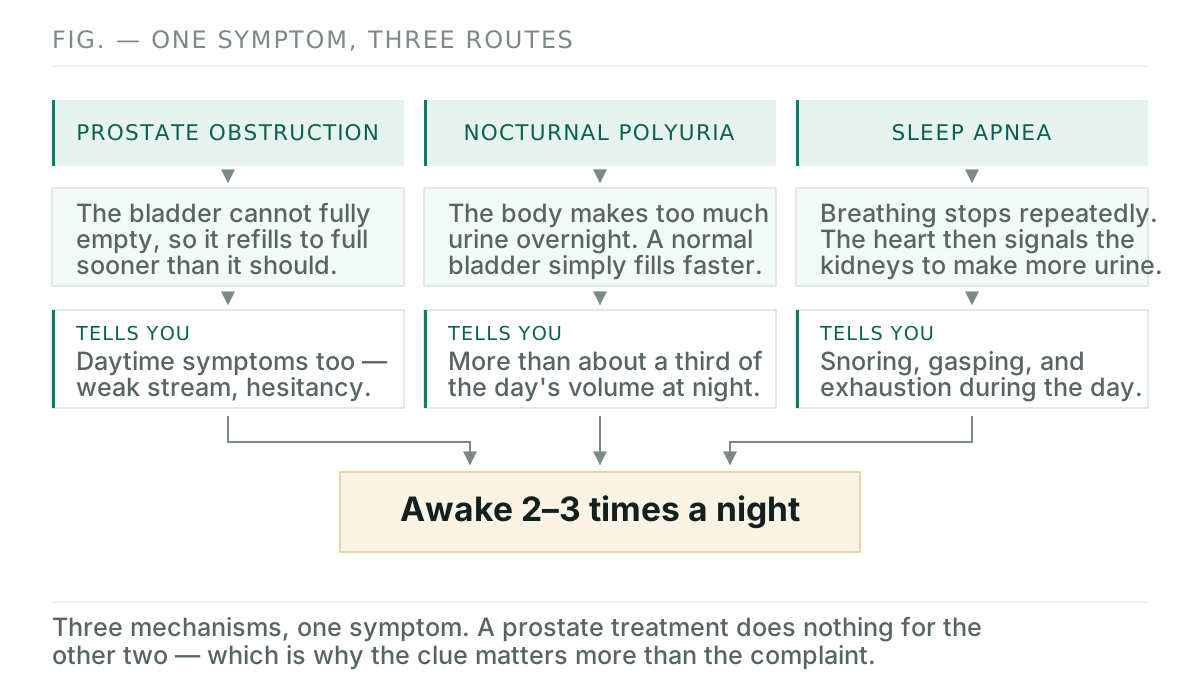
Three changes tend to arrive together in midlife. The prostate slowly enlarges and presses on the urethra. The bladder muscle becomes less elastic and holds less. And the hormonal signal that concentrates urine overnight weakens, so the kidneys keep producing while you sleep.
Any one of these alone might not wake you. Stacked together, they cross a threshold. This is why the problem so often seems to appear suddenly after years of nothing — nothing changed dramatically, you simply crossed the line where the combination became enough to interrupt sleep.
The prostate side
When the prostate presses on the urethra, the bladder has to work harder to push urine out. Over time it does not empty completely, so it refills to its trigger point faster. Functionally, your bladder has become smaller — not because it shrank, but because it never started from empty. That is the mechanism behind the feeling that you never fully empty your bladder, and it often shows up alongside a weakening urine stream.
The overnight urine side
Your body normally releases antidiuretic hormone at night, telling the kidneys to concentrate urine so you can sleep through. That rhythm flattens with age. When more than about a third of your total daily urine output happens overnight, doctors call it nocturnal polyuria — and it is a genuinely different problem from a prostate problem, even though it produces the identical symptom.
A prostate treatment will not help nocturnal polyuria, and a fluid-timing change will not help an obstructed urethra. Men who try one remedy, get no result and conclude that "nothing works" have often simply been treating the wrong mechanism. Finding out which one you have is the whole game.
Is it my prostate, or is my body making too much urine?
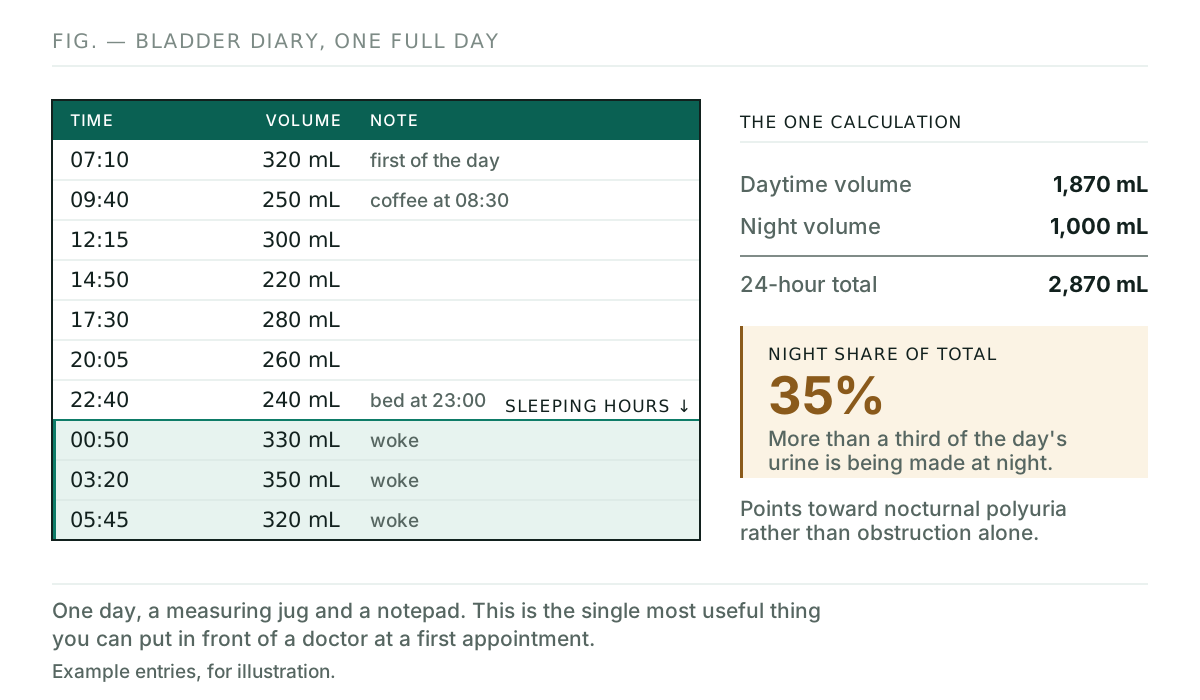
You can get a useful signal at home before you ever see a doctor. Measure and record every urine output for 24 hours, noting the time. If more than roughly a third of your total volume happens during your sleeping hours, that points toward nocturnal polyuria rather than obstruction alone.
Urologists call this a bladder diary or frequency-volume chart, and it is the single most useful thing you can bring to a first appointment. It costs nothing, takes one day, and turns a vague complaint into data your doctor can act on.
One thing the diary cannot tell you on its own is whether the bladder is what woke you in the first place. Getting up for another reason and going while you are already awake looks identical on the chart, and it points at a different specialist entirely. If that sounds like your nights, read do you wake up to pee, or wake up and then pee before working through the mechanisms below — it adds the one column that separates them.
The pattern usually separates like this:
| What you notice | Points toward | What tends to help |
|---|---|---|
| Small volumes each trip, weak stream, straining, dribbling at the end | Prostate obstruction (BPH) | Medical evaluation; prescription options; bladder training |
| Large volumes each trip, normal stream, mostly at night | Nocturnal polyuria | Fluid timing, reviewing diuretic timing, leg elevation, medical workup |
| Snoring, gasping, morning headache, daytime sleepiness | Obstructive sleep apnea | Sleep study; treating the apnea itself |
| Swollen ankles that flatten overnight | Fluid redistribution (leg oedema) | Elevating legs before bed; cardiac and kidney review |
| Constant thirst, unexplained weight change | Blood sugar problems | Prompt medical testing — do not wait |
Can sleep apnea really make you wake up to pee?
Yes, and it is one of the most commonly missed explanations. When breathing repeatedly stops during sleep, pressure changes inside the chest stretch the heart wall, which releases a hormone that tells the kidneys to produce more urine. The bathroom trip is a downstream symptom of a breathing problem.
This is worth taking seriously for a reason beyond sleep. Untreated obstructive sleep apnea is associated with cardiovascular risk, so the night-time urination may be the cheapest early warning you will get. If you snore heavily, wake unrefreshed, or your partner has noticed you stop breathing, mention it — even if you came in about your bladder.
Which medications and habits make it worse?
Several ordinary things push urine production into the night. Diuretics taken in the afternoon, alcohol in the evening, caffeine after mid-afternoon, and large fluid volumes in the last two hours before bed are the four most common. None of these cause nocturia alone, but each lowers the threshold.
The practical adjustments worth trying for two weeks:
- Move fluids earlier. Front-load your water intake before dinner rather than cutting total intake — dehydration creates its own problems.
- Ask about diuretic timing. If you take a water pill for blood pressure, ask your doctor whether taking it earlier in the day is appropriate. Do not change prescription timing on your own.
- Stop alcohol three hours before bed. Alcohol suppresses the hormone that concentrates urine overnight and fragments sleep independently.
- Elevate your legs for an hour in the evening. If your ankles swell during the day, that fluid returns to circulation when you lie down. Moving it earlier can shift the load out of the night.
- Empty twice before bed. Urinate, wait a few minutes, then try again. It is crude, but it helps men whose bladders do not empty completely.
Never change the dose or timing of a prescribed medication — especially blood pressure medication — without talking to the prescriber. Some interactions between common cardiovascular drugs and over-the-counter supplements are poorly covered online, which is why we wrote a separate guide on prostate supplements and blood pressure medication.
Do prostate supplements stop night-time urination?
The honest answer is that the evidence is considerably weaker than the advertising. The most studied ingredient, saw palmetto, was examined in a Cochrane systematic review that concluded it did not improve urinary symptoms more than placebo at the doses tested. That is the strongest tier of evidence available.
This does not mean every man who takes one is imagining things, and it does not mean the category is worthless. It means you should treat "clinically proven" claims on a sales page with real suspicion, and you should know that most products in this category have never been tested as a complete formula — only their individual ingredients have, often at doses the label does not disclose.
Cochrane's systematic review of Serenoa repens (saw palmetto) for lower urinary tract symptoms found no improvement over placebo in urinary flow measures or symptom scores at the doses studied.
Cochrane Database of Systematic Reviews, Cochrane Urology GroupIf you still want to try one — and plenty of men reasonably do, given that the downside of a two-month trial is mostly financial — go in with a defined test period, a way to measure whether anything changed, and a clear refund path.
The useful question is not "does this product work?" but "what would have to be true for me to know it worked, and how long will I give it before I stop?"
When should you see a doctor?
Go promptly if you cannot urinate at all, see blood in your urine, have pain, burning or fever, or notice your pattern changed suddenly over weeks rather than years. These are not symptoms to research further online — they need examination.
Beyond those red flags, the practical trigger is simpler: if you are waking two or more times a night and it is affecting your sleep, mood, driving safety or work, that is reason enough. Nocturia is a normal thing to raise with a doctor, and it is often treatable once the mechanism is identified.
It is also worth knowing what this symptom does not automatically mean. Waking up to pee is a symptom of prostate enlargement far more often than of prostate cancer, and the two conditions are distinguished by examination and testing, not by symptoms alone. We cover that distinction carefully in BPH versus prostate cancer.
Key takeaways
- Waking more than once a night to pass urine is nocturia, and after 40 it usually has a cause beyond drinking late.
- Three different mechanisms produce the identical symptom: an enlarged prostate, the body making too much urine overnight, and untreated sleep apnea.
- They need different treatment, so the useful question is which one you have — not how to stop waking up.
- A bladder diary separates them, and it costs a sheet of paper and one night’s attention.
- More than one can be true at once, which is why treating only the prostate sometimes changes nothing.
Where to go from here
This article is one piece of a larger picture. If you are working out what is happening to you, these are the logical next steps:
- Enlarged Prostate After 40: Symptoms, Causes and What Actually Helps — the complete guide this article belongs to.
- Weak Urine Stream After 50: What It Means — if your flow has changed as well as your nights.
- Can't Fully Empty Your Bladder? What's Going On — the symptom that most often travels with nocturia.
- Saw Palmetto for Prostate: What the Cochrane Review Actually Found — the evidence, in full, without the marketing.
- How Long Do Prostate Supplements Take to Work? — if you have decided to trial one and want a realistic timeline.
- What Actually Happens at a Prostate Exam — the appointment described plainly, start to finish.
- Foods and Drinks That Make Prostate Symptoms Worse — the drink changes worth testing first, and why drinking less backfires.
Frequently asked questions
How many times a night is it normal to pee?
Waking once a night is common and usually not a concern. The International Continence Society considers any waking to void as nocturia, but doctors typically treat it as clinically meaningful at two or more times per night, especially when it disrupts your sleep or daytime energy.
Does waking up to pee always mean prostate problems?
No. An enlarged prostate is one common cause in men over 40, but it is not the only one. Nocturnal polyuria, sleep apnea, uncontrolled diabetes, heart or kidney conditions, evening fluid habits and certain medications all cause the same symptom, sometimes together.
Can drinking less water at night fix it?
Sometimes, but it rarely fixes it alone. Limiting fluids two to three hours before bed helps if evening drinking is the main driver. If your body produces most of its urine overnight, or if your bladder cannot empty fully, cutting water will not solve the underlying problem.
Do prostate supplements stop night-time urination?
The evidence is weaker than the marketing suggests. Cochrane's systematic review of saw palmetto found it performed no better than placebo for urinary symptoms at the doses studied. Some men report improvement, but no supplement has been shown to reliably stop nocturia.
Can sleep apnea cause you to wake up and pee?
Yes. Obstructive sleep apnea is a well documented and frequently missed cause of nocturia. Interrupted breathing changes pressure inside the chest, which triggers hormonal signals that increase urine production overnight. Treating the apnea often reduces night-time bathroom trips.
When should I see a doctor about waking up to pee?
See a doctor if you cannot urinate, see blood in your urine, have pain, burning or fever, or notice a sudden change in your pattern. Also go if you wake two or more times nightly and it is affecting your sleep, mood or daytime function.
Sources
- National Institute of Diabetes and Digestive and Kidney Diseases (NIH) — Prostate Enlargement (Benign Prostatic Hyperplasia)
- Mayo Clinic — Benign prostatic hyperplasia (BPH): symptoms and causes
- Cleveland Clinic — Nocturia: causes, evaluation and management
- Cochrane Library — Serenoa repens for benign prostatic hyperplasia
- Urology Care Foundation (American Urological Association) — Nocturia patient information

Male Health Guide Editorial Team
We write about the health problems men over 40 actually search for at 3 a.m. — and we say plainly when the evidence for a popular product is thin. We do not invent credentials and we do not publish sponsored copy as editorial. Read more about how we work.
Medical disclaimer: This article is for general information only. We are not doctors, and nothing here diagnoses, treats or cures any condition. Nocturia can be a symptom of serious conditions including diabetes, heart failure and kidney disease. Please speak to a qualified healthcare professional about your own situation, and never start, stop or change a prescribed medication based on what you read online.