Saw Palmetto for Prostate: What the Cochrane Review Actually Found

Short answer
Cochrane's systematic review of saw palmetto for benign prostatic hyperplasia found it was no better than placebo for urinary symptoms or flow rate, including at double and triple the standard dose. Earlier positive findings came from smaller, weaker trials that larger, better-designed studies did not confirm.
Saw palmetto is in almost every prostate supplement on the market. It is the ingredient the label leads with, the one the advertorial calls "clinically studied", and the reason many men believe they are buying something evidence-based.
It has in fact been studied a great deal. That is exactly the problem for the marketing — because when you read what those studies found, the picture is not the one the bottle implies.
This article goes through the actual evidence: what Cochrane concluded, what the two largest independent trials found, why the early research disagreed, and why plenty of honest men still report that it helped them. It is part of our complete guide to an enlarged prostate after 40.
What does the Cochrane review actually say?
Cochrane reviews sit at the top of the evidence hierarchy because they pool all the randomised trials on a question and weigh them by quality rather than by headline. Its review of Serenoa repens — saw palmetto — for benign prostatic hyperplasia concluded the supplement did not outperform placebo on urinary symptoms or flow measures.
Two details in that conclusion matter more than the headline. The review covered dozens of trials and thousands of men, so this is not a single disappointing study. And the finding held at double and triple the usual dose, which removes the most common defence of a failed supplement — that people simply were not taking enough.
Cochrane's review of Serenoa repens for benign prostatic hyperplasia found no improvement over placebo in urinary symptom scores or peak urine flow, with the result holding at doses up to three times the standard amount.
Cochrane Database of Systematic Reviews — Serenoa repens for benign prostatic hyperplasiaWhy did earlier studies say it worked?
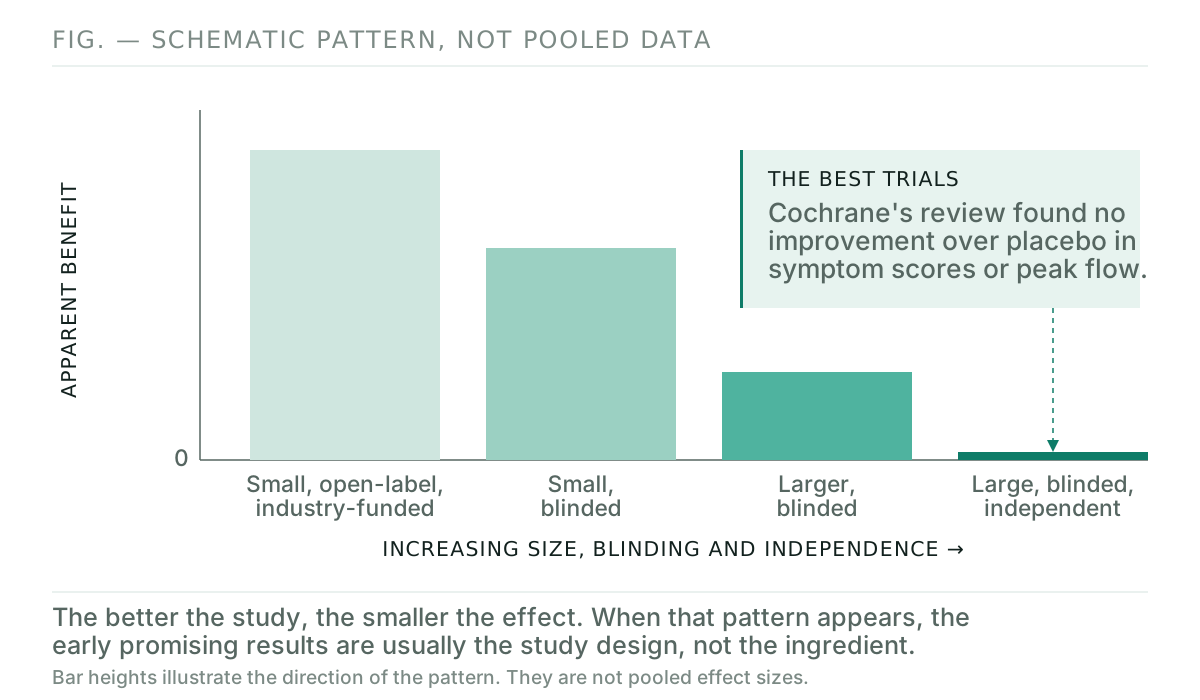
Because the early evidence base was mostly small, short and poorly controlled — and weak studies systematically overstate benefit. Earlier versions of the same Cochrane review were more favorable. As larger and better-designed trials were added, the apparent effect shrank and then disappeared entirely.
This is worth understanding properly, because it is the mechanism behind almost every "clinically proven" claim you will read on a supplement page. A study can be real, published, and peer-reviewed, and still be too small or too brief to detect the difference between a genuine effect and noise.
Three flaws recur in the early saw palmetto literature:
- Too few participants. Trials with dozens of men produce results that swing wildly by chance.
- Too short. Prostate symptoms fluctuate over months. A four-week study measures weather, not climate.
- Weak blinding and industry funding. When participants or researchers can guess who got what, expectation leaks into the results.
The phrase means a study exists. It does not mean the study was large, long, independent, or positive — and it certainly does not mean the finished product was tested. Most formulas have never been trialled as a complete blend; only their ingredients have, often at doses the label does not disclose.
What did the two largest independent trials find?
Two American trials are usually treated as the most rigorous tests of saw palmetto, and both were funded independently rather than by supplement manufacturers. Both compared it against placebo in men with moderate symptoms, and neither found a meaningful advantage for the supplement.
| Trial | Design | Result |
|---|---|---|
| STEP trial New England Journal of Medicine, 2006 |
Randomised, double-blind, placebo-controlled; 225 men; one year | No significant difference from placebo in symptom score or flow rate |
| CAMUS trial JAMA, 2011 |
Randomised, double-blind, placebo-controlled; 369 men; escalating doses up to three times standard | No significant difference from placebo at any dose tested |
The CAMUS design is the one that closes the argument. Researchers deliberately escalated the dose specifically to test whether higher amounts would work. They did not. There is no remaining "but you have to take more of it" position to fall back on.
If it doesn't work, why do so many men say it helped?
Because two powerful effects are at work, and neither requires anyone to be lying. Placebo response in prostate symptom trials is unusually strong — men in placebo arms routinely report real, measurable improvement. And urinary symptoms fluctuate naturally over weeks and months on their own.
Add to that the timing of when men start. Almost nobody buys a prostate supplement during a good month. They buy it during a bad stretch — which is, statistically, the point from which things were most likely to improve anyway.
A man who felt worse in March, bought capsules in April and felt better in May has experienced something completely real. What he cannot know, from the inside, is whether the capsules caused it.
This is not a reason to dismiss anyone's experience. It is a reason to be careful about drawing conclusions from it — including your own — and to measure with a symptom score rather than a memory if you decide to try something.
Is saw palmetto safe?
Broadly yes, on the available evidence. Across trials it was generally well tolerated, with side effect rates similar to placebo and complaints that were mostly mild and digestive. Ineffective is not the same as dangerous, and saw palmetto's safety record is one of the better ones in this category.
The caution most often raised concerns blood-thinning medication, because of a possible effect on bleeding. If you take an anticoagulant, an antiplatelet drug or daily aspirin, that is a conversation to have before starting. Interactions with other common prescriptions are covered in prostate supplements and blood pressure medication.
Do other prostate ingredients have better evidence?
Some do, though the bar is low. Beta-sitosterol and pygeum both have older systematic reviews suggesting improvement in urinary symptoms — a more favorable picture than saw palmetto's. The important caveat is that those trials were small and short, and have not been repeated at the standard the large saw palmetto trials set.
In other words, they may be in the position saw palmetto was in twenty years ago: promising on weak evidence, untested at scale. That is genuinely different from "disproven", and it is also genuinely different from "proven". Anyone telling you otherwise in either direction is overselling.
None of this makes supplements a substitute for assessment. Urinary symptoms can have causes that need medical attention, and prescription treatments for an enlarged prostate have evidence that no supplement in this category comes close to. Trialling a capsule instead of getting checked is the one genuinely risky choice here.
Should you take it anyway?
That can be a reasonable personal decision, and plenty of informed men make it. The downside of a two-month trial is mostly financial, the safety profile is acceptable for most people, and a strong placebo response still produces real relief. What matters is going in with accurate expectations rather than manufactured ones.
If you do, these four rules make the experiment worth something:
- Set the period before you start. Eight to twelve weeks, decided in advance, so you are not renewing indefinitely on hope.
- Measure with a symptom score, not a feeling. Use the same seven-question questionnaire your doctor uses, at the start and at the end.
- Check interactions first. Take the ingredient panel to a pharmacist before the first capsule, not after.
- Confirm the refund terms in writing. Know the window, the process and who to email, before you pay.
How long to run the trial is covered in how long prostate supplements take to work.
What is actually in the bottle you buy?
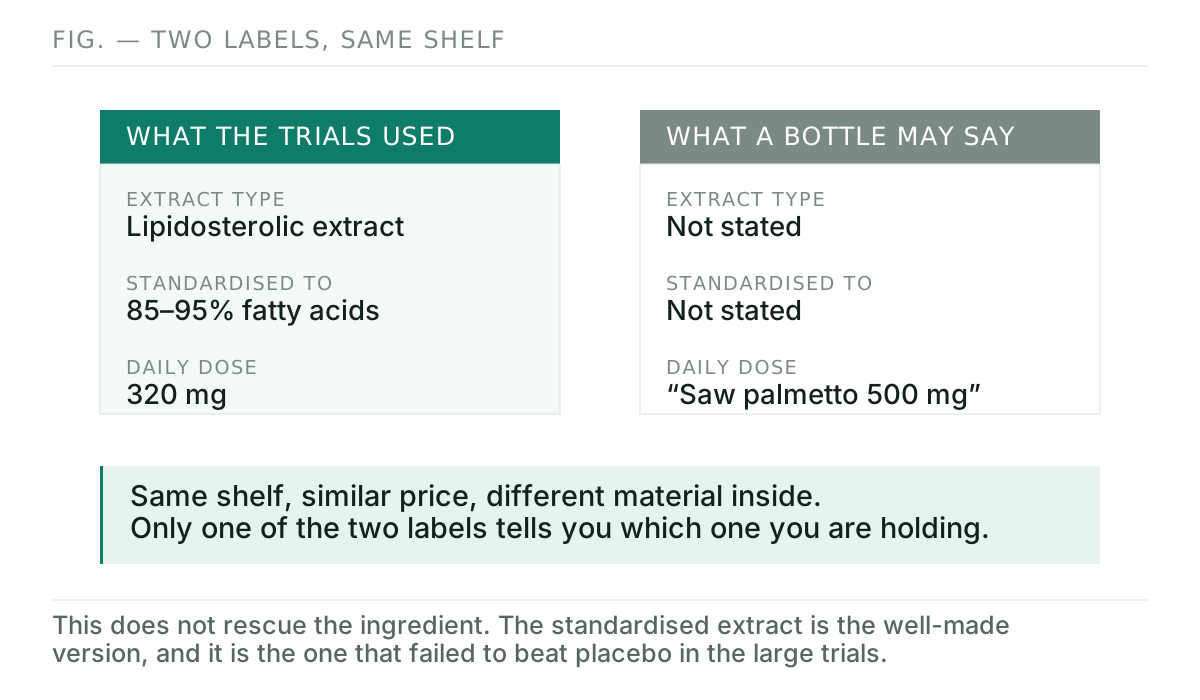
Often not the same preparation the trials tested. The large studies used a standardised extract, concentrated for its fatty acid content and dosed at 320 mg a day. A retail bottle may contain that, or it may contain dried berry powder, which is a different material at a different strength.
This matters when you read a label, and it matters less than you would hope. The obvious thought is that the trials tested a weak version and the good stuff was never assessed. The evidence points the other way: the standardised extract is the well-made version, and it is the one that failed to beat placebo. A cheaper preparation of the same plant has no reason to do better.
Where it does matter is comparison. Two bottles on the same shelf, at the same price, can contain materially different things, and only one of them will tell you which. A label that names the extract and states the standardisation is being straight with you. A label that says only "saw palmetto 500 mg" is not telling you what the 500 mg is.
The CAMUS trial tested a standardised saw palmetto extract at 320 mg a day, then escalated to 640 mg and 960 mg. No dose produced a greater reduction in urinary symptom scores than placebo.
Barry M.J. et al., Journal of the American Medical Association — Complementary and Alternative Medicine for Urological Symptoms (CAMUS)Key takeaways
- The Cochrane review found saw palmetto no better than placebo for urinary symptom scores or peak flow.
- That held at double and triple the usual dose.
- Earlier positive results came from smaller, weaker trials — a pattern that repeats across medicine.
- Men who report benefit are not imagining it. Placebo response in these trials is strong and symptoms fluctuate on their own.
- Ineffective is not the same as dangerous. The safety record here is one of the better ones in this category.
Where to go from here
If you are deciding what to do about prostate symptoms, these are the next steps:
- Enlarged Prostate After 40: Symptoms, Causes and What Actually Helps — the complete guide, including treatments with real evidence behind them.
- Prostate Supplements and Blood Pressure Medication — essential if you take prescriptions.
- Why Do I Wake Up 3 Times a Night to Pee? — the symptom that sends most men here.
- How Long Do Prostate Supplements Take to Work? — running a trial that actually tells you something.
- Prostate Supplement Side Effects: What to Watch For — the safety picture in full.
- Prostate Medications: What Each One Actually Does — the two prescription classes, what each does and how fast.
Frequently asked questions
Does saw palmetto work for an enlarged prostate?
The best available evidence says no. Cochrane's systematic review of randomised trials concluded that saw palmetto did not improve urinary symptoms or flow measures more than placebo, including at double and triple the usual dose.
Why did older studies say saw palmetto worked?
Early trials were mostly small, short and methodologically weak, and weak studies tend to overstate benefit. As larger, longer and better-controlled trials were published and added to the review, the apparent benefit disappeared. That pattern is common in medicine.
If it doesn't work, why do men say it helped them?
Placebo response in prostate symptom trials is unusually strong, and symptoms naturally fluctuate. Men often start a supplement during a bad stretch, so improvement afterwards may reflect normal variation rather than the capsule. Both effects feel identical from the inside.
Is saw palmetto safe to take?
It is generally well tolerated in trials, with side effects broadly similar to placebo and mostly mild digestive complaints. The main caution raised concerns blood-thinning medication, because of a possible effect on bleeding. Discuss it with a pharmacist if you take prescriptions.
Do any prostate supplement ingredients have better evidence?
Beta-sitosterol and pygeum have older reviews suggesting symptom improvement, but those trials were small and short and have not been repeated at modern standards. The evidence is more favorable than saw palmetto's, yet still far weaker than for prescription treatment.
Should I take saw palmetto anyway?
That is a reasonable personal choice if you go in with accurate expectations. Set a defined trial period, track a symptom score rather than a feeling, check interactions with a pharmacist first, and confirm the refund terms before you buy anything.
Sources
- Cochrane Library — Serenoa repens for benign prostatic hyperplasia
- Bent S. et al. — Saw Palmetto for Benign Prostatic Hyperplasia (STEP trial), New England Journal of Medicine
- Barry M.J. et al. — Effect of Increasing Doses of Saw Palmetto Extract on Lower Urinary Tract Symptoms (CAMUS trial), JAMA
- National Center for Complementary and Integrative Health (NIH) — Saw Palmetto: what the science says
- National Institute of Diabetes and Digestive and Kidney Diseases (NIH) — Prostate Enlargement (Benign Prostatic Hyperplasia)

Male Health Guide Editorial Team
We write about the health problems men over 40 actually search for at 3 a.m. — and we say plainly when the evidence for a popular product is thin. We do not invent credentials and we do not publish sponsored copy as editorial. Read more about how we work.
Medical disclaimer: This article is general information, not medical advice. We are not doctors, and nothing here diagnoses, treats or cures any condition. Urinary symptoms can have causes that require medical attention. Please speak to a qualified healthcare professional about your own situation, and never start, stop or change a prescribed medication based on what you read online.