How Long Do Prostate Supplements Take to Work?
Short answer
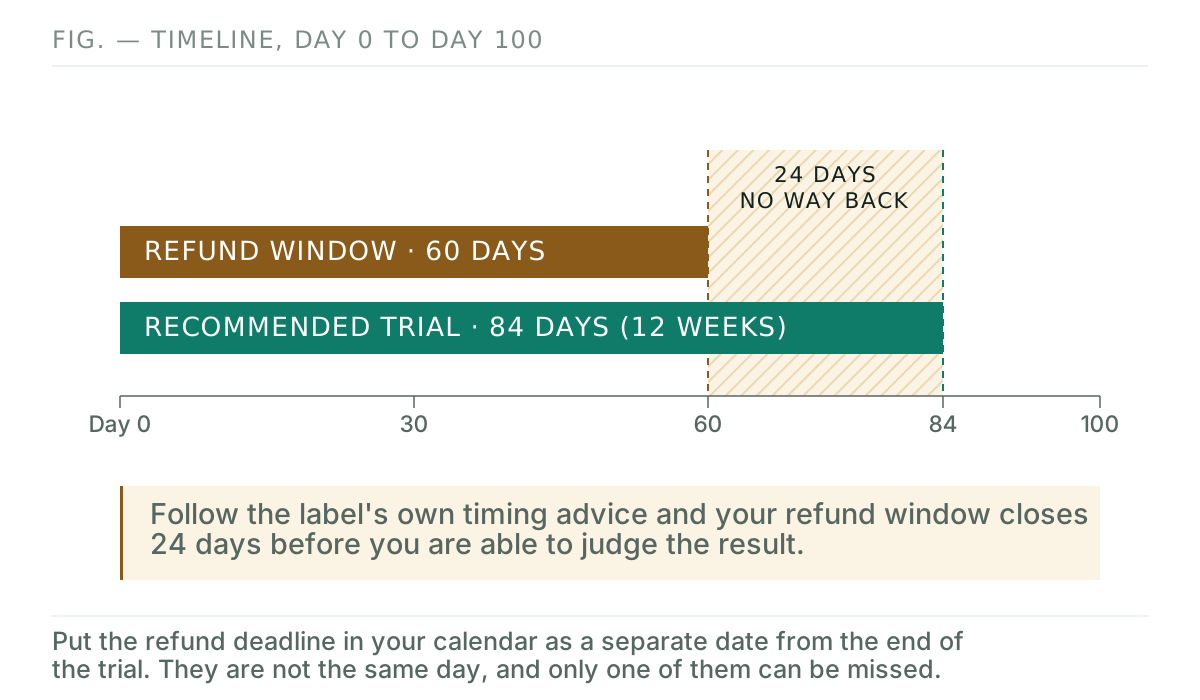
How long prostate supplements take to work depends on the label: most suggest eight to twelve weeks, matching the length used in clinical trials. The catch nobody mentions: a sixty-day money-back guarantee expires at day 60, while a twelve-week trial runs to day 84. Follow the label and your refund window closes first.
"How long do prostate supplements take to work?" is the question I asked with the bottle half empty and nothing different. I asked it twice, in fact — once for each product I bought — and both times I answered it the same way, which was to keep taking them and wait a bit longer.
That turned out to be the expensive answer. Not because the capsules cost much, but because "a bit longer" is precisely the interval in which the money stops being refundable.
The label says eight to twelve weeks. The forum says give it six months. The evidence says something less comfortable than either. And underneath all of it sits a piece of arithmetic that costs men real money every year — one that no review site seems willing to spell out.
This article covers all three: the honest timeline, how to tell whether anything is actually happening, and the refund trap built into the way these products are sold. It is part of our complete guide to an enlarged prostate after 40.
What timeline do the labels and the studies actually use?
Eight to twelve weeks is the standard answer, and it is not arbitrary — it reflects the length of the clinical trials in this field. Researchers chose that window because prostate symptoms fluctuate week to week, so shorter periods cannot separate a real change from ordinary variation.
The uncomfortable part is what those trials found inside that window. The largest and best-designed studies of saw palmetto, the dominant ingredient in the category, reported no advantage over placebo — not at four weeks, not at twelve, and not at a year. We go through that evidence in what the Cochrane review actually found on saw palmetto.
So the honest framing is not "how long until it works". It is "how long should I run the experiment before I decide". Those are different questions, and only the second one has a useful answer.
How fast do treatments with real evidence work?
The contrast is instructive. Prescription alpha blockers commonly relieve symptoms within days to a few weeks, because they relax muscle rather than shrink tissue. Drugs that genuinely reduce prostate size work over several months. Both produce effects large enough for trials to measure against placebo.
Seeing them side by side tells you what "working" is supposed to look like:
| Approach | Typical time to notice change | Evidence it beats placebo |
|---|---|---|
| Alpha blockers (prescription) | Days to a few weeks | Yes, well established |
| 5-alpha reductase inhibitors (prescription) | Three to six months | Yes, well established |
| Lifestyle and fluid timing | One to three weeks for night-time symptoms | Modest but real for nocturia |
| Saw palmetto supplements | Label says 8–12 weeks | No — large trials found none |
Notice the pattern. The treatments with proven effects also have specific, mechanistic timelines that make sense — muscle relaxation is fast, tissue shrinkage is slow. The vaguest timeline belongs to the option with the weakest evidence. That is not a coincidence.
Why does the refund window expire before the trial ends?
Because of simple arithmetic that works in the seller's favor. A sixty-day money-back guarantee ends on day 60. A twelve-week trial period, which is what the label recommends, ends on day 84. Follow the instructions on the bottle and your refund right expires twenty-four days before you can fairly judge the result.
This is the single most useful thing on this page, so it is worth stating plainly: the recommended trial period and the guarantee period are not aligned, and the gap is not in your favor.
Write two dates in your phone calendar. The first is day 50 — your decision point, safely inside a sixty-day guarantee. The second is the actual refund deadline, taken from the seller's own terms. At day 50 you decide: continue at your own cost, or claim the refund while you still can. Do not let the deadline pass by accident.
Some sellers do offer longer windows, and a few advertise 180 days. Verify it on the checkout page rather than the sales page, because the two do not always match — and pages published by affiliates frequently state the wrong figure.
I found out about the gap the way most people probably do, which is afterwards.
The truth is simpler and less flattering than any story I could tell about it: I never checked the deadline. I did not write it down, I did not look it up, and I did not think about it again until I had already decided the product had done nothing — by which point the window had closed. I did not lose a fortune. I lost the whole amount, which is a different thing, and I lost it to an administrative date I never gave five minutes of attention to.
How should you measure whether anything is happening?
With numbers, not memory. Use the seven-question symptom score urologists use, completed before your first capsule and again at the end. Add a simple tally of night-time bathroom trips. Eight weeks is far too long to judge by recollection, particularly when you are hoping for a result.
Three things worth recording, and they take under a minute a day:
- The symptom score, twice. Once at the start, once at your decision point. Same questionnaire both times.
- Night-time trips, every night. One number in a notes app. This is the symptom most men actually care about, and it is the easiest to count honestly.
- Anything else that changed. New medication, a holiday, a stressful stretch, a change in evening drinking. These confound your result and you will not remember them in week nine.
This log has a second use that outlasts the supplement. If you eventually see a urologist, eight weeks of nightly data is more useful than anything you could tell them from memory — and it is the kind of thing that gets you taken seriously quickly.
Here is what "a fair run" actually meant when I did it. I took the capsules. I noticed how I felt. At some point I decided it was not working, and I stopped.
Nowhere in that sequence is there a number. I never wrote anything down — not at the start, not at the end. I have written elsewhere on this site that neither product changed anything, and I still believe that. But the honest version of the sentence is weaker: nothing changed enough for me to notice it without looking. Whether something moved a little, I cannot say, because I had no way of measuring it and did not think to find one. I would not accept that standard of evidence about anything else, and I did not notice I was applying it until the editorial team here asked me what my score had been at the start.
What should you expect week by week?
Setting expectations in advance protects you from two mistakes: quitting at week two because nothing happened, and continuing to month six because you cannot admit it did not. A realistic map of the window looks like this.
Weeks 1 to 2
Expect nothing attributable to the supplement. Any change this early is more likely to come from the lifestyle adjustments most men make at the same time — moving fluids earlier, cutting evening alcohol. Those are worth doing regardless, and they are covered in why you wake up three times a night to pee.
Weeks 3 to 6
This is where placebo response typically shows up, and it is real relief even though the capsule did not cause it. It is also when side effects, if any, tend to appear. Keep logging, and resist drawing conclusions.
Weeks 7 to 8, and the decision point
Compare your two symptom scores. If nothing has moved, nothing is likely to move — continuing past this point is buying hope rather than testing a hypothesis. Check your refund deadline now, not later.
An experiment you never planned to end is not an experiment. It is a subscription.
Does a higher dose make it work faster?
No, at least not for the ingredient that dominates this category. A large randomised trial deliberately escalated saw palmetto to double and triple the standard dose specifically to test that idea, and found no benefit over placebo at any level. Higher doses also raise the likelihood of side effects.
Be particularly cautious about doubling up on your own if you take prescription medication. Several ingredients common in these blends affect blood pressure, and proprietary blends hide the doses — so "twice as much" is an unknown quantity of an unknown amount. That risk is covered in prostate supplements and blood pressure medication.
When should you stop and see a doctor instead?
Stop the experiment and seek assessment if symptoms worsen at any point, if you develop blood in your urine, pain, fever, or find you cannot urinate at all. Those are not results to log — they are reasons to be examined, and the last one is a medical emergency.
There is also a quieter reason to set a hard end date. Every month spent trialling capsules is a month not spent getting a diagnosis, and untreated obstruction can affect the bladder and kidneys over time. The supplement question is worth answering; it is just not worth answering slowly.
What happens when you stop?
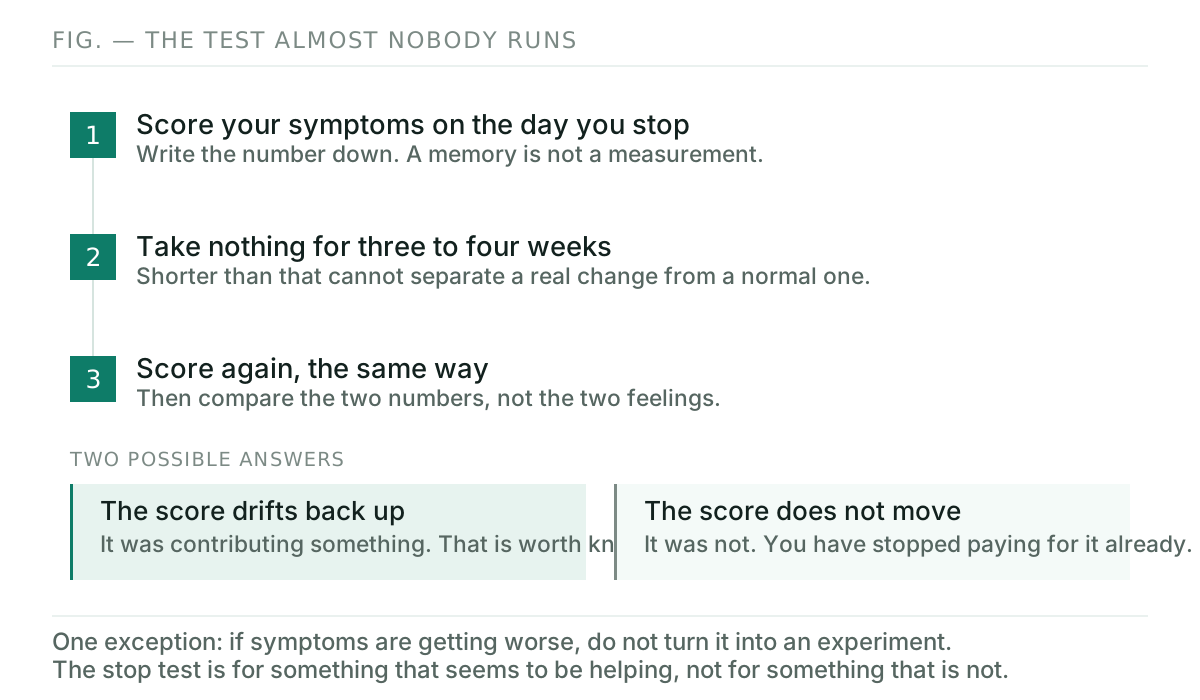
This is the test almost nobody runs, and it is the most informative one available to you. If a supplement is doing something, stopping it should let symptoms drift back over a few weeks. If nothing changes at all after stopping, you have your answer about what it was contributing.
Run it the same way you ran the trial. Score your symptoms on the day you stop, keep taking nothing for three to four weeks, then score again. Anything shorter is not long enough to distinguish a real change from an ordinary fluctuation, because these symptoms move around by themselves regardless of what you are taking.
Most men never find out, because they never stop. The bottle is on repeat, the symptoms are tolerable, and there is no moment that forces the question. Twelve months later there is still no evidence either way, and the money has gone out every month for a verdict that was never reached.
There is one situation where this does not apply: if your symptoms are worsening, do not turn it into an experiment. Get assessed. The stop test is for deciding whether to keep paying for something that seems to be helping — not for working out whether something that is getting worse needs attention.
I did not run this test. I stopped taking the second product and did not think about it again, which means I threw away the one piece of information the whole exercise could still have given me.
My impression is that nothing came back, because nothing had gone. Certainly nothing was cured. But that impression is worth exactly what the first one was worth — I was not measuring then either. If something had improved slightly and slipped away again over the following month, I would not have noticed, and I cannot now go back and check.
What I would do differently
Three things, and none of them is "do not buy the capsules".
- Write the number down first. Any of the standard symptom questionnaires, on the day you start. It takes five minutes and it is the difference between a trial and a hope.
- Put the refund deadline in the calendar, as a separate date from the end of the trial. They are different days. Only one of them can be missed.
- When you stop, keep paying attention for another month. That month is free, and it is the only part of the whole thing that would have told me anything.
Key takeaways
- Labels suggest eight to twelve weeks, matching the length used in clinical trials.
- A sixty-day guarantee expires at day 60. A twelve-week trial runs to day 84. Follow the label and the refund window closes first.
- Put the refund deadline in your calendar as a separate date from the end of the trial.
- A higher dose does not make it work faster.
- Stopping is a test in itself. If nothing changes after three or four weeks off, it was not doing anything.
Where to go from here
If you are running a trial or deciding whether to start one, these go deeper:
- Enlarged Prostate After 40: Symptoms, Causes and What Actually Helps — the complete guide, including treatments with real evidence.
- Saw Palmetto for Prostate: What the Cochrane Review Actually Found — whether the main ingredient does anything at all.
- Prostate Supplements and Blood Pressure Medication — check this before your first capsule.
- Why Do I Wake Up 3 Times a Night to Pee? — the symptom most men are trying to fix.
- Prostate Supplement Side Effects: What to Watch For — what to log during the trial.
Frequently asked questions
How long do prostate supplements take to work?
Most labels suggest eight to twelve weeks, which matches the length used in clinical trials. Be aware that the best trials found no benefit over placebo at any point in that window, so the honest framing is a trial period rather than a waiting period.
Why do refund windows expire before the trial period ends?
Because a 60-day guarantee is shorter than a 12-week trial, which runs to 84 days. Follow the label's own timing advice and your refund window closes before you can judge the result. Diarise the refund deadline separately from the trial end date.
How quickly do prescription treatments work by comparison?
Alpha blockers typically relieve symptoms within days to a few weeks because they relax muscle rather than shrink tissue. Drugs that actually reduce prostate size work over several months. Both have effects that clinical trials could measure against placebo.
How should I measure whether a supplement is working?
Use the same seven-question symptom score urologists use, completed before you start and again at the end. Add a simple count of night-time bathroom trips. Memory is unreliable over eight weeks, especially when you are hoping for a result.
Should I stop if nothing has changed after four weeks?
Not necessarily on effectiveness grounds, but four weeks is a sensible moment to check your refund deadline. If the guarantee expires before your planned end date, decide then whether to continue at your own cost or claim while you still can.
Does taking a higher dose make it work faster?
There is no evidence for this with saw palmetto. A large randomised trial deliberately escalated doses to twice and three times the standard amount and found no benefit over placebo at any level. Higher doses also raise the chance of side effects.
Sources
- Cochrane Library — Serenoa repens for benign prostatic hyperplasia
- Barry M.J. et al. — Effect of Increasing Doses of Saw Palmetto Extract on Lower Urinary Tract Symptoms (CAMUS trial), JAMA
- Urology Care Foundation (American Urological Association) — Benign Prostatic Hyperplasia (BPH)
- Mayo Clinic — Benign prostatic hyperplasia: diagnosis and treatment
- U.S. Federal Trade Commission — Free trial offers and refund rights

Ray H.
Ray H. is a pen name. He is a real contributor in his sixties writing from his own experience, and he asked us not to publish his name or photograph — for exactly the reasons this site exists. He is not a doctor and does not give medical advice. His articles are fact-checked by our editorial team. Read why we publish him this way.
Medical disclaimer: This article is general information, not medical advice. We are not doctors, and nothing here diagnoses, treats or cures any condition. Urinary symptoms can have causes that require medical attention. Please speak to a qualified healthcare professional about your own situation, and never start, stop or change a prescribed medication based on what you read online.