High Blood Sugar (Hyperglycemia): Signs, Causes, When to Act
Short answer
High blood sugar (hyperglycemia) almost always happens with diabetes, per MedlinePlus. Thirst, peeing a lot, tiredness and blurred vision often build slowly, and many people with type 2 diabetes notice nothing. Without a diagnosis, thirst or tiredness means a visit and a blood test. With or without one, vomiting, confusion, drowsiness, fruity breath or trouble breathing mean 911.
This site's low blood sugar article covers the drop that comes on fast. High blood sugar is the opposite reading, and it usually behaves differently. The NHS says its symptoms usually come on gradually and may only start when the level gets very high, and the NIDDK says many people with type 2 diabetes have no symptoms at all, or symptoms so mild they might not notice them.
This article covers what high blood sugar is, the numbers doctors use, the symptoms, the overlap with prostate symptoms, the common causes, high blood sugar without diabetes, ketones, the two emergencies to know by name, and what helps. It sits in the Energy section because tiredness is on every symptom list, though, in our reading, it is far from the most specific sign.
What high blood sugar is
MedlinePlus says high blood sugar, also called high blood glucose or hyperglycemia, almost always happens in people who have diabetes. It occurs when the body makes too little insulin, or does not respond to the signal insulin sends.
Insulin is the hormone that moves glucose from the blood into muscle or fat, where it is stored for later use as energy. When that fails, too much glucose stays in the blood.
MedlinePlus also describes a temporary version: high blood sugar sometimes occurs due to stress from surgery, infection, trauma or medicines, and blood sugar returns to normal after the stress is over.
The numbers doctors use
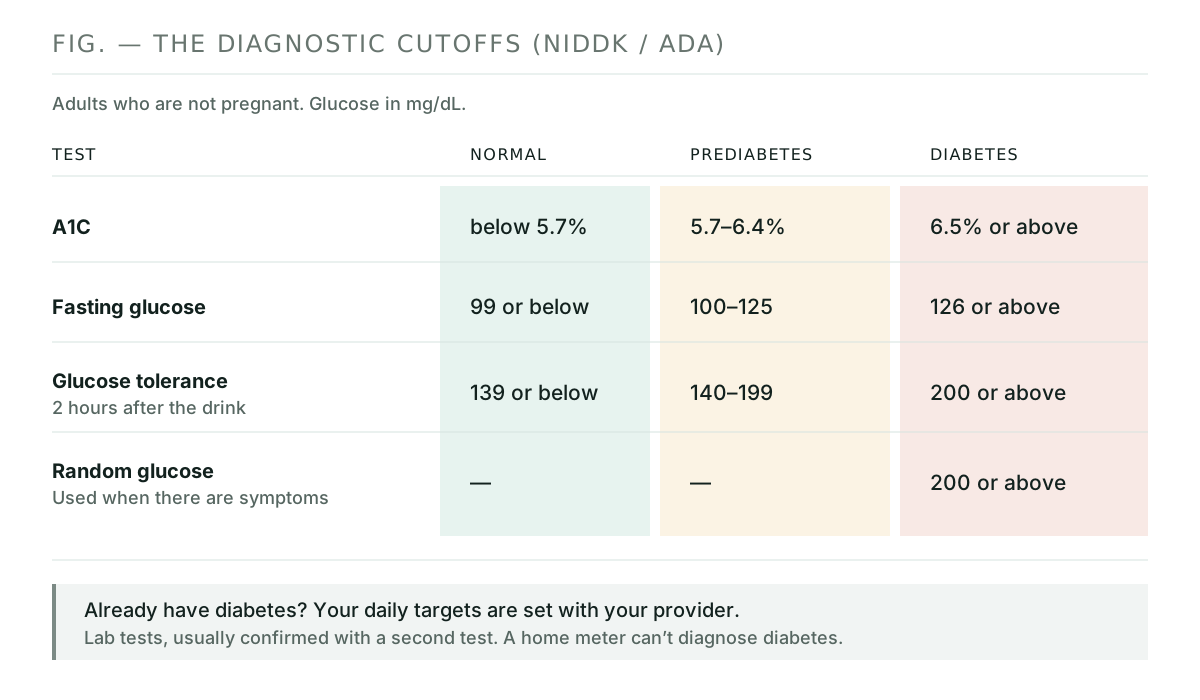
For diagnosing diabetes from high blood sugar in adults who are not pregnant, the NIDDK's test page gives a table sourced to the American Diabetes Association. Diabetes is an A1C of 6.5% or above, a fasting plasma glucose of 126 mg/dL or above, or a result of 200 mg/dL or above two hours into an oral glucose tolerance test.
A random plasma glucose of 200 mg/dL or above also counts, but that test is used when there are symptoms.
Prediabetes sits below those lines: an A1C of 5.7% to 6.4%, a fasting glucose of 100 to 125 mg/dL, or 140 to 199 mg/dL on the glucose tolerance test. This site's prediabetes after 40 article covers that range in detail.
The NIDDK adds that the A1C test might not be accurate in some situations, such as certain types of anemia or other blood problems, that a doctor usually uses a second test to confirm diabetes, and that a home blood glucose meter cannot diagnose it.
The full NIDDK table for adults who are not pregnant, sourced to the American Diabetes Association:
| Test | Normal | Prediabetes | Diabetes |
|---|---|---|---|
| A1C | Below 5.7% | 5.7% to 6.4% | 6.5% or above |
| Fasting plasma glucose | 99 mg/dL or below | 100 to 125 mg/dL | 126 mg/dL or above |
| Oral glucose tolerance test (2 hours) | 139 mg/dL or below | 140 to 199 mg/dL | 200 mg/dL or above |
| Random plasma glucose (used with symptoms) | — | — | 200 mg/dL or above |
For a man who already has diabetes, the diagnostic cutoffs are not the daily target. MedlinePlus says you and your provider set a target goal for blood sugar levels at different times of the day, and decide how often to check at home.
The NHS gives its own home-test guide in the units used in the UK and also says those levels are a guide that may differ with your age and type of diabetes.
The symptoms
For high blood sugar, MedlinePlus lists being very thirsty or having a dry mouth, blurry vision, dry skin, feeling weak or tired, and needing to urinate a lot, or needing to get up more often than usual at night to urinate. Its hyperglycemia page adds headaches. The NHS list adds losing weight.
MedlinePlus says that over time high blood sugar weakens the immune system and makes infections more likely.
The NIDDK's list of common diabetes symptoms overlaps: increased urination, feeling very thirsty, feeling very hungry even after eating, blurred vision, fatigue, sores that do not heal, and frequent infections, such as urinary tract or skin infections.
For type 2 diabetes, it says symptoms can develop slowly over several years, and that some people find out they have it when they develop other problems, which it lists as pain, numbness or tingling in the feet or hands, sexual problems, chest pain and vision loss.
Peeing at night: prostate or blood sugar?
Getting up at night to urinate is on the MedlinePlus high-blood-sugar list, and it is also a common symptom of an enlarged prostate, covered in this site's prostate section. In our reading, the two are worth separating rather than assuming: a man who blames his prostate may never have his blood sugar checked, and the reverse is also possible.
In our reading, a few clues help:
- Points toward blood sugar: thirst, a dry mouth and, per the NHS, weight loss.
- Points toward the prostate: in this site's prostate articles, a weak stream or a feeling that the bladder hasn't emptied; see weak urine stream and waking up to pee at night.
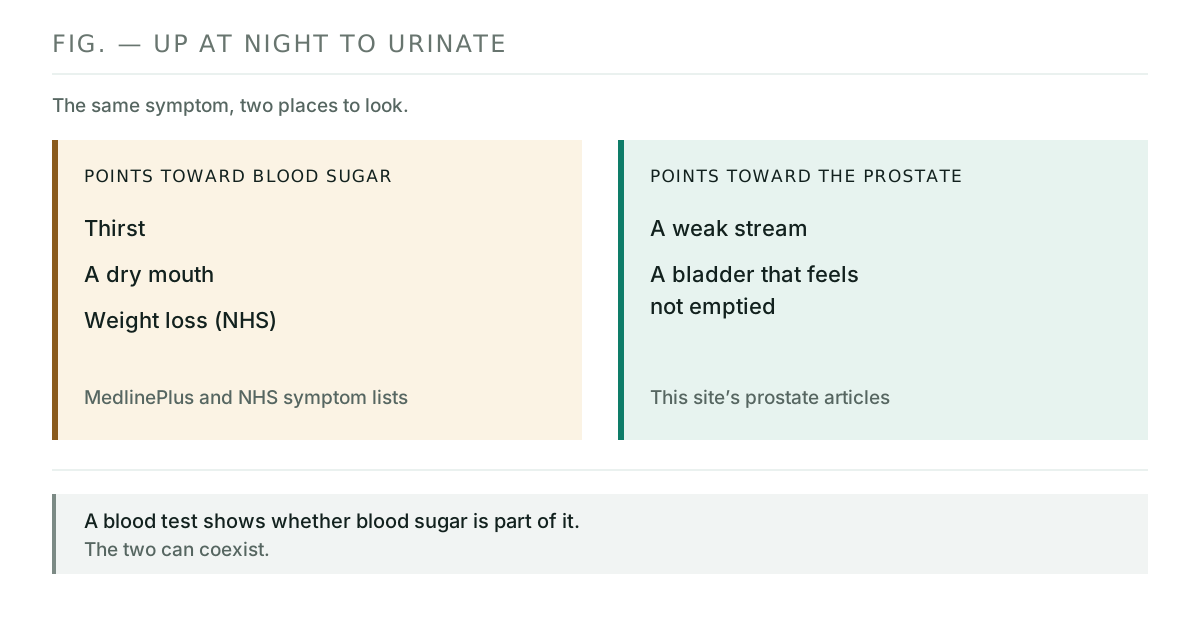
Sexual problems, also on the NIDDK's list, are covered in testosterone and erectile dysfunction. A blood test shows whether blood sugar is part of it, and the two can coexist.
What pushes blood sugar up in diabetes
The NHS names the common causes in people with diabetes: being unwell, feeling stressed, eating too much sugary or starchy food, being less active than usual, and missing doses of diabetes medicine. It adds that high blood sugar can happen if the medicine isn't working well, if you take certain medicines such as steroids, or after a recent operation.
MedlinePlus turns this into questions to ask yourself when your sugar runs high. Among them:
- Are you following your meal plan and taking your medicines correctly?
- If you use insulin, is the dose right, is it expired, and has it been stored too hot or too cold?
- Have you been less active, ill, dehydrated or stressed?
- Have you gained weight?
- Have you started a new medicine, including one for high blood pressure?
- Have you had a glucocorticoid (steroid) injection into a joint or elsewhere?
That last MedlinePlus question is worth flagging for men who get steroid injections for a painful knee or shoulder. In our reading, if you have diabetes, it is worth telling the person giving the injection and watching your readings afterwards.
High blood sugar without diabetes
MedlinePlus says that, less commonly, people without diabetes can get high blood sugar, from conditions that affect insulin or glucose levels, including problems with the pancreas or adrenal glands, certain medicines, and severe illnesses. If you don't have diabetes and are having symptoms, it says to see your provider to find out the cause and how to treat it.
The NHS says the same in its own terms: speak to your GP practice if you have symptoms of high blood sugar and have not been diagnosed with diabetes. In the U.S., the equivalent is your primary care provider; the NIDDK says the random plasma glucose test is the one doctors may use when you have symptoms and they do not want to wait for you to fast.
Ketones: the reading that changes the urgency
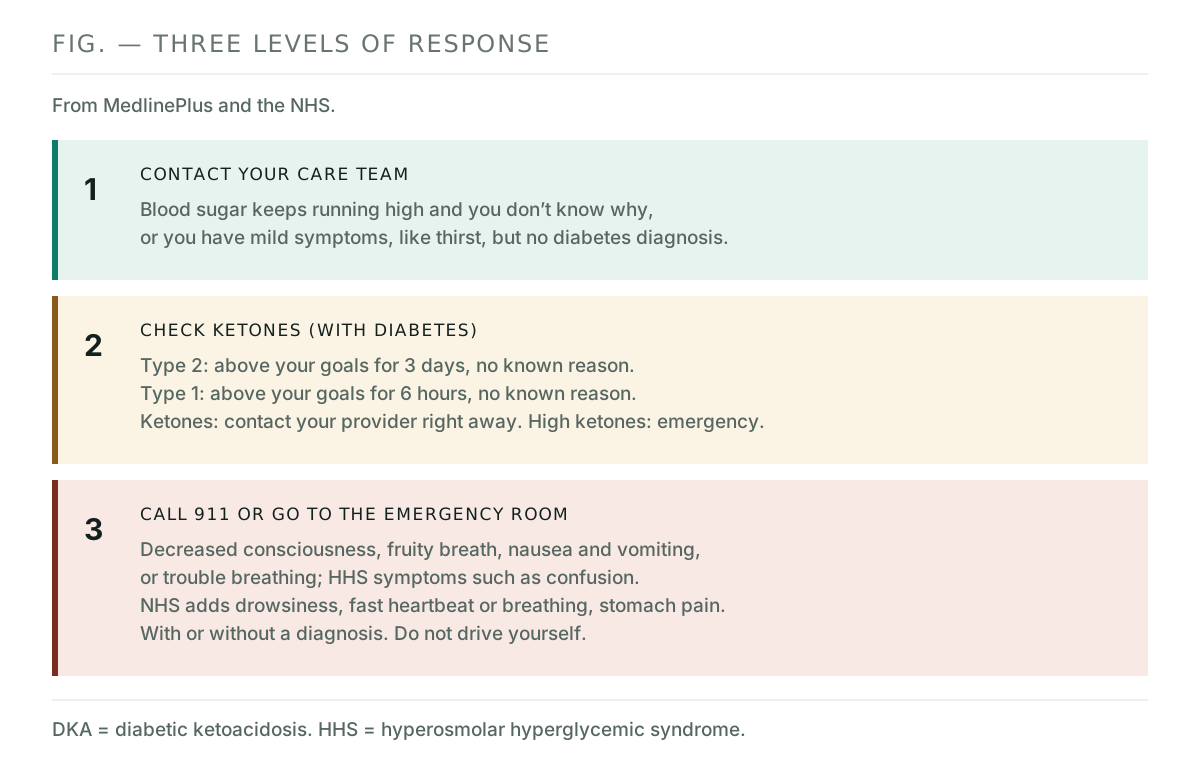
Ketones are acids the liver makes from fat. MedlinePlus says they become dangerous when too little insulin makes them build up fast. MedlinePlus says that with type 2 diabetes, if your blood sugar is higher than your goals over 3 days and you don't know why, check your urine for ketones; with type 1 diabetes, after 6 hours.
If ketones are present, it says to contact your provider or seek emergency medical care; its ketoacidosis page says to contact your provider right away and not to delay, and the NHS treats a high ketone level as an emergency.
Its hyperglycemia page adds that if you have an at-home ketone test, check every 4 to 6 hours when your blood glucose is very high or you have DKA symptoms such as nausea, vomiting, belly pain or trouble breathing, and that if ketones are moderate or high, or if you don't have a test, contact your provider right away or get emergency medical help.
The two emergencies to know by name
Diabetic ketoacidosis (DKA). MedlinePlus calls DKA a life-threatening problem in which fat is broken down too fast and ketones make the blood acidic. Common symptoms include decreased alertness, deep and rapid breathing, dry skin and mouth, a flushed face, frequent urination or thirst lasting a day or more, fruity-smelling breath, headache, muscle aches, nausea and vomiting, and stomach pain.
It says DKA is sometimes the first sign of type 1 diabetes, and that people with type 2 diabetes can also develop a form of it.
Hyperosmolar hyperglycemic syndrome (HHS). MedlinePlus describes HHS as a complication of type 2 diabetes, with extremely high blood sugar, extreme dehydration and, in many cases, decreased alertness. It may also occur in people not yet diagnosed with diabetes.
Symptoms include increased thirst and urination at first, weakness, nausea, weight loss, a dry mouth and tongue, fever, seizures, confusion and coma, and may get worse over days or weeks. Risk factors include older age, impaired thirst, poor kidney function, and running out of diabetes medicine.
Side by side, from the two MedlinePlus pages:
| DKA | HHS | |
|---|---|---|
| Who | Sometimes the first sign of type 1 diabetes; people with type 2 can also develop a form of it | A complication of type 2 diabetes; may also occur before diabetes is diagnosed |
| Signs that stand out | Fruity-smelling breath, deep and rapid breathing, nausea and vomiting, stomach pain | Extreme dehydration, decreased alertness, confusion, symptoms that worsen over days or weeks |
| What MedlinePlus says to do | Go to the emergency room or call 911 for decreased consciousness, fruity breath, nausea and vomiting, or trouble breathing in someone with diabetes; DKA can also be the first sign of diabetes | A medical emergency: call 911 or go to the emergency room if symptoms develop |
MedlinePlus says to go to the emergency room or call 911 if you or a family member with diabetes has decreased consciousness, fruity breath, nausea and vomiting, or trouble breathing. It calls HHS a medical emergency and says to call 911 if its symptoms develop.
Both conditions can appear before diabetes has been diagnosed. The NHS emergency list, for anyone who thinks they have high blood sugar, adds drowsiness, a faster heartbeat or breathing, stomach pain, confusion and high ketones, and says not to drive yourself.
What years of high blood sugar do
The NHS says it is not usually a serious problem if blood sugar is sometimes slightly high for a short time. If it stays high for long or gets very high, it can lead to permanent nerve damage in the hands and feet, permanent damage to the eyes, heart disease and stroke, and life-threatening conditions such as diabetic ketoacidosis.
This site's metabolic syndrome article covers fasting blood sugar as one of the five numbers that make up that syndrome.
What helps bring it down
To lower high blood sugar if you have diabetes, the NHS says to take any diabetes medicine as advised, avoid too much sugary or starchy food, find ways to manage stress, exercise regularly, lose weight if you're overweight, and follow your care team's advice for sick days.
It says not to skip or change doses of diabetes medicine unless advised, and to speak to your care team if your level stays high or symptoms continue despite trying.
MedlinePlus says that if you have diabetes and often have high blood glucose, your health care team may change your meal plan, activity plan or medicines, and that severe hyperglycemia with symptoms of DKA needs treatment in the hospital, often with intravenous fluids and insulin. For HHS, it suggests a sick-day plan and ordering diabetes medicines in 3-month amounts so you are less likely to run out.
Is high blood sugar behind your tiredness?
Feeling weak or tired is on both the MedlinePlus and NHS lists of high blood sugar symptoms, so the question is fair. In our reading, the sources cut both ways: tiredness can be a symptom, but the NIDDK says many people with type 2 diabetes have no symptoms, so feeling fine proves nothing either.
A blood test shows whether blood sugar is high; whether it explains the tiredness is a question for your provider. For the many other reasons men feel worn out, see this site's fatigue after 40 article.
Key takeaways
- MedlinePlus says high blood sugar almost always happens with diabetes; surgery, infection, trauma or medicines can raise it for a while.
- For diagnosis, the NIDDK table uses an A1C of 6.5% or above, fasting glucose of 126 mg/dL or above, or 200 mg/dL or above on a random test with symptoms.
- Symptoms include thirst, peeing a lot (including at night), tiredness and blurred vision, but many people with type 2 diabetes notice nothing.
- Night-time urination can come from blood sugar, the prostate or other causes; a blood test shows whether blood sugar is part of it, and the two can coexist.
- With diabetes, MedlinePlus says to check ketones after 3 days above goal (type 2) or 6 hours (type 1) without a known reason.
- Decreased consciousness, fruity breath, vomiting or trouble breathing means 911, with or without a diabetes diagnosis; DKA and HHS can be the first sign.
Where to go from here
If high blood sugar is what brought you here, these pages cover the surrounding ground:
- Prediabetes After 40 — the range just below diabetes.
- Low Blood Sugar (Hypoglycemia) — the opposite problem, and the faster one.
- Waking Up to Pee at Night — every cause of night-time urination, prostate included.
- Fatigue After 40 — the many other reasons for feeling worn out.
- All energy articles
Frequently asked questions
What blood sugar level is too high?
For diagnosing diabetes in adults who are not pregnant, the NIDDK table, sourced to the American Diabetes Association, uses an A1C of 6.5% or above, a fasting plasma glucose of 126 mg/dL or above, or a random plasma glucose of 200 mg/dL or above when there are symptoms. The NIDDK says a doctor usually confirms with a second test, and a home meter cannot diagnose diabetes. If you already have diabetes, MedlinePlus says you and your provider set your own target goals.
What are the symptoms of high blood sugar?
MedlinePlus lists being very thirsty or having a dry mouth, blurry vision, dry skin, feeling weak or tired, and needing to urinate a lot, including getting up more often at night. The NHS adds losing weight and says symptoms usually come on gradually and may only start when the level gets very high.
Can you have high blood sugar without diabetes?
Yes, though MedlinePlus says it is less common. Causes include problems with the pancreas or adrenal glands, certain medicines and severe illnesses, and blood sugar can rise for a while with the stress of surgery, infection or trauma. If you have symptoms and no diabetes diagnosis, MedlinePlus says to see your provider to find the cause.
When should I check for ketones?
MedlinePlus says that with type 2 diabetes, if your blood sugar is above your goals for 3 days and you don't know why, check your urine for ketones; with type 1 diabetes, after 6 hours. If you have ketones, it says to contact your provider or seek emergency medical care.
When is high blood sugar an emergency?
MedlinePlus says to go to the emergency room or call 911 if someone with diabetes has decreased consciousness, fruity breath, nausea and vomiting, or trouble breathing, which can be signs of diabetic ketoacidosis. It also calls hyperosmolar hyperglycemic syndrome a medical emergency and says to call 911 if its symptoms, such as confusion, develop.
Can high blood sugar make you tired?
Yes. MedlinePlus and the NHS both list feeling weak or tired among the symptoms of high blood sugar. But the NIDDK says many people with type 2 diabetes have no symptoms, so tiredness alone is not a reliable sign either way. A blood test shows whether blood sugar is high.
Sources
- MedlinePlus (National Library of Medicine) — High blood sugar — self-care
- MedlinePlus (National Library of Medicine) — Hyperglycemia
- MedlinePlus (National Library of Medicine) — Diabetic ketoacidosis
- MedlinePlus (National Library of Medicine) — Diabetic hyperglycemic hyperosmolar syndrome
- National Institute of Diabetes and Digestive and Kidney Diseases (NIH) — Diabetes Tests & Diagnosis
- National Institute of Diabetes and Digestive and Kidney Diseases (NIH) — Symptoms & Causes of Diabetes
- NHS — High blood sugar (hyperglycaemia)

Male Health Guide Editorial Team
We write about the health problems men over 40 actually search for at 3 a.m. — and we say plainly when the evidence for a popular product is thin. We do not invent credentials and we do not publish sponsored copy as editorial. Read more about how we work.
Medical disclaimer: This article is general information, not medical advice. We are not doctors, and nothing here diagnoses, treats or cures any condition. Do not change a diabetes medicine without your care team. Call 911 for decreased consciousness, fruity breath, vomiting or trouble breathing, with or without a diabetes diagnosis.