Shoulder Pain After 40: What the Arm Can't Do
Short answer
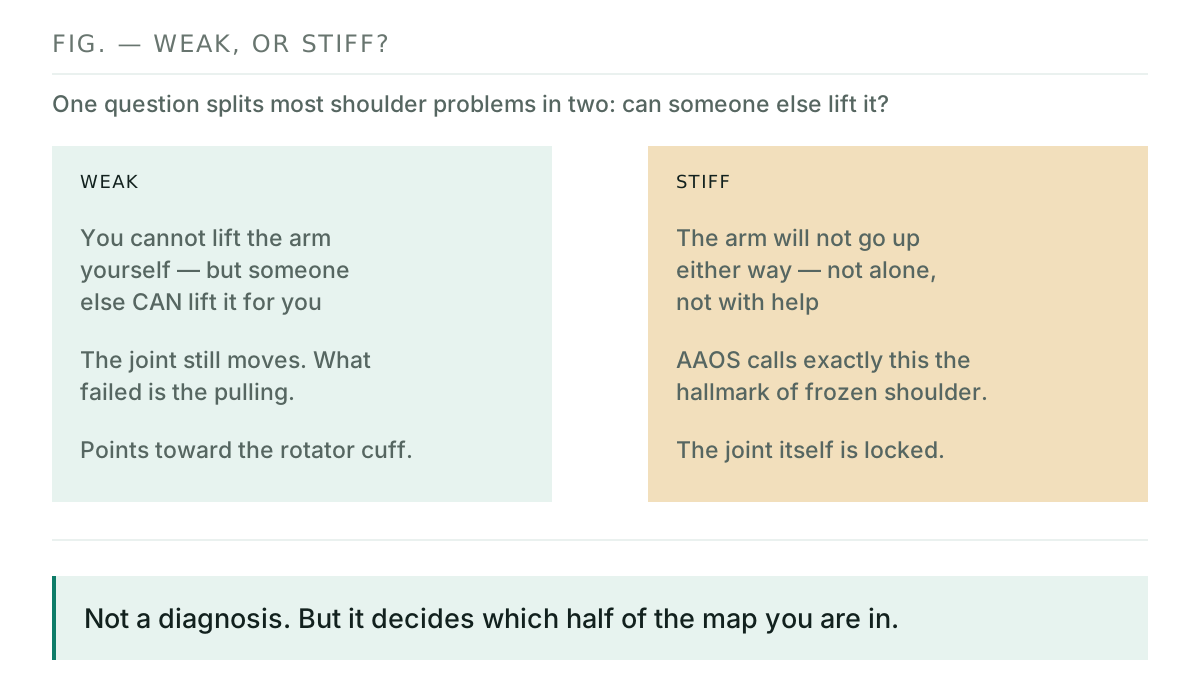
Shoulder pain after 40 usually comes from tendon trouble rather than the joint surface, and one question sorts most of it: can someone else lift your arm for you? If yes, the problem is weakness and points at the rotator cuff. If the arm will not go up either way, that is stiffness, and a different condition entirely.
A shoulder rarely fails all at once. It gives up territory. First the top shelf needs a second attempt, then putting on a jacket becomes a manoeuvre, then one night you roll onto that side and wake up properly. By the time most men look it up, they have been quietly working around it for months.
This is the third article in our joints section, and the companion to the one on knee pain. The knee sorts best by where it hurts. The shoulder does not — it sorts by what the arm can and cannot do, which is a different question and a more useful one.
We earn nothing from any of this. There is no brace, supplement or clinic being sold here, which is why this page can spend its time on what actually distinguishes these problems rather than steering every reader toward the same purchase.
Why the shoulder is the joint that goes wrong
The shoulder has more range of motion than any other joint in the body, and the American Academy of Orthopaedic Surgeons states the trade-off in four words: mobility has its price. That price, in their phrasing, is increasing problems with instability or with impingement of the soft tissue and bone, resulting in pain.
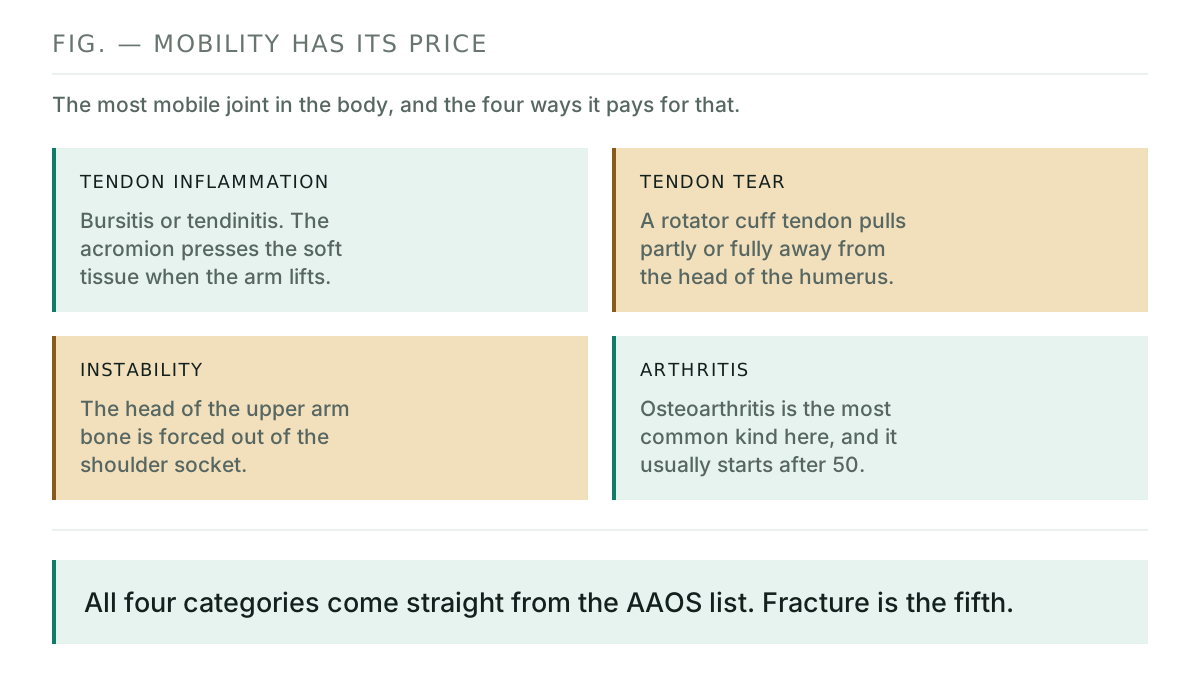
Keeping that much movement under control takes a specific piece of equipment. A group of muscles and tendons holds the head of the upper arm bone centred in a socket that is shallow by design, and that group is the rotator cuff — four muscles whose tendons form a covering around the top of the humerus.
This matters for one practical reason. In the knee, the thing that usually wears out is the joint surface. In the shoulder, the thing that usually wears out is the equipment holding it together. That is why so much shoulder pain after 40 behaves like a strength problem rather than a grinding problem.
Pain that wakes you at night: the rotator cuff
Of everything in this article, night pain is the detail most worth writing down before an appointment. AAOS lists it explicitly among the symptoms of a rotator cuff tear: pain at rest and at night, particularly when lying on the affected shoulder.
The rest of the pattern fits alongside it — weakness when lifting or rotating the arm, pain on lifting and lowering it, and sometimes a crackling sensation in certain positions. Pain often starts mild and only when reaching overhead, then becomes noticeable at rest as things progress.
That is the figure AAOS gives for rotator cuff tears, and it names people over 40 as being at greater risk, because the tendon accumulates ordinary wear over time. American Academy of Orthopaedic Surgeons
A tear is not necessarily the dramatic event the word suggests. The tendon can detach partially, staying attached but frayed, or fully. And the honest part, which the same source states plainly: some rotator cuff tears are not painful at all.
The shoulder that won't move, even with help
Here is the single most useful thing a man can check at home, and it takes ten seconds. Let the arm hang, relax it completely, and have someone else raise it for you.
If it goes up once they help, the joint still has its range and what failed is the pulling — a weakness problem. If it will not go up either way, that is stiffness, and AAOS describes exactly that as the hallmark of frozen shoulder: severe pain along with being unable to move the shoulder either on your own or with the help of someone else.
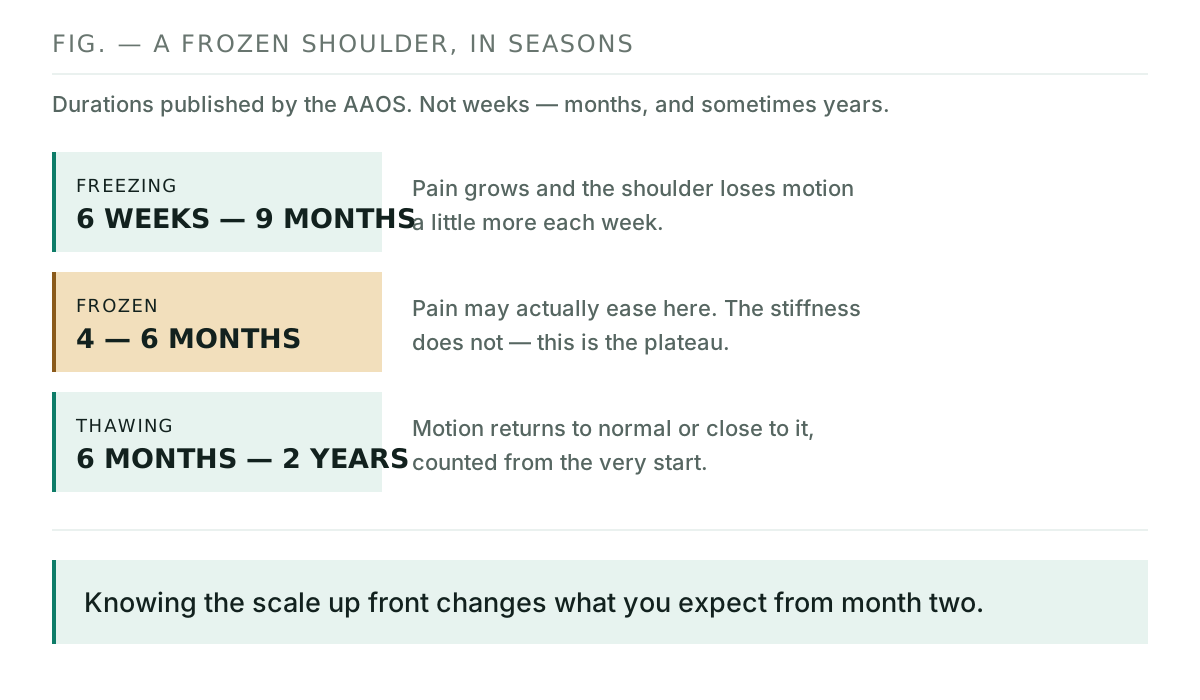
Frozen shoulder, also called adhesive capsulitis, most commonly affects people between 40 and 60, occurs more often in women than men, and carries a higher risk in people with diabetes. Its timeline is the part that catches men out: AAOS gives the freezing stage as roughly 6 weeks to 9 months, the frozen stage as 4 to 6 months, and a complete return to normal or near-normal motion as anywhere from 6 months to 2 years.
Telling frozen shoulder and a rotator cuff problem apart properly — and knowing why the treatments pull in opposite directions — is a big enough question to have its own article, coming next in this section.
Pain only partway up: impingement and bursitis
Some shoulders hurt through a band of the movement and then stop hurting at the top. That is the pattern that fits impingement, and AAOS explains the mechanism in one sentence: the acromion — the bony top of the shoulder blade — puts pressure on the soft tissue underneath when the arm is lifted away from the body.
What sits under that pressure is the rotator cuff tendons and the bursa, the small fluid cushion between them. Excessive use inflames the bursa, which is bursitis, and the tendons, which is tendinitis. The two travel together often enough that they are frequently named as a pair.
The reason this category deserves attention is that it is the same tissue that later tears. A shoulder that hurts overhead in a man's forties and a shoulder that fails to lift in his fifties are frequently the same story at two different points.
Pain right on top: the AC joint
There is a small joint where the collarbone meets the shoulder blade — the acromioclavicular, or AC, joint — and it produces a distinctly different complaint. AAOS puts it in terms of location: arthritis in the AC joint is focused on the top of the shoulder, while arthritis in the main ball-and-socket joint centres the pain in the side or back of the shoulder instead.
That is a rare gift in joint diagnosis: two conditions with the same name, in the same shoulder, that a man can partly separate himself by pointing at where it hurts. Worth pointing precisely at the next appointment rather than gesturing at the whole shoulder.
Deep, grinding, worse over years: shoulder arthritis
Shoulder arthritis behaves the way arthritis behaves elsewhere: pain aggravated by activity that progressively worsens over time, limited range of motion, and a grinding, clicking or snapping sensation — crepitus — as the shoulder moves. Osteoarthritis here usually affects people over 50.
AAOS lists five types in this joint, and one of them is worth knowing by name because it connects the two halves of this article: rotator cuff tear arthropathy, arthritis that develops as a consequence of a large, long-standing rotator cuff tear. The tendon problem and the joint problem are not always separate stories.
The general mechanics of osteoarthritis — what wears, why weight matters, how the morning-stiffness clock separates it from an autoimmune arthritis — are covered in the pillar guide for this section rather than repeated here.
The part most articles leave out
Two facts sit awkwardly beside each other, and both come from the same source. Rotator cuff tears are extremely common after 40, and some rotator cuff tears are not painful.
The practical consequence is that a scan finding a tear does not automatically explain the pain, and a shoulder can hold a tear quietly for years. This is not a reason to ignore imaging. It is a reason to be wary of any explanation that jumps from "the scan shows a tear" straight to "so that is what hurts, and here is what it costs to fix."
What actually helps
The most reassuring number in this article is also the least dramatic one. For rotator cuff tears, AAOS reports that nonsurgical treatment relieves pain and improves function in about 80 to 85 per cent of patients — rest, activity modification, anti-inflammatories, and physical therapy.
Steroid injections have a defined and limited role in that picture: AAOS describes them as effective in about two-thirds of patients for a period of at least three months. Useful, and not a permanent solution, which is a fair way to weigh one when it is offered.
Surgery generally enters the conversation when symptoms have persisted for six to twelve months despite that, or for large tears and significant weakness. Notably, the clock in that sentence is measured in months, which means a shoulder that has hurt for three weeks is usually still in the first chapter rather than the last.
What to do with this
- Do the lift test. Have someone raise the relaxed arm for you. Moves with help means weakness; will not move either way means stiffness.
- Note the night. Pain that wakes you when you roll onto that side is a rotator cuff detail worth reporting, not a minor one.
- Note where in the arc it hurts. Painful partway up and easier at the top fits impingement; painful throughout fits something else.
- Point at the exact spot. The top of the shoulder and the side or back of it are different joints with different answers.
- Give the conservative route real time. The published success rate for non-surgical treatment is high, and the timeline is measured in months.
A shoulder is a hard joint to describe and an easy one to under-report, largely because men adapt around it so efficiently. Arriving with the lift test, the night pattern and the exact location already answered does most of the work an examination is trying to do anyway.
Key takeaways
- The shoulder trades stability for range of motion — AAOS puts it as "mobility has its price."
- Night pain, especially lying on that side, is a listed rotator cuff tear symptom — AAOS.
- Almost 2 million Americans see a doctor for rotator cuff tears each year, and people over 40 are at greater risk — AAOS.
- Being unable to move the shoulder on your own or with help is the hallmark of frozen shoulder — AAOS.
- Frozen shoulder runs 6 weeks to 9 months freezing, 4 to 6 months frozen, and 6 months to 2 years to full recovery — AAOS.
- Nonsurgical treatment works for about 80 to 85 per cent of rotator cuff tear patients; injections help about two-thirds for at least 3 months — AAOS.
- Some rotator cuff tears are not painful, so a tear on a scan does not automatically explain the pain — AAOS.
Where to go from here
This is the third article in the joints section. The rest are being written now, one at a time:
- Joint Pain After 40 — the pillar guide, covering osteoarthritis, rheumatoid arthritis and post-traumatic arthritis.
- Knee Pain: What's Different About Where It Hurts — front, outside, behind, or sudden swelling, and what each one means.
- Hip Pain Explained: Why It's Often Not the Hip — sudden or gradual, and why it is often felt somewhere other than the hip.
- Osteoarthritis vs Rheumatoid Arthritis: What Differs — how long the stiffness lasts, whether both sides hurt, and why one of the two has a clock on it.
- Rotator Cuff vs Frozen Shoulder: Two Fixes, Not One — one tissue heals on its own given time, the other does not, and surgery means opposite things for each.
- Knee replacement — what gets tried first, and what recovery involves.
- Meniscus tear — injury or wear, and why imaging can blur the two.
- Glucosamine for joint pain — what the evidence actually shows.
Frequently asked questions
Why does my shoulder hurt more at night than during the day?
Night pain is one of the listed symptoms of a rotator cuff tear, and the American Academy of Orthopaedic Surgeons specifically notes pain at rest and at night, especially when lying on the affected shoulder. It is one of the more useful details to bring to an appointment.
How do I tell a weak shoulder from a stiff one?
Have someone else lift the arm for you. If it moves once they help, the problem is more likely weakness, which points toward the rotator cuff. AAOS describes being unable to move the shoulder either on your own or with help as the hallmark of frozen shoulder.
Why does it only hurt partway through lifting my arm?
That pattern fits impingement. AAOS describes the acromion, the top of the shoulder blade, putting pressure on the soft tissue underneath as the arm lifts away from the body, which can inflame the bursa and the rotator cuff tendons.
How common are rotator cuff problems after 40?
Common enough that AAOS reports almost 2 million people in the United States visit a doctor each year because of rotator cuff tears, and states that people over 40 are at greater risk because of normal wear over time.
Does a rotator cuff tear always need surgery?
No. AAOS reports that nonsurgical treatment — rest, anti-inflammatories, physical therapy and sometimes a steroid injection — relieves pain and improves function in about 80 to 85 per cent of patients. Surgery is generally considered when symptoms persist for six to twelve months.
How long does a frozen shoulder take to resolve?
Longer than most men expect. AAOS gives freezing as roughly 6 weeks to 9 months, the frozen stage as 4 to 6 months, and a complete return to normal or near-normal motion as anywhere from 6 months to 2 years.
Sources
- American Academy of Orthopaedic Surgeons (OrthoInfo) — Shoulder Pain and Common Shoulder Problems
- American Academy of Orthopaedic Surgeons (OrthoInfo) — Rotator Cuff Tears
- American Academy of Orthopaedic Surgeons (OrthoInfo) — Frozen Shoulder
- American Academy of Orthopaedic Surgeons (OrthoInfo) — Arthritis of the Shoulder
- NIAMS (National Institutes of Health) — Osteoarthritis
- National Institute on Aging (NIH) — Osteoarthritis

Male Health Guide Editorial Team
We write about the health problems men over 40 actually search for at 3 a.m. — and we say plainly when the evidence for a popular product is thin. We do not invent credentials and we do not publish sponsored copy as editorial. Read more about how we work.
Medical disclaimer: This article is general information about common causes of shoulder pain, and is not medical advice. It is not a diagnosis, not a recommendation to start or stop any treatment, and not a substitute for an examination by someone who can see and test the shoulder in question. Please speak to a qualified healthcare professional about your own situation.