Knee Pain: What's Different About Where It Hurts
Short answer
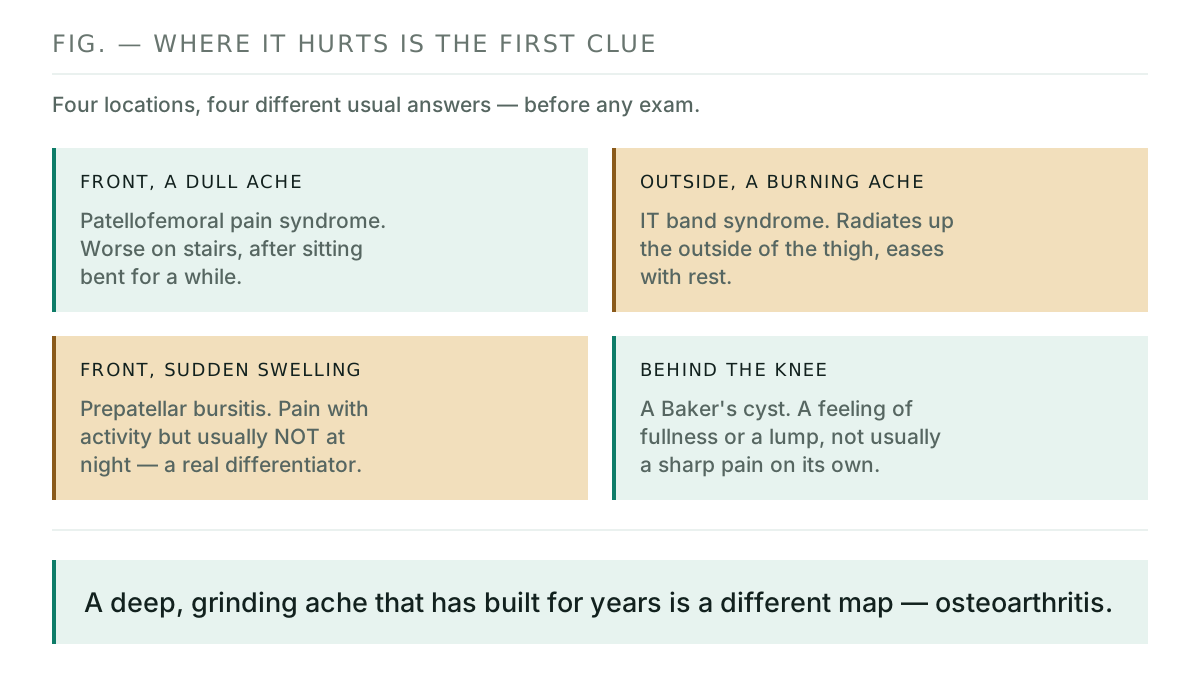
Knee pain is not one problem, and the location tells you more than most men realize. Front and dull is usually patellofemoral pain; outside and burning is usually the IT band; sudden front-of-knee swelling is usually bursitis; a lump behind the knee is usually a Baker's cyst — four different answers to the same complaint.
"My knee hurts" is not really a description. It is a category, and inside that category are several genuinely different problems that share almost nothing except the joint they happen to sit in. Two men can both say those three words and be dealing with completely different tissue.
This is the companion to our guide to joint pain after 40, which covers osteoarthritis, rheumatoid arthritis and post-traumatic arthritis in general. This article goes one level deeper on the knee specifically, into the causes that are not osteoarthritis at all — the overuse injuries, the bursitis, the cyst — and uses the single most useful clue a man can read off his own body before any appointment: exactly where it hurts.
We earn nothing from any of this. There is no brace, wrap or supplement being sold here, which is why this page can describe what actually distinguishes these conditions instead of pointing every reader toward the same product.
Where it hurts is the first real clue
Before any exam, before any imaging, the location of the pain already narrows the field. Four patterns cover most of what sends a man over 40 looking this up, and each one has a different usual cause, a different typical trigger, and a different first treatment.
None of this replaces an actual diagnosis. What it does is tell you which questions to ask, and which of the sections below is worth reading first.
Front of the knee, a dull ache: patellofemoral pain
This is the pattern most men mean when they say their knee "just aches." The American Academy of Orthopaedic Surgeons describes patellofemoral pain syndrome — sometimes called runner's knee — as pain in the front of the knee and around the kneecap, caused when nerves sense pain in the soft tissue and bone around the patella itself.
Two things usually drive it. One is overuse: vigorous activity that repeatedly stresses the knee, such as jogging, squatting and climbing stairs, or a sudden jump in how often, how long or how hard you have been active. The other is patellar malalignment — the kneecap tracking slightly off-course in its groove, often tied to weakness in the quadriceps muscles specifically.
AAOS lists discomfort after sitting for a long period with the knee bent, along with popping or crackling when climbing stairs, as characteristic symptoms — a pattern many men recognize immediately from a long drive or a flight. American Academy of Orthopaedic Surgeons
The recommended first steps are unglamorous and mostly work: activity modification, the RICE method (rest, ice, compression, elevation), over-the-counter anti-inflammatories, and physical therapy aimed specifically at the quadriceps and hip muscles. Surgery is rarely needed.
Outside of the knee, a burning ache: the IT band
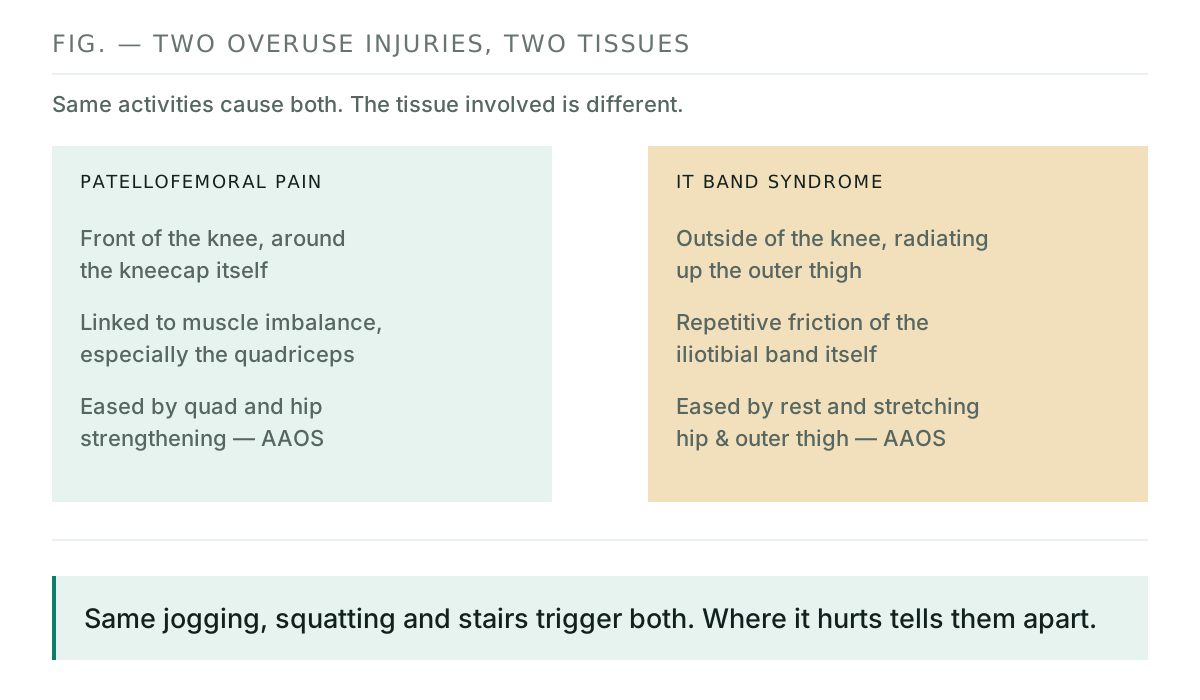
The iliotibial band is a thick strip of connective tissue running along the outside of the thigh from hip to knee, and its job is stabilizing both joints during walking and running. AAOS describes IT band syndrome as an overuse injury from repetitive friction of that band, producing stiffness, aching and burning on the outside of the knee and hip.
It is easy to confuse with patellofemoral pain because the triggers overlap almost completely — overtraining, a sudden increase in mileage, poor footwear, insufficient stretching. The difference is location: burning specifically on the outer edge of the knee, sometimes radiating up the whole outside of the leg, rather than a dull ache behind the kneecap.
Treatment again leans conservative: rest, physical therapy built around stretching and strengthening the hip, buttock and outer thigh muscles, and a gradual return to activity. AAOS notes surgery is rarely required.
Sudden swelling at the front: bursitis
This one is easy to mistake for a flare of arthritis, and it is not. AAOS describes prepatellar bursitis as inflammation of the small fluid-filled sac over the kneecap, which becomes irritated, overproduces fluid, and swells — sometimes dramatically, sometimes overnight.
Common causes include pressure from constant kneeling — AAOS specifically names plumbers, roofers, carpet layers and gardeners as higher-risk occupations — a direct blow to the front of the knee, or, less often, an underlying condition such as rheumatoid arthritis or gout. A version caused by bacterial infection through broken skin is also possible and needs different treatment entirely.
The genuinely useful differentiator: AAOS describes pain with activity but usually not at night. Most joint pain from arthritis or overuse does not follow that pattern as cleanly, which makes this one detail worth mentioning to whoever examines it. Watch for fluid buildup with redness, fever or chills, which points toward the infected version and needs prompt attention rather than home care.
First-line treatment is activity modification, ice three to four times a day for about 20 minutes, elevation, and NSAIDs. If that does not settle it, a doctor may drain the fluid with a needle, sometimes combined with a corticosteroid injection.
Behind the knee: a Baker's cyst
A Baker's cyst, also called a popliteal cyst, is fluid collecting at the back of the knee, and AAOS calls it one of the most common disorders of the joint. It shows up as a feeling of fullness or a visible lump behind the knee, sometimes with stiffness or mild swelling reaching down into the lower leg.
It is rarely the primary problem. AAOS explains the mechanism plainly: the cyst usually results from another condition already causing inflammation inside the joint — osteoarthritis, rheumatoid arthritis, a meniscus tear, an ACL injury — which makes the knee produce excess synovial fluid that travels backward and pools there. Treating the cyst without addressing what is causing it tends not to hold.
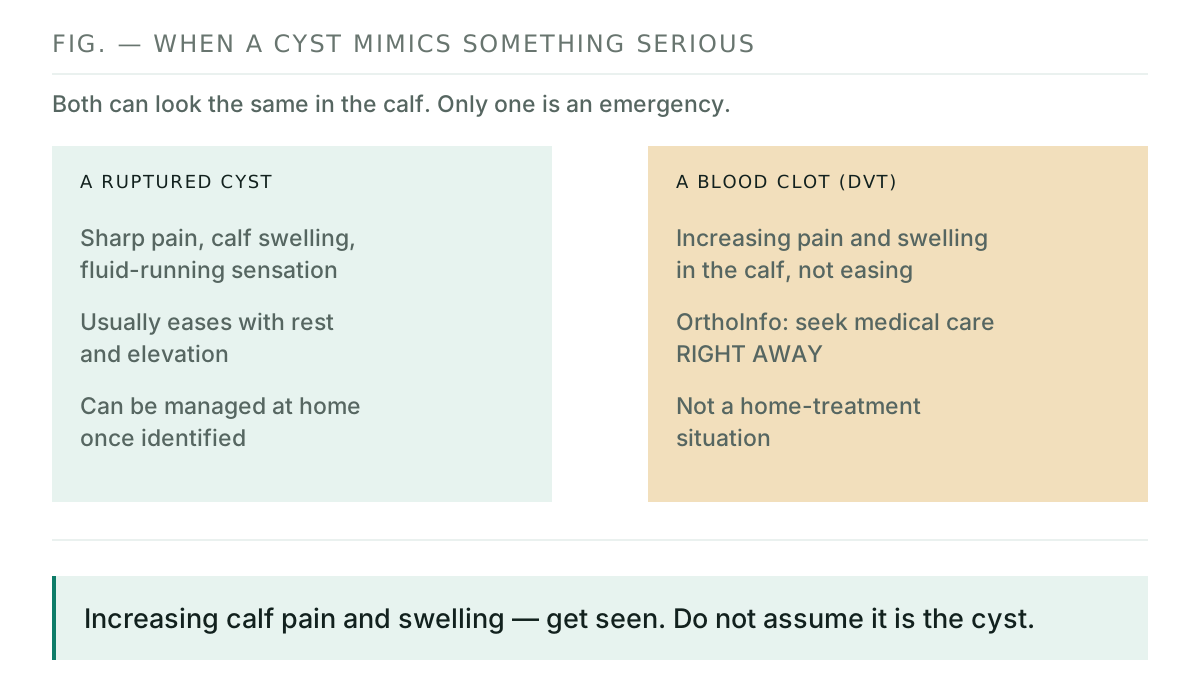
There is one warning worth taking seriously. AAOS states it directly: symptoms of a ruptured cyst can resemble a blood clot, and increasing pain and swelling in the calf needs medical attention right away rather than being written off as "just the cyst." That single sentence is the most important one in this section.
When it might be the meniscus instead
One pattern does not fit neatly into "where it hurts" because it fits into "how it started." A specific twisting movement, a catching or locking sensation, or a knee that suddenly gives way under normal weight point toward a meniscus tear rather than a gradual overuse problem.
That deserves more room than a paragraph here can give it — particularly the question of when a tear is a fresh injury and when it is simply what years of wear look like on an MRI. We cover that distinction in its own article, coming soon in this section.
The deep, grinding ache: when it's osteoarthritis
None of the four patterns above is osteoarthritis, and that is deliberate — it already has its own detailed treatment in our guide to joint pain after 40. The short version that matters here: osteoarthritis tends to build gradually over years rather than appear after one bad week, produces a grinding or scraping sensation rather than a sharp localized ache, and commonly comes with stiffness after rest that eases within about 30 minutes.
One more thing worth knowing before assuming the problem lives in the knee at all: hip osteoarthritis is commonly felt in the groin, inner thigh or buttocks rather than in the hip itself, and can refer pain down toward the knee. A knee that has been examined thoroughly and found unremarkable is sometimes a hip problem wearing a knee's clothing.
What actually helps, by cause
The four non-arthritis causes above share more in common than they first appear to, and the overlap is useful. Rest, activity modification and ice come up in every single one of them. Where they diverge is in what gets strengthened or stretched, and getting that part wrong is why some men do months of the wrong exercise.
- Patellofemoral pain: quadriceps and hip strengthening, not rest alone.
- IT band syndrome: stretching and strengthening the hip, glutes and outer thigh.
- Prepatellar bursitis: activity modification and protecting the front of the knee from further kneeling or impact, plus ice and elevation.
- Baker's cyst: treating whatever underlying joint problem is producing the fluid, not just the lump itself.
NSAIDs help with pain and inflammation across most of these, and physical therapy shows up as a recommendation in nearly every one — but pointed at a different muscle group each time. That is the part a generic "knee pain exercises" search misses.
What to do with this
- Locate it precisely. Front, outside, or behind changes the entire conversation.
- Note the night pattern. Pain that spares you at night points away from most arthritis and toward bursitis or an overuse injury.
- Note how it started. A specific twist or a sudden give-way points toward the meniscus rather than gradual wear.
- Watch the calf, not just the knee, if there is a lump behind the joint — increasing calf swelling is the one sign that should move you to urgent care.
- Bring the location and the timeline to whoever examines it. That detail alone does much of the diagnostic work a scan would otherwise have to do.
None of this is a substitute for an exam. It is the difference between walking in and saying "my knee hurts" and walking in able to say exactly where, exactly when, and exactly what makes it worse — which is usually most of what the exam is trying to establish anyway.
Key takeaways
- Front-of-knee dull ache, worse on stairs and after sitting, is usually patellofemoral pain syndrome — AAOS.
- Outside-of-knee burning that radiates up the thigh is usually IT band syndrome, from friction of the iliotibial band — AAOS.
- Sudden front-of-knee swelling with pain during activity but not at night is usually prepatellar bursitis — AAOS.
- A lump behind the knee is usually a Baker's cyst, most often caused by another joint problem producing extra fluid — AAOS.
- A ruptured Baker's cyst can mimic a blood clot; increasing calf pain and swelling needs care right away — AAOS.
- A specific twisting injury with catching, locking or giving-way points toward a meniscus tear, not gradual wear.
- Hip osteoarthritis can refer pain down to the knee, so a normal knee exam does not always end the search.
Where to go from here
This is the second article in the joints section. The rest are being written now, one at a time:
- Joint Pain After 40 — the pillar guide, covering osteoarthritis, rheumatoid arthritis and post-traumatic arthritis.
- Shoulder Pain After 40: What the Arm Can't Do — the ten-second test that separates a weak shoulder from a stiff one.
- Hip Pain Explained: Why It's Often Not the Hip — sudden or gradual, and why it is often felt somewhere other than the hip.
- Osteoarthritis vs Rheumatoid Arthritis: What Differs — how long the stiffness lasts, whether both sides hurt, and why one of the two has a clock on it.
- Rotator Cuff vs Frozen Shoulder: Two Fixes, Not One — one tissue heals on its own given time, the other does not, and surgery means opposite things for each.
- Knee replacement — what gets tried first, and what recovery involves.
- Meniscus tear — injury or wear, and why imaging can blur the two.
- Glucosamine for joint pain — what the evidence actually shows.
Frequently asked questions
Why does my knee hurt in the front, around the kneecap?
That pattern points to patellofemoral pain syndrome, sometimes called runner's knee. The American Academy of Orthopaedic Surgeons describes a dull ache around the kneecap linked to overuse or muscle imbalance, worse on stairs and after sitting with the knee bent for a while.
Why does the outside of my knee burn during a walk or run?
That is the classic pattern of IT band syndrome: repetitive friction of the iliotibial band, the connective tissue running from hip to knee along the outside of the thigh. AAOS describes stiffness, aching and burning on the outside of the knee that improves with rest.
My knee suddenly ballooned at the front. Is that arthritis?
More likely prepatellar bursitis, not arthritis. AAOS describes rapid swelling on the front of the kneecap with pain during activity but usually not at night — a genuine differentiator from other knee problems, which often ache more at rest.
What is the lump behind my knee?
Likely a Baker's cyst, also called a popliteal cyst. AAOS describes a feeling of fullness or a lump at the back of the knee, usually caused by an underlying issue such as osteoarthritis or a meniscus tear producing extra joint fluid.
Is a Baker's cyst dangerous?
The cyst itself usually is not, but AAOS gives a specific warning: a ruptured cyst can produce calf pain and swelling that resembles a blood clot. Increasing pain and swelling in the calf needs medical care right away rather than being assumed to be the cyst.
How do I know if it's a meniscus tear instead?
A meniscus tear often follows a specific twisting movement, and can come with catching, locking or a knee that gives way, rather than a gradual ache. It deserves its own evaluation rather than a guess, and this site covers it in more detail in a dedicated article.
Sources
- American Academy of Orthopaedic Surgeons (OrthoInfo) — Patellofemoral Pain Syndrome
- American Academy of Orthopaedic Surgeons (OrthoInfo) — Iliotibial Band (IT Band) Syndrome
- American Academy of Orthopaedic Surgeons (OrthoInfo) — Prepatellar (Kneecap) Bursitis
- American Academy of Orthopaedic Surgeons (OrthoInfo) — Baker's Cyst (Popliteal Cyst)
- American Academy of Orthopaedic Surgeons (OrthoInfo) — Arthritis of the Knee
- National Institute on Aging (NIH) — Osteoarthritis

Male Health Guide Editorial Team
We write about the health problems men over 40 actually search for at 3 a.m. — and we say plainly when the evidence for a popular product is thin. We do not invent credentials and we do not publish sponsored copy as editorial. Read more about how we work.
Medical disclaimer: This article is general information about common causes of knee pain, and is not medical advice. It is not a diagnosis, not a recommendation to start or stop any treatment, and not a substitute for an examination by someone who can see and test the joint in question. Please speak to a qualified healthcare professional about your own situation.