Meniscus Tear: What the Scan Can't Tell You
Short answer
A meniscus tear can be a single injury or the end of years of ordinary wear. After 50, tears show up on scans of knees that feel fine, so an MRI can show the tear without showing whether it is the source of the pain. For worn tears, trials found surgery no better than the alternatives.
Few phrases sound as final as "your MRI shows a meniscus tear." It has a location, a mechanism and an obvious fix, which is exactly why it has been one of the most trusted explanations in orthopaedics for decades. The story of this article is what happened when researchers finally went looking for that tear in people chosen without regard to whether their knees hurt at all.
So this one is arranged in the order the evidence arrived, rather than as a list of symptoms. First what the meniscus is and how it tears, then what everyone reasonably assumed, then the studies that complicated it, and finally what that means for a man standing in a clinic with a scan in his hand.
We earn nothing from any of this. There is no clinic, brace or supplement on this page, which is why it can report what the surgical trials found without softening it, and also report where those trials do not apply.
What the meniscus actually does
Each knee has two of them. AAOS describes "two wedge-shaped pieces of fibrocartilage" that "act as shock absorbers between the femur and tibia," and adds that the menisci "help to transmit weight from one bone to another and play an important role in knee stability."
That last part matters for everything below. The meniscus is not spare padding. It spreads load across the joint surface, which is why removing pieces of it is not a free action, and why the question "should this be trimmed out?" turned out to be harder than it looked.
Two very different ways it tears
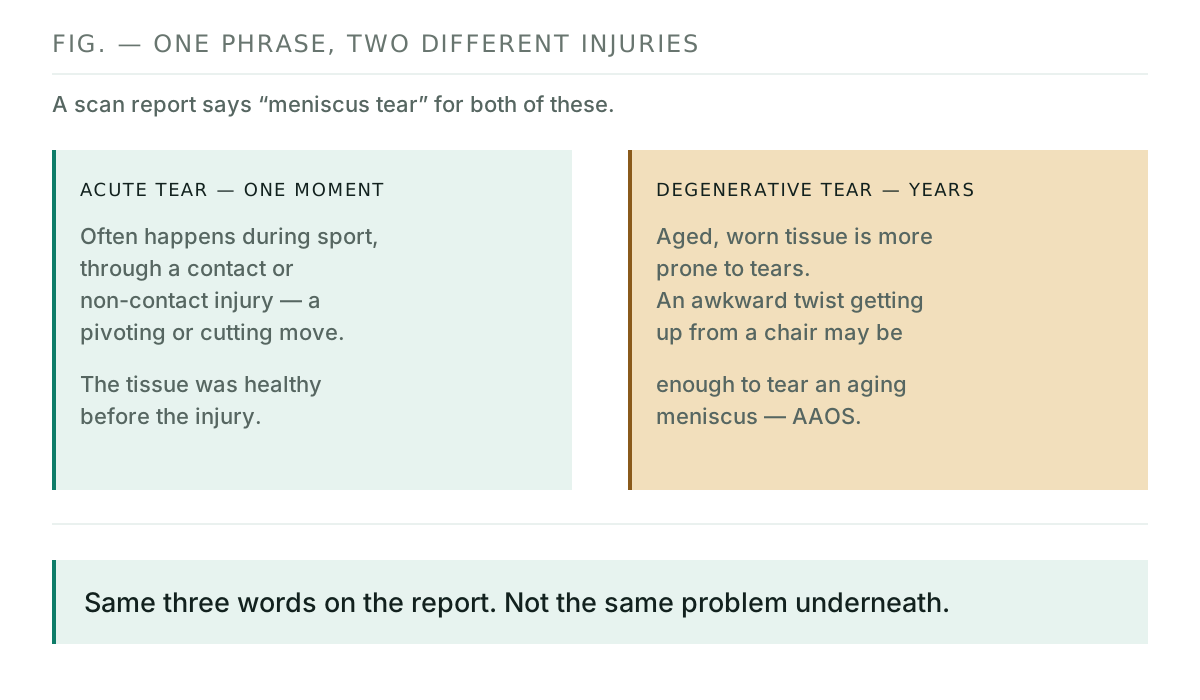
The first is the one everyone pictures. AAOS: "acute meniscus tears often happen during sports," through "either a contact or non-contact injury — for example, a pivoting or cutting injury." Healthy tissue, one bad movement, a specific moment the person can name.
The second is quieter. "As people age, they are more likely to have degenerative meniscus tears. Aged, worn tissue is more prone to tears." And then the sentence that makes the difference concrete: "an awkward twist when getting up from a chair may be enough to cause a tear in an aging meniscus."
Both end up described by the same three words in a report. They are not the same problem, and, as the rest of this article shows, they do not respond to the same treatment.
What a torn meniscus feels like
AAOS lists the common symptoms plainly: "pain, stiffness and swelling, catching or locking of your knee, the sensation of your knee giving way, inability to move your knee through its full range of motion."
And one detail that sends a lot of men to the doctor months late: "most people can still walk on their injured knee, and many athletes are able to keep playing with a tear." A knee that still works is not proof that nothing tore. It is one of the reasons a scan often happens long after the event that caused it — if there was an event at all.
What everyone reasonably assumed
Put those pieces together and the logic writes itself: the knee hurts, the scan shows a tear, the tear explains the pain, so trim the tear. That reasoning was standard for years, and it is stated in the opening of the study that tested it — when meniscal tears are found, "it is commonly assumed that the symptoms are attributable to them."
The weak point was never the surgery. It was the middle step: the assumption that a tear visible on a scan is the thing producing the pain.
2008: they scanned knees picked without asking about pain
Researchers in Framingham, Massachusetts took a different approach. Instead of scanning people who came in complaining, they recruited from census data and random phone dialling, and scanned the right knee of 991 adults aged 50 to 90 — chosen without regard to whether their knees bothered them at all. The results were published in the New England Journal of Medicine in 2008.
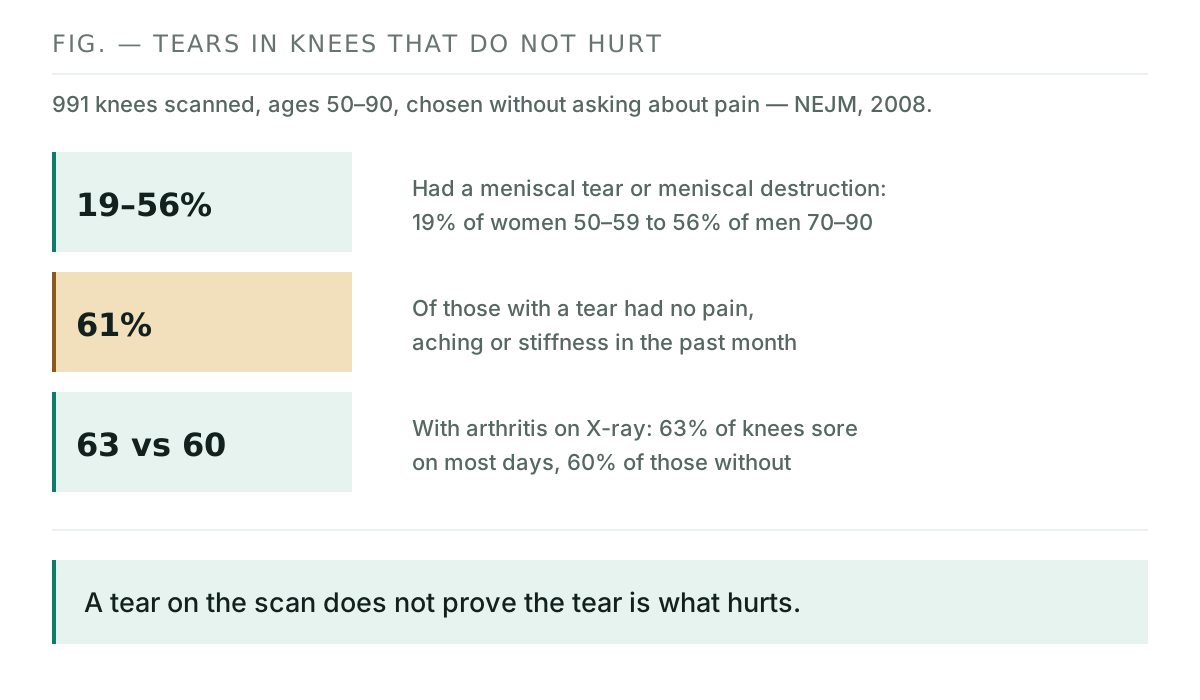
Meniscal damage was everywhere. The prevalence of "a meniscal tear or of meniscal destruction" ranged "from 19% (95% confidence interval [CI], 15 to 24) among women 50 to 59 years of age to 56% (95% CI, 46 to 66) among men 70 to 90 years of age." More striking still: "sixty-one percent of the subjects who had meniscal tears in their knees had not had any pain, aching, or stiffness during the previous month."
Among people with X-ray evidence of osteoarthritis, a meniscal tear was found in 63% of those with knee pain, aching or stiffness on most days — and in 60% of those without. Nearly the same rate in sore knees and comfortable ones. Englund et al., New England Journal of Medicine, 2008
The authors' conclusion was measured: "incidental meniscal findings on MRI of the knee are common in the general population and increase with increasing age." The practical translation is blunter. After 50, finding a tear tells you that you have an older knee. It does not, on its own, tell you what hurts.
2013: the surgery was compared with a pretend one
If the tear might not be the cause, then trimming it might not be the cure — a question that can only be answered by a trial. A Finnish group ran one of the strictest versions possible: 146 patients aged 35 to 65 with symptoms of a degenerative medial meniscus tear and no knee osteoarthritis, randomly assigned to arthroscopic partial meniscectomy or to sham surgery, with neither the patients nor the people assessing them knowing which had happened.
At 12 months, there were "no significant between-group differences in the change from baseline… in any primary outcome." Both groups improved, by roughly the same amount. The published conclusion: outcomes after the real operation "were no better than those after a sham surgical procedure."
2013 again: surgery against physical therapy
A second trial that year asked the question the other way, in a group where arthritis was already present. In the American METEOR trial, 351 patients aged 45 or older with a meniscal tear and mild-to-moderate osteoarthritis were assigned either to surgery followed by physical therapy, or to a standardised physical-therapy programme alone.
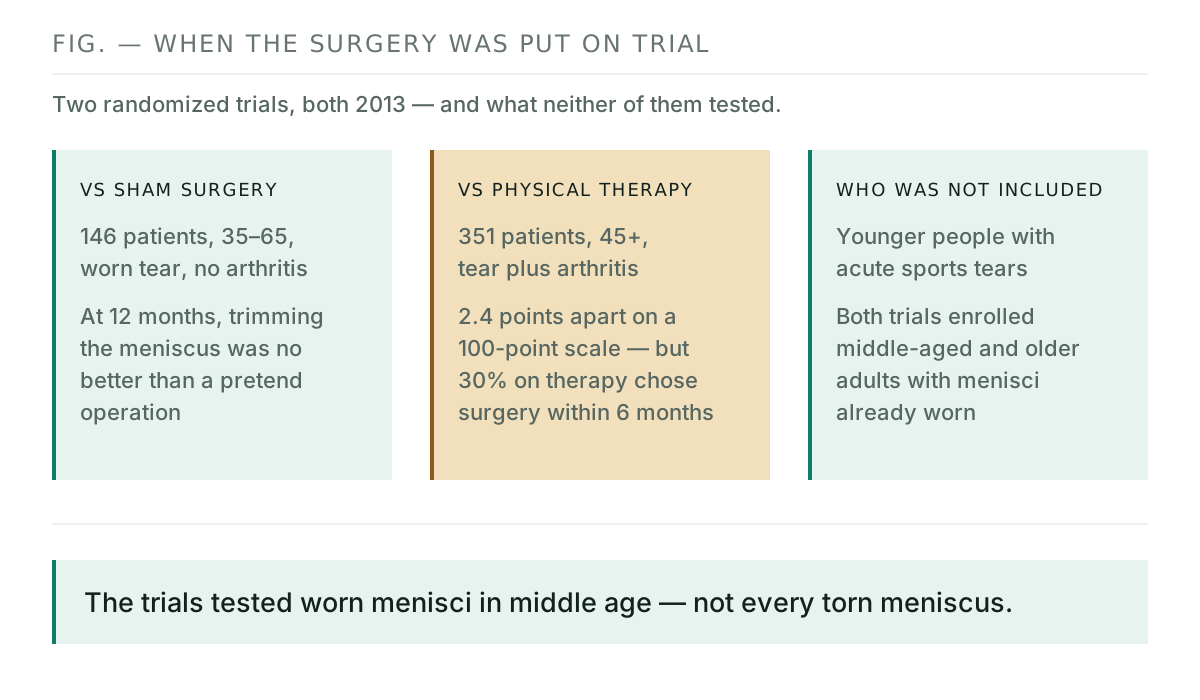
At six months, the surgery group improved by 20.9 points on a 100-point function scale and the therapy group by 18.5 — a difference of 2.4 points, with a confidence interval that crossed zero. Results at 12 months were similar. On average, adding the operation bought very little.
But this trial also carries the most important caveat in the whole article. Of the patients assigned to physical therapy alone, 30% had crossed over to surgery within six months. That is not a footnote. It means "start with physical therapy" is genuinely a starting point for a substantial minority, not a permanent verdict.
Where surgery still clearly belongs
Both trials recruited middle-aged and older adults with worn menisci: ages 35 to 65 without arthritis in one, 45 and older with arthritis in the other. A 24-year-old who felt a pop while pivoting was in neither study. The findings describe the group the old assumption was over-treating, and stop there.
AAOS also draws a line of its own around waiting. Nonsurgical treatment may be recommended "if your symptoms do not persist and you have no locking or swelling of the knee" — which puts a knee that locks or swells on the other side of that line.
Where the tear sits matters too, and here the anatomy is decisive. AAOS: "the outer one-third of the meniscus has a rich blood supply," and a tear in that red zone "may heal on its own or can often be repaired with surgery." By contrast, "the inner two-thirds of the meniscus lacks a significant blood supply," and without nutrients from blood, tears in that white zone "cannot heal."
That splits surgery into two quite different operations. A partial meniscectomy trims the damaged tissue away, with rehabilitation AAOS puts at "approximately 3 to 6 weeks." A meniscus repair stitches the torn pieces together so they can heal, and rehabilitation takes "about 3 to 6 months." The faster recovery is the one that removes tissue you were originally born with for a reason.
The part that usually gets left out
None of this says meniscus surgery is useless, and it would be dishonest to read it that way. It says that for a worn tear in a middle-aged knee, the operation performed no better than a convincing placebo, and no better than physical therapy by any statistically significant margin — while nearly a third of people who started with therapy still ended up choosing surgery.
There is a second honest limit. The Framingham study showed tears are common in knees without symptoms, not that tears never hurt. Some do. The point is that the scan alone cannot settle it, which puts the weight back on the story the knee tells: what you were doing when it started, whether it catches or locks, whether it gives way.
And a torn meniscus is not only a knee-pain question. As the pillar guide notes, a meniscus tear is one of the injuries that can lead to post-traumatic arthritis years later, which is another reason removing meniscal tissue is not a neutral act.
What to do with this
- Be able to date it. A specific pivot, twist or pop points one way; a knee that has been grumbling for years points the other. That history changes how much the scan is worth.
- Ask whether the tear explains the symptoms. Not whether it is there — after 50, it often is. Catching, locking and giving way are the symptoms AAOS lists for a torn meniscus, so say specifically whether you have them.
- Ask which operation is being proposed. Trimming tissue away and stitching it back together have different recoveries, 3 to 6 weeks versus 3 to 6 months, and different consequences.
- Treat physical therapy as a real first option for a worn tear. In the trial it came within 2.4 points of surgery — while leaving surgery available.
- Do not wait out a locked knee. AAOS ties nonsurgical treatment to symptoms that settle "and you have no locking or swelling of the knee," so a knee that locks or will not straighten is not the one to wait out.
The interesting part of this story is not that the surgery fell out of favour. It is that the assumption underneath it — the scan shows the problem, the problem is what hurts — had never actually been checked. When someone checked, in ordinary knees belonging to ordinary people, more than half of the tears turned out to belong to people with nothing to complain about.
Key takeaways
- The meniscus is two wedges of fibrocartilage that absorb shock, spread load and help stabilise the knee — AAOS.
- Acute tears come from pivoting or cutting injuries; degenerative tears happen in aged tissue, where rising awkwardly from a chair can be enough — AAOS.
- In 991 knees aged 50 to 90, a meniscal tear or meniscal destruction appeared in 19% to 56% of people, and 61% of those with a tear had no symptoms in the previous month — NEJM, 2008.
- With arthritis on X-ray, tears were found in 63% of those with knee symptoms on most days and 60% of those without them — the same study.
- Trimming a degenerative tear was no better than sham surgery at 12 months in 146 patients — NEJM, 2013.
- Surgery and physical therapy finished 2.4 points apart on a 100-point scale at six months, a difference that was not statistically significant — though 30% of the therapy group chose surgery anyway — NEJM, 2013.
- Tears in the outer third can heal or be repaired; tears in the inner two-thirds cannot heal, because there is no blood supply — AAOS.
Where to go from here
This is the eighth article in the joints section. The full set:
- Joint Pain After 40 — the pillar guide, covering osteoarthritis, rheumatoid arthritis and post-traumatic arthritis.
- Knee Pain: What's Different About Where It Hurts — front, outside, behind, or sudden swelling, and what each one usually means.
- Shoulder Pain After 40: What the Arm Can't Do — the ten-second test that separates a weak shoulder from a stiff one.
- Hip Pain Explained: Why It's Often Not the Hip — sudden or gradual, and why it is often felt somewhere other than the hip.
- Osteoarthritis vs Rheumatoid Arthritis: What Differs — how long the stiffness lasts, whether both sides hurt, and why one of the two has a clock on it.
- Rotator Cuff vs Frozen Shoulder: Two Fixes, Not One — one tissue heals on its own, the other does not, and why that changes what waiting buys.
- Knee Replacement: Is It Time, and What Will It Fix? — what to try first, what recovery really takes, and why expectations decide most regret.
- Glucosamine for Joint Pain: What the Trials Found — why the studies disagree, and what separates the positive trials from the negative ones.
Frequently asked questions
Can a meniscus tear heal on its own?
It depends where the tear sits. AAOS explains that the outer third of the meniscus has a rich blood supply, so a tear in that red zone may heal on its own or be repaired surgically. The inner two-thirds lacks a significant blood supply, and tears there cannot heal.
Does a meniscus tear on an MRI mean that is what hurts?
Not necessarily. In a 2008 study of 991 knees in adults aged 50 to 90, a meniscal tear or meniscal destruction showed up in 19% to 56% of people depending on age and sex, and 61% of those with a tear had no pain, aching or stiffness in the previous month. The tear can be a finding rather than the cause.
Is surgery necessary for a meniscus tear?
Often not, for a worn tear in middle age. In a 2013 trial of 146 patients aged 35 to 65 with a degenerative tear and no arthritis, trimming the meniscus was no better than sham surgery at 12 months. Neither that trial nor its companion enrolled younger people with acute sports tears, and AAOS reserves nonsurgical care for symptoms that settle with no locking or swelling of the knee.
How do I know if I tore my meniscus or just wore it out?
Mostly by how it started. AAOS describes acute tears happening during pivoting or cutting movements, often in sport. Degenerative tears happen in aged, worn tissue, where an awkward twist getting up from a chair can be enough. A scan can show the tear either way; the history is what separates them.
What does a meniscus tear feel like?
AAOS lists pain, stiffness and swelling, catching or locking of the knee, a sense of the knee giving way, and being unable to move it through its full range. Most people can still walk on the injured knee, and many athletes keep playing with a tear.
How long is recovery after meniscus surgery?
It differs by procedure. AAOS gives about 3 to 6 weeks of rehabilitation after a partial meniscectomy, where damaged tissue is trimmed away, and about 3 to 6 months after a meniscus repair, where the torn pieces are stitched together so they can heal.
Sources
- American Academy of Orthopaedic Surgeons (OrthoInfo) — Meniscus Tears
- American Academy of Orthopaedic Surgeons (OrthoInfo) — Arthritis of the Knee
- Englund et al., New England Journal of Medicine, 2008 — Incidental Meniscal Findings on Knee MRI in Middle-Aged and Elderly Persons
- Sihvonen et al., New England Journal of Medicine, 2013 — Arthroscopic Partial Meniscectomy versus Sham Surgery for a Degenerative Meniscal Tear
- Katz et al., New England Journal of Medicine, 2013 — Surgery versus Physical Therapy for a Meniscal Tear and Osteoarthritis

Male Health Guide Editorial Team
We write about the health problems men over 40 actually search for at 3 a.m. — and we say plainly when the evidence for a popular product is thin. We do not invent credentials and we do not publish sponsored copy as editorial. Read more about how we work.
Medical disclaimer: This article is general information about meniscus tears and the research on treating them, and is not medical advice. It is not a diagnosis, not a recommendation to have or to avoid any procedure, and not a substitute for examination by a clinician who can test the knee in question and see the imaging. Please speak to a qualified healthcare professional about your own situation.