Osteoarthritis vs Rheumatoid Arthritis: What Differs
Short answer
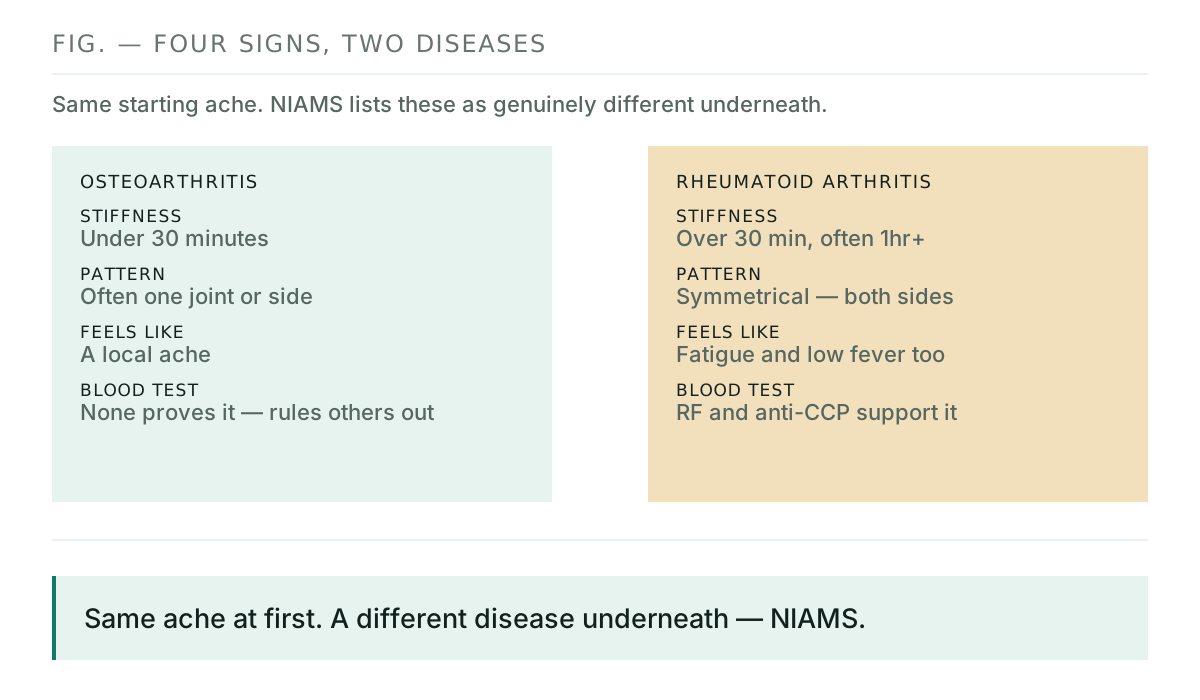
Osteoarthritis and rheumatoid arthritis can start with the same ache, but a handful of signs sort them well before any test: how long stiffness lasts, whether both sides hurt at once, and whether the whole body feels unwell or just the joint. Osteoarthritis stays local. Rheumatoid arthritis is a disease that happens to show up in joints first.
Two completely different diseases can hand a man the exact same complaint: a joint that aches, feels stiff, and does not want to cooperate in the morning. One is ordinary wear. The other is the immune system doing something on purpose. Both can start after 40, and from the outside, in the first week, they can look identical.
This is the fifth article in our joints section, and it does not sort by body part the way the knee, the shoulder and the hip articles do. It sorts by disease, using the signs that actually separate osteoarthritis from rheumatoid arthritis, so the rest of the cluster can keep saying "usually osteoarthritis" without leaving the exception unexplained.
We earn nothing from any of this. There is no brace, supplement or clinic being sold here, which is why this page can spend its time on what actually distinguishes these two diseases rather than steering every reader toward the same purchase.
Two different diseases, counted the same way
The pillar guide for this section already covers the basic split: osteoarthritis is cartilage wearing down mechanically, while rheumatoid arthritis is an autoimmune disease in which the immune system attacks the joint lining itself. This article does not re-walk that mechanism — it goes further into how the two actually present, and why the difference changes what happens next.
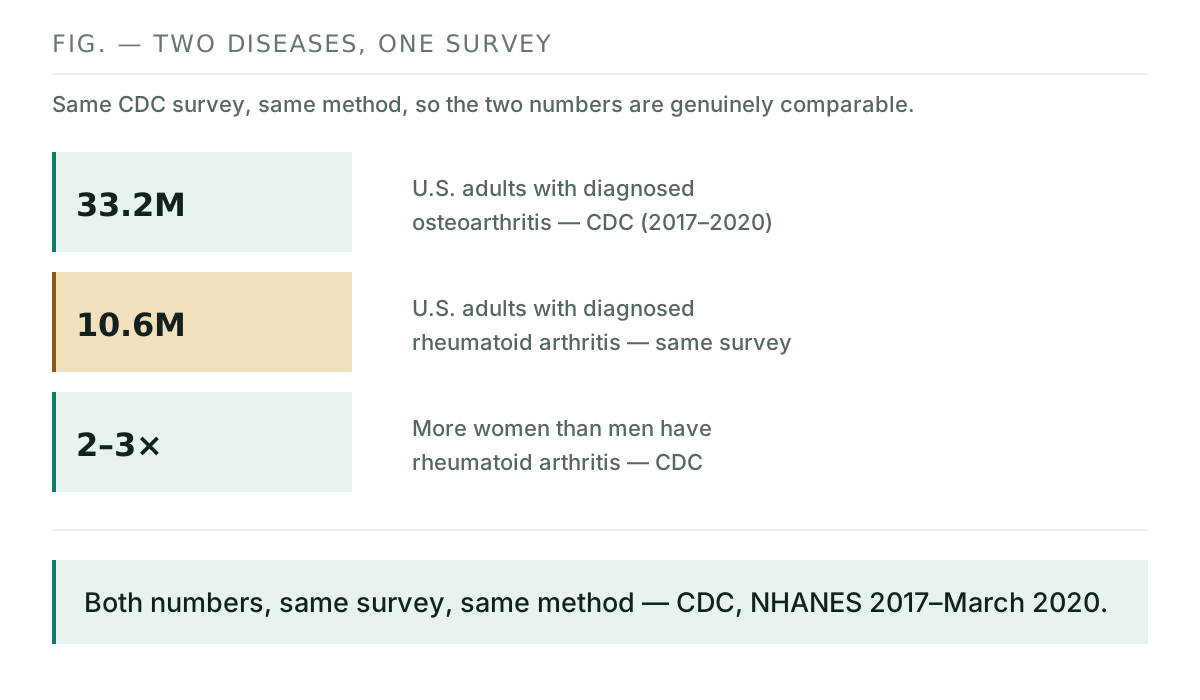
Using the same national survey, the CDC counts 33.2 million U.S. adults with diagnosed osteoarthritis and 10.6 million with diagnosed rheumatoid arthritis. Osteoarthritis is roughly three times more common, but ten million people is not a small number, and rheumatoid arthritis is the one of the two that behaves urgently.
How long the stiffness actually lasts
This is the detail worth timing before anything else. NIAMS describes osteoarthritis stiffness as usually lasting under 30 minutes after getting out of bed. Rheumatoid arthritis stiffness is described the other way: joint stiffness lasting longer than 30 minutes, typically after waking or after resting for a long period, and often an hour or more.
A knee that loosens up by the second cup of coffee is behaving like ordinary wear. A hand that is still locked an hour later is behaving like something the immune system is doing on purpose — and that single detail is worth bringing to an appointment before any test is ordered.
One side, or both at once
Rheumatoid arthritis has a habit osteoarthritis does not share. NIAMS states it "often occurs in a symmetrical pattern, meaning that if one knee or hand has the condition, the other hand or knee is often also affected." It commonly targets the wrists, hands and feet, on both sides, at the same time.
Osteoarthritis has no such rule. It can turn up in one knee, one hip, or the base of one thumb, and if it eventually shows up on both sides — which does happen, especially in weight-bearing joints — that is usually because both sides carried similar load or years, not because of a symmetrical disease process working through the body on a schedule.
Just the joint, or the whole body
This is where the two diseases stop resembling each other. NIAMS lists whole-body symptoms of rheumatoid arthritis that have nothing to do with any single joint: fatigue, occasional low-grade fever, and loss of appetite. The CDC adds that RA "can also affect the lungs, heart, and eyes" — not as rare complications, but as part of what the disease is capable of reaching.
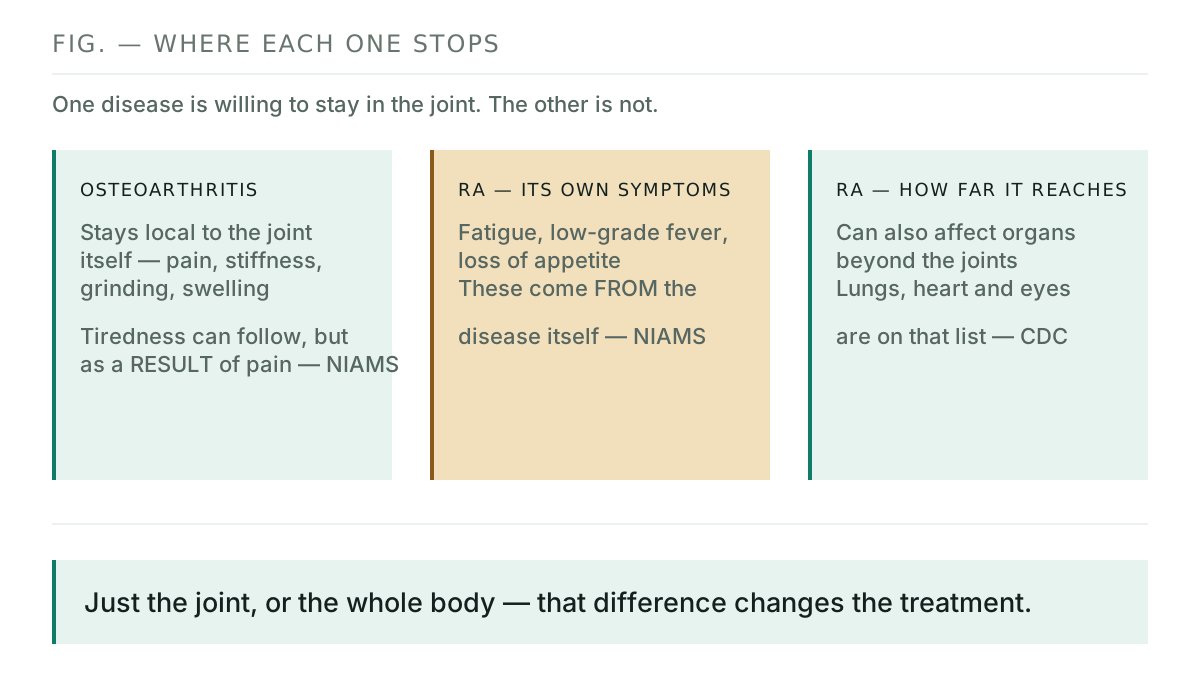
Osteoarthritis stays in its lane by comparison. NIAMS notes that "pain and other symptoms of osteoarthritis may lead you to feel tired, have problems sleeping, and feel depressed" — real effects, but downstream of pain and poor sleep, not the disease itself acting on organs the way rheumatoid arthritis can.
What blood work can, and can't, show
Here is a detail that surprises men who assume every disease has a test: NIAMS states plainly that "there is no single test for osteoarthritis." Blood work in an osteoarthritis workup exists to rule other causes out, not to confirm the diagnosis, and X-rays are used to look for loss of joint space, bone spurs and bone remodeling rather than to run a lab number.
Rheumatoid arthritis has two tests osteoarthritis does not: rheumatoid factor (RF) and anti-CCP antibody. NIAMS calls the combination "very useful in confirming a rheumatoid arthritis diagnosis" — but adds an honest limit, that "some people have rheumatoid arthritis even with normal blood tests." Neither disease hands a doctor a single number that settles it alone.
Who typically gets which one
Rheumatoid arthritis is not evenly distributed. The CDC states that "women are two to three times more likely to have RA" than men, and that risk "increases as people get older," peaking among adults 50 to 59. A man in this site's own audience is statistically less likely to be the one in the room with rheumatoid arthritis — but "less likely" is not "never," and the 10.6 million figure above is mostly not made up of women in their twenties.
Why getting this right has a clock on it
This is the part that makes the whole comparison more than trivia. NIAMS states that "rheumatoid arthritis may start causing joint damage during the first year or two" a person has the disease, and that "once joint damage occurs, it generally cannot be reversed" — which is exactly why NIAMS calls early diagnosis and treatment "very important."
NIAMS describes disease-modifying antirheumatic drugs, DMARDs, that "can help to slow or change the progression" of rheumatoid arthritis, with biologic response modifiers available if first-line treatment does not work. Osteoarthritis has no equivalent — treatment is pain relief, exercise, weight management and, if needed, surgery, not a drug that changes the disease itself. NIAMS
That asymmetry is the practical reason to sort these two diseases out rather than shrug and treat the ache the same way either way. A man who waits a year to find out he has rheumatoid arthritis loses a window that does not reopen. A man who waits a year on osteoarthritis has lost comfort, not a treatment option that no longer exists.
The part most comparisons leave out
Nothing above is a way to rule anything out at home. A man can have osteoarthritis in one knee and go on to develop rheumatoid arthritis in his hands years later — the two are not mutually exclusive, and having one does not protect against the other. NIAMS's own admission that some people test negative on blood work despite having rheumatoid arthritis cuts the other way too: a clean blood test does not fully clear it either.
The honest use of everything in this article is as a way to organize what to say at an appointment — how long the stiffness lasts, whether it is symmetrical, whether anything outside the joint feels wrong — not as a substitute for the exam and the blood work that actually settles it.
What to do with this
- Time the stiffness. Under 30 minutes points toward wear; well over 30 minutes, especially an hour or more, points toward an autoimmune process.
- Check both sides. The same joint bothering you on both left and right at once is a rheumatoid arthritis pattern, not a coincidence to ignore.
- Notice what else feels off. Fatigue, a low fever, or appetite loss alongside joint pain is worth mentioning, not filing under "getting older."
- Don't expect one number to settle it. Blood work supports a rheumatoid arthritis diagnosis but does not rule it out if negative, and there is no equivalent test for osteoarthritis at all.
- Don't sit on new joint symptoms for a year. If it turns out to be rheumatoid arthritis, the first year or two is when damage becomes permanent.
Same ache, two different diseases, and only one of them is racing a clock. Bringing the pattern — not just the pain — to the appointment is what actually moves a man from "it's probably just wear and tear" to an answer that changes what happens next.
Key takeaways
- Osteoarthritis stiffness usually lasts under 30 minutes; rheumatoid arthritis stiffness lasts over 30 minutes, often an hour or more — NIAMS.
- Rheumatoid arthritis often follows a symmetrical pattern, affecting both sides at once; osteoarthritis has no such rule — NIAMS.
- Rheumatoid arthritis brings whole-body symptoms — fatigue, low fever, appetite loss — and can affect the lungs, heart and eyes — NIAMS, CDC.
- There is no blood test that confirms osteoarthritis; rheumatoid factor and anti-CCP support a rheumatoid arthritis diagnosis, imperfectly — NIAMS.
- 33.2 million U.S. adults have diagnosed osteoarthritis and 10.6 million have diagnosed rheumatoid arthritis, counted in the same survey — CDC.
- Rheumatoid arthritis can cause permanent joint damage within the first year or two, which is why early treatment matters — NIAMS.
- Disease-modifying drugs exist for rheumatoid arthritis; osteoarthritis has no equivalent — only symptom management — NIAMS.
Where to go from here
This is the fifth article in the joints section. The rest are being written now, one at a time:
- Joint Pain After 40 — the pillar guide, covering osteoarthritis, rheumatoid arthritis and post-traumatic arthritis.
- Knee Pain: What's Different About Where It Hurts — front, outside, behind, or sudden swelling, and what each one usually means.
- Shoulder Pain After 40: What the Arm Can't Do — the ten-second test that separates a weak shoulder from a stiff one.
- Hip Pain Explained: Why It's Often Not the Hip — sudden or gradual, and why it is often felt somewhere other than the hip.
- Rotator Cuff vs Frozen Shoulder: Two Fixes, Not One — one tissue heals on its own given time, the other does not, and surgery means opposite things for each.
- Knee replacement — what gets tried first, and what recovery involves.
- Meniscus tear — injury or wear, and why imaging can blur the two.
- Glucosamine for joint pain — what the evidence actually shows.
Frequently asked questions
How long should morning stiffness last before it worries me?
NIAMS describes osteoarthritis stiffness as usually lasting under 30 minutes after waking. Rheumatoid arthritis stiffness is described as lasting longer than 30 minutes, typically after waking or after resting a long period, and often an hour or more.
Does it matter if both hands hurt, or just one?
Yes. NIAMS says rheumatoid arthritis often occurs in a symmetrical pattern, meaning if one hand or knee is affected, the other usually is too. Osteoarthritis has no such rule; it can turn up in a single joint or one side without that meaning anything by itself.
Can osteoarthritis make me feel sick all over, not just in the joint?
Indirectly. NIAMS notes that pain and other symptoms of osteoarthritis may lead you to feel tired, sleep poorly, and feel low, but that is a consequence of living with pain, not the disease acting elsewhere in the body the way rheumatoid arthritis does.
Is there a blood test that proves I have osteoarthritis?
No. NIAMS states there is no single test for osteoarthritis, and blood tests are used to rule out other causes rather than confirm it. Rheumatoid arthritis has two tests, rheumatoid factor and anti-CCP antibody, that support a diagnosis, though NIAMS notes some people have the disease even with normal results.
How many people actually have each condition?
Using the same national survey, the CDC counts 33.2 million U.S. adults with diagnosed osteoarthritis and 10.6 million with diagnosed rheumatoid arthritis. Rheumatoid arthritis also affects two to three times as many women as men.
Can someone have both osteoarthritis and rheumatoid arthritis at the same time?
Yes, and it is not rare after 50. Having one does not rule out the other, which is exactly why the signs in this article are a way to organize a conversation with a doctor, not a way to rule anything out on your own.
Sources
- Centers for Disease Control and Prevention — Distribution of Arthritis Subtypes Among Adults With Arthritis
- Centers for Disease Control and Prevention — Rheumatoid Arthritis
- NIAMS (National Institutes of Health) — Rheumatoid Arthritis
- NIAMS (National Institutes of Health) — Rheumatoid Arthritis: Diagnosis, Treatment, and Steps to Take
- NIAMS (National Institutes of Health) — Osteoarthritis: Diagnosis, Treatment, and Steps to Take
- NIAMS (National Institutes of Health) — Osteoarthritis

Male Health Guide Editorial Team
We write about the health problems men over 40 actually search for at 3 a.m. — and we say plainly when the evidence for a popular product is thin. We do not invent credentials and we do not publish sponsored copy as editorial. Read more about how we work.
Medical disclaimer: This article is general information comparing common features of osteoarthritis and rheumatoid arthritis, and is not medical advice. It is not a diagnosis, not a recommendation to start or stop any treatment, and not a substitute for examination and testing by a qualified healthcare professional. Please speak to a doctor about your own situation.