Carpal Tunnel Syndrome: Why It Wakes You at Night
Short answer
Carpal tunnel syndrome is pressure on the median nerve at the wrist, causing numbness, tingling and weakness in the hand. AAOS says nighttime symptoms are very common because most people sleep with their wrists bent. MedlinePlus is clear that typing and mouse use are not proven causes. Mild cases often improve with splinting; more than half of cases eventually need surgery.
It rarely starts as pain. It starts as a hand that falls asleep at 2 a.m., or a thumb that feels clumsy holding a coffee cup in the morning. Most men shake it off as a bad sleeping position for months before connecting the dots.
This article covers what carpal tunnel syndrome actually is, why it specifically targets sleep, what causes it (and what the evidence says doesn't), the exact tests a doctor uses to check for it, and the honest path from a wrist splint to surgery.
What carpal tunnel syndrome actually is
MedlinePlus describes carpal tunnel syndrome as excessive pressure on the median nerve at the wrist — the nerve that provides feeling and movement to the thumb, index finger, middle finger, and the thumb side of the ring finger. AAOS adds the anatomy: the carpal tunnel is a narrow passageway about an inch wide, with small wrist bones forming the floor and sides and a strong band of connective tissue, the transverse carpal ligament, forming the roof. Because these boundaries are rigid, the tunnel has little capacity to stretch.
Nine tendons that bend the fingers and thumb travel through the same tunnel alongside the nerve. When the tissue around those tendons swells, or the tunnel itself narrows, pressure builds on the nerve and reduces its blood supply — which is what produces the numbness, tingling, pain and weakness.
Why it wakes you at night specifically
AAOS states this plainly: nighttime symptoms are very common, and because many people sleep with their wrists bent, symptoms may wake them up. MedlinePlus's practical advice matches it exactly — avoid sleeping on your wrists, and wear a wrist splint at night for several weeks. AAOS explains why: keeping the wrist in a straight or neutral position reduces pressure on the nerve in the carpal tunnel.
During the day, AAOS notes symptoms often show up when holding something for a prolonged period with the wrist bent — using a phone, driving, or reading a book — and that many people find moving or shaking their hands brings relief. The pattern is the same mechanism at every hour: a bent wrist narrows the tunnel further and raises pressure on an already-compressed nerve.
Who gets it, and the causes that aren't what people assume
MedlinePlus states carpal tunnel syndrome occurs most often in people ages 30 to 60, and is more common in women than men. Some people are simply born with a smaller carpal tunnel. MedlinePlus also names two direct causes worth knowing: making the same hand and wrist motion over and over, and using hand tools that vibrate, such as drills or hammers. Beyond that, it lists alcohol use, wrist fractures and arthritis, a cyst or tumor in the wrist, infections, obesity, fluid retention during pregnancy or menopause, rheumatoid arthritis, and amyloidosis as contributing factors. AAOS separately names heredity, hand and wrist position, and thyroid gland imbalance.
That's different from what MedlinePlus says is NOT proven: studies have not proved that carpal tunnel syndrome is caused by typing on a computer, using a mouse, or repeating movements while working, playing an instrument, or playing sports. What those activities CAN do is cause tendinitis or bursitis in the hand, which narrows the carpal tunnel and leads to symptoms — an indirect route, not direct proof of the popular "keyboard causes it" claim.
The symptom list, and the sign it's gotten serious
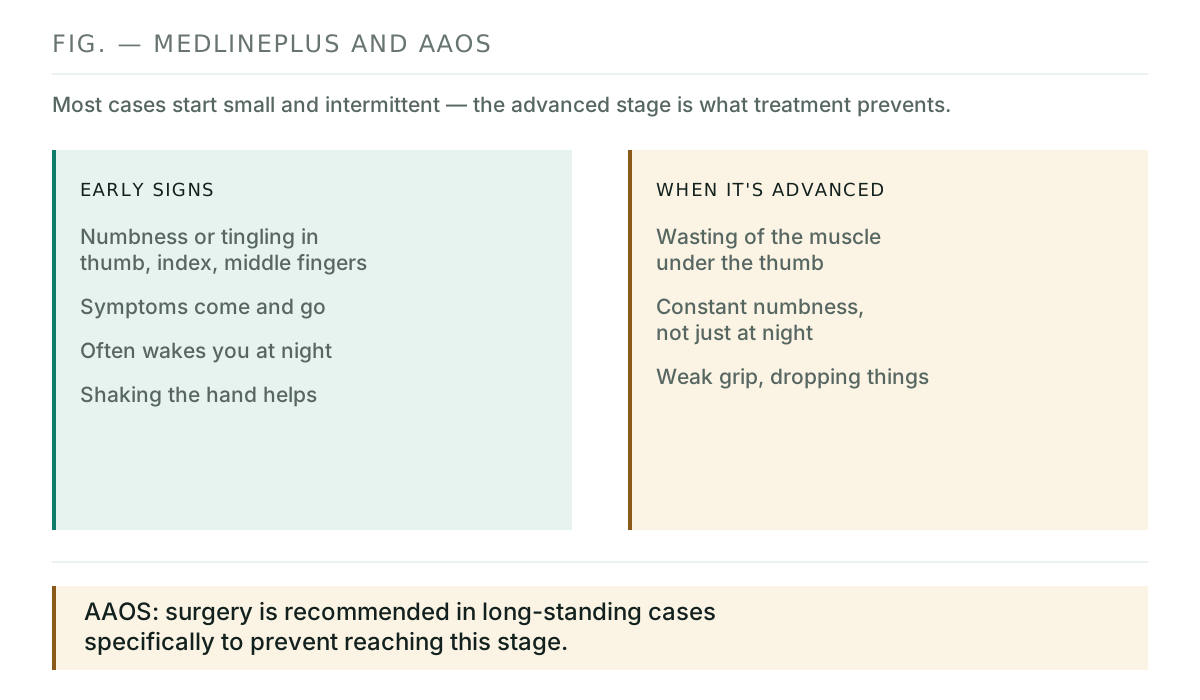
MedlinePlus lists numbness or tingling in the thumb and next two or three fingers, numbness in the palm, pain that extends to the elbow, clumsiness gripping objects, weak grip or difficulty carrying bags, and problems with fine finger movements. AAOS adds occasional shock-like sensations radiating into the fingers, and pain or tingling that can travel up the forearm toward the shoulder.
The sign both sources flag as advanced: MedlinePlus lists wasting of the muscle under the thumb as a feature of long-term cases, and AAOS states that in long-standing cases with constant numbness and thumb-muscle wasting, surgery is recommended to prevent irreversible damage. AAOS attributes dropping things to any of three causes — weakness, numbness, or a loss of proprioception, meaning awareness of where your hand is in space.
How a doctor actually checks
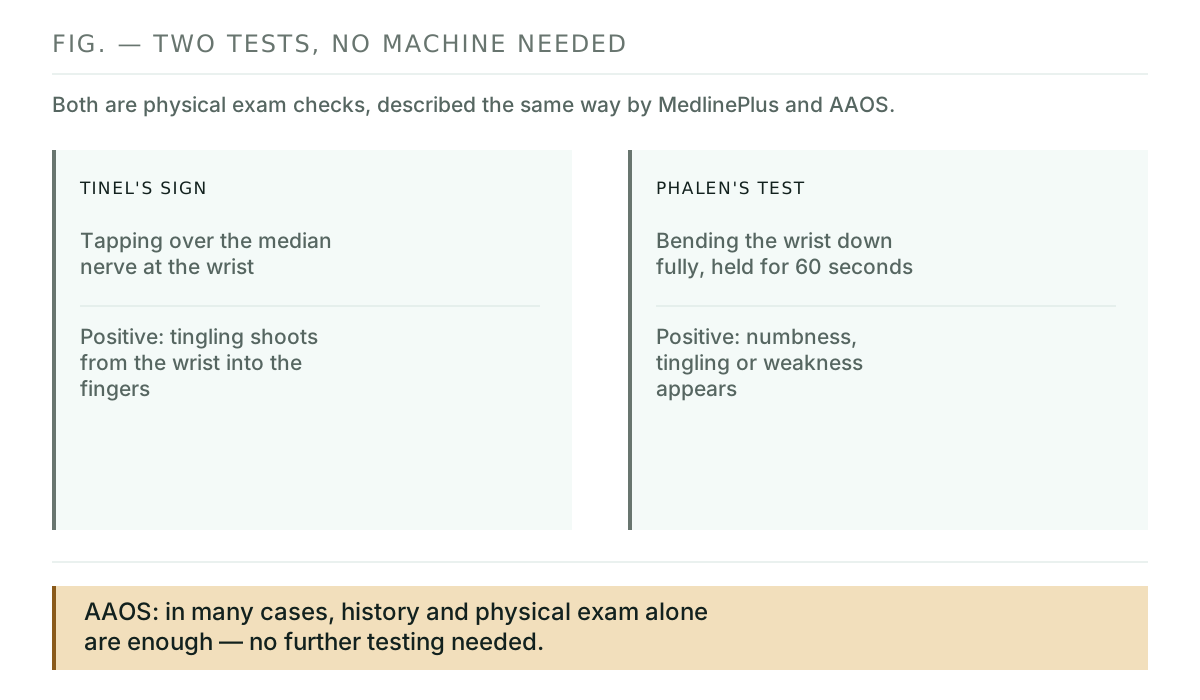
MedlinePlus describes two specific physical tests. Tapping over the median nerve at the wrist may cause pain to shoot from the wrist into the hand — this is called the Tinel sign; AAOS describes the same tap producing tingling into the fingers. Bending the wrist down all the way and holding it for 60 seconds will usually produce numbness, tingling or weakness in a positive case, per MedlinePlus — the Phalen test. AAOS describes the same maneuver, holding the wrist in a flexed position to check for numbness or tingling, and notes that in many cases, carpal tunnel syndrome can be diagnosed from history and physical exam alone, with no further testing needed.
When more testing is needed, AAOS lists nerve conduction studies and electromyography (EMG) to measure how well the nerve is conducting signals and whether muscle or nerve damage is present, plus ultrasound, X-rays, or MRI to rule out other causes like arthritis, a fracture, or a mass pressing on the nerve. MedlinePlus groups the nerve tests under electromyography and nerve conduction velocity testing.
What's tried first
- Wrist splint worn at night, and during the day if needed, to keep the wrist straight
- NSAIDs such as ibuprofen or naproxen
- Corticosteroid injection into the carpal tunnel — AAOS and MedlinePlus both note relief is usually temporary
- Activity and workstation changes — keyboard height, mouse type, work duties
- Nerve gliding exercises, per AAOS
AAOS notes that platelet-rich plasma (PRP) injections have shown temporary benefit in some studies but likely no long-term advantage. If symptoms are diagnosed and treated early, AAOS states they can often be relieved without surgery at all — which is the case for the stated reason it matters to see a doctor early, rather than waiting out months of nighttime numbness.
Surgery: when, and what recovery actually looks like
MedlinePlus states that symptoms often improve without surgery, but more than one half of cases eventually need it. AAOS bases the surgery decision on symptom severity, physical exam findings, response to non-operative treatment, and test results — not simply "it hasn't gone away."
The procedure, called carpal tunnel release, cuts the transverse carpal ligament to relieve pressure on the nerve. AAOS describes two techniques — open release through a small palm incision, and endoscopic release using a miniature camera through one or two smaller incisions — with similar outcomes between the two. Most carpal tunnel surgery is done as an outpatient procedure.
Nighttime symptoms improve dramatically for most patients within the first week. Grip and pinch strength usually return by 2 to 3 months, or 6 to 12 months if the nerve was in poor condition before surgery. Numbness and tingling improve over the first several months; in severe cases, normal sensation may take 6 to 12 months to return, and in very severe cases may never fully return. Complete recovery can take up to a year.
Like any surgery, carpal tunnel release carries real risk, even though serious complications are uncommon. AAOS lists the most common ones: bleeding, infection, wound healing issues, and nerve aggravation or injury. Your surgical team takes specific steps to minimize these, and it's worth asking what those steps are before the day of the procedure.
Prevention and when to see a doctor
MedlinePlus recommends using properly designed tools to reduce wrist injury risk, ergonomic aids like split keyboards and wrist braces to improve posture while typing, and taking frequent breaks — stopping as soon as tingling or pain starts. None of this guarantees prevention, since heredity and health conditions play a real role too.
MedlinePlus says to contact a provider if you have symptoms of carpal tunnel syndrome at all, if symptoms don't respond to rest and anti-inflammatory medicine, if there seems to be a loss of muscle bulk around the fingers, if fingers are losing more and more feeling, or if you're dropping things and becoming more clumsy with your hand. Earlier evaluation, per AAOS, is what keeps nonsurgical treatment on the table.
Key takeaways
- Carpal tunnel syndrome is pressure on the median nerve at the wrist — AAOS says nighttime symptoms are very common because most people sleep with bent wrists.
- MedlinePlus is explicit that typing and mouse use aren't proven causes, though related hand strain can narrow the tunnel indirectly.
- Tinel's sign and the Phalen test are simple physical exam checks that often settle the diagnosis without imaging.
- Splinting, NSAIDs and activity changes are tried first; more than half of cases eventually need surgery, per MedlinePlus.
- Complete recovery after surgery can take up to a year, and is slower the longer the nerve was compressed before treatment.
Where to go from here
If carpal tunnel is what brought you here, these pages cover related ground:
- Joint Pain After 40: What's Actually Wearing Down — the guide to this site's joints coverage.
- Osteoarthritis vs Rheumatoid Arthritis — RA is on AAOS's own list of carpal tunnel risk factors.
- Hypothyroidism: The Cutoff Moves, Treating It May Not Help — thyroid imbalance is another AAOS-listed risk factor.
- Glucosamine for Joint Pain: What the Trials Found — relevant if arthritis is part of your picture too.
- All joints articles
Frequently asked questions
What exactly is carpal tunnel syndrome?
MedlinePlus describes it as excessive pressure on the median nerve at the wrist, the nerve that allows feeling and movement to parts of the hand. AAOS adds that it occurs when the median nerve is squeezed or compressed as it travels through the carpal tunnel, a narrow passageway of ligament and small wrist bones about an inch wide.
Why does it wake me up at night specifically?
AAOS is direct about this: nighttime symptoms are very common, and because many people sleep with their wrists bent, symptoms may wake you up. MedlinePlus's own advice is specific — avoid sleeping on your wrists, and wear a wrist splint at night to keep the wrist straight.
Does typing or using a computer mouse cause it?
MedlinePlus is explicit that studies have not proved that carpal tunnel is caused by typing, using a mouse, or repeating movements at work, playing an instrument, or playing sports — though these activities may cause tendinitis or bursitis that narrows the tunnel and leads to symptoms. AAOS instead points to heredity, repetitive hand use, hand and wrist position, pregnancy, and conditions like diabetes and thyroid imbalance.
What are the warning signs it's gotten serious?
MedlinePlus lists wasting of the muscle under the thumb, fingers losing more and more feeling, and dropping things as signs of an advanced or long-term case. AAOS adds that constant numbness and muscle wasting around the thumb base, in long-standing cases, is when surgery is recommended to prevent irreversible damage.
Do I need surgery?
Not necessarily at first. MedlinePlus notes symptoms often improve without surgery, though more than one half of cases eventually need it. AAOS recommends nonsurgical treatment first for mild or uncertain cases, moving to surgery based on symptom severity, exam findings, and whether non-operative treatment has helped.
Can I prevent it?
MedlinePlus recommends using properly designed tools and equipment, ergonomic aids like split keyboards and wrist braces, and taking frequent breaks when typing — stopping as soon as you feel tingling or pain. Since heredity and health conditions also play a role per AAOS, prevention lowers risk but cannot eliminate it entirely.
Sources
- MedlinePlus (National Library of Medicine) — Carpal Tunnel Syndrome
- American Academy of Orthopaedic Surgeons (OrthoInfo) — Carpal Tunnel Syndrome
- Male Health Guide — Osteoarthritis vs Rheumatoid Arthritis (companion coverage of RA, a listed risk factor)
- Male Health Guide — Hypothyroidism Explained (companion coverage of thyroid imbalance, a listed risk factor)

Male Health Guide Editorial Team
We write about the health problems men over 40 actually search for at 3 a.m. — and we say plainly when the evidence for a popular product is thin. We do not invent credentials and we do not publish sponsored copy as editorial. Read more about how we work.
Medical disclaimer: This article is general information, not medical advice. We are not doctors, and nothing here diagnoses, treats or cures any condition. Whether your symptoms are carpal tunnel syndrome, and what treatment is right for you, requires evaluation by a qualified healthcare professional. Please speak to one about your own situation.