Hypothyroidism: The Cutoff Moves, Treating It May Not Help
Short answer
Hypothyroidism is diagnosed mainly by one blood test, TSH, but its normal range shifts upward with age, and symptoms alone predict it poorly. Even when a mild case is confirmed, the largest trial on treating it found no improvement in how people felt. The test matters; assuming a mild number means you are sick does not always hold up.
Hypothyroidism gets folded into almost every list of things that could explain being tired, gaining weight, or feeling cold all the time. That is not wrong, exactly — it genuinely can cause all three. The part usually left out is how blunt the instrument is: the test that decides has a moving target, the symptoms that supposedly point to it barely correlate with it, and treating the mildest, most common version does not reliably change how a person feels.
We earn nothing from any of this. There is no thyroid supplement, support formula, or test kit being sold on this page, which is why an article about a thyroid problem can spend most of its length on where the usual story oversimplifies.
What the test actually measures
The thyroid makes hormone; the pituitary gland makes a separate hormone, TSH (thyrotropin), whose job is to tell the thyroid how hard to work. When the thyroid underperforms, TSH rises as the pituitary tries to push it harder — which is why a high TSH, not a low one, is the signal of an underactive thyroid. A joint guideline from the American Association of Clinical Endocrinologists and the American Thyroid Association puts it plainly: "a serum thyrotropin is the single best screening test for primary thyroid dysfunction for the vast majority of outpatient clinical situations."
One test alone does not finish the diagnosis, though. A second hormone, free T4, is what separates two different situations that both show up as "high TSH." The large trial on subclinical hypothyroidism we cite below defines its own study population by both numbers at once: "persisting subclinical hypothyroidism (thyrotropin level, 4.60 to 19.99 mIU per liter; free thyroxine level within the reference range)." High TSH with a normal free T4 is subclinical — the mild, common version. High TSH with a low free T4 is overt hypothyroidism — the version with no real debate about treating it.
Why "normal" is not one number for every man
Here is the complication most explanations skip. A single upper limit for TSH, applied to every adult regardless of age, was built into the reference range used by the National Health and Nutrition Examination Survey (NHANES III). A 2007 reanalysis of that same population asked a pointed question: does the apparent rise in "subclinical hypothyroidism" with age reflect more sick people, or a population-wide shift in what a healthy TSH looks like as people get older?
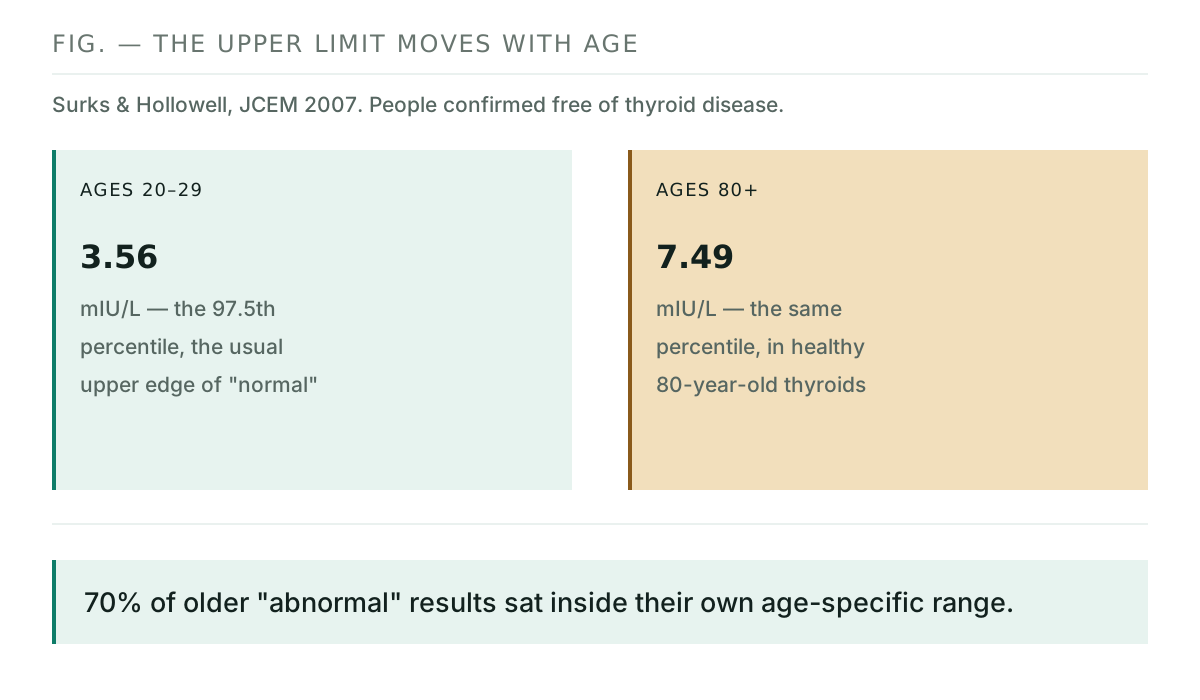
The answer was the second one. Among people confirmed to have no thyroid disease, "10.6% of 20- to 29-yr-olds had TSH greater than 2.5 mIU/liter, increasing to 40% in the 80+ group." The upper boundary of normal moved with it: "the 97.5 centiles for the 20-29 and 80+ groups were 3.56 and 7.49 mIU/liter, respectively." The authors' conclusion is the headline finding here: "the prevalence of SCH may be significantly overestimated unless an age-specific range for TSH is used." Using a single cutoff for everyone, they found that "seventy percent of older patients with TSH greater than 4.5 mIU/liter were within their age-specific reference range" — in plain terms, seven out of ten "abnormal" results in older adults were normal for that age.
This cuts against the instinct to treat a TSH of 5 or 6 the same way at every age. A man in his 70s with that number may simply be at the high end of what is typical for a 70-year-old thyroid, not showing early disease.
Symptoms alone rarely prove it
MedlinePlus lists the familiar roster: "Fatigue," "Weight gain," "A puffy face," "Trouble tolerating cold," "Joint and muscle pain," "Constipation," "Dry skin," "Dry, thinning hair," "Decreased sweating," "Depression," "Slowed heart rate," and "Goiter, an enlarged thyroid that may cause your neck to look swollen." Two items on the same list, "Heavy or irregular menstrual periods" and "Fertility problems in women," do not apply to a male reader — worth flagging, because a symptom list copied without that context can make a man think he is missing a sign that was never aimed at him. MedlinePlus adds that "because hypothyroidism develops slowly, many people don't notice symptoms of the disease for months or even years." Nearly every item that does apply to a man also has a dozen other common explanations, which is exactly the problem.
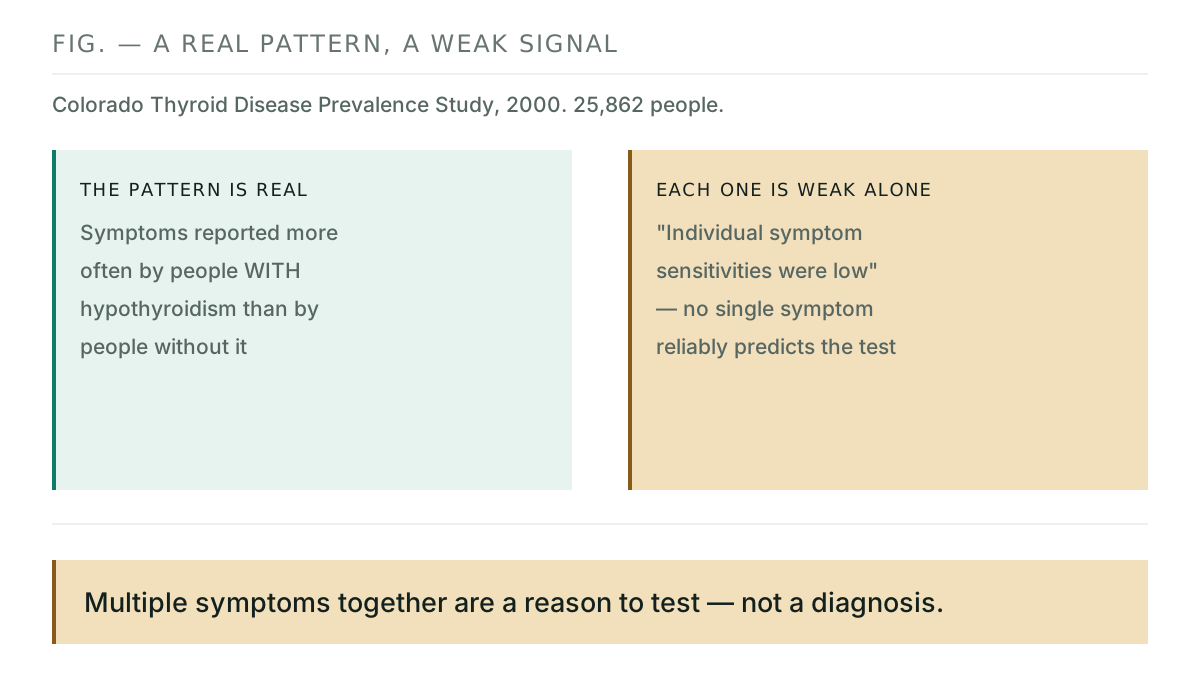
The Colorado Thyroid Disease Prevalence Study tested this directly in 25,862 people at a statewide health fair, comparing a hypothyroid symptoms questionnaire against actual blood results. Symptoms were reported more often by people with hypothyroidism than by people without it — the pattern exists. But "individual symptom sensitivities were low," meaning any single symptom, taken alone, was a weak predictor of the lab result. The study's own practical conclusion was not "trust your symptoms" or "ignore your symptoms." It was: "patients who report multiple thyroid symptoms warrant serum thyroid testing." Symptoms are a reason to test, not a replacement for testing.
The same health-fair survey found elevated TSH in 9.5% of participants and low TSH in 2.2%, and noted that "forty percent of patients taking thyroid medications had abnormal TSH levels" — a reminder that even people already being treated are often not well-controlled, which is itself an argument for periodic retesting rather than a one-time diagnosis.
Who actually runs higher risk
A separate, nationally representative sample of 17,353 Americans in NHANES III found overall "hypothyroidism was found in 4.6% of the U.S. population (0.3% clinical and 4.3% subclinical)," and that mean TSH "was higher in females than males" and increased with age in both sexes. The same survey measured two different antithyroid antibodies, and only one of them turned out to matter clinically: "TgAb were positive in 10.4 ± 0.5% and TPOAb, in 11.3 ± 0.4%," but "TPOAb were significantly associated with hypo or hyperthyroidism, but TgAb were not." Roughly one in nine people tested positive for TPOAb, the marker tied to the autoimmune process (Hashimoto's thyroiditis) behind most cases, and that one was "more prevalent in women than men" and rose with age in both sexes.
Age moves the TSH distribution upward decade by decade in both sexes, independent of disease, and for a man that is the risk factor he cannot opt out of just by being male: the sources here report mean TSH as lower in men than in women overall, but age still pushes every man's own number up over time. Beyond age, risk climbs with a personal or family history of thyroid disease, prior radiation to the neck, and autoimmune conditions such as type 1 diabetes or rheumatoid arthritis — conditions that run in the same direction as the antibody finding above. None of this is exotic; it is mostly a question of which boxes a given man checks.
The guideline's own uncertainty about when to treat
The same AACE/ATA guideline that calls TSH the best screening test does not treat every elevated result the same way. Its own words: "the decision to treat subclinical hypothyroidism when the serum thyrotropin is less than 10 mIU/L should be tailored to the individual patient." That is a guideline declining to give a blanket rule below 10. The guideline's summary does not spell out, in the sentence we can verify, exactly what it recommends above that line — only that the individualized judgment call is specific to the under-10 range.
What a major trial found when mild cases were treated
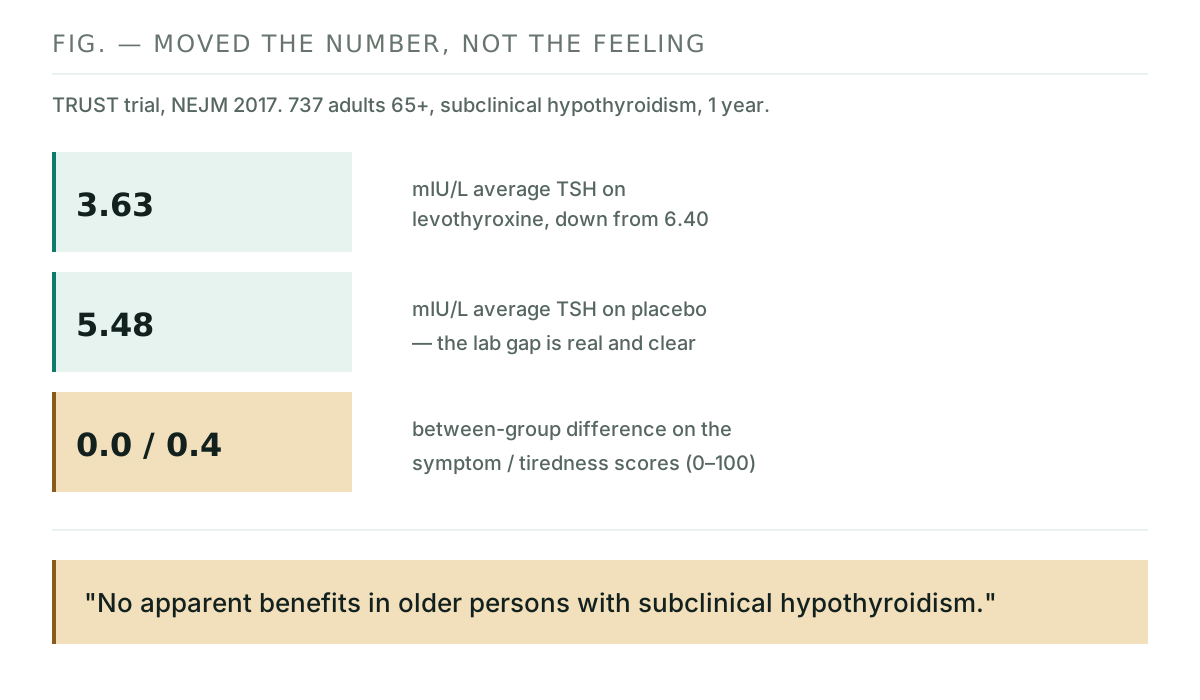
The strongest test of that individualized judgment call is the TRUST trial, a randomised, double-blind, placebo-controlled study of 737 adults 65 and older with confirmed, persisting subclinical hypothyroidism. Levothyroxine worked exactly as intended on the lab value: average TSH fell "to 3.63 mIU per liter in the levothyroxine group" compared with "5.48 mIU per liter" on placebo, "at a median dose of 50 µg."
On the two things that were actually supposed to improve, it did not move the needle. The trial measured a Hypothyroid Symptoms score and a Tiredness score, each 0 to 100, with 9 points set in advance as the smallest difference that would count as meaningful. The result: "no differences in the mean change at 1 year in the Hypothyroid Symptoms score... or the Tiredness score," with "no beneficial effects of levothyroxine... seen on secondary-outcome measures" either. The trial's own conclusion is unambiguous: "levothyroxine provided no apparent benefits in older persons with subclinical hypothyroidism."
This is a trial in adults 65 and older, not in men in their 40s or 50s, and it studied one outcome window of one year. It does not settle every question about every age group. It does directly contradict the assumption that correcting a mild lab abnormality will reliably correct the tiredness that prompted the test in the first place.
Why screening everyone is not recommended
Given a test this easy to order, why not just check every man's TSH as a matter of routine? The US Preventive Services Task Force looked at exactly that question for people without symptoms and landed on its most uncertain grade: "the USPSTF concludes that the current evidence is insufficient to assess the balance of benefits and harms of screening for thyroid dysfunction in nonpregnant, asymptomatic adults." That is an "I" statement — not a "no," but not a "yes" either.
The task force's reasoning, not just its grade, is the useful part: "screening for and treatment of thyroid dysfunction in nonpregnant, asymptomatic adults does not improve quality of life or provide clinically meaningful improvements in blood pressure, body mass index (BMI), bone mineral density, or lipid levels." That line about lipids is worth pausing on, because the Colorado study above found a real cross-sectional association between TSH and cholesterol — higher TSH tracked with higher lipid levels. An association on a snapshot and a benefit from treatment are two different claims, and the second one is the one that failed to show up in the evidence the task force reviewed.
The honest limits of all this
None of this is an argument against testing when you have real symptoms, risk factors, or a reason to suspect thyroid disease specifically. The USPSTF statement is about screening people with no symptoms at all; it says nothing about a man who already feels unwell and wants an answer. Getting tested when something is actually bothering you is a different decision than population-wide screening of everyone regardless of how they feel.
The TRUST trial's null result is specific to one population (65 and older), one drug regimen, and one year of follow-up. Overt hypothyroidism — high TSH with a low free T4 — is not what TRUST tested, and treating that version is not in dispute here. And a TSH persistently above 10, the range the guideline treats more firmly, is also outside what TRUST enrolled.
Finally, "symptoms predict it poorly" is a statement about group-level sensitivity, not a reason to dismiss how an individual man feels. The Colorado study's own conclusion was to test more readily when symptoms stack up, not to stop paying attention to them.
What to do with this
- If you have real symptoms or risk factors, ask for TSH and free T4 together. The pair, not TSH alone, is what separates overt from subclinical and from normal.
- Ask what reference range your lab used, and whether it is age-adjusted. A "high" result for a 30-year-old lab range may be ordinary for a man past 60.
- If the result is mildly high (TSH under 10) and you feel fine, ask about retesting before treating. The guideline itself calls this an individual judgment call, not an automatic prescription.
- If you start treatment for a mild result, track more than the lab number. The TRUST trial shows the number and how you feel can move independently of each other.
- Do not use this article to talk yourself out of testing when something feels wrong. The weak sensitivity of any one symptom is a reason to combine several and test, not a reason to wait.
The useful shift here is small and specific. A single TSH number, read without its age context and without a plan for what comes after, tells you less than it looks like it does. The number is the start of a conversation with a clinician, not the end of one.
Key takeaways
- "A serum thyrotropin is the single best screening test for primary thyroid dysfunction," per a joint AACE/ATA guideline — but free T4 is needed alongside it to distinguish overt from subclinical hypothyroidism.
- The upper limit of normal TSH is not fixed: the 97.5th percentile was 3.56 mIU/L at ages 20-29 and 7.49 mIU/L at ages 80+, and "seventy percent of older patients with TSH greater than 4.5" fell inside their own age-specific normal range.
- In a 25,862-person study, symptoms were reported more by people with hypothyroidism, but "individual symptom sensitivities were low" — the practical rule was to test when multiple symptoms stack up, not to diagnose from symptoms alone.
- NHANES III found hypothyroidism in 4.6% of the US population (0.3% clinical, 4.3% subclinical), with TSH "higher in females than males" and rising with age in both sexes.
- The guideline itself does not give a blanket rule for mild cases: "the decision to treat subclinical hypothyroidism when the serum thyrotropin is less than 10 mIU/L should be tailored to the individual patient."
- In the TRUST trial, 737 adults 65+ with subclinical hypothyroidism given levothyroxine for a year had TSH drop as intended, but "no apparent benefits" on hypothyroid-symptom or tiredness scores.
- The USPSTF rates screening asymptomatic adults an "I" (insufficient evidence), finding that screening and treatment "does not improve quality of life" or meaningfully change blood pressure, BMI, bone density, or lipids.
- None of this argues against testing a man who actually has symptoms or risk factors — the caution is about treating a borderline number automatically, not about ignoring real complaints.
Where to go from here
This is the fourth article in the energy section, and the last of the group covering causes that have a test behind them:
- Fatigue after 40 — sleepy and tired are not the same thing, and which one you have decides where to look.
- Anemia after 40 — in a man, a low-iron result is a finding that obliges a search, not a diagnosis on its own.
- Vitamin B12 — who is actually short of it, who is just taking it, and the newer question of whether high doses are free.
- Thyroid Nodule: Found by Accident, Rarely Cancer — a lump in the same gland, found a different way, sometimes alongside the Hashimoto's covered above.
- Caffeine — the daily lift is mostly withdrawal relief, not a boost above normal, and it can still cost you sleep six hours later.
- Brain fog — reported in a dozen unrelated conditions and defined inconsistently even by researchers, with a surprisingly specific fingerprint from sleep loss.
- Magnesium — common shortfall, rarely true deficiency, and the standard blood test is a poor way to check it.
- Vitamin D — the Endocrine Society withdrew its own cutoff in 2024 and now advises against routine testing for most adults, but still recommends it for three specific groups.
- CoQ10 — the best evidence isn't an energy study at all, it's a two-year heart-failure trial that cut deaths and hospital stays.
- Carpal Tunnel Syndrome: Why It Wakes You at Night — thyroid imbalance is on AAOS's own list of risk factors for this nerve condition.
In the meantime, the two sections this one borders on: sleep for everything on the nights, and testosterone for the hormone question.
Frequently asked questions
What test actually diagnoses hypothyroidism?
A guideline from the American Association of Clinical Endocrinologists and the American Thyroid Association states that "a serum thyrotropin is the single best screening test for primary thyroid dysfunction for the vast majority of outpatient clinical situations." Thyrotropin is TSH. A free T4 test alongside it distinguishes overt hypothyroidism (TSH high, free T4 low) from subclinical (TSH high, free T4 normal).
Is the normal TSH range the same at every age?
No. A study of the US population found the 97.5th percentile for TSH was 3.56 mIU/L for ages 20-29 and 7.49 mIU/L for ages 80 and up, and concluded that "the prevalence of SCH may be significantly overestimated unless an age-specific range for TSH is used." Seventy percent of older adults with TSH above 4.5 fell inside their own age-specific range.
Can I tell from my symptoms whether I have hypothyroidism?
Not reliably on your own. A study of nearly 26,000 people found that "individual symptom sensitivities were low" even though symptoms were reported more often by people with hypothyroidism than without it. The same study's practical conclusion was that patients reporting multiple thyroid symptoms warrant testing — the symptom pattern raises suspicion; it does not confirm or rule out the diagnosis by itself.
Does treating mild (subclinical) hypothyroidism make you feel better?
Not according to the largest trial on it. In 737 adults 65 and older with subclinical hypothyroidism, a year of levothyroxine produced "no apparent benefits" on a hypothyroid symptoms score or a tiredness score, despite successfully lowering TSH. The guideline itself says the decision to treat TSH under 10 mIU/L "should be tailored to the individual patient" rather than applied automatically.
Should every man get screened for hypothyroidism?
The USPSTF gives this an "I" grade, meaning the evidence is insufficient to weigh the benefits against the harms of screening asymptomatic adults, and found that screening and treatment "does not improve quality of life or provide clinically meaningful improvements in blood pressure, body mass index (BMI), bone mineral density, or lipid levels." Testing when you have symptoms or risk factors is a different question from population-wide screening.
Who is actually at higher risk of hypothyroidism?
Age is a risk factor no man opts out of: the TSH distribution itself shifts upward with age in both sexes, even though mean TSH runs lower in men than in women overall. Other risk factors apply regardless of sex: a personal or family history of thyroid disease, radiation to the neck, autoimmune conditions such as type 1 diabetes, and a positive TPOAb antibody test, which one national survey found in roughly one in nine adults and tied directly to thyroid disease (a second antibody, TgAb, was not).
Sources
- Surks & Hollowell, Journal of Clinical Endocrinology & Metabolism, 2007 — Age-specific distribution of serum thyrotropin and antithyroid antibodies in the US population
- Hollowell et al., Journal of Clinical Endocrinology & Metabolism, 2002 — Serum TSH, T4, and thyroid antibodies in the United States population (NHANES III)
- Canaris et al., Archives of Internal Medicine, 2000 — The Colorado thyroid disease prevalence study
- Garber et al., Endocrine Practice, 2012 — Clinical practice guidelines for hypothyroidism in adults (AACE/ATA)
- Stott et al. (TRUST trial), New England Journal of Medicine, 2017 — Thyroid Hormone Therapy for Older Adults with Subclinical Hypothyroidism
- US Preventive Services Task Force, 2015 — Screening for Thyroid Dysfunction
- MedlinePlus (National Library of Medicine, NIH) — Hypothyroidism

Male Health Guide Editorial Team
We write about the health problems men over 40 actually search for at 3 a.m. — and we say plainly when the evidence for a popular product is thin. We do not invent credentials and we do not publish sponsored copy as editorial. Read more about how we work.
Medical disclaimer: This article is general information about hypothyroidism and is not medical advice. It does not tell you what your own TSH result means or whether you should start, stop, or adjust any medication. Thyroid results deserve a clinician who knows your history and can order and interpret the full set of tests.