Anemia After 40: The Result That Starts a Search
Short answer
In a man over 40, iron-deficiency anemia is rarely the whole answer. It means iron is leaving faster than it arrives, and in a man the usual route is bleeding somewhere in the gut. Guidelines treat the result as a reason to look, not a reason to supplement and move on.
Most of what gets written about anemia is written about the symptom. You are tired, you look pale, you are short of breath on the stairs, and somewhere in the list of possible explanations sits a word that sounds like a diagnosis. That framing is not wrong, exactly. It is just aimed at the least important part.
The interesting thing about this particular result is what the medical guidelines do with it, and the thing they do is not treat it. They go looking. In an asymptomatic man, iron-deficiency anemia is one of the few ordinary blood findings that functions less like an answer and more like an instruction — and the instruction is to examine the inside of the gut, at both ends.
We earn nothing from any of this. There is no iron supplement, test panel or clinic being sold on this page, which is why an article about low iron can end by telling you the pills are the easy part.
What iron-deficiency anemia is, in numbers
Two separate things have to be true. The first is anemia: not enough hemoglobin, the protein in red blood cells that carries oxygen. The AGA technical review sets a working threshold and says in the same breath that it is not universal: "Although different societies and organizations have proposed different cutoffs for anemia, here we have defined anemia as a hemoglobin level <13 g/dL in men and <12 g/dL in nonpregnant women." The British Society of Gastroenterology cites the World Health Organization figure in different units — "below 130 g/L in men over 15 years of age," which is the same number — and adds a caution worth keeping: "The diagnostic criteria for anemia in IDA vary between published studies," and the normal range itself varies between populations.
The second is that the anemia is caused by a shortage of iron rather than by something else. MedlinePlus puts the mechanism in one line: "Iron deficiency anemia occurs when your body does not have enough iron. Iron helps make red blood cells." That distinction is not academic. The same review puts it simply: "The distinction between IDA and other types of anemia is important because a diagnosis of IDA often prompts further evaluation." Anemia with low iron sends you down the road this article describes. Anemia without low iron sends you down a different one, and nothing below applies to it.
Where does the iron go? The National Heart, Lung, and Blood Institute reduces it to one sentence: "When you lose blood, you lose iron." The institute lists gastrointestinal bleeding from inflammatory bowel disease, ulcers, colon cancer and celiac disease; traumatic injury or surgery; heavy menstrual periods or childbirth; bleeding in the urinary tract; and — this one matters for the age group reading this — "regular use of medicines such as aspirin or nonsteroidal anti-inflammatory drugs (NSAIDS), such as ibuprofen and naproxen that can lead to GI tract bleeding." Those are given as examples rather than as a complete list. A man who has been taking an anti-inflammatory for a bad knee for three years is not an unusual case. He is a common one.
How common it is, and which direction it moves with age
Anemia of all kinds is not rare, and it is not evenly spread. An analysis of five National Health and Nutrition Examination Surveys from 2003 to 2012, using WHO hemoglobin definitions, "estimated that an average of 5.6% of the U.S. population met the criteria for anemia and 1.5% for moderate-severe anemia during this 10-year period."
Two things in that paper are worth separating carefully. The first is the direction of travel with age: "Rates of anemia in men increased monotonically with age, while that of women increased bimodally with peaks in age group 40-49 years and 80-85 years." That abstract sentence has a bound the abstract itself leaves out, and the paper's own body states it: "anemia prevalence in males increased monotonically with age from 0.8% for age group 15-29 years to 26.3% for age group 80-85 years." From 15-29 upward, in other words — not across the whole male lifespan. Its Table 3 shows why the bound is needed: male prevalence runs 3.3% at ages 0.5 to 4, then 1.9%, then 1.6%, then bottoms out at 0.8% in the 15-29 band before climbing. For a man of 40 the practical reading is unaffected, because the climb covers his whole remaining life, but "it rises the whole way" would be false. The second figure is the direction of travel over time: the paper reports prevalence rising from 4.0% to 7.1%, and moderate-severe anemia from 1.0% to 1.9%, between 2003-2004 and 2011-2012.
We are deliberately not giving you a figure for "anemic men aged 40 to 64." That paper reports prevalence by sex and by age group, and multiplying one by the other would produce a number nobody measured. What it does support is the shape: for a man, this is a finding that gets more common every decade, not less.
Note also that this is anemia overall, from every cause. It is not a count of iron-deficiency anemia specifically, and the two are not interchangeable.
The same result, two different instructions
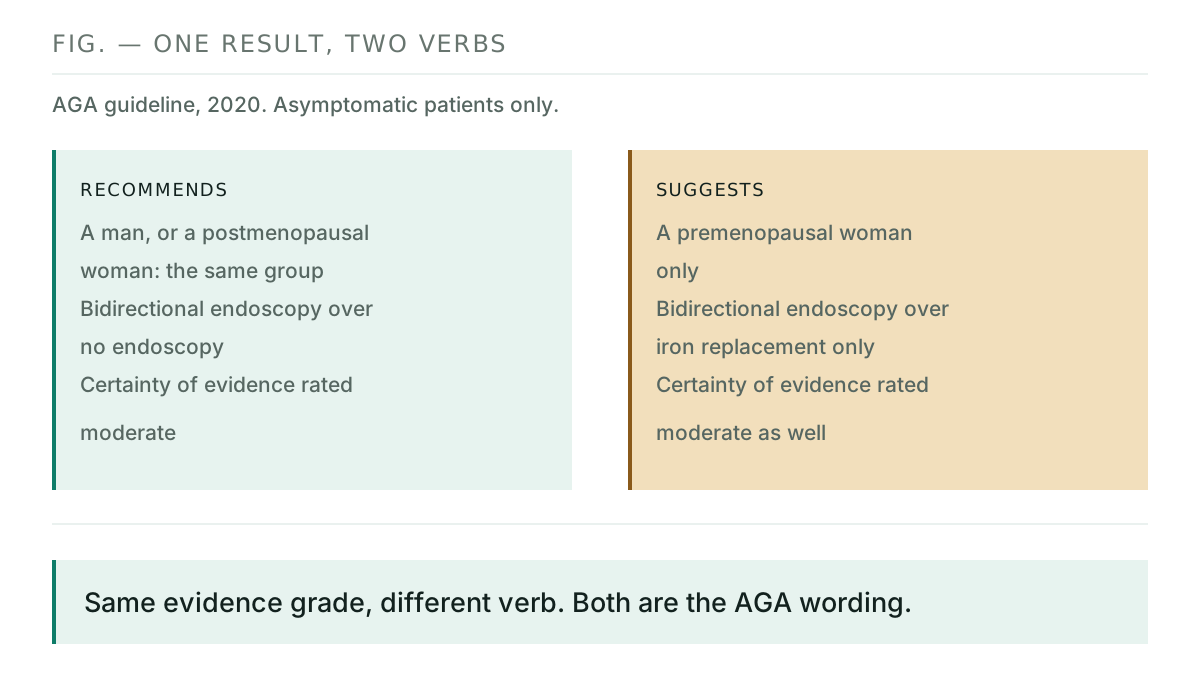
Here is the thing that makes this article worth writing. The AGA published seven numbered recommendations on how to evaluate iron-deficiency anemia. Two of them cover the same test result in different people, and the verb is not the same.
For one group: "In asymptomatic postmenopausal women and men with iron deficiency anemia, AGA recommends bidirectional endoscopy over no endoscopy." Bidirectional means both directions — the technical review spells out that it "refers to esophagogastroduodenoscopy (EGD) and colonoscopy," a camera down and a camera up.
For another: "In asymptomatic premenopausal women with iron deficiency anemia, AGA suggests bidirectional endoscopy over iron replacement therapy only." Suggests, not recommends — and the comparison is against iron alone rather than against doing nothing.
The interesting part is that the difference is not a difference in evidence quality. In the technical review, the certainty of evidence behind both of those is rated the same: moderate, in both cases "rated down due to indirectness." Same hemoglobin, same ferritin, same absence of symptoms, same grade of evidence. What changed is who is holding the printout. Why that should change the verb is not spelled out in the open-access material, so the explanation in the next paragraph is our reading of it. The guideline is not making a statement about biology there so much as about plausibility: a premenopausal woman has an obvious monthly route for losing iron, and a man does not. When a man is losing iron and nobody can say where it is going, the unexplained part is the finding.
The British Society of Gastroenterology says the same thing from the other direction, and adds the sentence that explains the urgency: "Unexplained IDA in all at-risk individuals is an accepted indication for fast-track secondary care referral in the UK because GI malignancies can present in this way, often in the absence of specific symptoms." Read that last clause twice. The absence of stomach symptoms is not reassurance. It is the scenario the referral pathway was built for.
What the search actually turns up
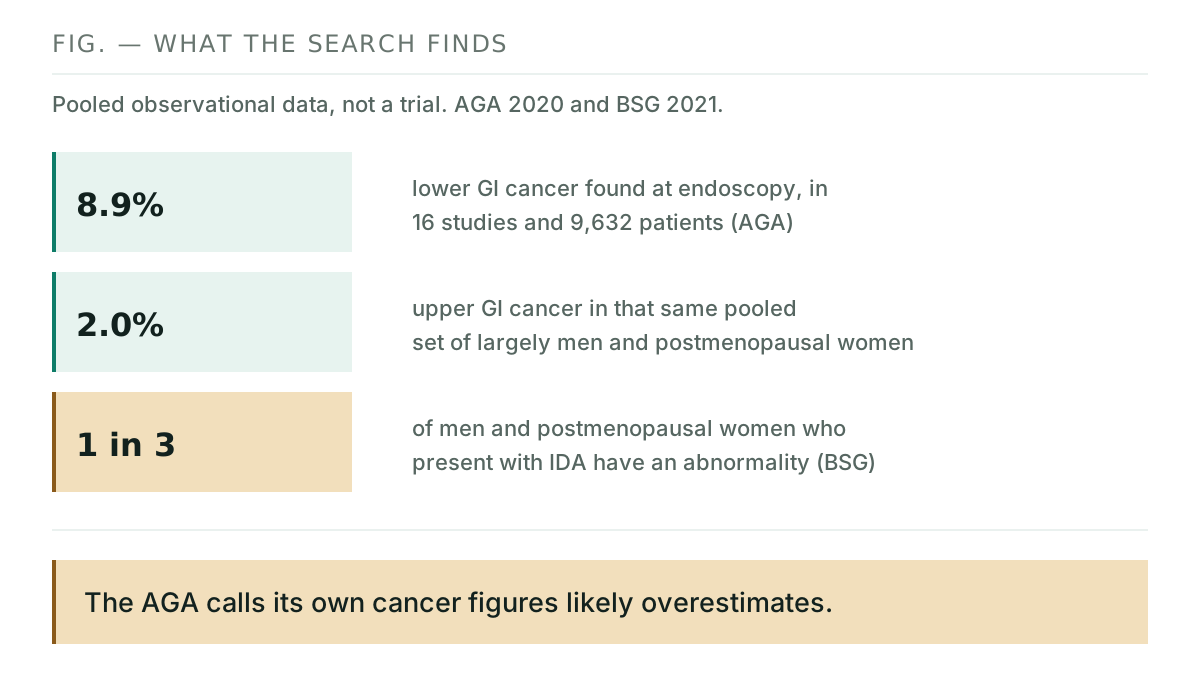
The AGA technical review that sits behind the guideline went looking for the diagnostic yield. It found 16 studies covering 9,632 patients and reported that "bidirectional endoscopy detected lower gastrointestinal malignancy in 8.9% (95% CI, 8.3-9.5) and upper gastrointestinal malignancy in 2.0% (95% CI, 1.7-2.3) of largely men and postmenopausal women with IDA."
That word "largely" is in the original, and it matters: the pooled population was mostly, not purely, men and postmenopausal women. So is the caveat the authors attach to the same figure elsewhere in the document — in the table and figure legend rather than in the line above, which is why we say attached rather than adjacent. We quote it in full because leaving it out would change what the number means: "Although this estimate is likely an overestimation due to the inclusion of symptomatic patients (high risk of bias), which makes the exact baseline risk for malignancy in IDA uncertain in this risk group, we have high certainty in the evidence that it is many fold higher … than an average risk screening population of similar age." The review puts a figure on that multiple in two places, once as "approximately 100-fold" and once as "up to 100-fold." The honest version of 8.9% is therefore: a pooled figure from referral populations that its own authors expect to be too high, attached to high certainty that the underlying risk is far above that of ordinary screening.
One more wrinkle, which we are reporting because it is in the source: the review states 16 studies and 9,632 patients in its text, while its own summary table logs the same outcome, detection of malignancy, as 12,040 participants across 18 studies. The premenopausal set has the same mismatch, 9 studies and 910 patients in the text against 1,026 participants across 10 studies in its table. We have used the figures the text gives in both cases and are flagging both tables.
The same review pooled 9 studies covering 910 patients for premenopausal women and found lower gastrointestinal malignancy in 0.9% (95% CI, 0.3-1.9) and upper in 0.2% (95% CI, 0.0-0.9), with the identical overestimation caveat. It is tempting to set 8.9% against 0.9% and call it a tenfold gap. We are not going to, because these are two separate pooled sets — 9,632 patients against 910, sixteen studies against nine — and the smaller one carries a confidence interval from 0.3% to 1.9%, which is wide enough that its own midpoint should not be used as a precise multiplier. The comparison supports a direction, not a ratio.
For the broader question of how often anything at all is found, the British guideline gives the cleanest single sentence: "Approximately a third of men and postmenopausal women presenting with IDA have an underlying pathological abnormality, most commonly in the GI tract." Not always cancer, and not always one obvious culprit: the technical review's own diagram of causes is captioned "Virtually any gastrointestinal tract lesion can bleed in an occult fashion." Note what that sentence counts: it is a proportion of the people who turn up with iron-deficiency anemia, not a yield figure for the examination, and the two are different quantities. Neither guideline says what share of that third is malignant, so we are not going to put a quantifier on it.
The cutoff that decides who gets searched
None of the above starts unless somebody decides your iron is low, and that decision runs through a single blood test with a contested threshold. The AGA's first recommendation is about exactly that: "In patients with anemia, AGA recommends using a cutoff of 45 ng/mL over 15 ng/mL when using ferritin to diagnose iron deficiency." The technical review behind it reports the firmest confidence it expresses anywhere in the document: "The certainty in the evidence with regard to the use of ferritin to make a diagnosis of iron deficiency is high."
The reason is a trade-off, and the numbers are specific. Drawing on a systematic review of 55 studies that used bone marrow biopsy as the reference standard, the technical review reports that at 15 ng/mL "the sensitivity was 0.59 (95% CI, 0.55-0.62), with a specificity of 0.99 (95% CI, 0.89-0.99)," while "a ferritin level of 45 ng/mL has a sensitivity and specificity for IDA of 0.85 (95% CI, 0.82-0.87) and 0.92 (95% CI, 0.91-0.94), respectively."
The review explains which error it was more afraid of, in its own words: "A false-negative ferritin level could label an iron-deficient anemic patient to be iron sufficient, leading to a delay in workup, including possibly missing an important gastrointestinal tract lesion," while a false positive "would label an iron-sufficient anemic patient as having IDA and lead to unnecessary workup, which is costly and poses increased risk to the patient." It then states the goal plainly: "We explored a ferritin threshold that minimizes false negatives without significantly increasing false positives."
It also modeled what the stricter line costs. In its worked example, "in a scenario in which the prevalence of IDA among 1000 anemic patients was 20%, using a ferritin of cutoff of 15 ng/mL would miss 48 patients with IDA or approximately one-quarter of all patients with true IDA." The looser cutoff misses fewer, at the price of more false alarms, and the guideline decided that was the better trade.
The practical consequence for a reader is narrow but real. A ferritin of 30 is above the old line and below the current one. If yours came back in that band alongside anemia, the current guideline treats you as iron deficient.
What the guideline asks for, step by step
The seven recommendations form a sequence, and the later ones are about not over-testing. After bidirectional endoscopy comes less, not more.
- If endoscopy finds nothing: "AGA suggests noninvasive testing for Helicobacter pylori, followed by treatment if positive, over no testing."
- Against routine extra sampling: "AGA suggests against the use of routine gastric biopsies to diagnose atrophic gastritis."
- For suspected celiac disease: "AGA suggests initial serologic testing, followed by small bowel biopsy only if positive, over routine small bowel biopsies" in asymptomatic adults "with iron deficiency anemia and plausible celiac disease."
- And when the examination comes back clean: "In uncomplicated asymptomatic patients with iron deficiency anemia and negative bidirectional endoscopy, AGA suggests a trial of initial iron supplementation over the routine use of video capsule endoscopy."
That last one is the shape of the whole document. Look properly once; if the look is clean, treat the iron rather than keep looking. The review's figure for capsule endoscopy explains the restraint: across 16 studies and 2,899 patients, "VCE detected malignancy in 1.3% (95% CI, 0.8-1.8) of patients with IDA and negative bidirectional endoscopy." The authors rated the certainty of that evidence very low, saying they could identify only "studies of the diagnostic yield of VCE that were limited by very serious risk of bias."
Where the iron pills fit, and they do fit
Nothing here is an argument against taking iron. The British guideline is explicit that both halves are needed: "optimal management of IDA requires IRT in combination with appropriate investigation to establish the underlying cause." In combination. The same guideline complains that in practice "the role of IRT for symptom relief" has been "neglected" — so the under-treatment it worries about runs in both directions.
Iron works, and reasonably fast. MedlinePlus notes that "iron supplements (most often ferrous sulfate) build up the iron stores in your body," that "often your anemia will improve or resolve with 6 weeks of iron therapy," and that even then "you will need to keep taking iron for another 6 months to replace your body's iron stores in your bone marrow." The British guideline goes further and treats the speed of response as information in itself, recommending that "a good response to iron therapy (Hb rise ≥10 g/L within a 2-week timeframe) in anemic patients is highly suggestive of absolute iron deficiency, even if the results of iron studies are equivocal."
The problem with starting iron alone, on your own, is not that it fails. It is that it works. The number comes up, the tiredness eases, the reason to investigate quietly disappears, and whatever was draining the iron carries on draining it. In a man over 40 that is the one sequence worth avoiding, and it is the easiest one to fall into, because a bottle costs a few dollars and an appointment costs an afternoon.
A separate situation, worth naming because it is not the same thing: low ferritin without anemia. The British guideline reviews it under the name non-anemic iron deficiency and reports a mixed picture — a meta-analysis found that it "was not significantly associated with physiological impairment assessed objectively by VO2 max or respiratory exchange ratio max," and that iron therapy "did not significantly improve either these parameters or maximal heart rate," while there is "evidence that IRT may provide subjective improvement of fatigue, mental quality of life and subjective cognitive function in premenopausal women." That subjective evidence is reported in premenopausal women, which is not this site's readership. The guideline's own conclusion is that "given the safety of the available iron preparations, it would be reasonable to offer treatment for NAID if symptomatic." We are reporting its position, not substituting ours.
When none of this applies to you
The recommendation has boundaries, and the technical review draws them itself. It states that the guideline "addresses the gastrointestinal evaluation of IDA primarily in patients without dominant gastrointestinal tract symptomatology, who we have considered asymptomatic," and that "in patients who have gastrointestinal symptoms, evaluation should be site-directed." If you have bleeding, pain, a change in bowel habit or difficulty swallowing, you are not in the group this article describes, and the route is aimed at the symptom instead. One caution from the review is worth carrying across even though it is addressed to the other group: writing about patients who do have prominent gut symptoms, it notes that "a careful history is fundamentally important in these patients because subtle symptoms are often present and should be sought after." The "these patients" there are the symptomatic ones, not you — but the reason the sentence exists is that the line between the two groups is drawn by how carefully somebody asked.
It also assumes no other obvious route for the blood to be leaving by. The review's conclusion for men and postmenopausal women is explicit about its own precondition: "This assumes that there is no other obvious source of chronic blood loss." That sentence is about blood loss specifically, and says nothing about diet or absorption. Our own example of what it would cover, not the review's: a man who donates blood frequently.
And one point of scope that is easy to miss: the review says that choosing between oral and intravenous iron "was outside the scope of this review." Nothing here tells you which form of iron to take, or by which route.
The honest limits of all this
The yield figures are the weakest part of the evidence, and the people who produced them say so first. The certainty was "rated down due to indirectness," and the reason is that the direct comparison was never done: "Because we could not identify any study, randomized or nonrandomized, that compared bidirectional endoscopy with observation or oral iron therapy alone in patients with IDA in any population group," the panel assembled indirect evidence instead — screening-colonoscopy reviews, observational yield studies and complication rates. What it describes as supporting the practice is "moderate-quality indirect evidence."
Two of the numbers above do not line up perfectly inside their own source, and we would rather say so than tidy it. The study count for the malignancy yield appears as 16 studies and 9,632 patients in the text and as 18 studies and 12,040 participants in the summary table. And the pooled sensitivity of 0.59 for the 15 ng/mL cutoff would imply missing more than four in ten true cases, while the review's own worked example describes that cutoff missing "approximately one-quarter." We have quoted both as published rather than reconciling them, and we have not done the arithmetic ourselves.
A note on which documents we read. The seven recommendations are quoted from the AGA's own published list of them. Everything quoted about the evidence behind those recommendations comes from the published technical review, which is open access. We did not quote the guideline article itself beyond those recommendations, because its full text sits behind a paywall and we do not quote what we have not read.
Our own framing has a limit too. Calling this result "an instruction" is our phrase, not the guideline's. What the guideline actually does is use "recommends" for one group and "suggests" for another, with the same moderate certainty of evidence behind both; reading that difference as an instruction attached to the result is our interpretation. We think it is a fair reading of a document that asks for looking before treating. It is still a reading.
Finally, the direction most readers arrive from is backwards. You are probably here because you are tired, and tiredness is a poor route to this diagnosis. In the VAMPIRE trial of 325 patients presenting with new unexplained fatigue in Dutch general practice, "eight percent of patients had a somatic illness that was detectable by blood-test ordering" — and that 8% covers every blood-test finding of any kind, not anemia on its own. That sample was 71% women with a mean age of 41, so it does not map cleanly onto men over 40 either. Anemia is worth knowing about because of what it obliges when it is there, not because it is a likely explanation for being tired. Our guide to fatigue after 40 covers the wider sorting.
What to do with this
- Ask for the two numbers together. Hemoglobin tells you whether there is anemia; ferritin tells you whether iron is the reason. One without the other leaves the question open.
- Know which cutoff was used. The AGA recommends 45 ng/mL over 15 ng/mL. A ferritin in the thirties reads differently under the two.
- Do not treat first and investigate later. The British guideline asks for iron therapy "in combination with appropriate investigation," not instead of it.
- Do not take the absence of stomach symptoms as reassurance. Gastrointestinal cancers "can present in this way, often in the absence of specific symptoms."
- Mention every anti-inflammatory you take. The NHLBI lists regular aspirin or NSAID use among the causes of blood loss, and a long-running knee prescription is easy to forget to mention.
- Ask whether a ferritin was done at all. A hemoglobin alone cannot tell anyone whether iron is the reason, and it is the iron part that sets off the search.
The useful shift here is small and worth making. A low hemoglobin with low iron is not a condition you have; in a man it is a question somebody has not answered yet. The pills are the easy half. The question is the half that matters.
Key takeaways
- The AGA technical review defines anemia as "a hemoglobin level <13 g/dL in men and <12 g/dL in nonpregnant women," while noting that "different societies and organizations have proposed different cutoffs"; the British Society of Gastroenterology cites the WHO threshold as "below 130 g/L in men over 15 years of age."
- For asymptomatic men and postmenopausal women the AGA "recommends bidirectional endoscopy over no endoscopy"; for asymptomatic premenopausal women it only "suggests" it, and against iron alone. The certainty of evidence is rated moderate for both, so the asymmetry is not one of evidence quality — reading it as a difference in baseline risk is our interpretation.
- AGA technical review, 16 studies and 9,632 patients: bidirectional endoscopy "detected lower gastrointestinal malignancy in 8.9% (95% CI, 8.3-9.5) and upper gastrointestinal malignancy in 2.0% (95% CI, 1.7-2.3) of largely men and postmenopausal women with IDA."
- Those authors call their own figure "likely an overestimation due to the inclusion of symptomatic patients (high risk of bias)" — while holding high certainty that the risk is well above a screening cohort.
- British Society of Gastroenterology: "Approximately a third of men and postmenopausal women presenting with IDA have an underlying pathological abnormality, most commonly in the GI tract."
- Ferritin cutoff: against bone marrow biopsy, 45 ng/mL has pooled sensitivity 0.85 (95% CI, 0.82-0.87) and specificity 0.92 (95% CI, 0.91-0.94); 15 ng/mL has pooled sensitivity of only 0.59 (95% CI, 0.55-0.62). The review set out "a ferritin threshold that minimizes false negatives without significantly increasing false positives."
- Iron is half the treatment, not a substitute for the other half: "optimal management of IDA requires IRT in combination with appropriate investigation to establish the underlying cause."
- The absence of gut symptoms is not reassurance — gastrointestinal malignancies "can present in this way, often in the absence of specific symptoms."
Where to go from here
This is the second article in the energy section. The map that sorts the rest:
- Fatigue after 40 — sleepy and tired are not the same thing, and which one you have decides where to look.
- Vitamin B12 — who is actually short of it, who is just taking it, and the newer question of whether high doses are free.
- Hypothyroidism — the normal range moves with age, and treating the mildest version did not change how a large trial's patients felt.
- Caffeine — the daily lift is mostly withdrawal relief, not a boost above normal, and it can still cost you sleep six hours later.
- Brain fog — reported in a dozen unrelated conditions and defined inconsistently even by researchers, with a surprisingly specific fingerprint from sleep loss.
- Magnesium — common shortfall, rarely true deficiency, and the standard blood test is a poor way to check it.
- Vitamin D — the Endocrine Society withdrew its own cutoff in 2024 and now advises against routine testing for most adults, but still recommends it for three specific groups.
- CoQ10 — the best evidence isn't an energy study at all, it's a two-year heart-failure trial that cut deaths and hospital stays.
In the meantime, the two sections this one borders on: sleep for everything on the nights, and testosterone for the hormone question.
Frequently asked questions
What counts as anemia in a man?
The AGA technical review defines it as "a hemoglobin level <13 g/dL in men and <12 g/dL in nonpregnant women," noting in the same sentence that "different societies and organizations have proposed different cutoffs." The British Society of Gastroenterology cites the WHO figure as "below 130 g/L in men over 15 years of age," which is the same number in different units.
Why does iron-deficiency anemia in a man mean a gut examination?
Because men have no routine monthly route for losing blood, so unexplained iron loss points at bleeding. For asymptomatic men and postmenopausal women the AGA "recommends" bidirectional endoscopy over no endoscopy; for premenopausal women it only "suggests" it, and against iron alone rather than against nothing. The certainty of evidence is rated moderate in both cases, so the difference is not one of evidence quality. Reading it as a difference in baseline risk is our interpretation, not a statement either document makes.
How often does the examination find cancer?
In the AGA technical review, 16 studies covering 9,632 patients found lower gastrointestinal malignancy in 8.9% (95% CI, 8.3-9.5) and upper gastrointestinal malignancy in 2.0% (95% CI, 1.7-2.3) of "largely men and postmenopausal women" with iron-deficiency anemia. The authors call this "likely an overestimation" because symptomatic patients were included.
What ferritin level counts as iron deficiency?
The AGA recommends "using a cutoff of 45 ng/mL over 15 ng/mL when using ferritin to diagnose iron deficiency" in patients with anemia. Against bone marrow biopsy, 45 ng/mL has a sensitivity of 0.85 and specificity of 0.92; 15 ng/mL has a sensitivity of only 0.59.
Should I just take iron supplements?
Iron is part of the treatment, not a substitute for the search. The British Society of Gastroenterology states that "optimal management of IDA requires IRT in combination with appropriate investigation to establish the underlying cause." Iron corrects the count; it does nothing about whatever is draining it.
If I am tired, is it probably anemia?
Probably not. In the VAMPIRE trial of 325 patients presenting with new unexplained fatigue in Dutch general practice, "eight percent of patients had a somatic illness that was detectable by blood-test ordering" — a figure that covers every blood-test finding, not anemia alone. That sample was 71% women, mean age 41.
Sources
- Ko et al., Gastroenterology, 2020 — AGA Clinical Practice Guidelines on the Gastrointestinal Evaluation of Iron Deficiency Anemia
- Rockey et al., Gastroenterology, 2020 — AGA Technical Review on Gastrointestinal Evaluation of Iron Deficiency Anemia
- Snook et al., Gut, 2021 — British Society of Gastroenterology guidelines for the management of iron deficiency anemia in adults
- Le CH, PLoS One, 2016 — The Prevalence of Anemia and Moderate-Severe Anemia in the US Population (NHANES 2003-2012)
- MedlinePlus (National Library of Medicine, NIH) — Iron deficiency anemia
- National Heart, Lung, and Blood Institute (NIH) — Iron-Deficiency Anemia

Male Health Guide Editorial Team
We write about the health problems men over 40 actually search for at 3 a.m. — and we say plainly when the evidence for a popular product is thin. We do not invent credentials and we do not publish sponsored copy as editorial. Read more about how we work.
Medical disclaimer: This article is general information about anemia and is not medical advice. It does not tell you which tests you need or what your results mean. A low hemoglobin or a low ferritin deserves a clinician who can take a history, examine you and decide what the finding obliges in your case.