CoQ10: The One Trial With Real, Hard Outcomes
Short answer
The strongest evidence for CoQ10 comes from a large trial in people with moderate to severe chronic heart failure, where it reduced deaths and hospital stays over two years. A small trial also found it eased fatigue during hard exercise. Evidence for fixing everyday low energy in people without a specific condition is much thinner.
CoQ10 gets marketed as a general energy supplement more often than almost anything else on this list. The best evidence behind it, though, does not come from an energy study at all — it comes from a large trial in a serious heart condition, with real outcomes like death and hospitalization, not a subjective "how energized do you feel" score.
We earn nothing from any answer here. There is no CoQ10 supplement, brand, or formula being sold on this page.
What CoQ10 actually does
The National Center for Complementary and Integrative Health (NCCIH), part of the NIH, describes it plainly: CoQ10 "is a substance that is naturally present in the human body, with the highest levels in the heart, liver, kidneys, and pancreas." Functionally, it works as a cofactor inside cells' energy-producing machinery and also acts as an antioxidant. Mortensen and colleagues, writing in the background to the trial covered below, put the heart-specific piece directly: "CoQ10 is an essential cofactor for energy production and is also a powerful antioxidant. A low level of myocardial CoQ10 is related to the severity of [heart failure]."
The trial that actually moved outcomes, not just a number
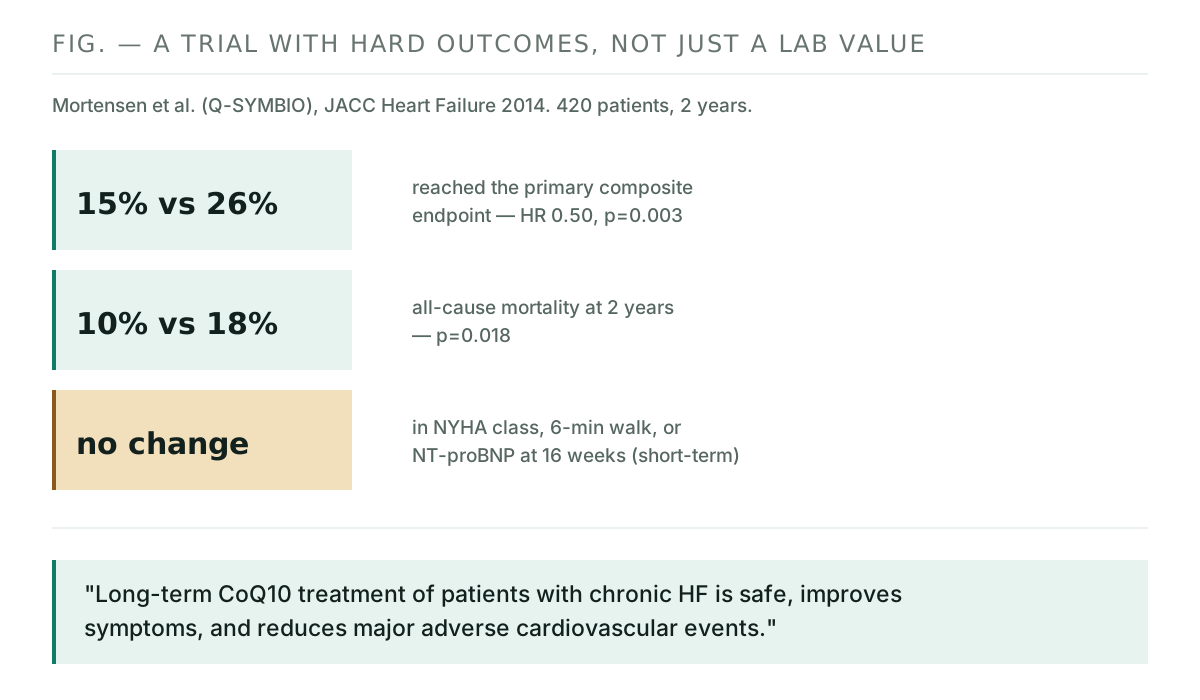
Most supplement evidence lives and dies by a blood marker or a symptom score. Q-SYMBIO, published in JACC Heart Failure in 2014 by Mortensen and colleagues, is unusual because it tracked things that matter directly: hospital stays and death. The trial randomized 420 patients with moderate to severe chronic heart failure to CoQ10 (100 mg three times daily) or placebo, both added on top of standard therapy, and followed them for two years.
The result on the primary long-term endpoint was not subtle: "the primary long-term endpoint was reached by 15% of the patients in the CoQ10 group versus 26% in the placebo group (hazard ratio: 0.50; 95% confidence interval: 0.32 to 0.80; p = 0.003)." Broken into its parts: cardiovascular mortality was "9% vs. 16% (p = 0.026)," all-cause mortality was "10% vs. 18% (p = 0.018)," and the CoQ10 group also had fewer hospital stays for heart failure (p = 0.033) and a significant improvement in heart-failure functional class after two years (p = 0.028).
The short-term picture, at 16 weeks, was quieter: "there were no significant changes in short-term endpoints," meaning functional class, a 6-minute walk test, and a heart-failure blood marker (NT-proBNP) did not shift significantly that early. The benefit here is a long-horizon one, not a quick lift, which matters for expectations — this trial does not suggest a bottle taken for a few weeks mirrors its result.
The trial's own conclusion: "long-term CoQ10 treatment of patients with chronic HF is safe, improves symptoms, and reduces major adverse cardiovascular events."
Why "inconclusive" and "one strong trial" can both be true
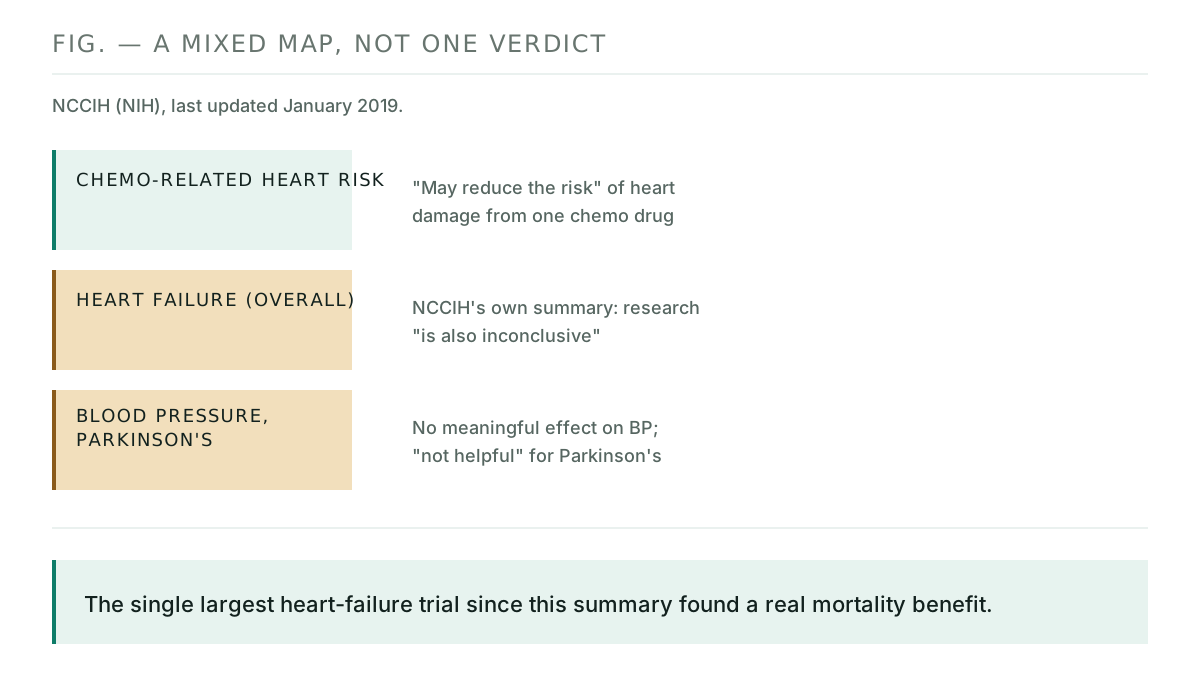
NCCIH's own overview of the evidence, last updated in January 2019 (roughly four years after Q-SYMBIO was published), still frames the broader heart-failure picture cautiously: "research on the effects of CoQ10 in heart failure is also inconclusive." NCCIH separately notes "there is evidence that CoQ10 may reduce the risk of some complications of heart surgery," and may "reduce the risk of heart damage caused by one type of cancer chemotherapy drug."
That is not a contradiction of Q-SYMBIO's own numbers above — it is a reminder that one large, well-conducted trial is real evidence, but the field overall has not treated it as the final word. Other conditions NCCIH reviewed came back less favorably: CoQ10 "probably doesn't have a meaningful effect on blood pressure," and a major NIH-funded study in early Parkinson's disease found that CoQ10, "even in higher-than-usual doses, didn't improve symptoms," with a 2017 evaluation concluding it "is not helpful for Parkinson's symptoms."
The most direct fatigue evidence: small, but positive
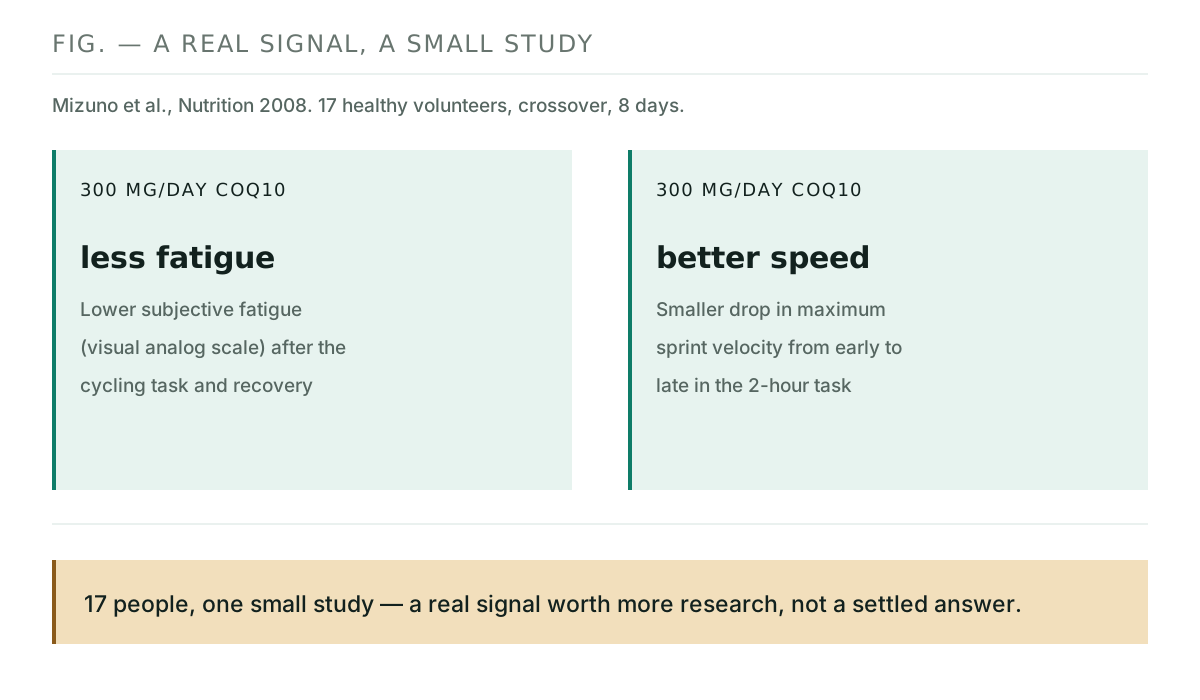
For the question this cluster cares most about — does CoQ10 actually help with fatigue — the most relevant trial is small but genuinely positive. A 2008 study in Nutrition by Mizuno and colleagues gave 17 healthy volunteers either 100 mg, 300 mg, or a placebo of CoQ10 daily for 8 days in a crossover design, then put them through a 2-hour fatigue-inducing cycling task followed by a 4-hour rest.
At the 300 mg dose, two things moved in the CoQ10 group's favor: "the change in maximum velocity from the 30- to the 210-min trial in the 300-mg coenzyme Q10-administered group was higher than that in the placebo group," and "subjective fatigue sensation measured on a visual analog scale... after the fatigue-inducing physical task and recovery period was alleviated when compared with that in the placebo group." The study's own conclusion: "oral administration of coenzyme Q10 improved subjective fatigue sensation and physical performance during fatigue-inducing workload trials."
Seventeen people in a crossover design is a real trial, not a case report — but it is small, and it tested fatigue specifically brought on by sustained physical exertion, not the general, undefined "low energy" that supplement marketing usually implies. It is the most directly relevant fatigue evidence this article found, and it points in a genuinely positive direction.
A quick note on statins and muscle pain
CoQ10 is also commonly recommended for muscle pain in people taking statins, since statins and CoQ10 share a production pathway in the body. The research on this specific question is mixed: different systematic reviews and meta-analyses looking at the same trials have reached different conclusions, some finding a benefit and some finding none. NCCIH's own read is on the skeptical side: "the overall scientific evidence does not support the idea that CoQ10 can reduce muscle pain caused by... statins." Anyone dealing with statin-related muscle symptoms is better served raising it directly with the prescribing clinician than assuming a supplement will solve it.
Safety and interactions
NCCIH's safety summary is reassuring on the whole: "no serious side effects of CoQ10 have been reported," though "mild side effects such as insomnia or digestive upsets may occur." It does flag two interactions worth knowing: CoQ10 "may interact with the anticoagulant (blood thinner) warfarin and the diabetes drug insulin, and it may not be compatible with some types of cancer treatment." Doses in the trials covered here ranged from 100 to 300 mg per day — worth mentioning to a clinician or pharmacist if you take either medication.
The honest limits of this
Q-SYMBIO is one large, well-designed trial in a specific, sicker population — people already diagnosed with moderate to severe chronic heart failure, on top of standard therapy. It does not tell us what CoQ10 does for a man with no heart diagnosis who simply feels tired. The Mizuno fatigue trial is real but small, and about exercise-induced fatigue specifically, not the everyday kind this cluster otherwise covers through causes like anemia, thyroid function, and B12. NCCIH's broader "inconclusive" read on heart failure, and its skeptical read on statin-related muscle pain, are both appropriately cautious summaries of a field with real disagreement between individual studies.
What to do with this
- If you have a diagnosed heart failure condition, ask your cardiologist whether CoQ10 alongside your standard therapy makes sense for you — this is the one use with a large trial behind it, and it is still a conversation for your own clinician, not a self-directed decision.
- If your main interest is everyday energy and you have no diagnosed condition, the evidence here does not single out CoQ10 as the fix — the better-evidenced causes covered elsewhere in this cluster are a more direct place to look first.
- If you take a statin and have muscle pain, talk to the prescriber directly. The evidence on CoQ10 for this specific problem is genuinely mixed, not a clear yes.
- If you take warfarin or insulin, mention any CoQ10 use to your clinician or pharmacist because of the noted interactions.
- Expect a long horizon, not a quick lift, if you do try it for a real indication — the strongest trial found its benefit over two years, with no significant short-term change at 16 weeks.
CoQ10's best evidence is real and worth taking seriously — it is just evidence about a specific, diagnosed condition, not a general permission slip for "more energy" in someone who has not been shown to need it.
Key takeaways
- In Q-SYMBIO, a 420-patient, 2-year trial in moderate to severe chronic heart failure, CoQ10 reduced the primary composite endpoint (15% vs. 26%, HR 0.50, p = 0.003) and all-cause mortality (10% vs. 18%, p = 0.018) versus placebo.
- Short-term endpoints at 16 weeks did not change significantly — the benefit showed up over two years, not within weeks.
- A small 2008 trial in 17 healthy volunteers found 300 mg/day of CoQ10 eased subjective fatigue and helped sustain sprint speed during a 2-hour fatigue-inducing cycling task.
- NCCIH still calls the broader heart-failure research "inconclusive" even after Q-SYMBIO, and states the overall evidence does not support CoQ10 for statin-related muscle pain, though individual meta-analyses disagree on that specific question.
- CoQ10 "probably doesn't have a meaningful effect on blood pressure" and "is not helpful for Parkinson's symptoms," per NCCIH.
- No serious side effects have been reported; mild ones include insomnia or digestive upset, and CoQ10 may interact with warfarin and insulin.
Where to go from here
This was the ninth article in the energy section, before a tenth reopened it. The others:
- Anemia — the tiredness that shows up in a routine blood count, and why in a man it obliges a search.
- Vitamin B12 — who is actually short of it, who is just taking it, and the newer question of whether high doses are free.
- Hypothyroidism — the normal range moves with age, and treating the mildest version did not change how a large trial's patients felt.
- Caffeine — the daily lift is mostly withdrawal relief, not a boost above normal, and it can still cost you sleep six hours later.
- Brain fog — reported in a dozen unrelated conditions and defined inconsistently even by researchers, with a surprisingly specific fingerprint from sleep loss.
- Magnesium — common shortfall, rarely true deficiency, and the standard blood test is a poor way to check it.
- Vitamin D — the Endocrine Society withdrew its own cutoff in 2024 and now advises against routine testing for most adults, but still recommends it for three specific groups.
- Creatine — sold for muscle, but the newest trials test sleep-deprived brains instead, where a single dose blunted the cognitive crash.
In the meantime, the two sections this one borders on: sleep for everything on the nights, and testosterone for the hormone question. And for the heart-failure side of this article, the heart section covers blood pressure, cholesterol, and the conditions that get confused with each other.
Frequently asked questions
What does CoQ10 actually do in the body?
CoQ10 (coenzyme Q10) is "a substance that is naturally present in the human body, with the highest levels in the heart, liver, kidneys, and pancreas," per the National Center for Complementary and Integrative Health (NCCIH). It is a cofactor involved in cellular energy production and also acts as an antioxidant.
What is the strongest evidence for CoQ10 supplementation?
A large randomized trial called Q-SYMBIO, in 420 patients with moderate to severe chronic heart failure, found that over two years the group taking CoQ10 reached a composite of major adverse cardiovascular events at a lower rate than placebo (15% vs. 26%, hazard ratio 0.50, p = 0.003), with lower all-cause mortality (10% vs. 18%, p = 0.018) and fewer hospital stays for heart failure.
Does CoQ10 help with everyday tiredness or energy?
The most directly relevant evidence is a small 2008 trial of 17 healthy volunteers, which found that 300 mg/day of CoQ10 for 8 days reduced subjective fatigue and helped sustain sprint performance during a 2-hour fatigue-inducing cycling task, compared with placebo. That is a real signal for exercise-induced physical fatigue in a small study — it is not the same as a trial showing CoQ10 fixes everyday low energy in people without a physical exertion task.
Does CoQ10 help with statin-related muscle pain?
The research here is mixed — different meta-analyses on the same question have reached different conclusions. NCCIH's own summary states that "the overall scientific evidence does not support the idea that CoQ10 can reduce muscle pain caused by" statins, though some individual meta-analyses have found a benefit. Anyone with statin-related muscle symptoms should raise it with the prescribing clinician rather than relying on a supplement alone.
What does NCCIH say about CoQ10 for heart failure overall?
As of its most recent update, NCCIH states that "research on the effects of CoQ10 in heart failure is also inconclusive" as a general summary of the field. That characterization sits alongside the specific, large Q-SYMBIO trial's positive mortality findings — one strong trial is meaningful evidence, but it has not yet been treated as settling the broader question.
Is CoQ10 safe, and does it interact with anything?
NCCIH states "no serious side effects of CoQ10 have been reported," though "mild side effects such as insomnia or digestive upsets may occur." It "may interact with the anticoagulant (blood thinner) warfarin and the diabetes drug insulin, and it may not be compatible with some types of cancer treatment" — reasons to mention it to a clinician or pharmacist if you take either.
Sources
- Mortensen et al. (Q-SYMBIO), JACC Heart Failure, 2014 — The effect of coenzyme Q10 on morbidity and mortality in chronic heart failure
- Mizuno et al., Nutrition, 2008 — Antifatigue effects of coenzyme Q10 during physical fatigue
- National Center for Complementary and Integrative Health (NIH) — Coenzyme Q10
- Qu et al., Journal of the American Heart Association, 2018 — Effects of Coenzyme Q10 on Statin-Induced Myopathy: An Updated Meta-Analysis
- Banach et al., Mayo Clinic Proceedings, 2015 — Effects of Coenzyme Q10 on Statin-Induced Myopathy: A Meta-Analysis

Male Health Guide Editorial Team
We write about the health problems men over 40 actually search for at 3 a.m. — and we say plainly when the evidence for a popular product is thin. We do not invent credentials and we do not publish sponsored copy as editorial. Read more about how we work.
Medical disclaimer: This article is general information about CoQ10 and is not medical advice. It does not account for your own heart condition, medications, or medical history. Talk to a clinician before starting CoQ10, especially if you have a diagnosed heart condition or take warfarin, insulin, or cancer treatment.