Brain Fog: Not One Thing, and Not a Diagnosis
Short answer
Brain fog is not a diagnosis. It is reported in more than a dozen unrelated conditions, and a major review concludes that overlapping language and shared symptoms like fatigue and mood, not one shared biology, likely explain why it looks similar across them. The best-studied cases show real cognitive effects, but highly inconsistent ones.
"Brain fog" is one of the most-searched phrases connected to feeling tired, and one of the least defined. It is not in standard diagnostic manuals as its own entry. It gets used for forgetting names, losing a train of thought, feeling mentally slow, and struggling to focus — sometimes all four at once, sometimes just one. This article does not try to give brain fog a tidier definition than the research itself can support. It reports what that research actually found, which is more useful than a confident-sounding explanation that goes past the evidence.
We earn nothing from any answer here. There is no supplement, nootropic, or cognitive-test product being sold on this page.
What the phrase actually covers
A 2025 review in Trends in Neurosciences by Denno and colleagues opens with the question most articles skip: "'Brain fog' is commonly reported in more than a dozen chronic diseases, but what is it?" Their answer is that it is not used consistently even by researchers: brain fog "has been used to refer to a variable set of overlapping symptoms implicating cognition, fatigue, and affect," and across different studies "it has been defined as a distinct symptom, a syndrome, or a nonspecific term."
That is a wider range of meanings than most readers would assume walks under one phrase. Depending on which paper you read, "brain fog" might mean a measured drop on a cognitive test, a person's subjective sense that their thinking feels slow, or simply a catch-all label a study used because patients kept bringing up the same vague complaint.
Is it one thing happening in the brain?
The review's authors looked specifically at whether brain fog might be a "transdiagnostic entity" — the same underlying brain problem showing up across very different diseases. Their conclusion leans the other way: "we discuss where these commonalities arise and argue that linguistic ambiguity, shared cognitive impairments, and noncognitive factors are more likely than shared neurobiology." In plain terms, different diseases probably produce brain-fog-like complaints through different routes — inflammation here, poor sleep there, low mood somewhere else — that happen to look and feel similar from the inside, rather than one common brain mechanism connecting all of them.
That is not a dismissal. The authors explicitly argue for better tools to "disambiguate the phenomena that brain fog conflates," which is a statement that the underlying problems are real and worth separating out, not a statement that the complaint is imaginary.
What the best-studied cases show
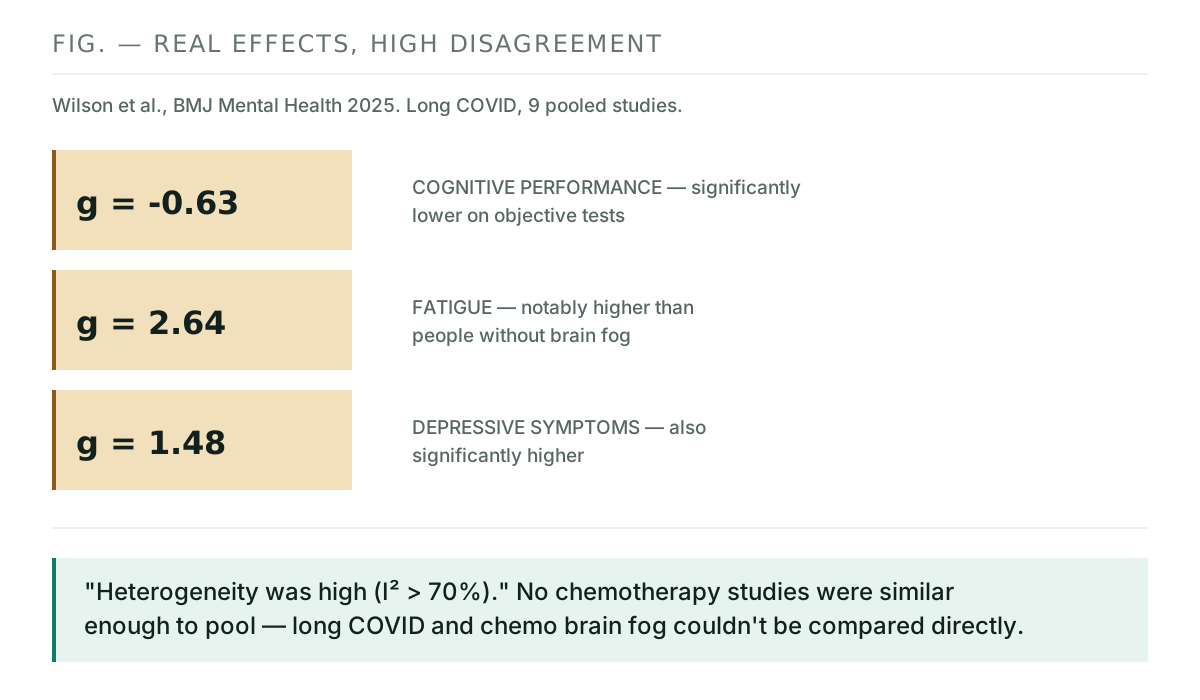
The two conditions with the most research behind the term are long COVID and chemotherapy ("chemo brain"). A 2025 systematic review and meta-analysis in BMJ Mental Health by Wilson and colleagues screened 3,077 records down to 65 qualifying studies — 40 in long COVID, 25 in chemotherapy — and pooled nine long COVID studies that were similar enough to combine statistically.
Compared with people who did not report brain fog, people who did had measurably lower performance on objective cognitive tests: "significantly lower cognitive performance (Hedge's g = -0.63, 95% CI -1.15 to -0.12)." They also reported "higher fatigue (Hedge's g = 2.64, 95% CI 0.41 to 4.86) and more depressive symptoms (Hedge's g = 1.48, 95% CI 0.40 to 2.55)" than people without brain fog. Those are real, statistically significant differences — this is not nothing.
The honest caveat sits right next to the numbers: "heterogeneity was high (I² > 70%)," meaning the individual studies disagreed with each other substantially, and "no chemotherapy studies were appropriate for meta-analysis," so chemo brain and long-COVID brain fog could not even be directly compared to each other in this review. The authors' own conclusion calls for "adoption of consistent tools and definitions in future studies" before research on brain fog across conditions can be meaningfully compared at all.
What chemo brain specifically looks like
The National Cancer Institute describes the chemotherapy version in plain language: "cancer treatments such as chemotherapy may cause difficulty with thinking, concentrating, or remembering things." The severity varies widely — "some people notice very small changes, such as a bit more difficulty remembering things, whereas others have much greater memory or concentration problems" — and the timing is not fixed either: "these cognitive problems may start during or after cancer treatment."
One practical detail the NCI page adds is easy to miss: "treating conditions such as poor nutrition, anxiety, depression, fatigue, and insomnia may also help." That is a direct statement that some of what gets attributed to the chemotherapy itself may actually be coming from treatable conditions running alongside it — the same conditions worth checking for brain fog from any cause, not just cancer treatment.
The one cause with a very precise fingerprint: sleep loss
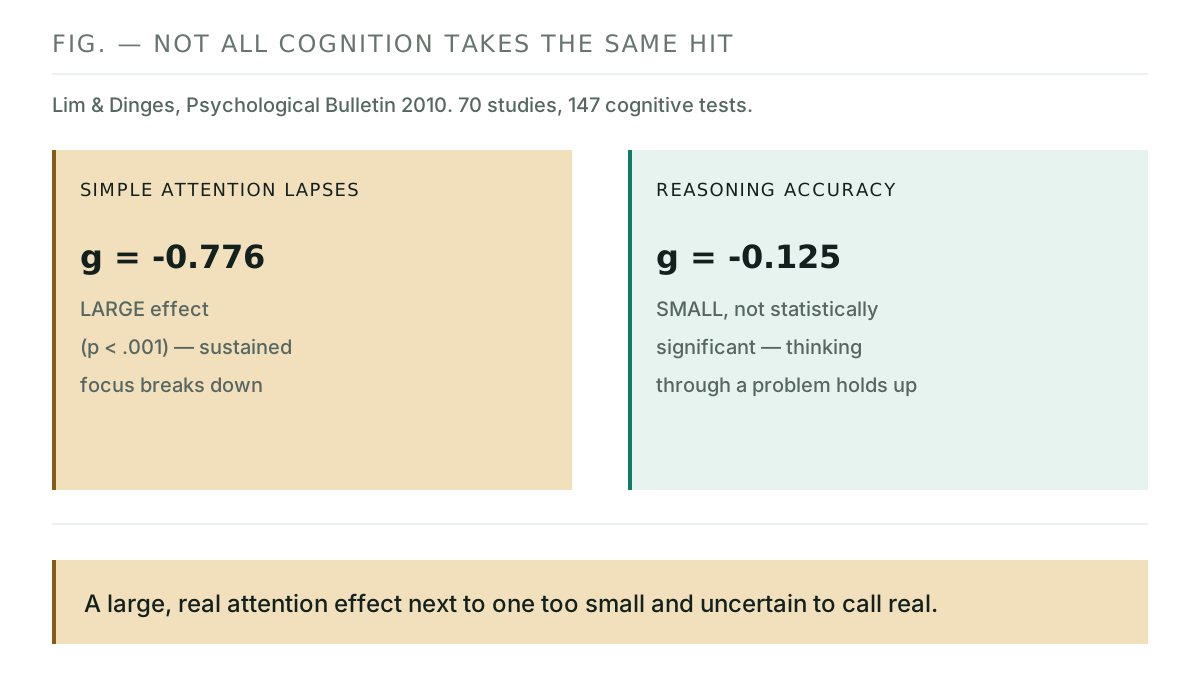
Of every contributor to brain fog, poor sleep is the most thoroughly measured, down to which specific mental skill it damages. A 2010 meta-analysis in Psychological Bulletin by Lim and Dinges combined 147 cognitive tests from 70 studies on short-term sleep deprivation across six cognitive categories. The effects were not uniform: "effect sizes ranged from small and nonsignificant (reasoning accuracy: g = -0.125... ) to large (lapses in simple attention: g = -0.776... p < .001)."
The attention effect is large and clearly real; the reasoning effect is small and, by the review's own confidence interval, not statistically distinguishable from no effect at all — its range runs from -0.27 to +0.02, crossing zero. Any single multiplier between the two numbers would be illustrative at best, not a precise ratio, since the smaller one is not a stable number to divide by. Sleep-deprived people do not necessarily reason worse when they sit down and focus on a single problem — the measured hit lands hardest on simple, sustained attention: the ability to notice something and respond, moment after moment, without drifting. That matches the everyday description of brain fog better than "can't think straight" does: it is often less "I got the wrong answer" and more "I read that paragraph and could not tell you what it said."
A cause almost nobody names: stopping a stimulant
This site's own article on caffeine covers a 2004 review of caffeine withdrawal that validated ten specific symptoms, among them "difficulty concentrating" and "foggy/not clearheaded" — typically peaking 20 to 51 hours after the last dose. Nicotine withdrawal follows a similar, slower pattern: a 2007 review in Nicotine & Tobacco Research by Hughes lists "difficulty concentrating" among the "valid withdrawal symptoms that peak within the first week and last 2-4 weeks" after stopping.
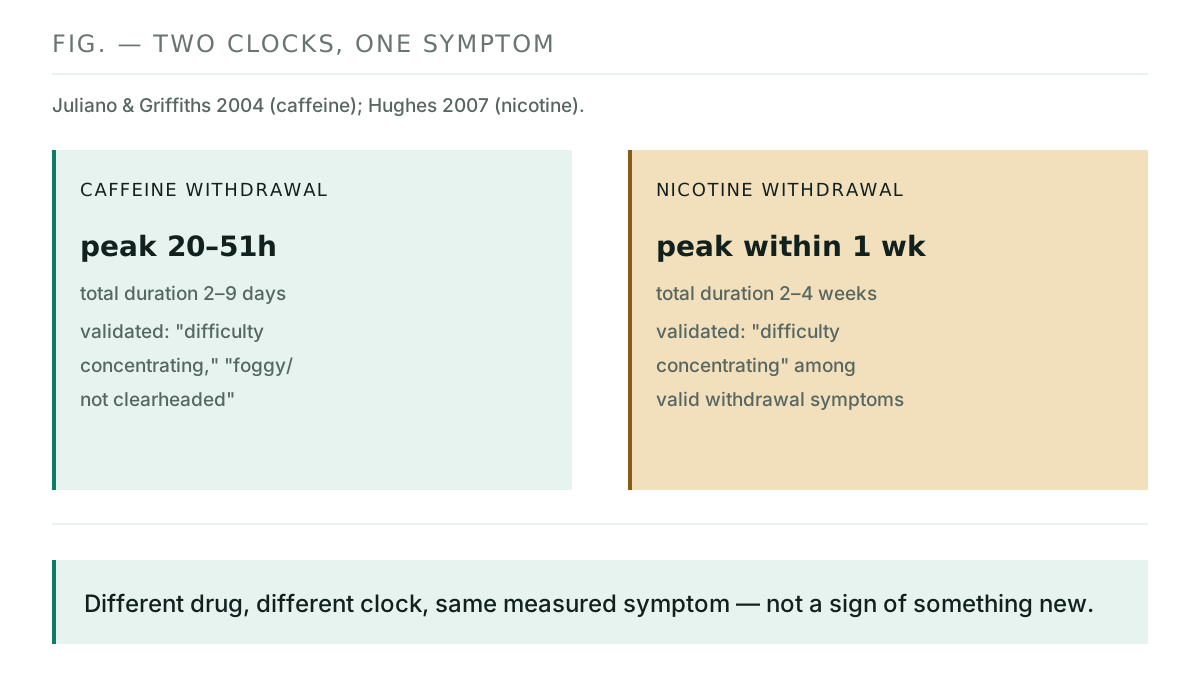
Cutting back on coffee or quitting cigarettes are both common, deliberate choices — and both can produce real, time-limited mental fog as a side effect of the withdrawal itself, not a sign that something new and separate has gone wrong. Knowing the rough timeline (days for caffeine, weeks for nicotine) is useful mainly so the fog is not mistaken for a permanent new problem partway through quitting.
The causes already covered on this site worth ruling out
Three earlier articles in this energy section cover causes of tiredness that come with a blood test attached: anemia, an underactive thyroid, and a vitamin B12 shortfall. None of those articles sets out to prove a specific link to "brain fog" as a named complaint, and this article is not claiming they do. What they do establish is that each condition is a real, testable cause of tiredness with a cheap blood test behind it — and tiredness itself is one of the "noncognitive factors" the Denno review names as a likely contributor to brain-fog-type complaints. If fog arrives together with fatigue that will not lift, those are the causes worth asking a clinician to test for before assuming the fog is mysterious or permanent.
The honest limits of this
The Denno review is itself a review of other research, written by researchers with their own theoretical position about why brain fog looks similar across conditions — it is an argument, backed by evidence, not a settled fact voted on by the whole field. The BMJ Mental Health meta-analysis pooled only nine long-COVID studies and zero chemotherapy studies, which is a real evidence base but not a large one, and the high heterogeneity it reports means individual studies do not agree closely with each other.
The sleep-deprivation meta-analysis covers short-term total sleep deprivation in controlled settings, which is a different exposure than the partial, chronic sleep restriction most tired adults actually live with — the direction of the effect (attention hit harder than reasoning) is informative, but the exact numbers should not be assumed to transfer one-for-one to a man who sleeps six hours a night for years rather than staying awake for a full day or two in a lab.
What to do with this
- Describe the fog specifically, not just as "foggy." Forgetting names, losing your train of thought mid-sentence, and struggling to start tasks are different complaints that point different directions — saying which one you actually have helps a clinician more than the umbrella word does.
- Rule out the causes with a cheap test first. Anemia, thyroid function, and B12 status are all inexpensive blood draws, and all three are documented causes of the tiredness that often travels with mental fog.
- If you are cutting caffeine or nicotine, expect fog on a schedule. Days for caffeine, up to a few weeks for nicotine — and treat it as a withdrawal symptom running its course, not a new, separate problem.
- Protect sleep before reaching for anything else. It is the single cause on this page with the clearest dose-response evidence, and the effect lands specifically on attention — the "I can't focus" version of fog.
- If fog followed an illness, an infection, or cancer treatment, say so explicitly when you bring it up. Long COVID and chemo brain are the two best-studied versions of this complaint, and naming the trigger gives a clinician an actual research base to work from instead of a vague symptom.
The least useful thing to do with brain fog is assume it is one condition with one fix. The research says, fairly consistently, that it is not.
Key takeaways
- "Brain fog" is reported in more than a dozen unrelated chronic diseases and has been defined inconsistently — "a distinct symptom, a syndrome, or a nonspecific term," per a 2025 review in Trends in Neurosciences.
- That same review argues "linguistic ambiguity, shared cognitive impairments, and noncognitive factors are more likely than shared neurobiology" to explain why it looks similar across conditions.
- A 2025 meta-analysis of long COVID and chemotherapy found real effects — lower cognitive scores (g = -0.63), higher fatigue (g = 2.64), more depression (g = 1.48) — but very high inconsistency between studies (I² > 70%).
- The National Cancer Institute states chemo brain "may start during or after cancer treatment" and that treating nutrition, anxiety, depression, fatigue, or insomnia alongside it "may also help."
- Sleep deprivation's effects are specific, not general: a large hit to attention lapses (g = -0.776) versus a small, non-significant hit to reasoning accuracy (g = -0.125).
- Stopping caffeine or nicotine both produce validated, time-limited "difficulty concentrating" as a withdrawal symptom — days for caffeine, weeks for nicotine.
Where to go from here
This is the sixth article in the energy section, and the second of Group B ("what you do every day"). The ones published so far:
- Anemia — the tiredness that shows up in a routine blood count, and why in a man it obliges a search.
- Vitamin B12 — who is actually short of it, who is just taking it, and the newer question of whether high doses are free.
- Hypothyroidism — the normal range moves with age, and treating the mildest version did not change how a large trial's patients felt.
- Caffeine — the daily lift is mostly withdrawal relief, not a boost above normal, and it can still cost you sleep six hours later.
- Magnesium — common shortfall, rarely true deficiency, and the standard blood test is a poor way to check it.
- Vitamin D — the Endocrine Society withdrew its own cutoff in 2024 and now advises against routine testing for most adults, but still recommends it for three specific groups.
- CoQ10 — the best evidence isn't an energy study at all, it's a two-year heart-failure trial that cut deaths and hospital stays.
In the meantime, the two sections this one borders on: sleep for everything on the nights, and testosterone for the hormone question.
Frequently asked questions
Is brain fog a real medical diagnosis?
No. A 2025 review in Trends in Neurosciences notes that brain fog "has been used to refer to a variable set of overlapping symptoms implicating cognition, fatigue, and affect," and "has been defined as a distinct symptom, a syndrome, or a nonspecific term" depending on the condition and the researcher. It is a description people reach for, not a diagnosis a clinician writes down on its own.
Does brain fog mean the same thing in every condition?
Probably not biologically. The same review argues that shared wording, shared cognitive impairments, and noncognitive factors like fatigue and mood "are more likely than shared neurobiology" to explain why brain fog looks similar across more than a dozen unrelated chronic diseases. The word may be doing more of the work than any single shared brain mechanism.
What does the actual research on brain fog show?
A 2025 systematic review and meta-analysis in BMJ Mental Health, covering long COVID and chemotherapy, found that people reporting brain fog scored significantly lower on objective cognitive tests (Hedge's g = -0.63), alongside notably higher fatigue (g = 2.64) and more depressive symptoms (g = 1.48) than people without it. The studies were highly inconsistent with each other (I² greater than 70%), and chemotherapy studies could not yet be pooled at all.
Does poor sleep cause brain fog?
It causes a specific, well-measured piece of it. A meta-analysis of short-term sleep deprivation found a large effect on lapses in simple attention (g = -0.776) but a small, non-significant effect on reasoning accuracy (g = -0.125). Sleep loss mainly erodes the ability to stay switched on, more than the ability to think something through once you are.
Can quitting caffeine or nicotine cause brain fog?
Yes, and it is a validated, time-limited symptom in both. A review of caffeine withdrawal lists "difficulty concentrating" and "foggy/not clearheaded" among its ten validated symptoms, typically peaking within 20 to 51 hours. A separate review of tobacco withdrawal lists difficulty concentrating as a valid symptom that "peak within the first week and last 2-4 weeks."
What is chemo brain?
The National Cancer Institute states that "cancer treatments such as chemotherapy may cause difficulty with thinking, concentrating, or remembering things," that these problems "may start during or after cancer treatment," and that "treating conditions such as poor nutrition, anxiety, depression, fatigue, and insomnia may also help" — meaning some of what gets blamed on the chemotherapy itself may be coming from treatable things alongside it.
Sources
- Denno et al., Trends in Neurosciences, 2025 — Defining brain fog across medical conditions
- Wilson et al., BMJ Mental Health, 2025 — Brain fog with long covid and chemotherapy: systematic review and meta-analysis
- National Cancer Institute (NIH) — Memory or Concentration Problems and Cancer Treatment
- Lim & Dinges, Psychological Bulletin, 2010 — A meta-analysis of the impact of short-term sleep deprivation on cognitive variables
- Juliano & Griffiths, Psychopharmacology, 2004 — A critical review of caffeine withdrawal: empirical validation of symptoms and signs, incidence, severity, and associated features
- Hughes, Nicotine & Tobacco Research, 2007 — Effects of abstinence from tobacco: valid symptoms and time course

Male Health Guide Editorial Team
We write about the health problems men over 40 actually search for at 3 a.m. — and we say plainly when the evidence for a popular product is thin. We do not invent credentials and we do not publish sponsored copy as editorial. Read more about how we work.
Medical disclaimer: This article is general information about brain fog and is not medical advice. It cannot tell you what is causing your own cognitive symptoms or whether they warrant urgent evaluation. Sudden or severe confusion, especially with other neurological symptoms, deserves prompt medical attention, not a web search.