Vitamin B12: Too Little Is Rare, Too Much Is Not Settled
Short answer
Real vitamin B12 deficiency is uncommon, concentrated in people over 60, people on long-term metformin or acid-suppressing drugs, strict vegans, and anyone with pernicious anemia. The standard blood test catches it reliably in sick patients and misses most cases in surveys. A newer finding also ties high-dose B12 supplements to added lung cancer risk in men who smoke — real, but not yet settled.
Vitamin B12 occupies an unusual place among the nutrients people worry about. It is sold everywhere as an energy fix, stacked into gas-station shot bottles and gummy multivitamins, marketed on the assumption that more of it will make a tired man feel less tired. Almost none of that marketing mentions a blood test, because almost none of it is aimed at someone who has been diagnosed with anything. It is aimed at the feeling.
That gap between the marketing and the medicine is the subject of this article. On one side is a real, well-defined, testable deficiency that shows up in a specific set of people for specific reasons. On the other is a much larger population that has simply started taking the vitamin, at whatever dose the bottle suggests, without ever finding out whether they needed it. We are not selling anything here, which is the only reason an article about a vitamin can spend as much time on its risks as on its benefits.
Who actually runs out
Genuine vitamin B12 deficiency is not evenly spread across the population, and it is not common in absolute terms. A 2009 review of US and UK survey data put the figure at "approximately 6% of those aged ≥60 y" using a plasma B12 cutoff below 148 pmol/L, "with the prevalence of deficiency increasing with age." A wider band sits just above that line: "closer to 20% have marginal status (plasma vitamin B-12: 148-221 pmol/L) in later life." An earlier national survey, NHANES III, found serum B12 below 200 pg/mL in "only approximately 3 percent" of its sample — "persons 4 years and over," so this figure excludes infants and toddlers but otherwise spans the population.
The reason shifts with age. In younger adults, "inadequate intake, due to low consumption of animal-source foods, is the main cause" — this is the strict-vegan and strict-vegetarian picture, since B12 occurs naturally only in animal foods. In older adults, the same review states that "food-bound cobalamin malabsorption becomes the predominant cause of deficiency, at least in part due to gastric atrophy" — the stomach's ability to pry the vitamin loose from food weakens with age, independent of diet.
Beyond age and diet, three groups deserve specific attention, and two of them involve common prescriptions rather than anything exotic.
Metformin, in a trial's own numbers
The first is anyone on long-term metformin, the first-line drug for type 2 diabetes and a common prescription for men in this readership. The strongest trial evidence on B12, though, comes from a more specific slice of that population: a randomised, placebo-controlled trial that enrolled "390 patients with type 2 diabetes receiving treatment with insulin," giving them either 850 mg of metformin or a placebo, three times a day, for 4.3 years, on top of their insulin. Every participant was already on insulin, a more advanced stage of diabetes than metformin-alone, so the numbers below describe metformin added to insulin, not metformin as a man's only diabetes medication. The result: "metformin treatment was associated with a mean decrease in vitamin B-12 concentration of -19% (95% confidence interval -24% to -14%; P<0.001)."
Translated into how many people actually crossed into deficiency, not just how far the average moved: "the absolute risk of vitamin B-12 deficiency (<150 pmol/l) at study end was 7.2 percentage points higher in the metformin group than in the placebo group," which the authors express as "a number needed to harm of 13.8 per 4.3 years." Roughly one extra case of deficiency for every 14 patients kept on the drug that long. A wider "low" band (150-220 pmol/l) was 11.2 percentage points more common in the metformin group, with a number needed to harm of 8.9. The trial's own conclusion is direct: "regular measurement of vitamin B-12 concentrations during long term metformin treatment should be strongly considered."
Acid-suppressing drugs, in the same kind of numbers
The second group is anyone on a long-term proton pump inhibitor (PPI) or H2 blocker — the omeprazole, esomeprazole, and famotidine family used for reflux and ulcers, often taken for years without anyone revisiting whether it is still needed. A case-control study inside the Kaiser Permanente Northern California system compared 25,956 patients with a new diagnosis of B12 deficiency against 184,199 patients without one.
Among the deficient patients, "3120 (12.0%) were dispensed a 2 or more years' supply of PPIs," against "13,210 (7.2%)" of the patients without deficiency — an odds ratio of 1.65 (95% CI, 1.58-1.73). H2 blockers carried an odds ratio of 1.25 (95% CI, 1.17-1.34). The dose mattered: doses above 1.5 PPI pills a day carried a higher odds ratio (1.95) than doses under 0.75 pills a day (1.63), "P = .007 for interaction." The mechanism is not a mystery — stomach acid is what separates B12 from the protein it is bound to in food, so turning that acid off for years is a plausible route to malabsorption, not just a statistical coincidence.
The test that works great for the sick and poorly for everyone else
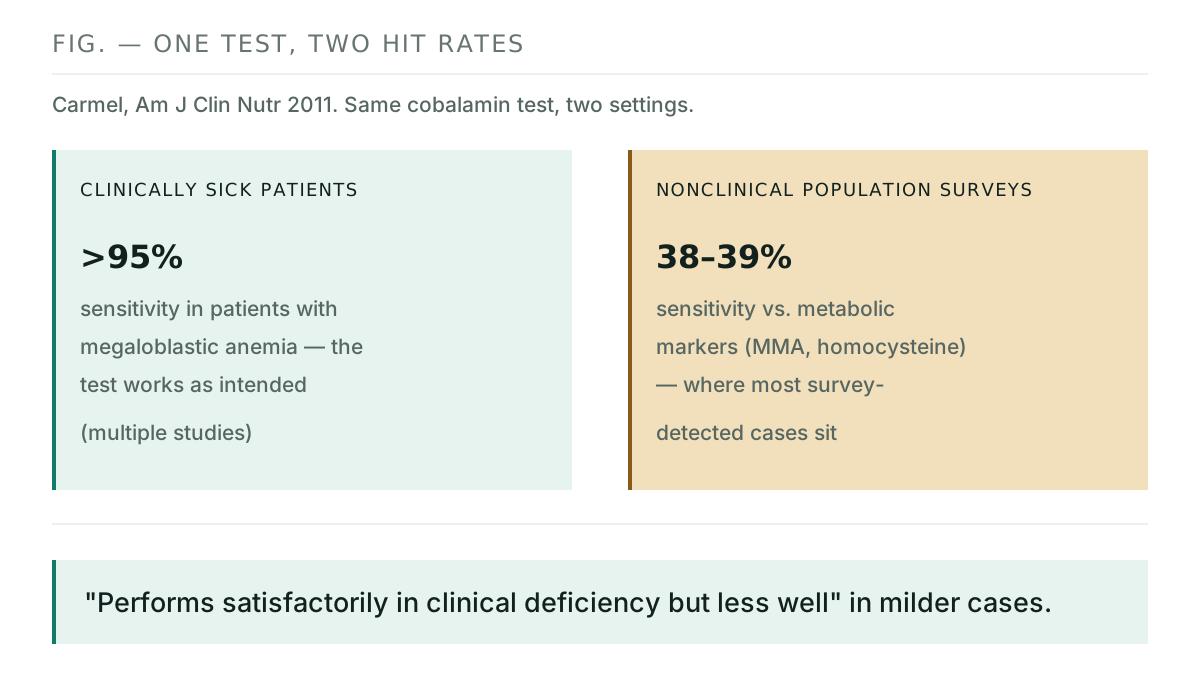
Here is the complication that makes "just get tested" harder than it sounds. The standard blood test measures total serum cobalamin, and a 2011 review in the American Journal of Clinical Nutrition laid out exactly where that test is trustworthy and where it is not.
In patients who are clinically sick — megaloblastic anemia, the classic picture of severe deficiency — "the sensitivity of cobalamin concentrations <148 pmol/L (<200 ng/L) usually exceeded 95%." That is a test doing its job. But most of what gets flagged as "B12 deficiency" in population surveys, including the 6% and 20% figures above, is not that sick picture. It is what the review calls subclinical cobalamin deficiency, diagnosed only by metabolic markers with no symptoms of its own. In that setting, the same cobalamin test's "sensitivity fell to 38-39% in nonclinical population surveys that compared against MMA or homocysteine endpoints." A test that is excellent in the hospital is wrong more often than right in the survey.
The reviewer's own summary is the fairest one available: cobalamin, "like all diagnostic biomarkers, performs satisfactorily in clinical deficiency but less well" in the subclinical state. His recommended fix, stated for population research rather than for a single doctor's visit, is not a different single test but a combination: "the combination of ≥2 test result abnormalities, such as cobalamin and MMA, [is] the most reliable approach to diagnosing deficiency in the research setting; reliance on one test alone courts frequent misdiagnosis." He does not spell out the equivalent recommendation for routine clinical care, but the logic travels: if a doctor orders only a basic B12 level and nothing else, a genuinely low-grade deficiency has a real chance of reading as normal, and asking whether a second marker is warranted is a reasonable question to bring to that visit — not a guideline either of us can point to by name.
One honest complication inside that same review, worth stating plainly: subclinical deficiency is not simply a milder version of the serious kind. The review notes that whether subclinical deficiency causes the health problems associated with it in surveys "awaits proof by randomized clinical trials" — meaning some of what gets treated as early-stage deficiency may not behave the same way the severe, well-understood kind does.
Folic acid can make a hidden deficiency harder to see, not easier
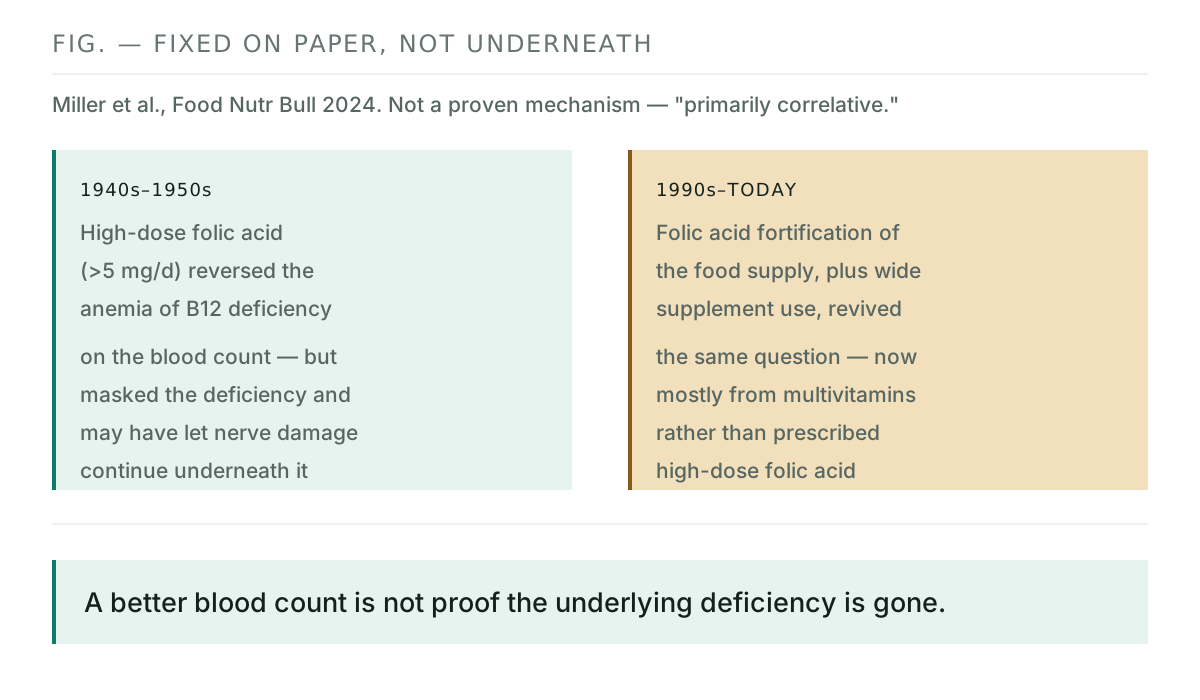
There is a specific reason doctors are taught to check B12 before treating anemia with folic acid, and it is worth a man taking both in a daily multivitamin. A 2024 narrative review lays out the history: "in the 1940s to 1950s, high-dose folic acid supplements (>5 mg/d) were used clinically to reverse the megaloblastic anemia of vitamin B12 deficiency caused by pernicious anemia. However, this treatment strategy masked the underlying B12 deficiency and possibly exacerbated its neuropathological progression." The anemia improved on paper while the nerve damage that B12 deficiency can cause kept going underneath it. That practice was discontinued in the 1970s for exactly this reason.
The review is careful about how settled this is: "the evidence for excess folic acid exacerbating B12 deficiency is primarily correlative or from uncontrolled clinical observations, and the hypothesis to explain the phenomenon has not yet been tested." It is not a proven mechanism. Even so, the authors conclude it is "sufficiently compelling to warrant increased vigilance for identifying B12 deficiency in at risk individuals" — the same groups named above — "who also ingest excessive folic acid or are prescribed folic acid in high doses." A separate NHANES analysis, by Selhub and colleagues, supports the general direction: among people who were already low in B12, higher serum folate was associated with higher, not lower, levels of the functional markers MMA and homocysteine — "a worsening of vitamin B(12)'s enzymatic functions as folate status increases" in exactly the people who can least afford it.
The practical point is narrow and specific: if you are in one of the at-risk groups above and your multivitamin or energy supplement also contains a large dose of folic acid, that is a reason to get B12 checked before assuming the folic acid is helping, not a reason to avoid folic acid altogether.
The other direction: when more might not be better
Almost everything written about B12 treats more as safer, because it is water-soluble and the body excretes what it does not use. That assumption is now genuinely in question for one specific outcome, in one specific group, and it deserves to be said plainly rather than buried.
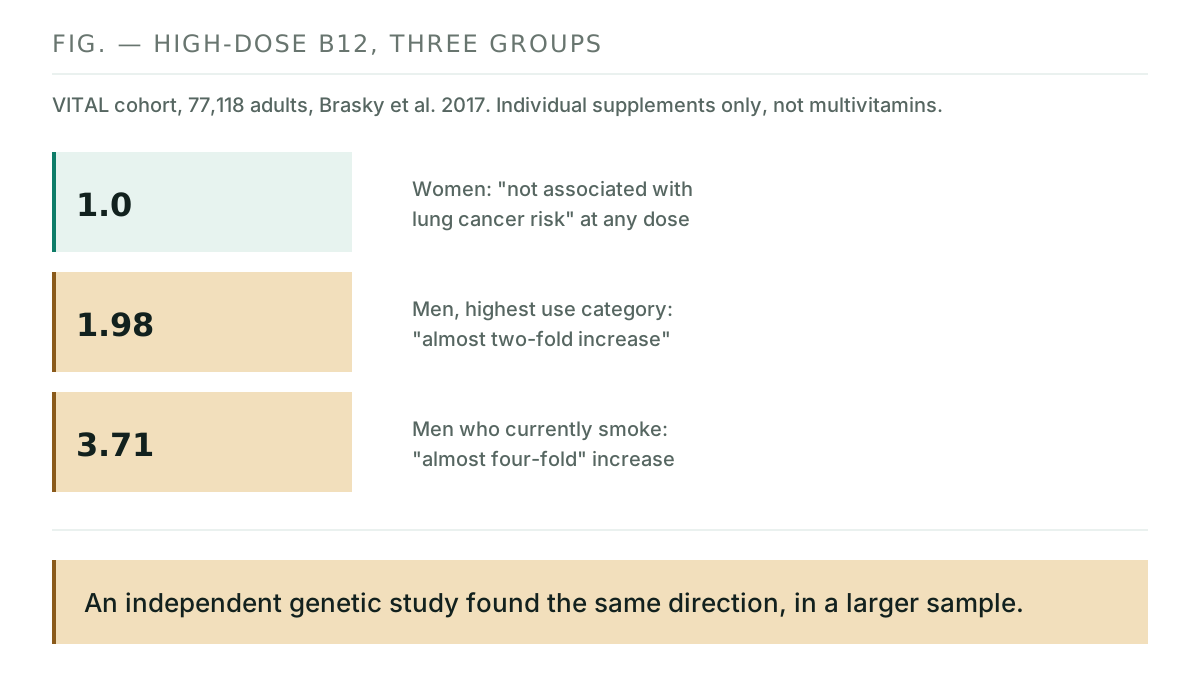
The VITAL cohort followed 77,118 adults aged 50 to 76, recruited between 2000 and 2002, and tracked 808 incident lung cancers against reported supplement use. The result, in the authors' own words: "use of vitamin B6 and B12 from individual supplement sources, but not from multivitamins, was associated with a 30% to 40% increase in lung cancer risk among men." Looking specifically at the top category of long-term use, "there was an almost two-fold increase in lung cancer risk among men in the highest categories of vitamin B6 (>20 mg/d; hazard ratio, 1.82; 95% CI, 1.25 to 2.65) and B12 (>55µg/d; hazard ratio, 1.98; 95% CI, 1.32 to 2.97) compared with nonusers." Use of B12 in a multivitamin, at ordinary multivitamin doses, showed no such association. Use of the same vitamins in women showed no association either.
The number that should get a smoker's attention specifically: among men who were current smokers, the same high-use category of B12 "was associated with an almost four-fold increased risk of lung cancer among current smokers (HR, 3.71; 95% CI, 1.77 to 7.74; P trend <.01)." The risk was smaller, though still above 1.0, in recent and former smokers, and the association held across lung cancer subtypes "except adenocarcinoma, which is the type less related to smoking" — a pattern that points toward tobacco as part of the mechanism rather than B12 acting entirely alone.
A cohort study showing an association between self-reported supplement use and later cancer is vulnerable to a specific kind of doubt: maybe people who are already getting sick change their habits, including what they take, for reasons that have nothing to do with the vitamin itself. A separate study addressed exactly that doubt using a different method. It combined directly measured blood B12 from 5,183 case-control pairs across 20 cohorts with a Mendelian randomization analysis — using genetic variants that raise B12 levels, which a person cannot acquire by getting sick first — across 29,266 cases and 56,450 controls. Both approaches pointed the same way: "circulating vitamin B12 [was found] to be positively associated with overall lung cancer risk in a dose response fashion," and "genetically determined higher vitamin B12 concentrations were positively associated with overall lung cancer risk" as well. The authors' conclusion: "these findings support the hypothesis that high vitamin B12 status increases the risk of lung cancer."
What this finding does not mean
It would be easy to read the above and conclude that B12 is dangerous, and that is not what either study shows. Three limits matter.
First, multivitamins were specifically not implicated. The VITAL cohort's elevated risk sat entirely in individual B12 and B6 supplements, the standalone pills and shots sold separately from a general multivitamin. If your B12 comes from a daily multivitamin rather than a dedicated B12 product, this finding does not describe your situation.
Second, the effect in women was absent, not just smaller. "Use of supplemental vitamins B6, folate, and B12 was not associated with lung cancer risk among women." Whatever is happening is specific to men, and the authors do not yet know why.
Third, both studies describe an association, and even the genetic study's authors frame their conclusion as supporting "the hypothesis" rather than declaring it proven. Mendelian randomization is a stronger design than a simple observational link precisely because genes are assigned before birth and cannot be caused by early cancer, but it still is not the same thing as a randomized trial of giving people B12 and watching what happens. No major guideline body has, to our knowledge, issued a warning against B12 supplementation on the strength of this work. That may change as more evidence accumulates, or it may not.
The honest limits of all this
Put the two halves of this article next to each other and the asymmetry is obvious: the deficiency numbers are decades old and well replicated; the cancer numbers are more recent and resting on a smaller base of evidence, even with a second, independently designed study pointing the same direction. We have tried to keep those two kinds of certainty visibly different rather than flattening them into one confident voice.
We also do not know the dose at which risk begins for an individual man, only the threshold one cohort measured in aggregate (>55µg/d over a 10-year average). A man who has taken a single B12 shot or a short course of high-dose tablets for a confirmed deficiency is not the population either study describes. The studies describe sustained, years-long, high-dose use of a standalone supplement, mostly in men, and most strongly in men who currently smoke.
Finally, nothing here changes the case for treating a confirmed, real deficiency. Untreated B12 deficiency causes anemia and, left long enough, nerve damage that does not always reverse. The caution above is about guessing at a high dose with no diagnosis behind it, not about treating a diagnosis you actually have.
What to do with this
- Get tested before you supplement, if you are in a risk group. Over 60, long-term metformin, long-term PPI or H2 blocker, strict vegan or vegetarian, pernicious anemia, celiac or Crohn disease, or a history of gastric or bowel surgery.
- If the first test comes back borderline, ask whether a second marker is worth checking. A combination with methylmalonic acid or homocysteine catches cases a single cobalamin test misses in population research; no guideline tells a single patient's doctor to do this routinely, but it is a reasonable question to raise.
- If you take metformin long-term, ask your doctor whether your B12 has ever been checked. The trial above argues for checking it regularly, not once.
- If you have been on a PPI or H2 blocker for years, ask whether you still need it. That question is worth asking for its own reasons, and B12 is one more.
- Check your own bottle. A standalone, high-dose B12 or B-complex product is a different exposure than the B12 inside an ordinary multivitamin, and the two are not interchangeable in what the evidence above covers.
- If you currently smoke and take a standalone high-dose B12 supplement, raise it with your doctor rather than deciding alone, in either direction.
The honest version of "who needs this vitamin" is smaller than the market for it, and the honest version of "is more always fine" is no longer an automatic yes. Neither answer is the dramatic one. Both are the accurate one.
Key takeaways
- True B12 deficiency is concentrated, not widespread: "approximately 6% of those aged ≥60 y" by one review's figures, with another 20% in a marginal zone, and "only approximately 3 percent" of NHANES III's sample (ages 4 and up) below 200 pg/mL.
- Metformin, in a randomized trial in insulin-treated patients: a mean 19% drop in B12 over 4.3 years, and an absolute risk of deficiency 7.2 percentage points higher than placebo, with a number needed to harm of 13.8.
- Long-term PPIs carried an odds ratio of 1.65 for B12 deficiency in a 25,956-patient case-control study; H2 blockers carried 1.25, and higher PPI doses carried higher odds.
- The standard B12 blood test exceeds 95% sensitivity in clinically sick patients but falls to 38-39% in population surveys measured against metabolic markers — it "performs satisfactorily in clinical deficiency but less well" in milder, subclinical cases.
- High-dose folic acid once corrected the anemia of B12 deficiency while, per a 2024 review, "neuropathological progression" continued underneath — evidence the review itself calls "primarily correlative," not proven.
- A cohort of 77,118 adults found what its authors call "an almost two-fold increase" in lung cancer risk (HR 1.98) in men using high-dose individual B12 supplements long-term, rising to "an almost four-fold increased risk" (HR 3.71) in men who currently smoke. Multivitamins and women showed no such association.
- An independent study combining measured blood B12 with genetic variants in 29,266 cases and 56,450 controls found the same direction of association, which the authors describe as supporting, not proving, a causal link.
- Nothing here argues against treating a confirmed deficiency — the caution is specific to high-dose, long-term, standalone supplementation without a diagnosis behind it.
Where to go from here
This is the third article in the energy section. The map that sorts the rest:
- Fatigue after 40 — sleepy and tired are not the same thing, and which one you have decides where to look.
- Anemia after 40 — in a man, a low-iron result is a finding that obliges a search, not a diagnosis on its own.
- Hypothyroidism — the normal range moves with age, and treating the mildest version did not change how a large trial's patients felt.
- Caffeine — the daily lift is mostly withdrawal relief, not a boost above normal, and it can still cost you sleep six hours later.
- Brain fog — reported in a dozen unrelated conditions and defined inconsistently even by researchers, with a surprisingly specific fingerprint from sleep loss.
- Magnesium — common shortfall, rarely true deficiency, and the standard blood test is a poor way to check it.
- Vitamin D — the Endocrine Society withdrew its own cutoff in 2024 and now advises against routine testing for most adults, but still recommends it for three specific groups.
- CoQ10 — the best evidence isn't an energy study at all, it's a two-year heart-failure trial that cut deaths and hospital stays.
In the meantime, the two sections this one borders on: sleep for everything on the nights, and testosterone for the hormone question.
Frequently asked questions
Who actually needs to be tested for vitamin B12 deficiency?
People over 60, people on long-term metformin or acid-suppressing drugs (PPIs or H2 blockers), strict vegans and vegetarians, anyone with pernicious anemia, celiac disease, Crohn disease, or a history of gastric or bowel surgery. A 2009 review put true deficiency at about 6% of adults 60 and older, with another 20% in a marginal zone.
Can a normal blood test miss a real vitamin B12 deficiency?
Yes, outside of clearly sick patients. A 2011 review found the standard cobalamin test exceeded 95% sensitivity in patients with megaloblastic anemia, but fell to 38-39% in population surveys measured against metabolic markers. The reviewer's own conclusion is that the test "performs satisfactorily in clinical deficiency but less well" in the milder, subclinical state most survey-detected cases represent.
Does metformin cause vitamin B12 deficiency?
A randomized, placebo-controlled trial in patients already on insulin found that adding metformin lowered B12 by a mean of 19% over 4.3 years and raised the absolute risk of deficiency by 7.2 percentage points, with a number needed to harm of about 14 patients over that period. The trial's own conclusion: "regular measurement of vitamin B-12 concentrations during long term metformin treatment should be strongly considered."
Do acid-reducing medicines affect vitamin B12?
A large case-control study found two or more years of proton pump inhibitor use carried an odds ratio of 1.65 for vitamin B12 deficiency, and H2 blockers an odds ratio of 1.25, with higher PPI doses carrying higher odds. Stomach acid is what releases B12 from food in the first place, so suppressing it for years is a plausible mechanism, not just a statistical association.
Can taking too much vitamin B12 be harmful?
A cohort study found what its own authors call "an almost two-fold increase" in lung cancer risk among men in the highest 10-year-use category of supplemental B12 (hazard ratio 1.98), driven entirely by individual supplements rather than multivitamins, and, in current smokers, "an almost four-fold increased risk" (hazard ratio 3.71). A separate analysis combining blood measurements with genetics found the same direction of association. Neither proves B12 causes cancer, and the finding does not apply to women or to multivitamin-level doses.
Should I stop taking my multivitamin because of the cancer finding?
The finding that raised concern was specific to individual B12 supplements at a 10-year average above 55 micrograms a day, not to multivitamins, which were not associated with the risk in the same study. If you take a standalone, high-dose B12 product and you smoke, that combination is worth a conversation with your own doctor rather than a decision made from this article alone.
Sources
- Allen LH, American Journal of Clinical Nutrition, 2009 — How common is vitamin B-12 deficiency?
- Wright et al. (NHANES III), Vital and Health Statistics, 1998 — Blood folate and vitamin B12: United States, 1988-94
- Carmel R, American Journal of Clinical Nutrition, 2011 — Biomarkers of cobalamin (vitamin B-12) status in the epidemiologic setting
- de Jager et al., BMJ, 2010 — Long term treatment with metformin in patients with type 2 diabetes and risk of vitamin B-12 deficiency
- Lam et al., JAMA, 2013 — Proton pump inhibitor and histamine 2 receptor antagonist use and vitamin B12 deficiency
- Miller et al., Food and Nutrition Bulletin, 2024 — Excess Folic Acid and Vitamin B12 Deficiency: Clinical Implications?
- Selhub et al., Proceedings of the National Academy of Sciences, 2007 — In vitamin B12 deficiency, higher serum folate is associated with increased total homocysteine and methylmalonic acid concentrations
- Brasky et al., Journal of Clinical Oncology, 2017 — Long-Term, Supplemental, One-Carbon Metabolism-Related Vitamin B Use in Relation to Lung Cancer Risk in the VITAL Cohort
- Fanidi et al., International Journal of Cancer, 2019 — Is high vitamin B12 status a cause of lung cancer?
- MedlinePlus (National Library of Medicine, NIH) — Vitamin B12 deficiency anemia

Male Health Guide Editorial Team
We write about the health problems men over 40 actually search for at 3 a.m. — and we say plainly when the evidence for a popular product is thin. We do not invent credentials and we do not publish sponsored copy as editorial. Read more about how we work.
Medical disclaimer: This article is general information about vitamin B12 and is not medical advice. It does not tell you whether you personally need testing or supplementation, or at what dose. Decisions about testing, treatment, and stopping or starting any supplement belong to you and a clinician who knows your history.