Caffeine: The Boost Is Mostly Withdrawal Relief
Short answer
A review of long-term withdrawal studies found that caffeine's apparent boost to performance and mood is mostly reversal of overnight withdrawal, not a rise above normal. The FDA's rough daily ceiling is 400 mg. A trial found caffeine still disrupted sleep when taken a full six hours before bed, earlier than most people assume is safe.
Caffeine is the one stimulant almost every adult uses on purpose, every day, without thinking of it as a drug. That is a reasonable way to live — caffeine is legal, common, and generally well tolerated. It is also, according to the research on how it actually works in regular users, not quite what it feels like. We earn nothing from any answer here: there is no coffee brand, supplement, or energy-drink company behind this page.
What caffeine actually does
MedlinePlus, the National Library of Medicine's consumer health site, describes caffeine's core effect plainly: it "stimulates your central nervous system, which can make you feel more awake and give you a boost of energy." The same page lists caffeine's other, less advertised effects: it is a diuretic, it increases stomach acid (sometimes causing heartburn or an upset stomach), it may interfere with calcium absorption, and it raises blood pressure.
Timing matters more than most people assume. MedlinePlus states that caffeine "reaches its peak level in your blood" within about one hour of consumption, and that "you may continue to feel the effects of caffeine for four to six hours." That four-to-six-hour window becomes important later in this article, when a sleep trial tests it directly.
Typical amounts, per MedlinePlus, vary by drink: "An 8-ounce cup of coffee: 95-200 mg," "A 12-ounce can of cola: 35-45 mg," "An 8-ounce energy drink: 70-100 mg," and "An 8-ounce cup of tea: 14-60 mg." The range within coffee alone is wide enough that "a cup of coffee" is not a precise unit of caffeine.
The question almost no one asks: compared to what?
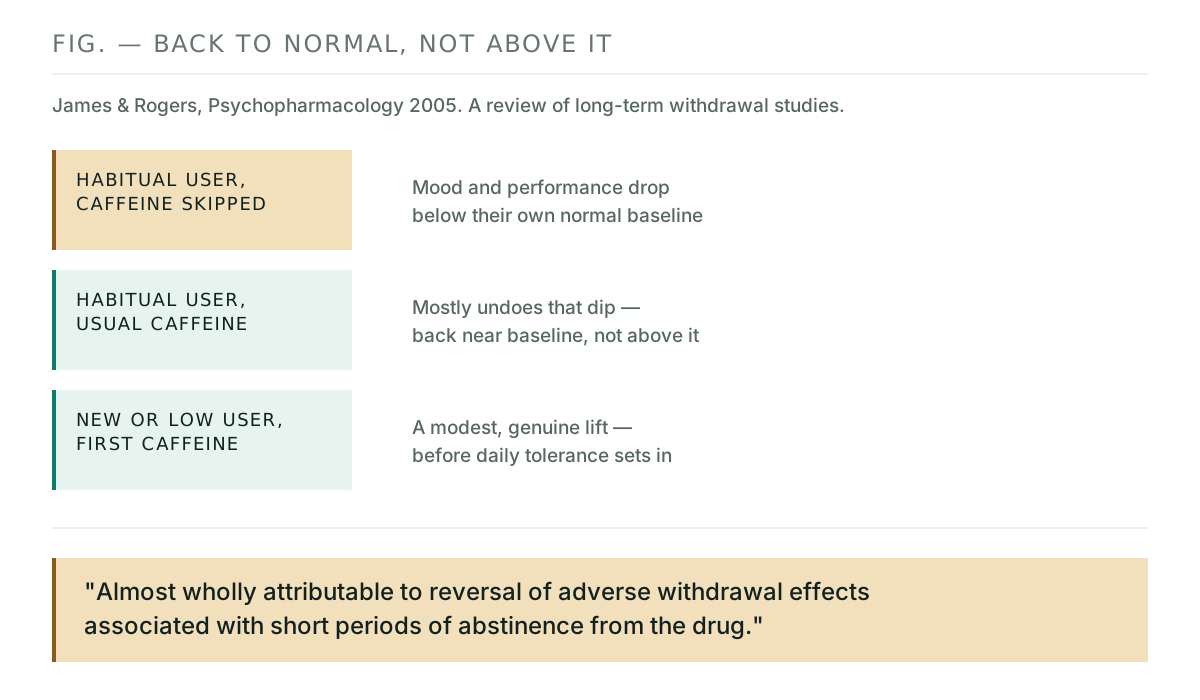
Most of what people believe about caffeine's benefits comes from a simple comparison: how do I feel with coffee versus without it today? That comparison has a built-in flaw for anyone who drinks caffeine regularly. "Without it today" is not a neutral baseline — it is a state of early withdrawal. A 2005 review in Psychopharmacology by James and Rogers set out to separate a genuine performance-and-mood benefit from simple withdrawal reversal, and concluded that ordinary placebo-controlled studies "are ambiguous due to failure to control for the confounding influence of withdrawal reversal."
To get past that, the review looked specifically at three kinds of evidence: studies comparing habitual consumers to low or non-consumers, studies of pre-treatment and ad-lib consumption, and long-term withdrawal studies. Its conclusion singled out the last category as the only one capable of answering the question cleanly: "only long-term withdrawal studies are capable of unambiguously revealing the net effects of caffeine." Across those studies, the finding was consistent: "there is little evidence of caffeine having beneficial effects on performance or mood under conditions of long-term caffeine use vs abstinence."
The review's own summary sentence is the one worth remembering: "the effects of caffeine on performance and mood, widely perceived to be net beneficial psychostimulant effects, are almost wholly attributable to reversal of adverse withdrawal effects associated with short periods of abstinence from the drug." In plain terms, for most daily drinkers, the morning cup is not adding energy on top of a normal day. It is undoing the deficit that built up overnight.
Who actually gets a genuine lift
This is not an argument that caffeine does nothing. The same review found that "modest acute effects may occur following initial use" — meaning someone who rarely drinks caffeine can get a real, if small, improvement the first few times, because there is no withdrawal debt to pay down first. The catch is in the next clause: "tolerance to these effects appears to develop in the context of habitual use of the drug." The genuine lift fades as the body adapts, and what replaces it is the withdrawal-reversal pattern described above.
That has a practical implication the review does not spell out as advice, but that follows from its own data: an occasional or infrequent caffeine user is in a different position than a twice-a-day coffee drinker. The twice-a-day drinker's "boost" is mostly a return to their own normal; the occasional user's is closer to an actual boost, until habit catches up with them too.
What withdrawal itself looks like
If caffeine's daily effect is substantially about avoiding withdrawal, it is worth knowing what that withdrawal actually involves. A 2004 systematic review in Psychopharmacology by Juliano and Griffiths analyzed 57 experimental and 9 survey studies and validated ten specific symptoms: "headache, fatigue, decreased energy/activeness, decreased alertness, drowsiness, decreased contentedness, depressed mood, difficulty concentrating, irritability, and foggy/not clearheaded." Flu-like symptoms, nausea, and muscle pain were judged likely but not fully validated as part of the core syndrome.
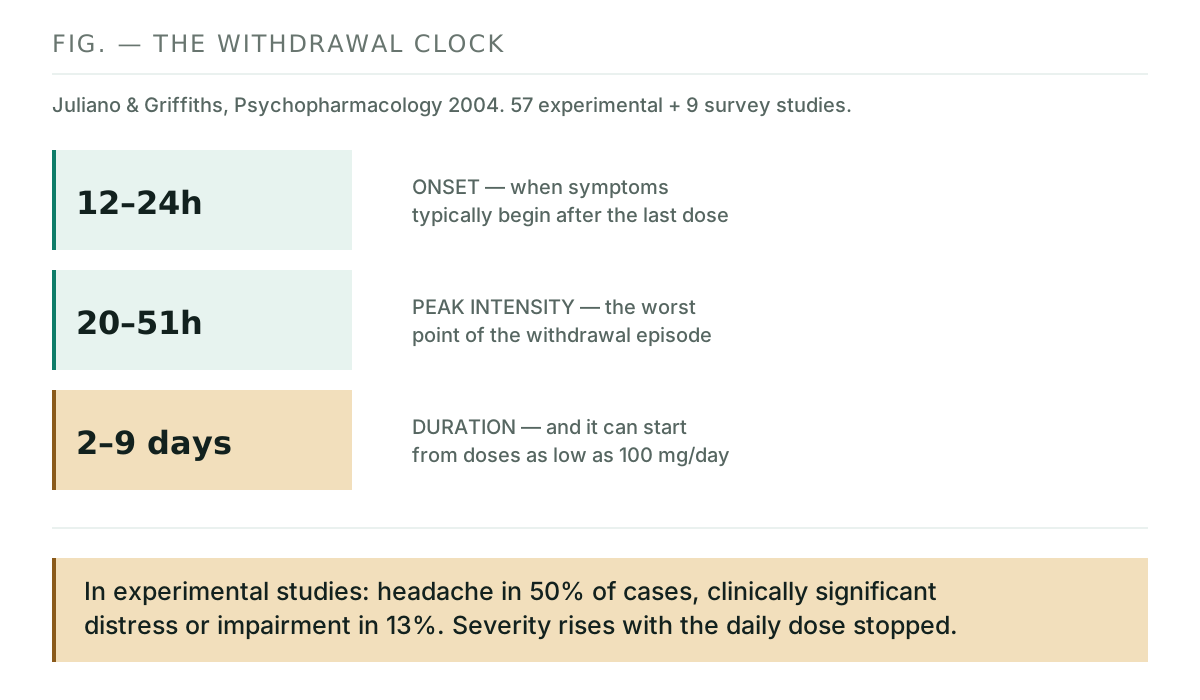
The numbers are specific: "in experimental studies, the incidence of headache was 50% and the incidence of clinically significant distress or functional impairment was 13%." Timing follows a fairly tight pattern: "onset of symptoms occurred 12-24 h after abstinence, with peak intensity at 20-51 h, and for a duration of 2-9 days." And the dose required to trigger it is lower than most people would guess: "the incidence or severity of symptoms increased with increases in daily dose; abstinence from doses as low as 100 mg/day produced symptoms" — that is roughly one modest cup of coffee, consumed daily, is enough to set up a withdrawal response if stopped abruptly.
The review's authors frame this as more than a curiosity: "avoidance of withdrawal symptoms plays a central role in habitual caffeine consumption," and they found enough validated evidence to argue caffeine withdrawal belongs as "a disorder in the DSM," with a separate call to revise the diagnostic criteria in the ICD. That is a stronger claim than most coffee drinkers would expect about their own habit.
How much is too much
The FDA's consumer guidance gives most adults a rough ceiling: "the FDA has cited 400 milligrams a day — that's about two to three 12-fluid-ounce cups of coffee — as an amount not generally associated with negative effects." The same guidance is careful to add that "there is wide variation in both how sensitive people are to the effects of caffeine and how fast they eliminate it from the body," so 400 mg is a population-level reference point, not a personal guarantee.
Past that point, or past an individual's own tolerance, the FDA lists a specific set of warning signs: "increased heart rate, heart palpitations, high blood pressure, insomnia or sleep disruptions, anxiety, jitters, upset stomach, nausea, headache." MedlinePlus adds "dependency, so you need to take more of it to get the same results" to its own side-effect list, and both sources advise talking to a clinician if these symptoms show up regularly.
MedlinePlus also lists conditions that call for a direct conversation with a clinician about caffeine specifically: sleep disorders including insomnia, migraines or other chronic headaches, anxiety, GERD or ulcers, arrhythmia, and high blood pressure, plus a note to check for interactions with "certain medicines or supplements, including stimulants, certain antibiotics, asthma medicines, and heart medicines."
A separate, more serious risk: pure caffeine powder
Drinks and ordinary supplements are not the whole caffeine market. The FDA has a specific warning for "pure and highly concentrated caffeine products," the powders and liquids sold in bulk where a teaspoon can equal dozens of cups of coffee: "the FDA estimates toxic effects, like seizures, can be observed with rapid consumption of around 1,200 milligrams of caffeine, or less than 1/2 teaspoon of pure caffeine." The FDA states plainly that these products "can have serious health consequences, including death," and that despite past enforcement action, "some products containing pure and highly concentrated caffeine remain on the market." A kitchen measuring spoon is not a precise enough tool for a substance this concentrated — the ordinary 400 mg guidance above assumes beverages and standard supplement doses, not powder measured by eye.
The six-hour problem
If caffeine's felt effects fade in "four to six hours," as MedlinePlus states, a reasonable guess would be that an afternoon coffee is clear of your system well before a normal bedtime. A 2013 trial in the Journal of Clinical Sleep Medicine by Drake, Roehrs, Shambroom, and Roth tested that guess directly. The design was simple: give healthy adults a 400 mg dose of caffeine — or a placebo — at one of three times relative to their own habitual bedtime: right at bedtime, 3 hours before, or 6 hours before, and measure sleep disturbance both by self-report and with a validated portable sleep monitor, in the participants' own homes.
The result did not match the "it wears off by then" intuition. "Results demonstrated a moderate dose of caffeine at bedtime, 3 hours prior to bedtime, or 6 hours prior to bedtime each have significant effects on sleep disturbance relative to placebo (p < 0.05 for all)." All three timepoints showed a real, statistically significant effect — not just the dose taken right at bedtime.
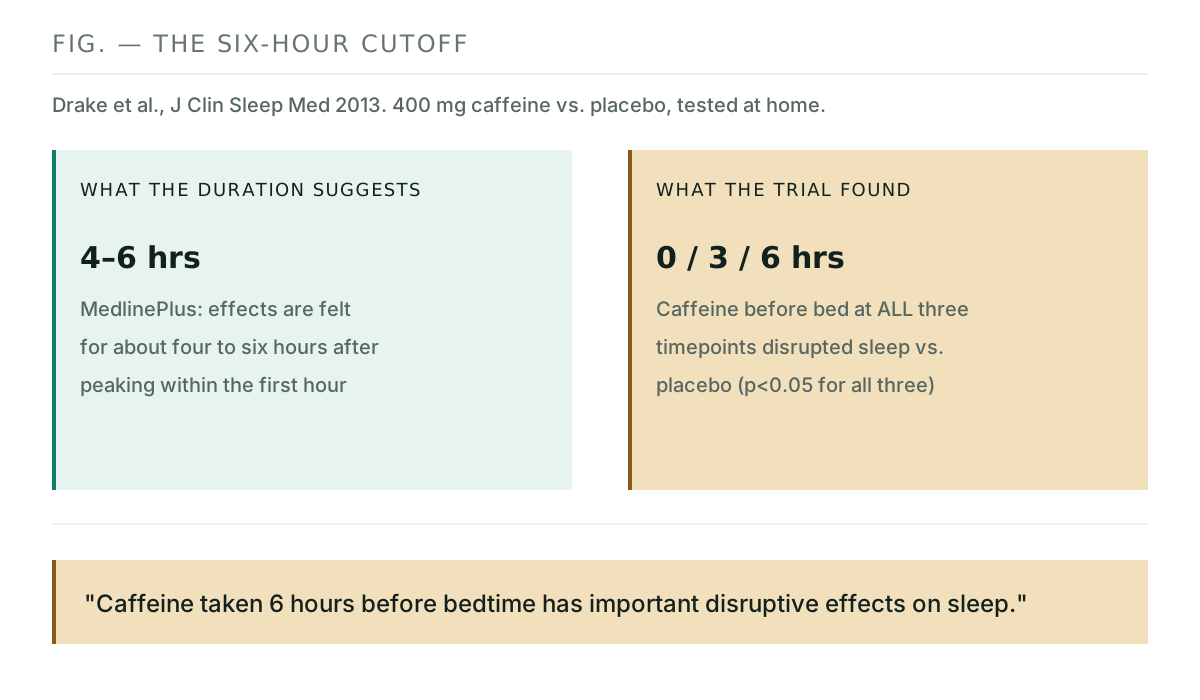
The trial's own conclusion draws the practical line: "the magnitude of reduction in total sleep time suggests that caffeine taken 6 hours before bedtime has important disruptive effects on sleep and provides empirical support for sleep hygiene recommendations to refrain from substantial caffeine use for a minimum of 6 hours prior to bedtime." For someone with a 10 p.m. bedtime, that puts the cutoff at 4 p.m. — earlier than an "I only drink it in the morning" rule would assume is necessary, and considerably earlier than how long the drug subjectively feels present.
Where caffeine fits, and where it does not
This site's pillar article on fatigue draws a distinction worth repeating here: sleepiness — a tendency to doze off — and fatigue, a lack of energy that sleep does not resolve, are different symptoms that get treated as one word in everyday English. Caffeine's entire documented mechanism in this article is about counteracting a withdrawal-driven dip in alertness, which sits much closer to the sleepiness side of that line than the fatigue side.
That matters for a very ordinary reason: if the tiredness in question comes from anemia, an underactive thyroid, a B12 shortfall, or simply not enough sleep in the first place, caffeine is not treating the underlying problem. At best it is masking it for a few hours during the day, and — per the trial above — it can make the underlying sleep problem worse if used late enough to reach into the night.
The honest limits of this
The withdrawal-reversal review is a review of other studies, not a single new trial, and its strongest evidence applies to people who already drink caffeine daily — which is most adults, but not everyone. It says little about caffeine's effects in someone who has never used it regularly, beyond noting that a modest genuine effect can occur before tolerance develops.
The withdrawal-syndrome numbers come from a mix of experimental and survey studies with different designs, which is why the review reports ranges (12-24 hours, 20-51 hours, 2-9 days) rather than single figures. And the sleep trial used a fixed 400 mg dose and a specific set of healthy adult participants; it tells us that caffeine at that dose disrupted sleep at all three timepoints tested, not the exact amount of sleep lost at each one, which the published abstract does not state as a single comparable number.
What to do with this
- Add up your actual daily total, not just "a couple of cups." Coffee alone ranges from 95 to 200 mg per 8-ounce cup, per MedlinePlus — two large cups can already approach the FDA's 400 mg reference point.
- Set your own cutoff time, working backward from bedtime by at least six hours. The 2013 trial found disruption at exactly that point, not just at bedtime itself.
- If caffeine feels essential just to feel normal, that is consistent with withdrawal reversal, not a flaw in your character. It is what the research predicts for a daily user — worth knowing, not worth panicking over.
- Watch for the FDA's listed warning signs — heart palpitations, high blood pressure, anxiety, jitters, insomnia — and bring them to a clinician rather than assuming more caffeine will fix how caffeine itself might be contributing.
- If your tiredness does not lift no matter when or how much you drink, treat that as a signal to look at causes caffeine cannot touch — sleep itself, anemia, thyroid function, or B12 — rather than reaching for a stronger dose.
None of this makes caffeine dangerous for most adults at ordinary doses. It does mean the daily "boost" is smaller and later-reaching than it feels like from the inside — mostly paying off a debt you created the night before, and capable of adding to tomorrow's debt if the timing is wrong.
Key takeaways
- A 2005 review in Psychopharmacology concluded that caffeine's effects on performance and mood in regular users are "almost wholly attributable to reversal of adverse withdrawal effects associated with short periods of abstinence from the drug."
- People who rarely use caffeine can get a genuine, modest lift — "modest acute effects may occur following initial use" — but tolerance develops with habitual use.
- A 2004 review found caffeine withdrawal follows a predictable pattern: onset 12-24 hours, peak 20-51 hours, duration 2-9 days, with headache in 50% of experimental-study cases and symptoms possible from doses as low as 100 mg/day.
- The FDA cites 400 mg a day for most adults "as an amount not generally associated with negative effects," while warning that pure, concentrated caffeine powder can cause seizures around 1,200 mg consumed rapidly.
- A 2013 trial found 400 mg of caffeine disrupted sleep whether taken at bedtime, 3 hours before, or 6 hours before — all three were statistically significant versus placebo.
- Caffeine's mechanism targets sleepiness, not fatigue from causes like anemia, hypothyroidism, or B12 deficiency — it can mask those for a few hours without treating them.
Where to go from here
This is the fifth article in the energy section, and the first covering what you do every day. The ones published so far:
- Anemia — the tiredness that shows up in a routine blood count, and why in a man it obliges a search.
- Vitamin B12 — who is actually short of it, who is just taking it, and the newer question of whether high doses are free.
- Hypothyroidism — the normal range moves with age, and treating the mildest version did not change how a large trial's patients felt.
- Brain fog — reported in a dozen unrelated conditions and defined inconsistently even by researchers, with a surprisingly specific fingerprint from sleep loss.
- Magnesium — common shortfall, rarely true deficiency, and the standard blood test is a poor way to check it.
- Vitamin D — the Endocrine Society withdrew its own cutoff in 2024 and now advises against routine testing for most adults, but still recommends it for three specific groups.
- CoQ10 — the best evidence isn't an energy study at all, it's a two-year heart-failure trial that cut deaths and hospital stays.
- Creatine — not a stimulant, and not a daily habit in the evidence that holds up best — a single dose, on the night it mattered.
In the meantime, the two sections this one borders on: sleep for everything on the nights, and testosterone for the hormone question.
Frequently asked questions
Does caffeine actually give you energy?
Not in the way it feels like it does. A 2005 review in Psychopharmacology concluded that for regular users, the effects of caffeine on performance and mood "are almost wholly attributable to reversal of adverse withdrawal effects associated with short periods of abstinence from the drug." Caffeine mostly brings a daily drinker back to their own normal baseline, not above it.
If I rarely drink caffeine, will it still help me?
The same review found that "modest acute effects may occur following initial use" in people who do not drink caffeine regularly — a smaller but genuine lift, not withdrawal relief, because there is no withdrawal to reverse. It also found that tolerance to this effect develops once caffeine use becomes habitual.
What happens if I stop drinking caffeine?
A systematic review in Psychopharmacology found that withdrawal symptoms typically begin 12 to 24 hours after the last dose, peak at 20 to 51 hours, and last 2 to 9 days. In experimental studies, headache occurred in 50% of cases, and 13% reported clinically significant distress or functional impairment. Symptoms can appear from a daily dose as low as 100 milligrams, roughly one cup of coffee.
How much caffeine is too much in a day?
The FDA has cited 400 milligrams a day for most adults — about two to three 12-fluid-ounce cups of coffee — "as an amount not generally associated with negative effects." Beyond that, the FDA lists increased heart rate, heart palpitations, high blood pressure, insomnia, anxiety, jitters, upset stomach, nausea, and headache as signs of too much.
How late in the day can I drink caffeine without it affecting sleep?
Later than most people assume. A 2013 trial gave 400 mg of caffeine at 0, 3, or 6 hours before a person's usual bedtime; all three timepoints, including 6 hours before bed, produced a statistically significant increase in sleep disturbance compared with placebo. The trial's own conclusion was that caffeine taken 6 hours before bedtime "has important disruptive effects on sleep."
Can caffeine fix fatigue that isn't about sleepiness?
Not reliably. Caffeine's best-documented job is counteracting sleepiness — the tendency to doze off — largely by undoing your own withdrawal. Fatigue from anemia, an underactive thyroid, a B12 shortfall, or poor sleep itself is a different problem that caffeine does not treat, and may just mask for a few hours.
Sources
- James & Rogers, Psychopharmacology, 2005 — Effects of caffeine on performance and mood: withdrawal reversal is the most plausible explanation
- Juliano & Griffiths, Psychopharmacology, 2004 — A critical review of caffeine withdrawal: empirical validation of symptoms and signs, incidence, severity, and associated features
- Drake et al., Journal of Clinical Sleep Medicine, 2013 — Caffeine effects on sleep taken 0, 3, or 6 hours before going to bed
- U.S. Food and Drug Administration, 2024 — Spilling the Beans: How Much Caffeine Is Too Much?
- MedlinePlus (National Library of Medicine, NIH) — Caffeine

Male Health Guide Editorial Team
We write about the health problems men over 40 actually search for at 3 a.m. — and we say plainly when the evidence for a popular product is thin. We do not invent credentials and we do not publish sponsored copy as editorial. Read more about how we work.
Medical disclaimer: This article is general information about caffeine and is not medical advice. It does not account for your own medications, heart condition, anxiety history, pregnancy status, or sensitivity to stimulants. Talk to a clinician about your own caffeine use if you have a relevant health condition.