Vitamin D: The Cutoff the Experts Gave Up On
Short answer
In 2024 the Endocrine Society withdrew its own vitamin D blood-level cutoffs, saying the trial evidence cannot support a number that predicts who benefits. The same guideline now advises against routine testing and against extra supplementation for most healthy adults under 75 — but still recommends it for three specific groups, and a real, confirmed deficiency is a different situation entirely.
Vitamin D has one of the stranger recent histories of any nutrient on a supplement shelf. The professional society most responsible for the "normal range" doctors use just took the unusual step of disowning its own number. That is not a story most sources selling vitamin D tell you, and it changes what a sensible man over 40 should actually do about it.
We earn nothing from any answer here. There is no vitamin D supplement, brand, or test kit being sold on this page.
What vitamin D actually does
MedlinePlus describes the core job plainly: "vitamin D helps the body absorb calcium," which matters because without enough of it, "bone production and bone tissues may suffer." Real, uncorrected deficiency "can lead to weakened bones (osteomalacia and osteoporosis in adults or rickets in children)" — a genuine disease outcome, not a vague complaint.
Most of the body's supply does not come from food. "The body makes vitamin D when the skin is directly exposed to the sun," which is why it is "often called the 'sunshine' vitamin," and "very few foods naturally contain vitamin D" outside fatty fish like tuna, salmon, and mackerel, with smaller amounts in beef liver, cheese, and egg yolks. Fortified foods fill much of the remaining gap.
The number that was supposed to settle this
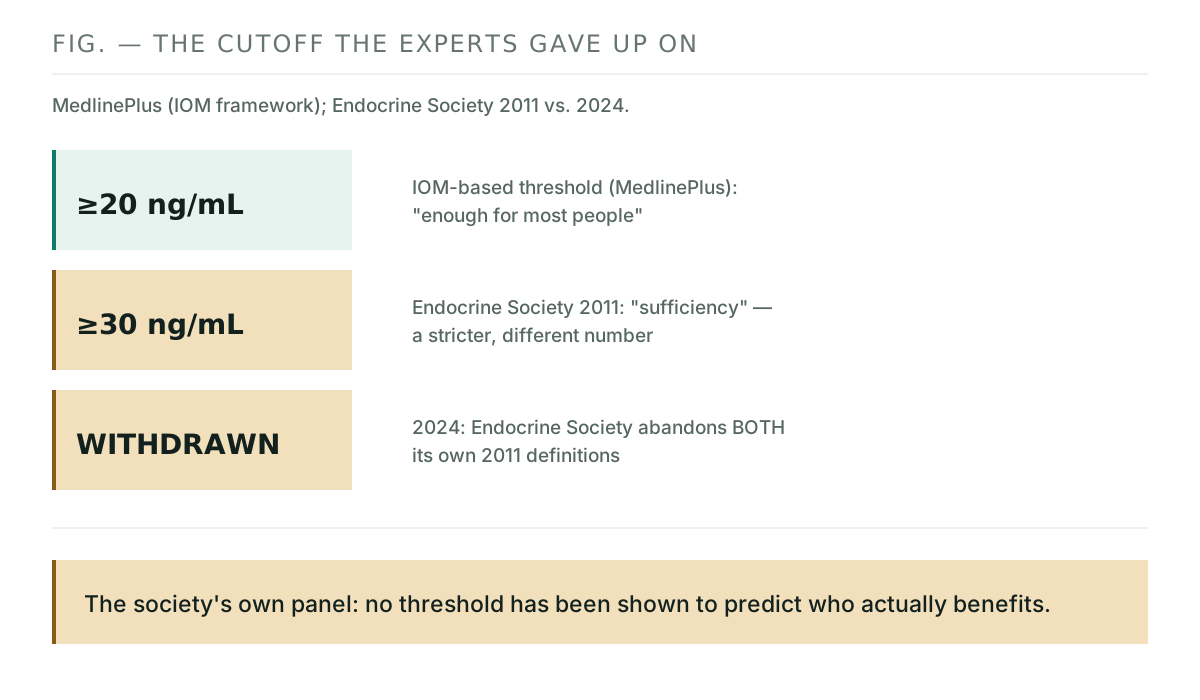
For over a decade, the working answer to "am I low on vitamin D" was a blood test for 25-hydroxyvitamin D, or 25(OH)D, measured against a cutoff. MedlinePlus, following an Institute of Medicine framework, puts it this way: "levels of 50 nmol/L or above (20 ng/mL or above) are enough for most people," while "levels below 30 to 50 nmol/L (12 to 20 ng/mL) are too low for bone or overall health."
The Endocrine Society's own 2011 guideline used a different, stricter pair of numbers: "sufficiency" at 30 ng/mL or more, "insufficiency" between 20 and 30. Two respected sources, two different lines on the same test — already a sign that the number was less settled than it looked on a lab report.
In 2024, the Endocrine Society went further than disagreeing with someone else's number: it walked back its own. In a Guideline Communication, the society states that "the most appropriate 25(OH)D threshold to distinguish unacceptably low vs reliably adequate concentrations remains controversial," and that a newly commissioned panel "determined that available clinical trial evidence does not permit the establishment of 25(OH)D thresholds that specifically predict meaningful benefit with vitamin D supplementation." The panel's "overall certainty in the available evidence was very low." As a direct result, "the Endocrine Society no longer endorses its previously proposed definition of vitamin D 'sufficiency'... or its previously proposed definition of vitamin D 'insufficiency.'"
That is a professional body publicly retracting the exact number a decade of patients were tested against.
Why the new guideline says to skip the test
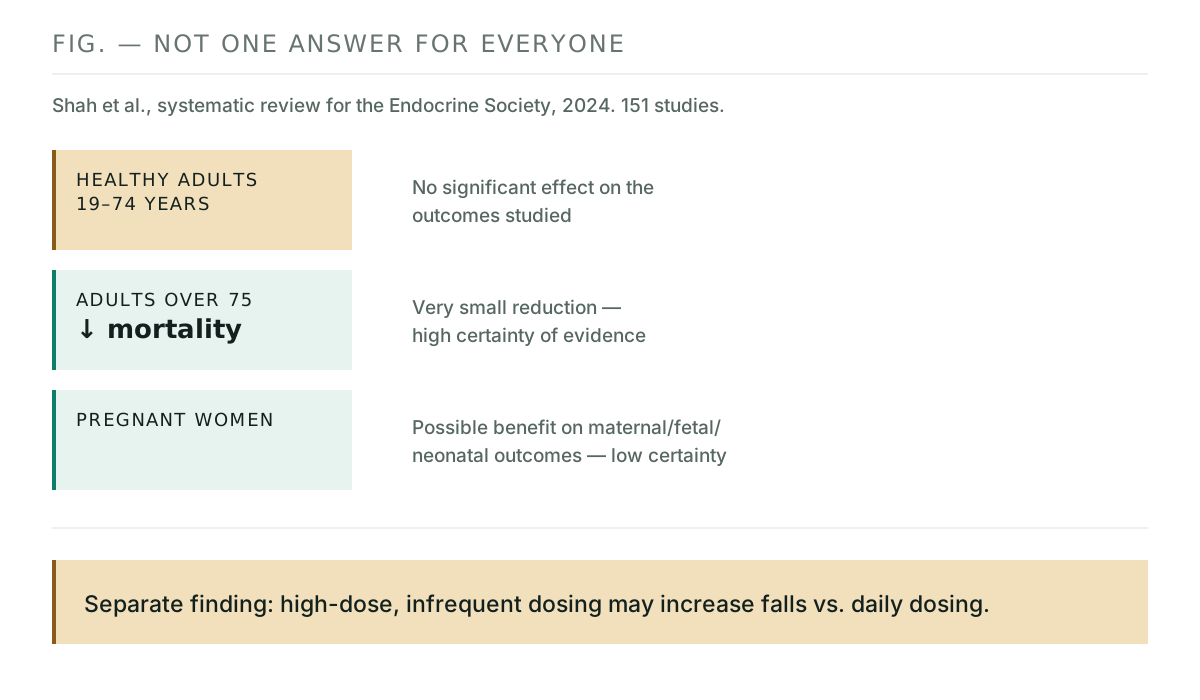
A companion systematic review, built to support the 2024 guideline, screened 37,007 citations down to 151 included studies across 14 prioritized clinical questions. For the group most readers of this site fall into, the finding is direct: "there was no significant effect on select outcomes in healthy adults aged 19 to 74 years with variable certainty of evidence."
The guideline's own recommendation follows from that: "the panel suggests against routine 25(OH)D testing in all populations considered," and notably, that includes groups often told they need extra scrutiny — "no clinical trial evidence was found to support routine screening for 25(OH)D in the general population, nor in those with obesity or dark complexion." The panel's reasoning is not "the test is unreliable"; it is that no trial has actually shown screening changes outcomes for the better, in any of the populations they reviewed.
Who the guideline says yes to — without even testing
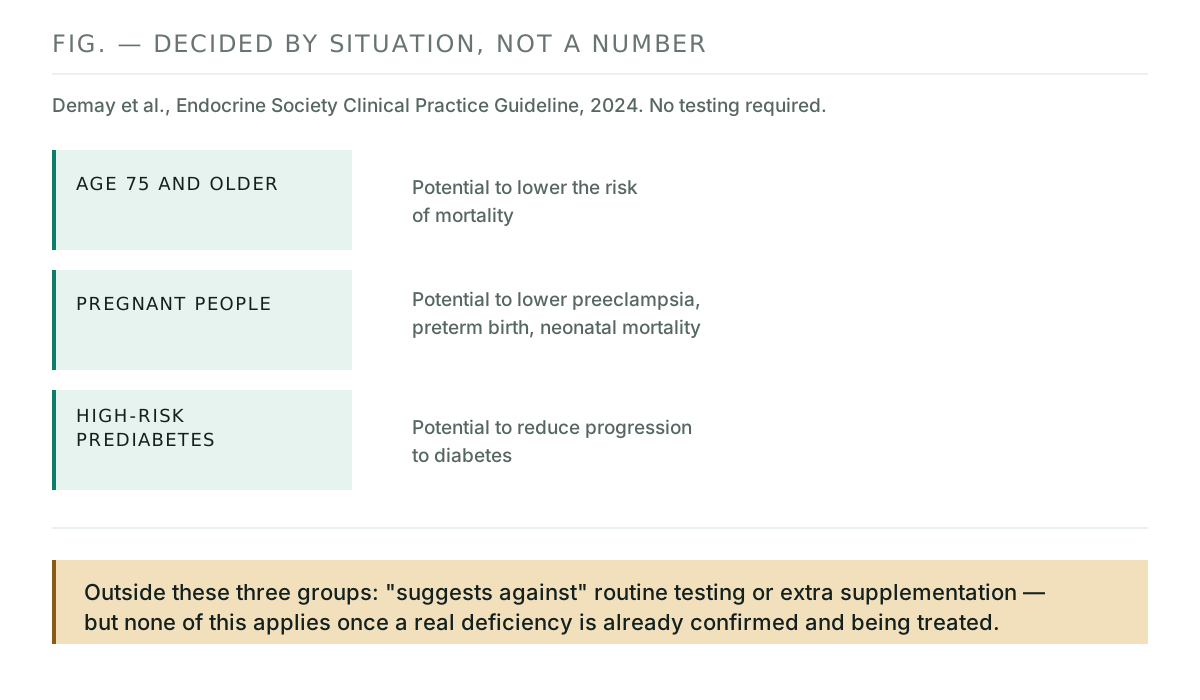
The guideline does not land on "nobody needs vitamin D." It identifies three specific groups where empiric supplementation — meaning taking it without testing 25(OH)D first — is suggested, each tied to a specific, named benefit: adults "aged 75 years and older because of its potential to lower the risk of mortality"; people who are pregnant "because of its potential to lower the risk of preeclampsia, intra-uterine mortality, preterm birth, small-for-gestational-age birth, and neonatal mortality"; and people "with high-risk prediabetes because of its potential to reduce progression to diabetes."
The systematic review backs the strongest of those three with its most confident finding: "a very small reduction in mortality among adults older than 75 years" rated "high certainty of evidence" — one of the few results in the whole review graded that solidly. The prediabetes finding carries "moderate certainty," and the pregnancy finding "low-certainty evidence."
For men specifically past 50 who do have an indication for vitamin D, the guideline adds a dosing note worth knowing: "the panel suggests supplementation via daily administration of vitamin D, rather than intermittent use of high doses." That is not a minor preference — the systematic review separately found that "administration of high-dose intermittent vitamin D may increase falls, compared to lower-dose daily dosing."
Everyone else: no clear benefit shown, not "don't bother"
Outside those three groups, the guideline's position is specific and worth reading exactly as written: "the panel suggests against empiric vitamin D supplementation above the current DRI to lower the risk of disease in healthy adults younger than 75 years." That is a statement about supplementing beyond ordinary dietary intake to prevent future disease in someone with no established problem — it is not a blanket statement that vitamin D does nothing for anyone, and it is not this article disqualifying the vitamin's value.
The guideline draws that line itself, explicitly: these recommendations "do not apply to people with established indications for vitamin D treatment or 25(OH)D testing." A man with real symptoms, a known malabsorption condition, very limited sun exposure, or another specific reason a clinician wants to investigate is not the "general population without an indication" this guideline is talking about. The recommendation against routine testing is about screening people with no particular reason to suspect a problem — not about ignoring one that is actually there.
How much is too much
Excess vitamin D is a real risk, and unlike magnesium, it does not require extreme amounts of a supplement to get there. MedlinePlus: "too much vitamin D can make the intestines absorb too much calcium," which can lead to "calcium deposits in soft tissues such as the heart and lungs," "confusion and disorientation," "damage to the kidneys," "kidney stones," and "nausea, vomiting, constipation, poor appetite, weakness, and weight loss." MedlinePlus lists the safe upper limit for adults at 4,000 IU/day (100 mcg/day) from supplements; toxicity "almost always occurs from using too many supplements," not from food or sunlight.
The honest limits of this
None of the 14 clinical questions the 2024 guideline panel prioritized was specifically about fatigue or energy as an outcome — the "no significant effect" finding in healthy adults covers the outcomes the panel actually studied (bone, cardiovascular, and related measures), not a dedicated fatigue trial. That is an absence of evidence for a broad energy benefit, not direct evidence against one in every individual case. The guideline is also explicitly about empiric supplementation in a general population without an established indication — it says nothing about what happens when a real, confirmed deficiency is corrected in someone who actually has one, which is a different clinical question with its own, smaller body of evidence this article has not reviewed in full.
What to do with this
- If you fall into one of the three named groups — 75 or older, pregnant, or high-risk prediabetes — supplementation is worth a direct conversation with a clinician, without needing a blood test first.
- If you don't, and you have no specific symptoms or risk factors, routine testing is not what the current guideline recommends, even if you have risk factors like obesity or darker skin that used to be reasons to test more often.
- If you do have real symptoms or a specific reason to suspect a problem, that is exactly the situation these recommendations say they do not cover — ask a clinician to investigate properly rather than applying a population-wide guideline to an individual concern.
- If you supplement past 50, take it daily rather than in large, infrequent doses. The trial evidence favors daily dosing, partly over a fall-risk signal tied to high, intermittent doses.
- Don't expect a vitamin D bottle to fix ordinary tiredness if you are not actually deficient — the trial evidence in healthy adults under 75 does not show that effect, whatever the marketing around it implies.
The honest version of this story is not "vitamin D is useless." It is that the number used to decide who needs it turned out not to predict benefit, the society that proposed it agrees, and the groups actually shown to benefit are defined by who they are, not by a blood test.
Key takeaways
- In 2024 the Endocrine Society withdrew its own 2011 vitamin D "sufficiency" (≥30 ng/mL) and "insufficiency" (20-30 ng/mL) definitions, stating trial evidence "does not permit the establishment of 25(OH)D thresholds that specifically predict meaningful benefit."
- The guideline "suggests against routine 25(OH)D testing in all populations considered," including people with obesity or dark complexion.
- A systematic review found "no significant effect on select outcomes in healthy adults aged 19 to 74 years" from empiric supplementation.
- Three groups still get a "yes," decided without testing: adults 75+ (small mortality reduction, high-certainty evidence), pregnant people (possible benefit, low certainty), and high-risk prediabetes (reduced progression, moderate certainty).
- High-dose, infrequent dosing "may increase falls" compared with daily dosing in people over 50 who are supplementing.
- None of this applies to someone with an already-established reason to test or treat — the guideline says so explicitly.
Where to go from here
This is the eighth article in the energy section, and the second of the supplement group. The ones published so far:
- Anemia — the tiredness that shows up in a routine blood count, and why in a man it obliges a search.
- Vitamin B12 — who is actually short of it, who is just taking it, and the newer question of whether high doses are free.
- Hypothyroidism — the normal range moves with age, and treating the mildest version did not change how a large trial's patients felt.
- Caffeine — the daily lift is mostly withdrawal relief, not a boost above normal, and it can still cost you sleep six hours later.
- Brain fog — reported in a dozen unrelated conditions and defined inconsistently even by researchers, with a surprisingly specific fingerprint from sleep loss.
- Magnesium — common shortfall, rarely true deficiency, and the standard blood test is a poor way to check it.
- CoQ10 — the best evidence isn't an energy study at all, it's a two-year heart-failure trial that cut deaths and hospital stays.
- Creatine — same pattern as this one: the benefit concentrates in people who were actually short of it, not in rested, well-stocked bodies.
In the meantime, the two sections this one borders on: sleep for everything on the nights, and testosterone for the hormone question.
Frequently asked questions
What blood level of vitamin D counts as normal?
There is no single agreed number. MedlinePlus, using an Institute of Medicine framework, states that 25-hydroxyvitamin D levels of 50 nmol/L (20 ng/mL) or above are "enough for most people." The Endocrine Society's own 2011 guideline had proposed a stricter definition, 30 ng/mL for "sufficiency." In 2024, the Endocrine Society withdrew both of its 2011 definitions, stating that clinical trial evidence "does not permit the establishment of 25(OH)D thresholds that specifically predict meaningful benefit."
Should I get my vitamin D level tested?
The 2024 Endocrine Society guideline "suggests against routine 25(OH)D testing" in every population it considered, including people with obesity or dark complexion, because "no clinical trial evidence was found to support routine screening" for those groups either. This applies to people without an already-established reason to test — it does not apply to someone with real symptoms or risk factors a clinician wants to investigate.
Does taking vitamin D help with low energy or fatigue?
Not for most healthy adults who aren't deficient. A systematic review supporting the 2024 Endocrine Society guideline found "no significant effect on select outcomes in healthy adults aged 19 to 74 years" from empiric vitamin D supplementation. Fatigue specifically was not one of the 14 clinical questions the guideline panel prioritized, so this is an absence of the kind of trial evidence that would show a broad benefit, not proof that correcting a real deficiency never helps how someone feels.
Who does the guideline actually recommend vitamin D for?
Three groups, decided by life situation rather than a blood test: adults 75 and older ("potential to lower the risk of mortality"), pregnant people ("potential to lower the risk of preeclampsia, intra-uterine mortality, preterm birth, small-for-gestational-age birth, and neonatal mortality"), and people with high-risk prediabetes ("potential to reduce progression to diabetes"). The guideline suggests against extra supplementation for healthy adults younger than 75 outside those situations.
Does a real vitamin D deficiency matter?
Yes. MedlinePlus states that vitamin D deficiency "can lead to weakened bones (osteomalacia and osteoporosis in adults or rickets in children)." The 2024 guideline's recommendations against routine testing and extra supplementation explicitly "do not apply to people with established indications for vitamin D treatment or 25(OH)D testing" — in other words, someone already being evaluated for a real, confirmed problem is a different situation than population-wide screening.
Is it possible to take too much vitamin D?
Yes, and it happens almost always from supplements, not food or sun. MedlinePlus states that "too much vitamin D can make the intestines absorb too much calcium," which can cause confusion, kidney damage, kidney stones, nausea, and weakness. Separately, a systematic review found that high-dose, infrequent dosing "may increase falls, compared to lower-dose daily dosing" — one more reason daily, moderate dosing is preferred over occasional large doses.
Sources
- McCartney et al., Journal of Clinical Endocrinology & Metabolism, 2024 — Vitamin D Insufficiency and Epistemic Humility: An Endocrine Society Guideline Communication
- Demay et al., Journal of Clinical Endocrinology & Metabolism, 2024 — Vitamin D for the Prevention of Disease: An Endocrine Society Clinical Practice Guideline
- Shah et al., Journal of Clinical Endocrinology & Metabolism, 2024 — A Systematic Review Supporting the Endocrine Society Clinical Practice Guidelines on Vitamin D
- MedlinePlus (National Library of Medicine, NIH) — Vitamin D

Male Health Guide Editorial Team
We write about the health problems men over 40 actually search for at 3 a.m. — and we say plainly when the evidence for a popular product is thin. We do not invent credentials and we do not publish sponsored copy as editorial. Read more about how we work.
Medical disclaimer: This article is general information about vitamin D and is not medical advice. It does not account for your own medical history, medications, or lab results. Talk to a clinician about your own vitamin D status if you have real symptoms or risk factors, rather than applying a population-level guideline to your individual situation.