Creatine: Strongest in Tired Brains, Not Rested Ones
Short answer
Creatine is best known as a muscle supplement, but a single dose measurably protected cognitive performance during 21 hours of sleep deprivation in two recent trials, and older adults show a far larger memory benefit than young, rested ones. The popular kidney-damage worry does not hold up in current data, and neither does the loading phase — it only saves time, not level.
This page belongs to the energy section, and it is the one ingredient article in this cluster that nobody asked for by name — unlike magnesium, vitamin D or CoQ10, creatine is not usually sold as an energy supplement at all. It is sold in gyms, for muscle. That turns out to be exactly why it is worth covering here: the evidence for what this site’s reader actually wants — a brain that still works on four hours of sleep — sits in a different, newer, less talked-about body of research.
We earn nothing from any of this. There are no affiliate links on this site, nothing here is sponsored, and there is no tub of powder to sell, which matters more than usual on this particular ingredient — as the sources section below will make clear, much of the standard dosing literature was written by scientists with financial ties to companies that manufacture creatine. We read around that where we could.
What creatine actually is
Creatine is not a stimulant and not a vitamin. It is a compound the body makes itself, mostly in the liver and kidneys, and also gets from food — mainly meat and fish. Once made or eaten, most of it is stored in skeletal muscle as phosphocreatine, a fast-access reserve that helps regenerate ATP, the molecule cells actually spend as energy, during short bursts of high demand.
A smaller, separate pool sits in the brain, which is one of the most metabolically demanding organs in the body. That brain pool is the one this article is mostly about. People who eat little or no meat start with lower creatine stores in both pools, because diet is their only source besides what the body manufactures on its own — a detail that turns out to matter later in this article.
The claim this site cares about is not the muscle one
The International Society of Sports Nutrition’s position stand summarizes creatine as one of the most popular ergogenic aids for athletes, with a long record of improving high-intensity exercise performance. That literature is large, old and well settled. It is also not this site’s subject — a man reading the pillar of this section is not asking whether he can squat more. He is asking why he feels wrung out, and whether anything sold at the pharmacy actually helps that.
The more interesting, much newer literature asks a version of that exact question: does creatine do anything for a brain that is not getting enough rest or enough dietary creatine to begin with? That is where the real surprises are.
The freshest evidence: one dose, one long night
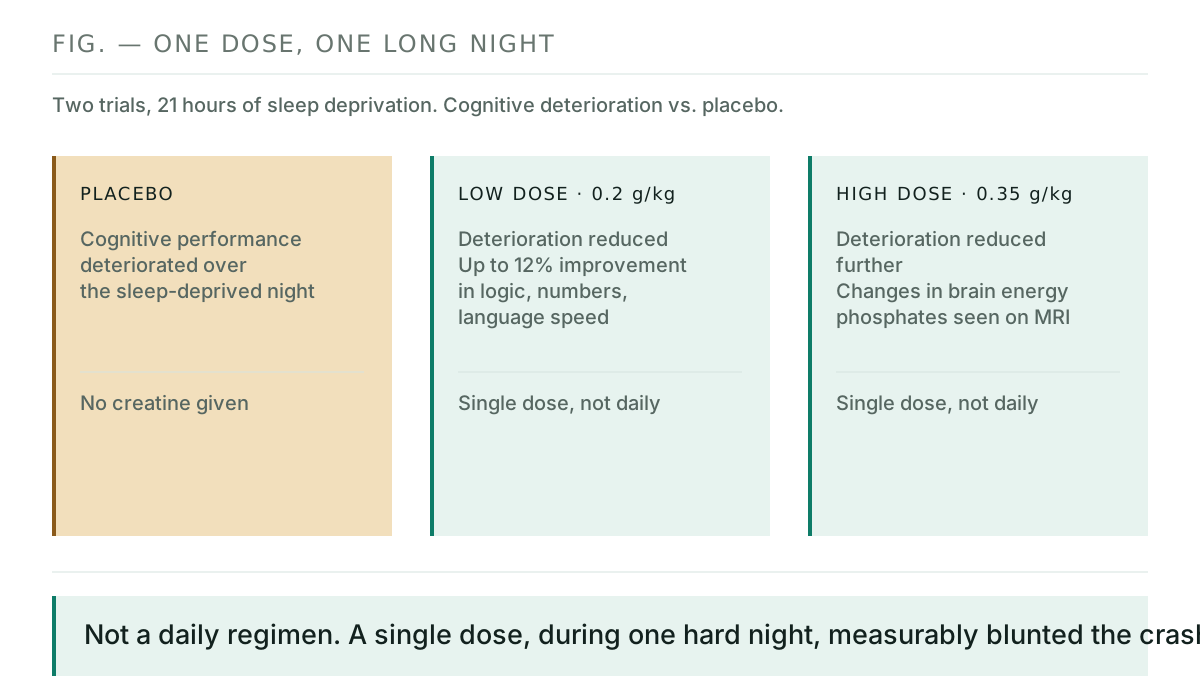
A German research group ran the cleanest test of this question available. Healthy subjects were kept awake for 21 hours straight — a sub-total sleep deprivation protocol — and given either a single dose of creatine or a placebo partway through, with cognitive testing and brain imaging at intervals afterward.
A single oral dose of creatine monohydrate (0.35 g/kg) during 21 hours of sleep deprivation induced measurable changes in cerebral high-energy phosphates on MRI, prevented a drop in brain pH, and improved cognitive performance and processing speed compared with placebo. Gordji-Nejad et al., Scientific Reports, 2024
That is a striking result on its own — most creatine research assumes it takes weeks of daily dosing to raise brain creatine levels at all, because the brain is slow to take it up from the blood. A single dose working on the same night runs against that assumption, and the authors’ own explanation is that acute sleep deprivation temporarily increases the brain’s uptake of creatine, opening a short window where a single dose reaches tissue it normally could not.
The same group then tested whether a smaller, more practical dose did anything at all.
A single dose of 0.2 g/kg creatine — roughly half the earlier dose — also reduced sleep-deprivation-induced deterioration in logical and numerical tasks, language processing speed, and sustained attention, with up to a 12% improvement, though the effect was less pronounced than with the higher dose. Gordji-Nejad et al., Nutrients, 2026
An older, smaller study found a narrower version of the same pattern. Subjects took 5 g of creatine four times a day for a week, then were tested through 36 hours of sleep deprivation combined with moderate exercise. The creatine group performed significantly better than placebo, but only on one task — the most cognitively demanding one, and only at the worst point of the deprivation, 36 hours in.
During sleep deprivation with moderate-intensity exercise, creatine supplementation only affects performance of complex central executive tasks. McMorris et al., Physiology & Behavior, 2007
Put the three studies together and a consistent shape appears: creatine’s effect on a tired brain is real, and it shows up hardest on the tasks that are hardest to do while exhausted — not on everything equally.
In rested, healthy young adults, the signal is weaker
This is the honest complication, and it is worth stating plainly before going further: most of the broader cognition literature was not run on sleep-deprived people. It was run on ordinary healthy adults going about a normal week, and there the results are mixed.
A 2024 meta-analysis of 16 randomized trials (492 participants) found creatine significantly improved memory, attention time, and information processing speed, but found no significant improvement in overall cognitive function or executive function, with certainty of evidence rated low to moderate. Xu et al., Frontiers in Nutrition, 2024
A separate, independent meta-analysis focused specifically on memory reached a similar headline result, with an important subgroup finding underneath it.
Creatine supplementation improved memory overall (standardized mean difference 0.29), but the effect in older adults aged 66–76 (SMD 0.88) was far larger than in younger adults aged 11–31 (SMD 0.03, not significant). Prokopidis et al., Nutrition Reviews, 2023
A 2024 critical review, written by the same researcher behind the 2007 sleep-deprivation study above, looked across this literature and reached a pointed conclusion: results on creatine and cognition are somewhat equivocal overall, but supplementation does appear to significantly raise brain creatine content specifically in “stressed” populations — sleep-deprived, elderly, hypoxic — which the review flags as the place where more research on the resulting cognitive effects is warranted.
A brain with full reserves, well rested, does not have much reason to show improvement from extra creatine — it is not short of anything the supplement replaces. A brain under strain — sleep-deprived, older, or starting from a lower baseline — has more room to benefit, and that is where every positive result above comes from.
Vegetarians start from a smaller reserve
The baseline matters because diet is one of two sources of creatine, and the other — the body’s own synthesis — does not fully make up for skipping meat and fish. A systematic review of creatine supplementation in vegetarians found it raised total creatine and phosphocreatine in muscle, plasma and red blood cells, often to levels higher than omnivores’, and improved measures of memory and intelligence in vegetarian participants.
A controlled trial in an all-female sample isolated the comparison by diet alone, and found the same split.
Creatine supplementation did not influence verbal fluency or vigilance in either group, but in vegetarians — not in those who ate meat — it resulted in better memory. Benton & Donohoe, British Journal of Nutrition, 2011
This is the same shape of finding as the sleep-deprivation and older-adult results: creatine moves the needle most where the starting reserve was lowest to begin with, which is a pharmacologically unglamorous but consistent story across three unrelated populations.
The kidney myth, checked against 2025–2026 data
Creatine’s reputation problem has nothing to do with the evidence above. It is the decades-old worry that it damages the kidneys — a concern serious enough that it is the third item on a 2021 sports-nutrition-society paper’s own named list of common questions and misconceptions about creatine. Two independent systematic reviews, both published in the past year, give the most current answer.
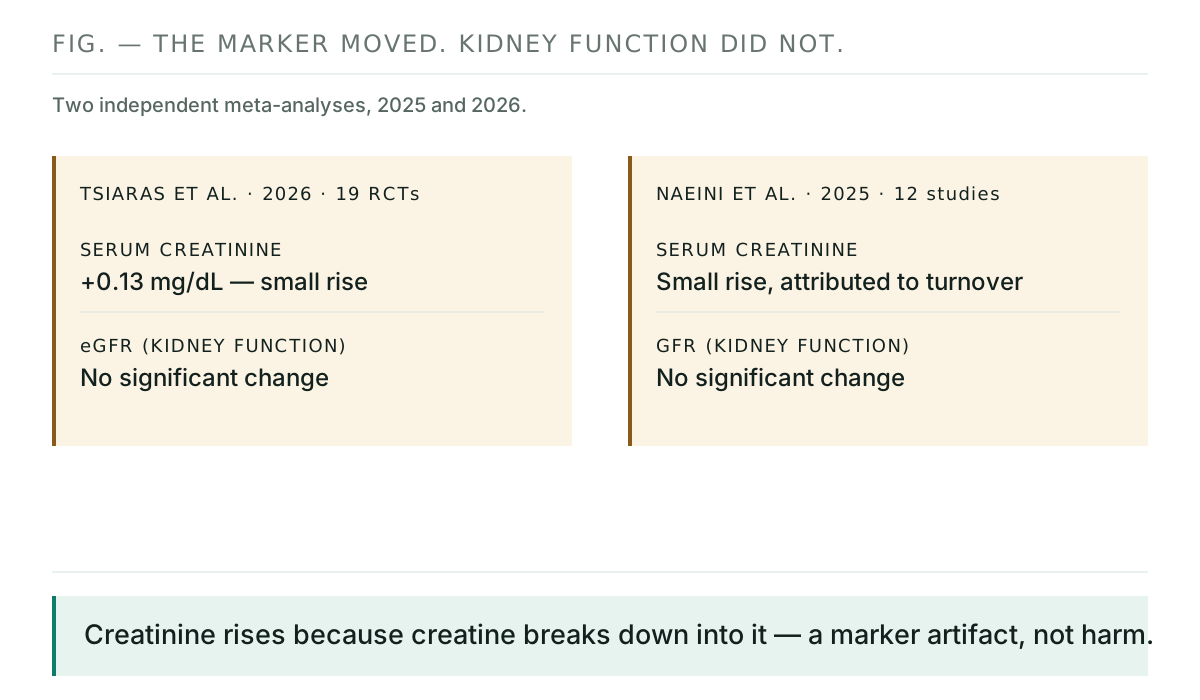
Across 19 randomized trials, creatine supplementation was associated with a small increase in serum creatinine (+0.13 mg/dL); among the subset of trials that also measured them, there was no significant change in urea (12 trials) or in estimated glomerular filtration rate, eGFR, the actual measure of kidney function (8 trials). Tsiaras et al., Journal of Renal Nutrition, 2026
A separate meta-analysis of 12 studies found a small, statistically significant rise in serum creatinine, which the authors attribute to metabolic turnover rather than renal impairment, with no significant change in GFR, suggesting preserved kidney function. Naeini et al., BMC Nephrology, 2025
The reason creatinine rises without the kidneys being harmed is mechanical, not reassurance by assertion: creatine itself breaks down into creatinine as a normal metabolic byproduct, so taking more creatine means making more creatinine — the same blood test used to screen for kidney disease reads slightly higher simply because there is more of the parent compound in the system, not because filtration has gotten worse. eGFR — a separate calculation from the raw creatinine number, meant to estimate actual filtration — stayed flat in both reviews despite that rise.
Both reviews studied people without pre-existing kidney disease. Neither is a reason for a man with known kidney impairment to start creatine without asking his own provider first — that is a different question with a different evidence base.
Skip the loading phase
The other persistent piece of folklore is the “loading phase” — a week of high-dose creatine, 20 g a day, often in four separate servings, before dropping to a maintenance dose. The classic study behind this practice also measured the slower alternative, in the same subjects.
Muscle total creatine rose about 20% after 6 days at 20 g/day, a level then maintained with 2 g/day. A slower protocol of 3 g/day produced a similar 20% increase in muscle creatine over 28 days without any loading dose. Hultman et al., Journal of Applied Physiology, 1996
That same 2021 misconceptions paper lists “is a creatine ‘loading-phase’ required?” among its named questions, and the answer in the underlying data is no — loading buys speed, not a higher ceiling. A man willing to wait four weeks reaches the same muscle creatine level as one who loads for a week, without the larger daily dose, which is also the dose most associated with the stomach upset some people get at 20 g/day.
The standard dose, and who is studying it
The dose used across most of the research above, and recommended in that same paper, is 3–5 g/day, or about 0.1 g per kilogram of body mass per day, taken indefinitely once a steady state is reached. The International Society of Sports Nutrition’s own 2017 position stand puts a number on the upper end: studies have used doses up to 30 g/day for five years in healthy individuals and a range of patient populations without evidence of harm, though that is a far higher dose than the maintenance level most people actually take.
The 2021 misconceptions paper’s own disclosure section is unusually long: multiple authors report serving on the scientific advisory board of a creatine manufacturer, receiving industry research funding, creatine donations for studies, or speaking fees tied to creatine conferences. That does not make the dosing figures wrong — they match the independent 1996 saturation study above — but it is a reason to lean on the independently funded meta-analyses for the efficacy and safety claims in this article, and to treat both sports-nutrition-society papers mainly as sources for practical dosing mechanics.
What to actually do with this
- Do not expect a jolt. This is not a stimulant and nothing here suggests it works like one; the evidence is about blunting cognitive decline under strain, not creating energy that was not there.
- The clearest case is for a bad night, not an ordinary day. The sleep-deprivation trials used a single dose on the night it mattered, not a daily routine built around an ordinary Tuesday.
- If you are older, vegetarian, or chronically short on sleep, the evidence for you specifically is stronger than the mixed general-population average suggests.
- Skip the loading phase unless speed specifically matters to you. A steady 3–5 g/day reaches the same muscle saturation in about four weeks.
- The kidney worry is not supported in people with healthy kidneys in the two most current reviews — but it is a fair question to raise with a provider if kidney function is already a concern.
Key takeaways
- A single dose of creatine (0.35 g/kg or 0.2 g/kg) measurably blunted cognitive deterioration during 21 hours of sleep deprivation in two recent trials, with brain-chemistry changes visible on MRI at the higher dose.
- In ordinary rested adults the evidence is mixed: a 2024 meta-analysis found creatine improved memory and processing speed but not overall cognitive or executive function.
- The memory benefit is far larger in older adults (66–76, SMD 0.88) than in younger adults (11–31, SMD 0.03, not significant); a 2024 critical review found cognition results equivocal overall but flagged "stressed" populations (sleep-deprived, elderly) as where creatine most reliably raises brain creatine content, warranting more cognitive research there.
- Vegetarians, who start with lower baseline creatine from diet, showed a memory benefit from supplementation that meat-eaters in the same trial did not.
- Two independent 2025–2026 meta-analyses found creatine raises serum creatinine slightly (a metabolic marker artifact) without changing eGFR, the actual measure of kidney function, in people without pre-existing kidney disease.
- The classic loading-phase study found 3 g/day for 28 days reaches the same muscle creatine saturation as 20 g/day for 6 days — loading only saves time, not level.
- The sports nutrition society’s dosing position paper carries extensive industry-funding disclosures from creatine manufacturers; its dosing figures match independent data, but its safety framing is worth weighing against independently funded sources.
Where to go from here
Creatine is one ingredient among several this site has checked the evidence on. These sit alongside it:
- Fatigue After 40: Sleepy and Tired Are Not the Same Thing — the pillar, and where this fits among the other explanations for low energy.
- Magnesium: Common Shortfall, Rarely True Deficiency — another supplement where the real benefit is narrower than the marketing.
- Vitamin D: The Cutoff the Experts Gave Up On — same pattern: strongest in people who are actually short of it.
- CoQ10: The One Trial With Real, Hard Outcomes — the other energy-adjacent supplement with evidence worth taking seriously.
- Caffeine: The Boost Is Mostly Withdrawal Relief — the daily stimulant this is not.
Frequently asked questions
Does creatine actually give you more energy?
Not in the stimulant sense. The clearest evidence is that a single dose blunts cognitive deterioration during sleep deprivation, and that older adults and vegetarians see a real memory benefit. In ordinary rested adults, overall cognitive function and executive function have not shown significant improvement in meta-analysis, even though memory and processing speed have.
Does creatine help with brain fog or mental fatigue?
The strongest evidence is specific to sleep deprivation, not brain fog generally. Two trials found a single dose of creatine reduced cognitive deterioration during 21 hours of sleep deprivation, improving logical, numerical and language-processing tasks. A 2024 critical review called cognition results equivocal overall, but found creatine most reliably raises brain creatine content in sleep-deprived and other stressed populations, and said cognitive research there specifically is still needed.
Is creatine bad for your kidneys?
Not in people with healthy kidneys, based on the two most current systematic reviews. Both found serum creatinine rises slightly with supplementation, but kidney filtration itself (measured as eGFR in one review and GFR in the other, the actual measure of kidney function) does not change. The creatinine rise is a predictable metabolic byproduct, not evidence of kidney damage. People with existing kidney disease should still ask their own provider.
Do I need to do a creatine loading phase?
No. The classic study on this found that 3 grams a day for 28 days raises muscle creatine by about the same amount as 20 grams a day for 6 days. Loading reaches the same level faster; it does not reach a higher level. Skipping it also avoids the dose most associated with stomach upset.
How much creatine should I take?
The standard maintenance dose used in most of the research is 3 to 5 grams a day, or about 0.1 gram per kilogram of body weight, taken daily. The sports nutrition society’s own position stand reports that studies have used doses up to 30 grams a day for 5 years without evidence of harm in healthy adults; several authors across this strand of the literature disclose creatine-industry funding ties, worth knowing when weighing the safety framing.
Does creatine work the same for everyone?
No. The benefit shows up most clearly in people with lower starting reserves or under more strain: older adults, vegetarians (who get less dietary creatine), and anyone sleep-deprived. In young, rested, well-nourished adults, several measures of cognition have not shown a significant benefit in meta-analysis.
Sources
- Gordji-Nejad A et al. Scientific Reports, 2024 — Single Dose Creatine Improves Cognitive Performance and Induces Changes in Cerebral High Energy Phosphates During Sleep Deprivation
- Gordji-Nejad A et al. Nutrients, 2026 — Single-Dose Creatine Reduces Sleep Deprivation-Induced Deterioration in Cognitive Performance
- McMorris T et al. Physiology & Behavior, 2007 — Creatine Supplementation, Sleep Deprivation, Cortisol, Melatonin and Behavior
- McMorris T et al. Behavioral Brain Research, 2024 — Creatine Supplementation Research Fails to Support the Theoretical Basis for an Effect on Cognition: Evidence From a Systematic Review
- Xu C et al. Frontiers in Nutrition, 2024 — The Effects of Creatine Supplementation on Cognitive Function in Adults: A Systematic Review and Meta-Analysis
- Prokopidis K et al. Nutrition Reviews, 2023 — Effects of Creatine Supplementation on Memory in Healthy Individuals: A Systematic Review and Meta-Analysis of Randomized Controlled Trials
- Kaviani M et al. International Journal of Environmental Research and Public Health, 2020 — Benefits of Creatine Supplementation for Vegetarians Compared to Omnivorous Athletes: A Systematic Review
- Benton D, Donohoe R. British Journal of Nutrition, 2011 — The Influence of Creatine Supplementation on the Cognitive Functioning of Vegetarians and Omnivores
- Tsiaras A et al. Journal of Renal Nutrition, 2026 — The Effect of Creatine Supplementation on Kidney Function: A Systematic Review and Meta-Analysis of Randomized Controlled Trials
- Naeini EK et al. BMC Nephrology, 2025 — Effect of Creatine Supplementation on Kidney Function: A Systematic Review and Meta-Analysis
- Hultman E et al. Journal of Applied Physiology, 1996 — Muscle Creatine Loading in Men
- Antonio J et al. (ISSN) Journal of the International Society of Sports Nutrition, 2021 — Common Questions and Misconceptions About Creatine Supplementation: What Does the Scientific Evidence Really Show?
- Kreider RB et al. (ISSN) Journal of the International Society of Sports Nutrition, 2017 — International Society of Sports Nutrition Position Stand: Safety and Efficacy of Creatine Supplementation in Exercise, Sport, and Medicine

Male Health Guide Editorial Team
We write about the health problems men over 40 actually search for at 3 a.m. — and we say plainly when the evidence for a popular claim is thin. We do not invent credentials and we do not publish sponsored copy as editorial. Read more about how we work.
Medical disclaimer: This article is general information about creatine and the evidence behind common claims made for it, and is not medical advice. It is not a substitute for diagnosis or treatment, and it is not a recommendation to start or avoid any supplement. Please speak to a qualified healthcare professional about your own situation, particularly if you have kidney disease or another condition that changes how a supplement should be used.