Magnesium: Common Shortfall, Rarely True Deficiency
Short answer
Most adults fall short of the magnesium target on paper, but true magnesium deficiency is rare and concentrated in specific risk groups. The standard blood test is a poor measure of the body's actual magnesium status — a controlled trial found weeks of supplementation did not even move it. A modest, real signal exists for sleep.
Magnesium shows up on more "things men over 40 should take" lists than almost any other mineral. Part of its reputation rests on a real and common fact: most people's diets fall short of the target. Part of it rests on a detail almost nobody mentions — the blood test most people would use to check their own status is measuring something close to irrelevant.
We earn nothing from any answer here. There is no magnesium supplement, brand, or formula being sold on this page.
The real, common problem: diet, not disease
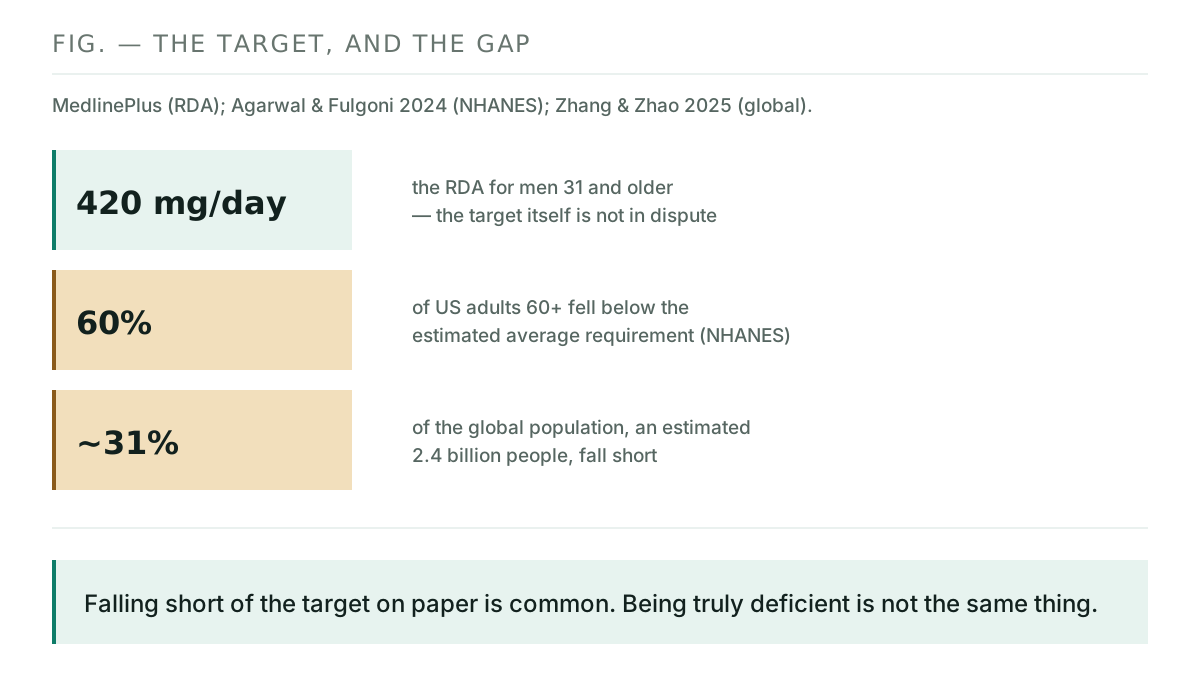
MedlinePlus lists the Recommended Dietary Allowance for adult men at 400 mg/day from ages 19 to 30, rising to 420 mg/day from 31 on. A 2025 review in the International Journal for Vitamin and Nutrition Research frames how wide the gap between that target and actual intake runs: "an estimated 2.4 billion people, or roughly 31% of the global population, fail to meet the recommended magnesium intake levels," driven by "modern dietary patterns low in whole grains and vegetables, soil nutrient depletion from intensive agriculture, food processing losses, aged populations, chronic diseases, and socioeconomic disparities."
A US-focused analysis using 2011-2018 NHANES data on adults 60 and older put a number on this country specifically: "a high percentage of older adults did not meet nutrient recommendations for... magnesium (60%)," among several other shortfalls. (Worth disclosing: this specific study was funded directly by the Beef Checkoff, the US beef industry's own promotion program, and its two authors separately disclose general consulting work for food and beverage companies. The NHANES methodology is standard and the magnesium figure is consistent with the broader pattern other researchers report, but the funding is worth knowing — especially since the study's own focus was showing that beef consumers had better nutrient adequacy than non-consumers.)
Food sources, per MedlinePlus, lean heavily on plants: "dark green, leafy vegetables," plus bananas, dried apricots, avocados, almonds, cashews, legumes, soy products, whole grains, and milk. A diet light on those foods is the ordinary, unglamorous reason intake runs low — not a medical problem waiting to be diagnosed.
Falling short on paper is not the same as being deficient
Here is the distinction this article keeps coming back to, in the same shape as several other articles in this cluster: a common gap between intake and target does not mean a common disease. MedlinePlus states this directly: "although you may not get enough magnesium from your diet, it is rare to be truly lacking in magnesium." The body conserves what it has.
Real deficiency concentrates in specific groups, per MedlinePlus: people who misuse alcohol, people with "gastrointestinal disease or surgery causing malabsorption," older adults, and people with type 2 diabetes. MedlinePlus separately notes that an uncategorized shortage can bring "hyperexcitability," "muscle weakness," and — worth noting for a site about tiredness — "sleepiness," and then breaks the fuller picture into three named stages: early symptoms ("loss of appetite," "nausea," vomiting, fatigue, weakness); moderate deficiency symptoms ("numbness or tingling," muscle contractions and cramps, seizures, personality changes, and abnormal heart rhythms); and severe deficiency, which shows up in lab values rather than a feeling — low blood calcium (hypocalcemia) and low blood potassium (hypokalemia). The moderate-stage list already includes seizures and heart-rhythm changes; it is usually accompanied by one of the risk factors above, not appearing out of nowhere in an otherwise healthy man.
Why the blood test cannot settle the question
Even if a man suspects a real shortfall, the obvious next step — a blood test — is a weaker tool than it looks. A 1998 double-blind, placebo-controlled study in Medicine and Science in Sports and Exercise opens with the number that matters: "less than 1% of total body Mg is found in serum, yet the serum Mg concentration is used to assess the body's Mg status."
The study tested this directly in athletes with low-normal serum magnesium, giving half of them 500 mg of magnesium oxide daily for three weeks and half a placebo, then measuring magnesium in serum, blood cells, and calf muscle by nuclear magnetic resonance. The supplementation "did not increase the Mg concentration in serum or any cellular compartment studied" — including the muscle tissue it was meant to reach. The authors' conclusion: "serum Mg appears to be a poor indicator for Mg in skeletal muscle or most other cellular compartments."
In practice, that means a normal serum magnesium result does not rule out a real shortfall in the tissue that actually uses it, and three weeks of oral supplementation in this trial could not move the blood number at all. Testing magnesium status well requires more than the routine panel most people get — worth knowing before either dismissing a real symptom because "the blood test was normal," or assuming a normal result means nothing is wrong.
How much is too much
From ordinary food, overdoing magnesium is essentially a non-issue: "the body generally removes extra amounts," and MedlinePlus states that side effects from high intake "are not common, except in people with significantly reduced kidney function." Excess almost always traces back to supplements or to magnesium-containing laxatives, not diet. That does not make a supplement dose something to take casually — it means the caution belongs on the bottle, not the vegetable aisle.
Where a real, if modest, signal shows up: sleep
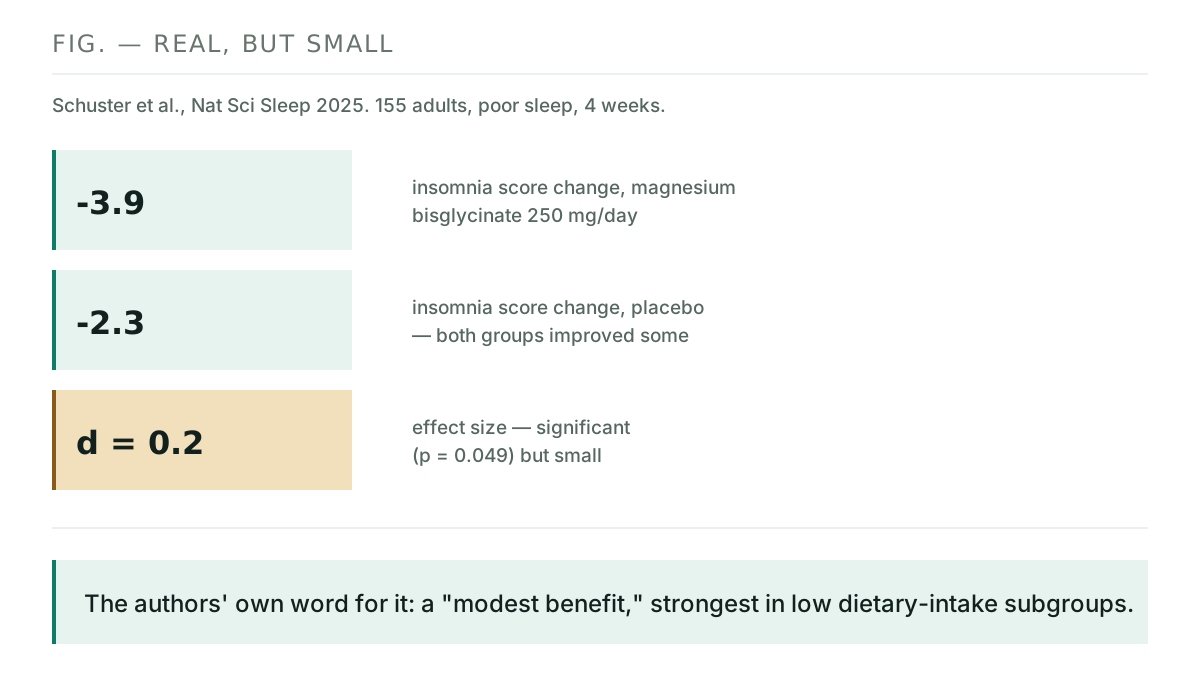
A 2025 randomized, double-blind, placebo-controlled trial in Nature and Science of Sleep enrolled 155 adults aged 18 to 65 with self-reported poor sleep quality — not selected for any diagnosed deficiency — and gave half of them 250 mg of elemental magnesium as magnesium bisglycinate daily for four weeks, the other half a placebo.
The magnesium group's insomnia severity score fell by "-3.9" points against "-2.3" for placebo, a statistically significant difference ("p = 0.049"). The honest caveat sits right beside it: "the effect size was small (Cohen's d = 0.2), indicating a modest benefit." The placebo group improved too, which is normal in sleep trials and part of why the gap between groups, not the raw change, is what matters. A secondary finding worth flagging as exploratory, not confirmed: "exploratory analyses suggested notably greater improvements among participants reporting lower baseline dietary magnesium intake" — a hint, not yet a proven way to predict who benefits most.
Where this fits with the rest of this cluster
Magnesium genuinely participates in energy metabolism — MedlinePlus credits it with helping in "the production of energy and protein" among "more than 300 biochemical reactions in the body." That mechanism is real; it is also a different claim from "taking more will make a non-deficient person feel more energetic," which this article is not in a position to settle either way. What the cluster's other articles do offer is a clearer, test-backed path for unexplained tiredness: anemia, an underactive thyroid, and a B12 shortfall are all conditions with an established diagnostic test behind them, which magnesium status, as covered above, does not have in the same way.
The honest limits of this
The NHANES-based US intake figure comes from a study whose authors have financial ties to the food industry, disclosed above; the underlying method (usual-intake modeling from dietary recall) is standard, but readers should know who funded the analysis. The sleep trial is one study of 155 people over four weeks — real and statistically significant, but a small effect that has not yet been replicated at scale. The serum-magnesium trial was conducted in athletes with low-normal levels specifically, over three weeks; it does not speak to every possible dosing schedule or population. None of this is settled science; it is the best evidence available right now, stated with its own limits attached.
What to do with this
- Try food first. Leafy greens, legumes, nuts, and whole grains move the needle on intake without any risk of excess — the body removes what it does not need from food sources.
- Do not expect a standard blood test to settle the question. A normal serum magnesium result does not rule out a real tissue-level shortfall, and the reverse is also true — ask a clinician what a more specific workup would involve if you have real risk factors (alcohol use, GI malabsorption, type 2 diabetes).
- If sleep is the actual complaint, that is where the trial evidence here is strongest — modest, not dramatic, and worth discussing with a clinician alongside the other things that affect sleep.
- If the real complaint is unexplained fatigue, the better-evidenced, test-backed causes are worth checking first — anemia, thyroid, B12.
- A supplement dose is still a deliberate choice, not an afterthought — talk to a clinician first if you have reduced kidney function or take medications that interact with minerals.
Magnesium is cheap, generally safe at food-level intake, and worth getting enough of regardless. What this article can responsibly say is where the evidence is solid (the intake gap, the test's blind spot, the modest sleep signal) and where it simply does not yet have a clear answer for this readership.
Key takeaways
- The RDA for adult men is 400-420 mg/day; a 2025 review puts the global shortfall at "an estimated 2.4 billion people, or roughly 31% of the global population."
- MedlinePlus: "although you may not get enough magnesium from your diet, it is rare to be truly lacking in magnesium" — true deficiency concentrates in alcohol misuse, GI malabsorption, older age, and type 2 diabetes.
- Less than 1% of total body magnesium is in blood; a controlled trial found 3 weeks of oral supplementation did not raise serum or muscle magnesium at all in athletes with low-normal levels.
- A 2025 trial found magnesium bisglycinate produced a statistically significant but small improvement (Cohen's d = 0.2) in insomnia severity versus placebo, in adults not selected for deficiency.
- Excess magnesium from food is essentially a non-issue; nearly all excess comes from supplements or magnesium-containing laxatives.
- Magnesium participates in real energy-metabolism pathways, but that is a different claim from supplementation measurably increasing energy in someone who isn't deficient.
Where to go from here
This is the seventh article in the energy section, and the first of the supplement group. The ones published so far:
- Anemia — the tiredness that shows up in a routine blood count, and why in a man it obliges a search.
- Vitamin B12 — who is actually short of it, who is just taking it, and the newer question of whether high doses are free.
- Hypothyroidism — the normal range moves with age, and treating the mildest version did not change how a large trial's patients felt.
- Caffeine — the daily lift is mostly withdrawal relief, not a boost above normal, and it can still cost you sleep six hours later.
- Brain fog — reported in a dozen unrelated conditions and defined inconsistently even by researchers, with a surprisingly specific fingerprint from sleep loss.
- Vitamin D — the Endocrine Society withdrew its own cutoff in 2024 and now advises against routine testing for most adults, but still recommends it for three specific groups.
- CoQ10 — the best evidence isn't an energy study at all, it's a two-year heart-failure trial that cut deaths and hospital stays.
- Creatine — another supplement where the real benefit is narrower than the marketing, and strongest in people starting from the lowest reserve.
In the meantime, the two sections this one borders on: sleep for everything on the nights, and testosterone for the hormone question.
Frequently asked questions
How much magnesium do men actually need?
MedlinePlus lists the RDA for adult men as 400 mg/day from ages 19 to 30 and 420 mg/day from age 31 on. A 2025 review notes this is a target a large share of adults in multiple countries fail to reach through diet, and a US analysis using NHANES data found 60% of adults 60 and older fell below the lower estimated average requirement.
If my diet falls short, am I magnesium deficient?
Probably not in the clinical sense. MedlinePlus states plainly: "although you may not get enough magnesium from your diet, it is rare to be truly lacking in magnesium." True deficiency concentrates in specific groups: people who misuse alcohol, people with gastrointestinal disease or surgery causing malabsorption, older adults, and people with type 2 diabetes.
Can a blood test tell me if I'm low on magnesium?
Not reliably. Less than 1% of total body magnesium is found in serum, which is what a standard blood test measures. A controlled trial gave athletes with low-normal serum magnesium 500 mg a day for three weeks; it did not raise their serum or muscle magnesium. The study's conclusion: serum magnesium "appears to be a poor indicator for magnesium in skeletal muscle."
Who is actually at risk of real magnesium deficiency?
MedlinePlus names specific groups: people who misuse alcohol, people with gastrointestinal disease or surgery causing malabsorption, older adults, and people with type 2 diabetes. It lists an uncategorized shortage as bringing hyperexcitability, muscle weakness, and sleepiness, then separates a fuller deficiency into three named stages: early (loss of appetite, nausea, vomiting, fatigue, weakness), moderate (numbness or tingling, muscle contractions and cramps, seizures, personality changes, abnormal heart rhythms), and severe (low blood calcium and low blood potassium on lab testing).
Does magnesium help with sleep?
There is a real but modest signal. A 2025 randomized, placebo-controlled trial in adults with poor sleep (not selected for diagnosed deficiency) found magnesium bisglycinate improved an insomnia severity score significantly more than placebo over four weeks, but the effect size was small (Cohen's d = 0.2), which the authors themselves describe as a "modest benefit."
Is it possible to get too much magnesium?
From food, essentially no — MedlinePlus states side effects from high intake "are not common, except in people with significantly reduced kidney function," because the body removes the excess. Excess almost always comes from supplements or magnesium-containing laxatives, not diet, which is why a supplement dose should still be a deliberate choice, not an afterthought.
Sources
- Zhang & Zhao, International Journal for Vitamin and Nutrition Research, 2025 — Global Dietary Magnesium Deficiency: Prevalence, Underlying Causes, Health Consequences, and Strategic Solutions
- Agarwal & Fulgoni, Nutrients, 2024 — Beef Consumption Is Associated with Higher Intakes and Adequacy of Key Nutrients in Older Adults Age 60+ Years (funded by the Beef Checkoff; authors also disclose general consulting work for food and beverage companies)
- Weller et al., Medicine and Science in Sports and Exercise, 1998 — Lack of effect of oral Mg-supplementation on Mg in serum, blood cells, and calf muscle
- Schuster et al., Nature and Science of Sleep, 2025 — Magnesium Bisglycinate Supplementation in Healthy Adults Reporting Poor Sleep: A Randomized, Placebo-Controlled Trial
- MedlinePlus (National Library of Medicine, NIH) — Magnesium in diet

Male Health Guide Editorial Team
We write about the health problems men over 40 actually search for at 3 a.m. — and we say plainly when the evidence for a popular product is thin. We do not invent credentials and we do not publish sponsored copy as editorial. Read more about how we work.
Medical disclaimer: This article is general information about magnesium and is not medical advice. It does not account for your own kidney function, medications, or medical history. Talk to a clinician before starting a magnesium supplement, especially if you have reduced kidney function or take medications that interact with minerals.