Low Testosterone Symptoms: Which Ones Actually Point at It
Short answer
Most low testosterone symptoms are shared with a dozen other conditions, which is why a symptom list cannot diagnose anything on its own. When researchers tested which complaints actually travel with the number, only three did so as a group — and all three were sexual. Everything else needs the blood test to mean anything.
There is a version of this article on almost every health site, and it is nearly always the same list: tired, heavier round the middle, less interested in sex, sleeping badly, a bit flat. Read it at forty-eight and it describes you. Read it at forty-eight after a bad fortnight at work and it describes you even better.
That is the problem with it, and the reason this page is organised differently. The list is not wrong. It is simply not discriminating, and a list that fits nearly every man over forty cannot be used to tell one man from another. What follows is the same material sorted by how much weight each part of it can carry.
We earn nothing from any of this. There are no affiliate links on this site, nothing here is sponsored, and we do not sell tests, programmes or products, which is why this page can tell you that the symptom checker you just filled in says yes to almost everybody.
The guideline sorts the symptoms into three groups
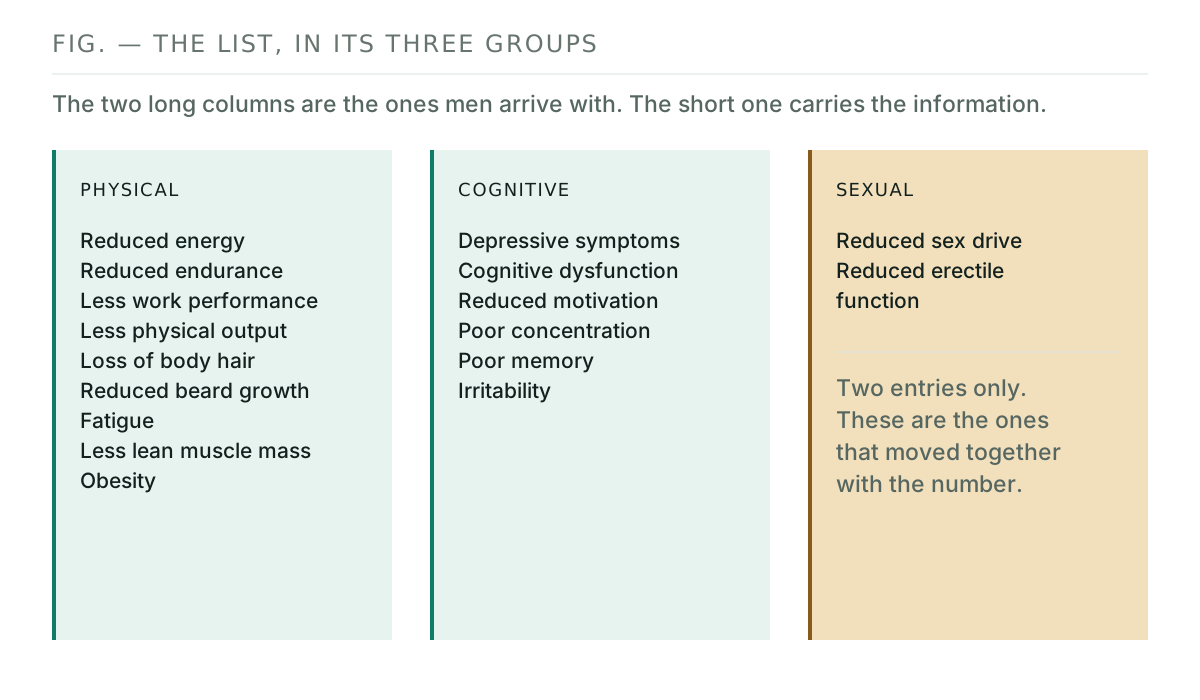
The American Urological Association publishes a table of the signs and symptoms associated with testosterone deficiency, and it is worth reading in full rather than in the trimmed version that usually circulates. It has three headings.
| Group | What is on the list |
|---|---|
| Physical | Reduced energy, reduced endurance, diminished work performance, diminished physical performance, loss of body hair, reduced beard growth, fatigue, reduced lean muscle mass, obesity |
| Cognitive | Depressive symptoms, cognitive dysfunction, reduced motivation, poor concentration, poor memory, irritability |
| Sexual | Reduced sex drive, reduced erectile function |
The first thing to notice is how long the first two columns are and how short the third one is. The second thing to notice is that the short column is the one that turns out to carry the information, which is the opposite of how these lists are usually presented.
The MedlinePlus page on the same test keeps a shorter set for men who have been through puberty: low sex drive, difficulty with erections, difficulty getting someone pregnant, enlarged breasts, lack of face or body hair, thinning bones or anaemia without a known cause, and loss of muscle mass. Some of those are much more specific than fatigue, and that is not an accident.
Every symptom on the list belongs to something else as well
The guideline does not leave this to the reader to work out. It states the difficulty directly: the symptoms that have been associated with low testosterone levels are very non-specific and can be manifestations of other conditions, and it gives its own examples — chronic fatigue, chronic stress, a depressed state.
That sentence is the reason the whole diagnostic apparatus exists. If the symptoms were specific, you could diagnose from the symptoms. Because they are not, the guideline builds the diagnosis on a blood level taken twice on separate early mornings, combined with symptoms, and neither half is sufficient on its own.
A man with the full list and a normal level does not have a testosterone problem, and treating him as if he did means the real cause goes unexamined. A man with a low level and no symptoms at all is not, by this guideline, a patient either. Both errors come from reading one half of the pair.
This is also why the symptoms belong before the test rather than after it. They are what makes testing reasonable. What the number then means is covered in our guide to low testosterone after 40, and how the sample has to be taken for the number to be worth anything is in the testosterone test.
One study asked which symptoms actually travel with the number
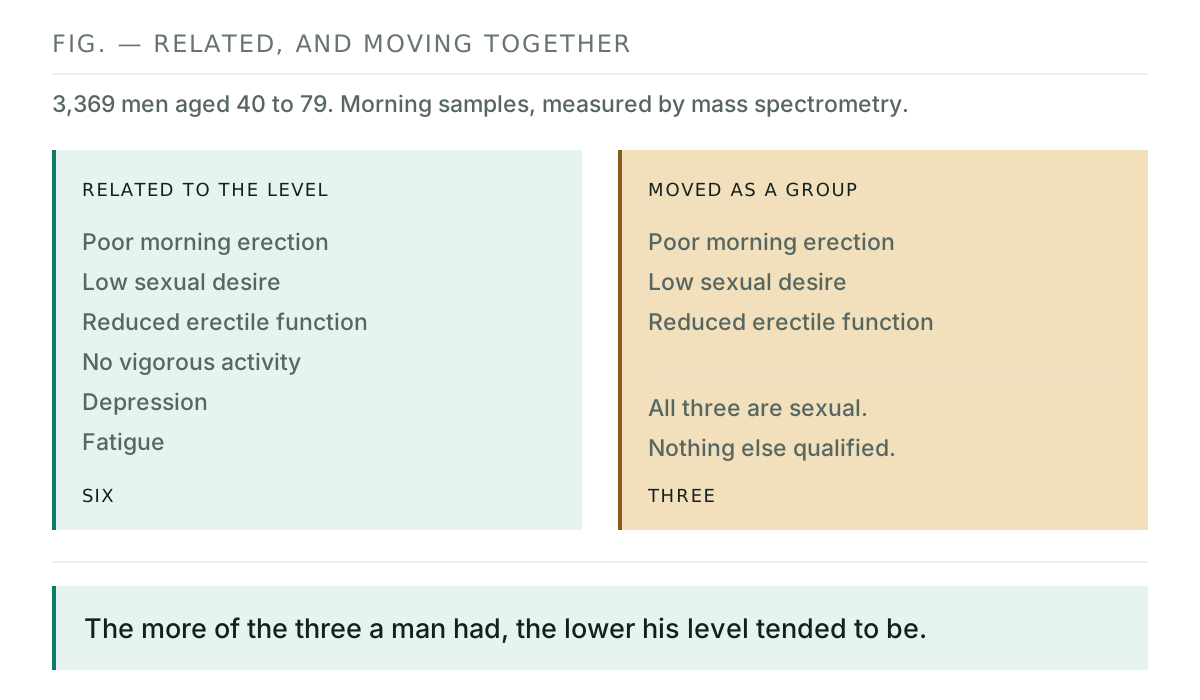
The European Male Ageing Study surveyed a random population sample of 3,369 men aged 40 to 79 across eight European centres. Every man answered questionnaires about his general, sexual, physical and psychological health, and every man gave a morning blood sample measured by mass spectrometry, which is the reference method rather than the cheap one.
Six symptoms came back significantly related to the testosterone level: poor morning erection, low sexual desire, reduced erectile function, inability to perform vigorous activity, depression and fatigue. That is the list most articles stop at, and stopping there misses the point of the study.
The authors reported that only the three sexual symptoms had a syndromic association with decreased testosterone levels, and that there was an inverse relationship between an increasing number of sexual symptoms and a decreasing testosterone level. Wu et al., New England Journal of Medicine, 2010
The word doing the work there is syndromic. Plenty of things are statistically related to a hormone level in a sample of three thousand men. Far fewer cluster together in the same individual in the way a genuine syndrome does, and the study was built specifically to separate those two situations by splitting the data into a training set and a validation set and confirming the result twice.
The definition the authors arrived at was narrow: at least three sexual symptoms together with a total testosterone below 11 nmol per litre — 3.2 nanograms per millilitre, which an American laboratory would print as 320 ng/dL — and a free testosterone below 220 pmol per litre. Three symptoms and two thresholds, not a list of twelve complaints.
Morning erections are on the list as a measurement, not a mood
Of the three, the one that surprises men most is the first, and it is worth explaining why it earns its place. A morning erection is not primarily a statement about desire or about a relationship. It is a downstream sign of what happened while you were asleep, during the hours when this hormone is at its daily peak.
That is what makes it useful in a symptom list. It is closer to an observation than to an opinion, it does not require you to compare yourself with anybody, and a change in it over months is something a man can actually report accurately, which is more than can be said for “less energy than I used to have”.
It also connects this article to the one next door. Peak testosterone occurs in the small hours, so a run of broken or fragmented nights is not a neutral background to any of this. Our guide to sleep after 40 sorts that complaint into its five separate problems, and if one of them is yours it is worth settling before you read anything into a symptom that depends on sleeping.
The physical group is the longest and the least specific
Reduced energy, fatigue, less endurance, less lean muscle, more weight round the middle: this is the group men actually arrive with, and it is the group that discriminates least. Every item on it is produced by a dozen ordinary things, several of which are more common in a forty-five-year-old than a hormone deficiency is.
The guideline is unusually candid about what treatment does for this group. Statement 14 says patients should be informed that testosterone therapy may result in improvements in erectile function, low sex drive, anaemia, bone mineral density, lean body mass and depressive symptoms. Statement 15, immediately after it, says patients should be informed that the evidence is inconclusive as to whether testosterone therapy improves cognitive function, measures of diabetes, energy, fatigue, lipid profiles and quality of life measures.
Read those two statements side by side and something becomes clear that the advertising never mentions. Energy and fatigue — the two complaints that bring most men to this subject in the first place — sit in the second list, the one where the panel says the evidence has not settled. The panel still recommends counselling patients that improvement is possible, because absence of definitive evidence is not evidence of absence, but it will not promise it.
It does not mean tiredness is unrelated to the hormone. It means tiredness is a poor starting point for a diagnosis and a poor single yardstick for judging any treatment, and that a man whose only complaint is fatigue should expect his doctor to look at several other things first.
Mood, motivation and memory sit in the same trap
The cognitive column — depressive symptoms, cognitive dysfunction, reduced motivation, poor concentration, poor memory, irritability — has the same structure as the physical one. Each item is real, each is on the guideline's own table, and each has a long list of other causes queuing up behind it.
Depressive symptoms are the interesting case, because they appear in statement 14 as something therapy may improve while cognitive function appears in statement 15 as something where the evidence is inconclusive. Two neighbouring items on the same table, two different strengths of evidence behind them. That is what a careful list looks like, and it is why collapsing everything into “symptoms of low T” loses information.
The practical consequence is unglamorous. Low mood and poor concentration are reasons to be assessed properly rather than reasons to conclude anything, and the assessment includes questions that have nothing to do with hormones. A symptom list is not a shortcut past that conversation.
The quiz that says yes to almost everyone
Somewhere between the symptom list and the blood test sits the online questionnaire, and it deserves its own section because it is where a great deal of money changes hands. Fill one in, get told you may be low, click through to whatever comes next.
These quizzes are not invented by marketers. They are usually one of a handful of real, validated instruments — ADAM, Quantitative ADAM, the Aging Male Survey, MMAS, ANDROTEST. What is not usually mentioned is what the guideline says about using them this way.
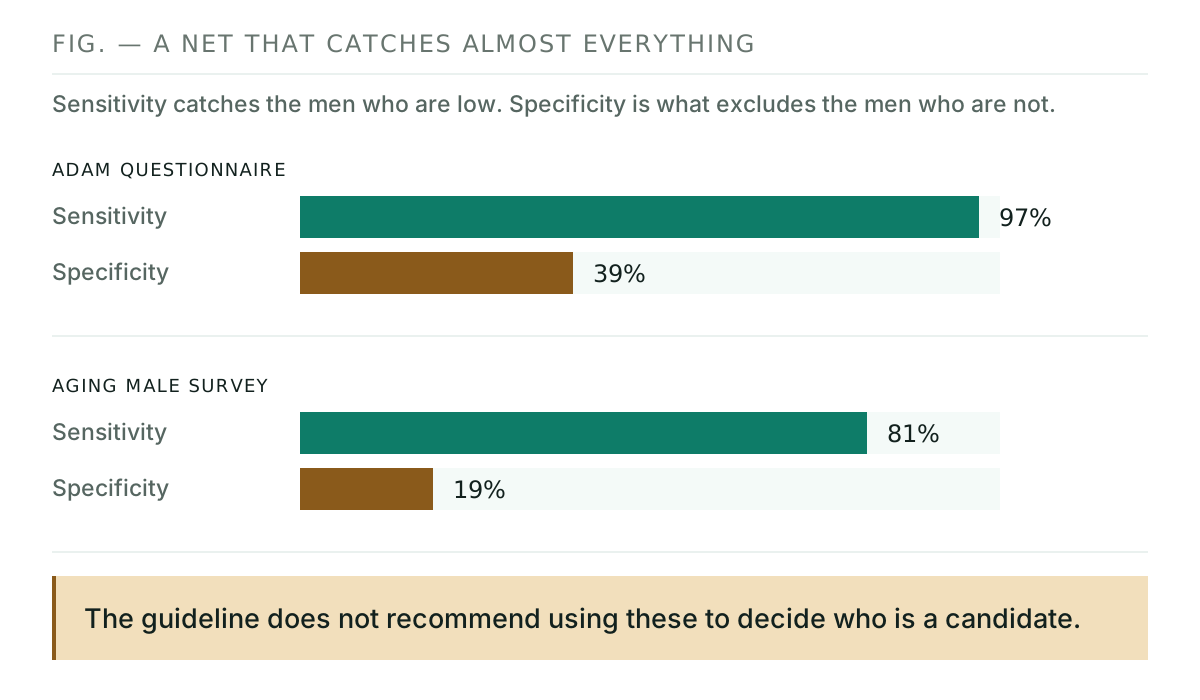
The guideline reports the ADAM questionnaire with a sensitivity and specificity of 97 and 39 per cent, and the Aging Male Survey with 81 and 19 per cent. Statement 5 concludes that the use of validated questionnaires is not currently recommended either to define which patients are candidates for testosterone therapy or to monitor symptom response. American Urological Association, Testosterone Deficiency Guideline
Those two numbers are worth translating. High sensitivity means the questionnaire rarely misses a man who genuinely is low, which sounds excellent. Low specificity means it also flags a very large share of men who are not, and at a specificity of 19 per cent it is flagging roughly four out of five men who do not have the condition.
The guideline's own explanation is that there is an absence of concordance among the questionnaires as to which symptoms are related to low testosterone, that each validation study used a different testosterone cut-off, and that total testosterone has been shown to correlate poorly with most of the questions. It adds that they should not be used at the expense of a full patient evaluation including laboratory measurement.
None of that makes a questionnaire useless as a way of organising what you want to say in an appointment. It makes it a bad way to reach a conclusion by yourself, and a worse one to reach a purchase.
Some men should be tested with no symptoms at all
There is a mirror image of this article that almost nobody writes, and it belongs here because it shows how loosely symptoms and levels are actually coupled. The guideline lists situations in which measuring testosterone is reasonable even in the absence of symptoms or signs.
Statement 4 names them: a history of unexplained anaemia, bone density loss, diabetes, exposure to chemotherapy, exposure to testicular radiation, HIV or AIDS, chronic narcotic use, male infertility, pituitary dysfunction, and chronic corticosteroid use. If any of those applies to you, the question of testing does not wait for a symptom list at all.
The reverse case matters just as much. A low reading taken during untreated sleep apnoea, an acute illness or a badly broken stretch of nights may be measuring the circumstance rather than the man. If somebody has told you that you stop breathing at night, what separates snoring from sleep apnea is worth settling first.
What to do with a symptom list before you spend anything
The honest use of everything above is narrow, and that is fine. A symptom list is a reason to ask a question properly, and there is a version of that conversation that gets you a real answer and a version that gets you a single afternoon blood draw and a shrug.
- Write down which of the three sexual items apply, and for how long. That is the group the evidence weights most heavily, and duration matters more than intensity.
- Write the physical and cognitive ones separately, without merging them into the first list. They are context, not evidence.
- Note anything from statement 4 — unexplained anaemia, diabetes, long-term steroids or opioids, fertility difficulty — because those change the threshold for testing on their own.
- Ask for the test to be early morning, and for a second one, on a separate morning. One afternoon draw cannot answer this.
- Do not buy anything on the strength of a questionnaire. At the specificities reported above, it has not told you anything specific to you.
That is five minutes of writing, and it converts a vague feeling into something a clinician can work with. What comes back from the laboratory, and how to read it against the reference range printed beside it, is the subject of normal testosterone levels by age. If the answer turns out to be yes, what treatment actually involves is in testosterone replacement therapy.
Key takeaways
- The guideline sorts the symptoms into physical, cognitive and sexual groups — and says plainly that they are very non-specific and can be manifestations of other conditions.
- In 3,369 men aged 40 to 79, six symptoms were significantly related to the testosterone level, but only the three sexual ones had a syndromic association with it.
- The more sexual symptoms a man had, the lower his level tended to be; the study's own definition required at least three of them plus two blood thresholds.
- Poor morning erection earns its place because it is a downstream sign of what happens overnight, when this hormone peaks.
- Statement 14 lists what therapy may improve; statement 15 places energy and fatigue among the outcomes where the evidence is inconclusive.
- The ADAM questionnaire is reported at 97 per cent sensitivity and 39 per cent specificity, the Aging Male Survey at 81 and 19; the guideline does not recommend using them to decide who is a candidate.
- Some men should be tested with no symptoms at all — unexplained anaemia, bone density loss, diabetes, chronic narcotic or corticosteroid use, infertility, pituitary dysfunction and others.
Where to go from here
Symptoms are the reason to ask. These are the pages that answer what comes next:
- Low Testosterone After 40: The Number and What It Means — the guide to the whole subject.
- The Testosterone Test That Actually Tells You Something — how the sample has to be taken.
- Normal Testosterone Levels by Age — reading the number against the range printed beside it.
- Testosterone Replacement Therapy: What Each Form Does — if the answer is yes.
- Snoring or Sleep Apnea? What Separates Them — worth settling before you test.
Frequently asked questions
What are the symptoms of low testosterone?
The AUA guideline groups them in three. Physical: reduced energy, reduced endurance, diminished work and physical performance, loss of body hair, reduced beard growth, fatigue, reduced lean muscle mass, obesity. Cognitive: depressive symptoms, cognitive dysfunction, reduced motivation, poor concentration, poor memory, irritability. Sexual: reduced sex drive and reduced erectile function.
Which symptoms actually point at low testosterone?
In the European Male Ageing Study of 3,369 men aged 40 to 79, six symptoms were significantly related to the testosterone level, but only the three sexual ones had what the authors called a syndromic association with it: poor morning erection, low sexual desire and reduced erectile function. The more of the three a man had, the lower his level tended to be.
Is tiredness a symptom of low testosterone?
Fatigue and reduced energy are on the guideline's own list, so the answer is yes in principle. But the guideline also says these symptoms are very non-specific and can be manifestations of other conditions such as chronic fatigue, chronic stress or a depressed state. Tiredness on its own is not evidence of a hormone problem.
Do online low testosterone quizzes work?
The AUA does not recommend using validated questionnaires to decide who is a candidate for therapy or to monitor response. The ADAM questionnaire has been reported with a sensitivity of 97 per cent and a specificity of 39 per cent, and the Aging Male Survey with 81 and 19 per cent. A test that says yes to almost everyone cannot tell you apart from the man beside you.
Are morning erections a sign of testosterone levels?
Poor morning erection was one of the three symptoms with a syndromic association with testosterone in the European Male Ageing Study. It is used as a biological marker of what happens overnight rather than as a question about sex, which is why it belongs in a symptom list at all.
Can low testosterone cause depression?
Depressive symptoms appear in the guideline's cognitive group, and statement 14 says patients should be informed that testosterone therapy may result in improvements in depressive symptoms among other things. The direction of the arrow is not settled by a symptom list, which is why low mood is a reason to be assessed rather than a diagnosis on its own.
Sources
- American Urological Association — Testosterone Deficiency Guideline (Table 5, statements 4, 5, 14 and 15)
- Wu et al., New England Journal of Medicine, 2010 — Identification of Late-Onset Hypogonadism in Middle-Aged and Elderly Men (European Male Ageing Study)
- MedlinePlus (National Library of Medicine) — Testosterone Levels Test
- StatPearls (National Library of Medicine) — Physiology, Testosterone
- Travison et al., Journal of Clinical Endocrinology & Metabolism, 2017 — Harmonized Reference Ranges for Circulating Testosterone Levels in Men of Four Cohort Studies

Male Health Guide Editorial Team
We write about the health problems men over 40 actually search for at 3 a.m. — and we say plainly when the evidence for a popular product is thin. We do not invent credentials and we do not publish sponsored copy as editorial. Read more about how we work.
Medical disclaimer: This article is general information about how symptoms are used in the assessment of testosterone levels and is not medical advice. It cannot tell you whether your own symptoms have a hormonal cause, and several of the complaints described here have causes that need attention in their own right. Please speak to a qualified healthcare professional about your own situation.