Statins: The Benefit Is a Share of Your Own Risk
Short answer
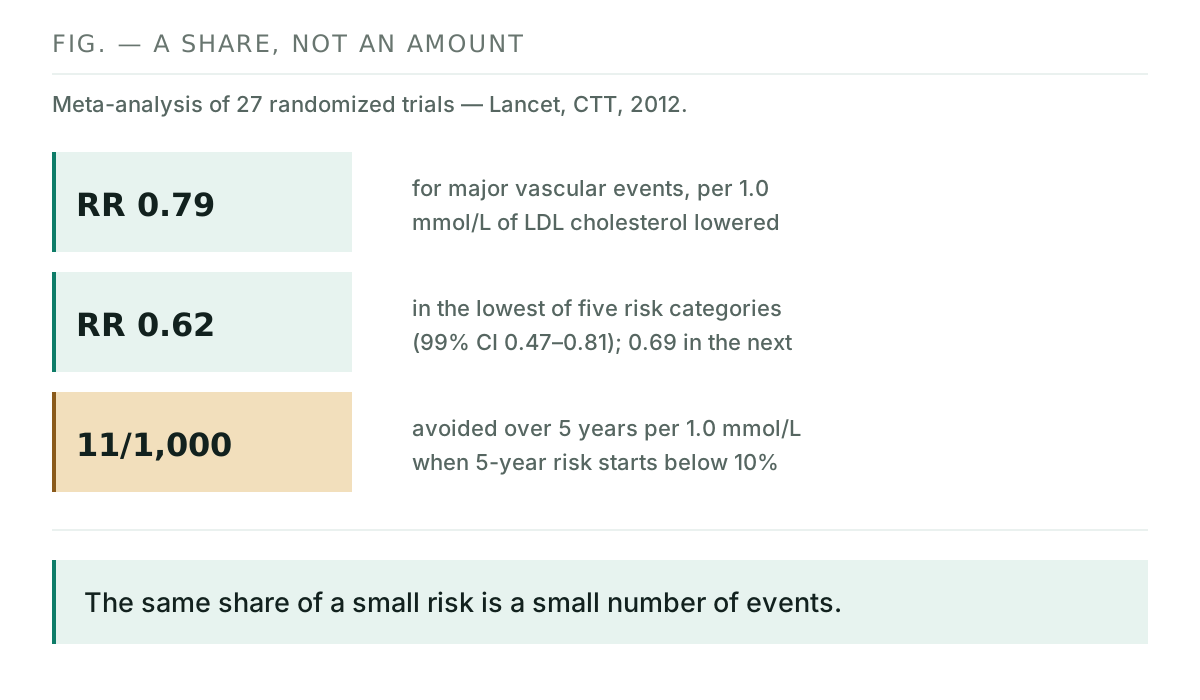
Statins lower cardiovascular risk by a proportion rather than a fixed amount. Across 27 randomised trials, each 1.0 mmol/L drop in LDL cholesterol cut major vascular events with a rate ratio of 0.79, and that proportion held up even in the lowest-risk groups. The same share of a small risk is simply a smaller number of events prevented.
The cholesterol article in this section covered what LDL, HDL and triglycerides are and why the trial evidence keeps pointing downward. This one picks up where that leaves a lot of men over 40: a number that came back high, a prescription on the table, and an argument on the internet that runs in both directions at full volume.
Most of that argument is not actually a disagreement about the data. Both sides are usually quoting the same trials. They are quoting them in different units — and the unit you pick decides whether the answer sounds impressive or trivial.
We earn nothing from any of this. No supplement, test kit or clinic is being sold here, which is the only reason this page can weigh a prescription drug without a product waiting at the end of the paragraph.
What a statin actually does
Before the arithmetic, the mechanism, because it is simpler than the debate suggests. MedlinePlus describes statins as "a type of cholesterol medicine" that works on two fronts: they slow "how much cholesterol the liver makes," and they increase "your liver's ability to remove LDL cholesterol that is already in the blood." Production down, clearance up.
The downstream claim is stated just as plainly: "studies have shown that statins lower the risk of heart attack and stroke in people with high LDL cholesterol." MedlinePlus adds that they can also lower your triglyceride level and "may also increase your HDL cholesterol." NHLBI puts their position in one line — "statins are the most common medicine used to treat high blood cholesterol."
As for who gets offered one, MedlinePlus frames it as a second step rather than a first: "your health care provider may prescribe them if you have high cholesterol and making lifestyle changes does not lower your cholesterol enough."
The percentage everyone quotes
The single largest body of evidence here is the Cholesterol Treatment Trialists' Collaboration, which pooled individual participant data rather than published summaries. Its 2012 analysis in The Lancet covered 27 randomised trials, and it reports the benefit the way drug trials almost always do: as a rate ratio.
The CTT analysis pooled individual data from 22 trials of statin versus control (134,537 participants, median follow-up 4.8 years) and five trials of more versus less statin (39,612 participants). Reduction of LDL cholesterol with a statin "reduced the risk of major vascular events (RR 0.79, 95% CI 0.77-0.81, per 1.0 mmol/L reduction), largely irrespective of age, sex, baseline LDL cholesterol or previous vascular disease, and of vascular and all-cause mortality." CTT Collaborators, The Lancet, 2012
A rate ratio of 0.79 is the "21% reduction" that headlines round off to "cuts your risk by a fifth." The number is real, it is drawn from a very large evidence base, and it is also the source of nearly all the confusion — because a fifth of what is never stated in the headline.
Why the same share is a different amount
Here is the part that makes statins genuinely hard to have an opinion about in the abstract. A proportional benefit is applied to whatever risk you already carry. Two men can take the same drug, get the same LDL reduction, receive the same proportional benefit — and one of them is having a meaningfully different amount of risk removed than the other.
The obvious guess would be that the proportion itself shrinks in lower-risk people, and that is what the CTT investigators set out to test. It is not what they found. The proportional reduction "was at least as big in the two lowest risk categories as in the higher risk categories." The five baseline-risk categories, lowest to highest, came out at 0.62 (99% CI 0.47-0.81), 0.69, 0.79, 0.81 and 0.79, with a trend p=0.04. That is not a clean ladder — the second-highest-risk category has the weakest proportional benefit of the five. What the series does show is that the share was largest where the risk was smallest, which is the opposite of the intuitive guess.
So the share holds. The amount is what moves. The CTT authors put the absolute figure in plain units in their own interpretation: "in individuals with 5-year risk of major vascular events lower than 10%, each 1 mmol/L reduction in LDL cholesterol produced an absolute reduction in major vascular events of about 11 per 1000 over 5 years."
Eleven per thousand over five years. Note that this is the low-risk group's own proportional reduction expressed as events — a larger proportion than the headline 0.79, not the same one, applied to a much smaller starting risk. Someone who calls that worthwhile and someone who calls it small are both describing the identical finding accurately. That is the honest shape of this decision, and no amount of arguing about the percentage resolves it.
Two things are worth being precise about. The CTT authors were not neutral on the question — they concluded that this benefit "greatly exceeds any known hazards of statin therapy," and suggested that guidelines "might need to be reconsidered" to cover such individuals. And the whole calculation runs on 1.0 mmol/L, roughly 39 mg/dL, of LDL reduction; a larger or smaller drop scales it.
Who the guidelines actually point to
In the United States the practical answer to "does this apply to me" comes from the US Preventive Services Task Force, whose 2022 recommendation on statins for primary prevention is built around exactly the baseline-risk logic above. Its scope is worth stating before its numbers: "these recommendations apply to adults 40 years or older without a history of known CVD and who do not have signs and symptoms of CVD," and they "do not apply to adults with a low-density lipoprotein cholesterol (LDL-C) level greater than 190 mg/dL (4.92 mmol/L) or known familial hypercholesterolemia."
The USPSTF "recommends that clinicians prescribe a statin for the primary prevention of CVD for adults aged 40 to 75 years who have 1 or more CVD risk factors (i.e. dyslipidemia, diabetes, hypertension, or smoking) and an estimated 10-year risk of a cardiovascular event of 10% or greater." Below that, at "7.5% to less than 10%," the wording shifts to "selectively offer" — the same drug, a weaker recommendation, precisely because the amount of risk being removed is smaller.
And at the top of the age range the Task Force declines to make a call at all: for adults 76 or older it "concludes that the current evidence is insufficient to assess the balance of benefits and harms of initiating a statin for the primary prevention of CVD events and mortality." Worth noting exactly what that covers — initiating a statin in that age group for primary prevention, not continuing one already started.
The side effect question, and the trial built for it
The other half of the argument is muscle symptoms, and it is a real question rather than a manufactured one: plenty of men start a statin, ache, and stop. The sources list the recognized side effects briefly. MedlinePlus says statins may raise the risk of type 2 diabetes, mainly in people already at high risk, and may cause "abnormal results on liver enzymes tests, but actual liver damage is very rare." It calls muscle damage "another uncommon side effect," which in rare cases can lead to muscle pain and kidney damage. NHLBI states that statins "usually don't cause side effects, but they may raise the risk of diabetes," and lists muscle damage and cognitive impairment among the rare ones.
Those lists describe uncommon events. They do not explain the very common experience of aching after starting a statin, and the design problem there is awkward: aches are also very common in men over 40 who are not taking anything. A British trial was built specifically to separate the two.
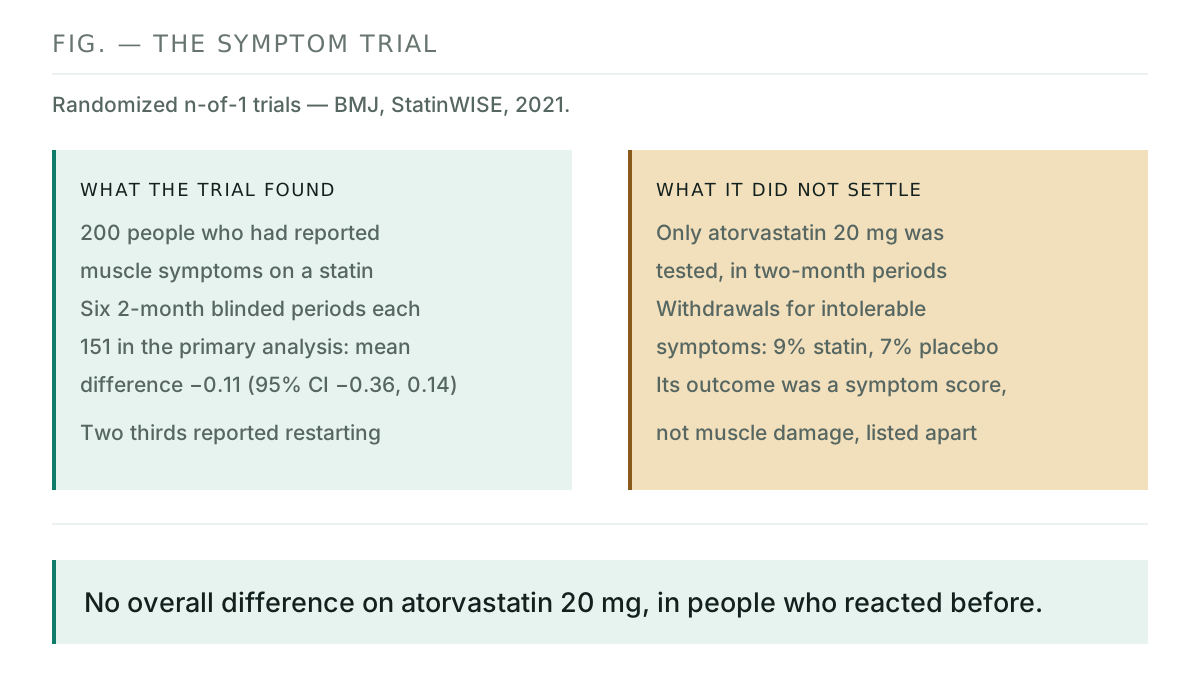
StatinWISE recruited 200 people in UK primary care "who had recently stopped or were considering stopping treatment with statins because of muscle symptoms." Each was randomised to "a sequence of six double blinded treatment periods (two months each) of atorvastatin 20 mg daily or placebo," rating muscle symptoms on a 0-10 visual analogue scale at the end of each period. Among the 151 participants in the primary analysis: "no difference in muscle symptom scores was found between the statin and placebo periods (mean difference statin minus placebo -0.11, 95% confidence interval -0.36 to 0.14; P=0.40)." Herrett et al., The BMJ, 2021
The authors' conclusion is narrow and worth quoting as written: "no overall effect of atorvastatin 20 mg on muscle symptoms compared with placebo was found in participants who had previously reported severe muscle symptoms when taking statins." They also report what the participants did next — "two thirds of those completing the trial reported restarting long term treatment with statins."
What that trial does not settle
This result gets flattened in both directions online, so it is worth marking the edges, including one that cuts against the headline finding.
It does not say the symptoms were imagined. Participants rated real symptoms during both statin and placebo periods; the finding is that the scores did not differ by which one they were taking. Nor was the trial free of dropouts: "withdrawals because of intolerable muscle symptoms were 18 participants (9%) during a statin period and 13 (7%) during a placebo period." More people left during statin periods than placebo periods, and that sits inside the same paper as the null primary result.
It also tested one drug at one dose — atorvastatin 20 mg — over two-month periods, in people already selected for having reacted badly before. And it was a symptom trial: it did not study the uncommon muscle damage MedlinePlus lists separately, which is a different event from an ache and is the reason a prescriber may want blood work rather than a verbal report.
The most useful line in the paper may be its last, which is about method rather than statins: "n-of-1 trials can assess drug effects at the group level and guide individual treatment." That design is available to an individual patient, with a prescriber, as a way of actually finding out.
The honest limits of all of this
Start with what this article cannot tell you, which is the thing you came for: whether you personally should take one. Every number above is a group result, and the whole point of this piece is that group results land differently on different people depending on their baseline risk. Your own risk estimate is the missing input, and it is calculated from readings and history that are not in this article.
Second, the evidence base is not symmetrical. The benefit side rests on 27 randomised trials and more than 170,000 participants. The muscle-symptom side is smaller and more mixed: StatinWISE randomised 200 people and analyzed 151, on one drug at one dose. It is not the only evidence there, though — the USPSTF's own 2022 review reports that "although observational studies have reported an association between statin use and muscle pain, a pooled analysis of 9 trials (n = 46,388) found no increased risk of myalgia with statin therapy compared with placebo." Treating StatinWISE as the last word on tolerability would overstate it as badly as ignoring it would.
Third, one line from MedlinePlus overrides everything else here, and it is not a hedge: "you should not stop taking this medicine on your own, since that can lead to a serious problem or, in rare cases, even cause death." The instruction that follows is to "talk to your provider if you have any concerns about your statin or if you would like to stop or change to a different treatment." Reading an article and quietly stopping is the one response the sources explicitly warn against.
Finally, the lifestyle side does not retire. NHLBI's treatment page puts medicines and a healthy lifestyle side by side, and the lifestyle list it gives is the ordinary one — heart-healthy foods, regular physical activity, a healthy weight, managing stress, quitting smoking, adequate sleep and limiting alcohol. A statin changes a number; it does not take over the rest of the job.
What to do with this
- Ask for your risk estimate, not just your cholesterol number. The proportional benefit held up across risk groups. What decides the size of the benefit is the baseline risk it gets applied to.
- Translate any percentage into events. A rate ratio and a figure like "about 11 fewer events per 1,000 over 5 years, per 1.0 mmol/L of LDL lowering" are two ways of sizing the same drug effect. Ask for the second form.
- Know where you sit against the USPSTF thresholds. A 10-year risk of 10% or greater is a recommendation; 7.5% to under 10% is a selective offer. The difference is deliberate.
- Report muscle symptoms rather than stopping over them. StatinWISE found no overall difference from placebo at the group level, but the only way to learn about you is a conversation, and possibly a structured trial off and on.
- Never stop on your own. MedlinePlus is unusually blunt about this, and it is the one instruction on this page with no caveats attached.
The reason this debate never ends is not that the evidence is weak. It is that a proportional benefit is genuinely worth different amounts to different people, and no single sentence can be true for all of them at once. The question worth asking is not whether statins work. It is how much risk you are starting with — because that is the number the benefit gets applied to.
Key takeaways
- Per MedlinePlus, statins slow how much cholesterol the liver makes and increase the liver's ability to clear LDL cholesterol already in the blood.
- CTT (The Lancet, 2012) pooled individual data from 27 randomised trials: RR 0.79 for major vascular events per 1.0 mmol/L of LDL reduction.
- The proportional reduction was "at least as big in the two lowest risk categories as in the higher risk categories" — RR 0.62 (99% CI 0.47-0.81) in the lowest, but the five-category series is 0.62, 0.69, 0.79, 0.81, 0.79, not a ladder.
- In absolute terms below 10% five-year risk, that came to about 11 fewer major vascular events per 1,000 people over 5 years, per 1.0 mmol/L of LDL reduction.
- USPSTF 2022, for primary prevention in adults with no history of CVD: prescribe at a 10-year risk of 10% or greater with a risk factor; selectively offer from 7.5% to under 10%; evidence insufficient for initiating at 76 or older.
- StatinWISE (BMJ, 2021): 200 people with prior muscle symptoms randomised to six blinded two-month periods, 151 in the primary analysis — no difference in symptom scores (mean difference −0.11, 95% CI −0.36 to 0.14).
- Withdrawals for intolerable muscle symptoms were 9% during statin periods and 7% during placebo periods, and only one drug at one dose was tested.
- MedlinePlus: "You should not stop taking this medicine on your own, since that can lead to a serious problem or, in rare cases, even cause death."
Where to go from here
This is the eighth article in the heart section, which is now complete. All nine:
- Heart Health After 40: What the Numbers Mean — the pillar guide, covering blood pressure, cholesterol and resting heart rate.
- High Blood Pressure After 40: The Number That Moved — why the definition changed in 2017, and what one reading can't tell you.
- Cholesterol After 40: The Number With No Floor — LDL, HDL and triglycerides, and the trial evidence behind "lower is better."
- Chest Pain After 40: When It's the Heart, and When It's Not — the self-test almost everyone tries, and what it actually proves.
- Heart Attack vs Cardiac Arrest: Plumbing vs Electrical — two different emergencies, and the one question that sorts them.
- Heart Palpitations vs AFib: Why a Normal EKG Proves Little — why detection depends on how long anyone is watching.
- Blood Pressure Medication: The First Pill Is a Starting Point — why the same person responds differently to different drug families.
- Fish Oil for Heart Health: The Winning Trial Used a Drug — why the trial everyone quotes was not testing the capsules on the shelf.
Frequently asked questions
What do statins actually do?
Per MedlinePlus, statins slow how much cholesterol the liver makes and increase the liver's ability to remove LDL cholesterol already in the blood. MedlinePlus states that studies have shown statins lower the risk of heart attack and stroke in people with high LDL cholesterol.
How much do statins reduce cardiovascular risk?
By a proportion, not a fixed amount. In the CTT analysis of 27 randomised trials, each 1.0 mmol/L reduction in LDL cholesterol cut major vascular events with a rate ratio of 0.79. "Major vascular events" is a composite: non-fatal heart attack or coronary death, stroke, or coronary revascularisation. Because the effect is proportional, the same reduction removes more events from a higher starting risk.
Are statins worth taking if my heart risk is low?
The CTT analysis found the proportional benefit was at least as big in the two lowest-risk categories, and estimated about 11 fewer major vascular events per 1,000 people over 5 years, per 1.0 mmol/L of LDL reduction, when 5-year risk starts below 10%. Whether that size of benefit is worth it is a decision to make with a prescriber.
Who do the US guidelines say should take a statin?
It covers primary prevention only: the USPSTF 2022 recommendation applies to adults with no history of known CVD. For adults aged 40 to 75 with one or more CVD risk factors, it recommends prescribing a statin at an estimated 10-year risk of 10% or greater, and selectively offering one at 7.5% to less than 10%.
Do statins cause muscle pain?
StatinWISE (BMJ, 2021) randomised 200 people who had reported muscle symptoms on statins to a sequence of six blinded two-month periods of atorvastatin 20 mg or placebo. Among the 151 in the primary analysis, it found no overall difference in muscle symptom scores between the statin and placebo periods. Separately, MedlinePlus lists muscle damage as an uncommon side effect.
Can I stop taking a statin on my own?
No. MedlinePlus is explicit: "You should not stop taking this medicine on your own, since that can lead to a serious problem or, in rare cases, even cause death." It directs you to talk to your provider about concerns or about changing to a different treatment.
Sources
- Cholesterol Treatment Trialists' (CTT) Collaborators, The Lancet, 2012 — The effects of lowering LDL cholesterol with statin therapy in people at low risk of vascular disease
- Herrett et al. (StatinWISE), The BMJ, 2021 — Statin treatment and muscle symptoms: series of randomised, placebo controlled n-of-1 trials
- MedlinePlus (National Library of Medicine, NIH) — Statins
- National Heart, Lung, and Blood Institute (NIH) — Blood Cholesterol — Treatment
- US Preventive Services Task Force, 2022 — Statin Use for the Primary Prevention of Cardiovascular Disease in Adults

Male Health Guide Editorial Team
We write about the health problems men over 40 actually search for at 3 a.m. — and we say plainly when the evidence for a popular product is thin. We do not invent credentials and we do not publish sponsored copy as editorial. Read more about how we work.
Medical disclaimer: This article is general information about statins and is not medical advice. It is not a substitute for the prescriber who knows your cholesterol readings, your risk estimate, your other medicines and your history. Never start, stop or change a prescription based on an article.