Fish Oil for Heart Health: The Winning Trial Used a Drug
Short answer
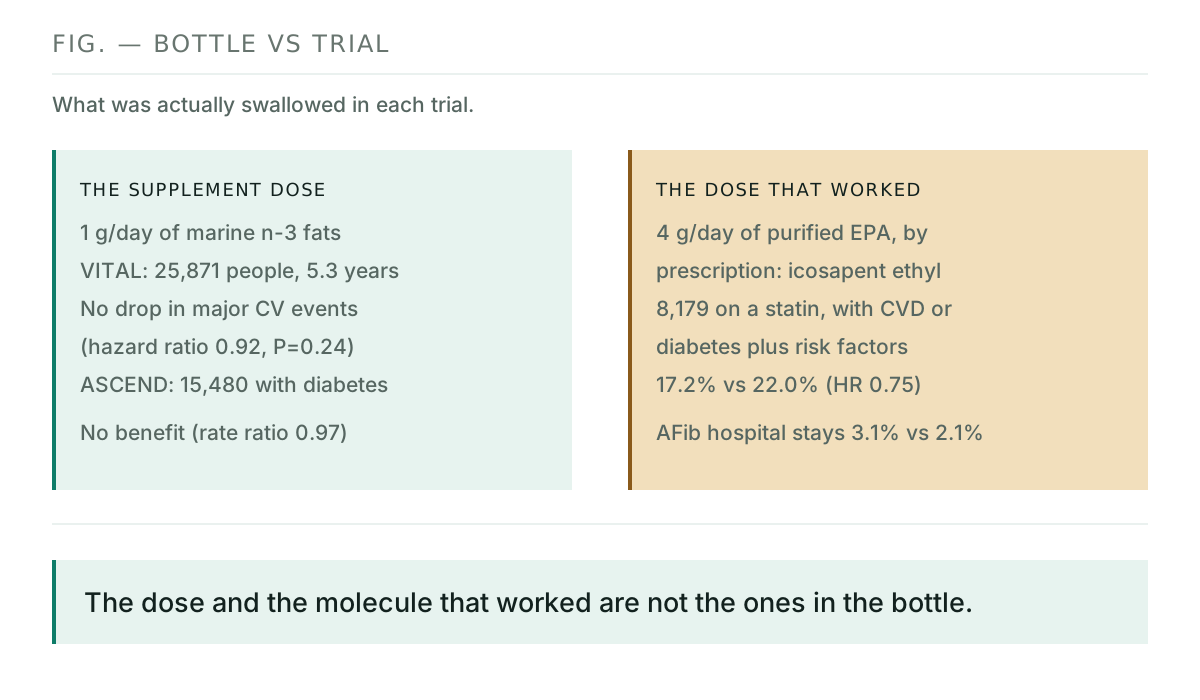
The large trials of fish oil at the supplement dose did not find fewer heart attacks or strokes. The one trial that did find a clear benefit used a prescription drug — purified EPA at four times that dose. Reading its result as support for the capsules on the shelf confuses two different things.
The statins article ended on the idea that a benefit is worth different amounts to different people. This one is about a different problem, and it is the last article in this section: what happens when the evidence everyone cites turns out to be about a product nobody is buying.
Fish oil is the most sold heart supplement there is, and the marketing is not inventing its science from nothing. There are large, serious, well-run randomised trials behind the claims. The trouble is which trials say what, and what exactly was in the capsule in each one.
We earn nothing from any of this. There is no affiliate link on this page and no brand being recommended, which is the whole reason a site like this can go through the omega-3 evidence without needing it to land somewhere particular.
What fish oil is, and what the label promises
Fish oil is oil pressed from oily fish, and the part everyone is interested in is two omega-3 fatty acids: EPA and DHA. MedlinePlus describes omega-3s as "a type of polyunsaturated fat" that the body uses "to build brain cells and for other important functions."
The heart claims on the shelf are downstream of a real, if mixed, literature. MedlinePlus lists several mechanisms attributed to omega-3s: they "reduce triglycerides," "reduce the risk of developing an irregular heartbeat," "slow the buildup of plaque" and "help to slightly lower your blood pressure."
None of that is in dispute here. The question this article is about is narrower and more practical: when a healthy-ish man over 40 takes the standard 1-gram capsule every morning, do the randomised trials show fewer heart attacks and strokes? That is a question with an answer.
What the bottle dose actually did in the trials
Two very large primary-prevention trials tested close to the dose sold over the counter, and both reported in the same journal within a year of each other.
VITAL randomised men 50 and older and women 55 and older in the United States to 1 gram a day of marine n-3 fatty acids or placebo. Over a median follow-up of 5.3 years, a major cardiovascular event occurred in 386 participants on n-3 and 419 on placebo — "hazard ratio, 0.92; 95% confidence interval [CI], 0.80 to 1.06; P=0.24." The trial concluded that "supplementation with n-3 fatty acids did not result in a lower incidence of major cardiovascular events or cancer than placebo." Manson et al., New England Journal of Medicine, 2019
ASCEND asked the same question in people at higher risk. It randomised 15,480 patients with diabetes but no established cardiovascular disease to "1-g capsules containing either n-3 fatty acids (fatty acid group) or matching placebo (olive oil) daily," and followed them for a mean of 7.4 years. A serious vascular event occurred in 8.9% of the fatty acid group and 9.2% of the placebo group — "rate ratio, 0.97; 95% confidence interval [CI], 0.87 to 1.08; P=0.55."
Forty thousand people between them, years of follow-up, and the primary endpoints landed on nothing. Neither trial is underpowered in the usual sense. But neither excludes a modest benefit either: VITAL's interval runs from a 20% reduction to a 6% increase, ASCEND's from a 13% reduction to an 8% increase. What they rule out is a large effect at this dose.
The one signal inside the null result
It would be easy, and wrong, to stop there. VITAL reported a list of secondary endpoints, and one of them moved: for total myocardial infarction the hazard ratio was 0.72 (95% CI 0.59 to 0.90), while total stroke was 1.04 and death from cardiovascular causes was 0.96.
That heart attack number is not nothing, and honest writing has to include it. It is also not a conclusion. A secondary endpoint in a trial whose primary endpoint was null is a lead for the next trial, not a finding the next trial can be skipped over. Trials report many secondary outcomes, and some move by chance; the primary endpoint is nominated in advance precisely to stop everyone from picking the winner afterwards.
So the fair statement is the awkward one: at 1 gram a day, the composite of heart attack, stroke and cardiovascular death did not fall, and inside that null result sits an unexplained signal on heart attacks alone that nobody has yet confirmed in a trial designed to test it.
The trial that did work, and what was in it
REDUCE-IT is the trial that fish oil marketing leans on, and its result is genuinely strong. It is also not a trial of fish oil.
REDUCE-IT enrolled patients "with established cardiovascular disease or with diabetes and other risk factors, who had been receiving statin therapy" and who had elevated triglycerides. They received "2 g of icosapent ethyl twice daily (total daily dose, 4 g) or placebo" — icosapent ethyl being "a highly purified eicosapentaenoic acid ethyl ester." Over a median 4.9 years, a primary end-point event occurred in 17.2% of the icosapent ethyl group versus 22.0% on placebo: "hazard ratio, 0.75; 95% confidence interval [CI], 0.68 to 0.83; P<0.001." Cardiovascular death was 4.3% versus 5.2%. Bhatt et al., New England Journal of Medicine, 2019
Four differences from the capsule on the shelf, and they all matter. The dose was four times higher. The substance was purified EPA rather than the EPA-and-DHA mixture in fish oil. It is a prescription medicine, not a supplement. And the population was not healthy men hedging their bets — it was people already on a statin, with established cardiovascular disease or diabetes plus risk factors, and raised triglycerides.
The trial also reported costs. "A larger percentage of patients in the icosapent ethyl group than in the placebo group were hospitalized for atrial fibrillation or flutter (3.1% vs. 2.1%, P=0.004)," and serious bleeding events were 2.7% versus 2.1% (P=0.06). Anyone quoting the 0.75 should be quoting those too.
Why "just take four capsules" does not follow
The obvious inference from REDUCE-IT is that the supplement trials simply used too little. There is a trial that tests exactly that inference, and it does not support it.
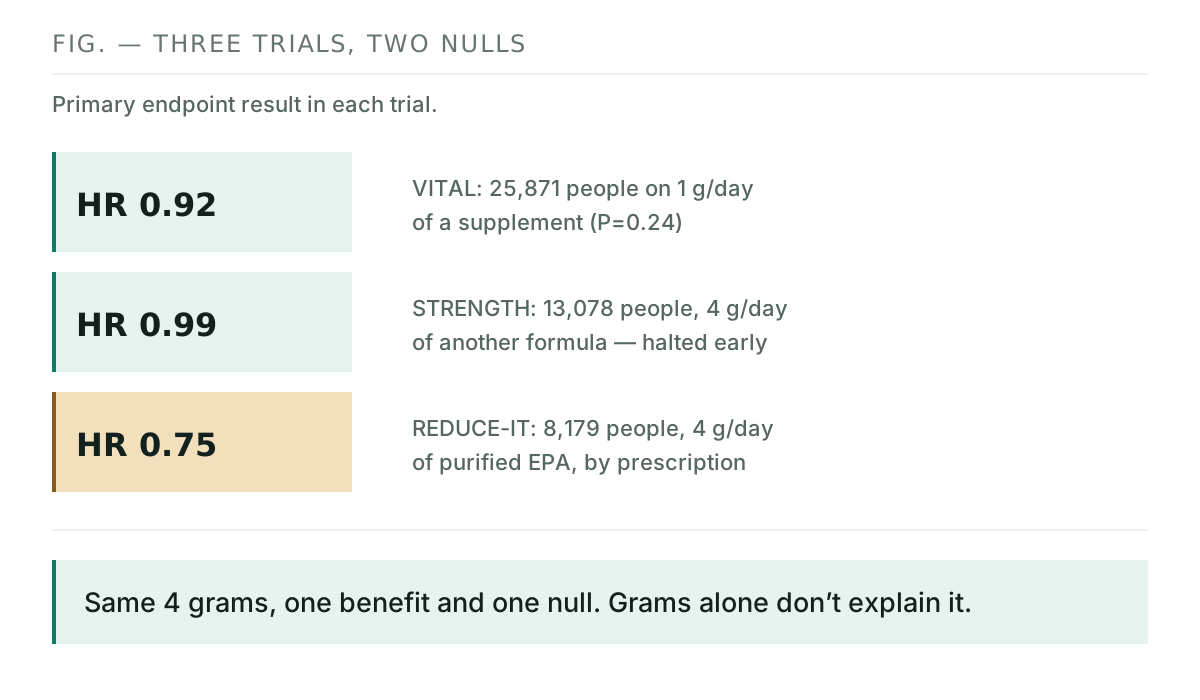
STRENGTH randomised 13,078 statin-treated patients at high cardiovascular risk, with raised triglycerides and low HDL, to "4 g/d of omega-3 CA" — a carboxylic acid formulation of EPA and DHA — or corn oil, "which was intended to serve as an inert comparator." The trial was "prematurely halted based on an interim analysis that indicated a low probability of clinical benefit of omega-3 CA vs the corn oil comparator" — a stop that came with 1,384 of a planned 1,600 primary events recorded. The primary endpoint occurred in 12.0% versus 12.2%: "hazard ratio, 0.99 [95% CI, 0.90-1.09]; P = .84." Gastrointestinal adverse events were 24.7% versus 14.7%.
Same 4 grams a day, and one trial found a benefit while the other found none. Note that a null is not an opposite: STRENGTH did not find harm, it found "no significant difference," with a confidence interval of 0.90 to 1.09.
The two populations were also not the same, which is worth spelling out rather than waving at. Both enrolled statin-treated patients at high cardiovascular risk with raised triglycerides. But STRENGTH additionally required "low levels of high-density lipoprotein cholesterol," which REDUCE-IT did not; REDUCE-IT capped LDL cholesterol at "41 to 100 mg per deciliter," where STRENGTH states no LDL entry criterion; and REDUCE-IT reports that "70.7%" of its patients were enrolled "for secondary prevention of cardiovascular events," a figure STRENGTH does not give at all.
So the number of grams is not what separates these two results, but the trials differ in more than one way at once and neither paper identifies the cause. Purified EPA versus an EPA-and-DHA mixture is one candidate. The comparators are another, though the reports do not let you compare them: STRENGTH names its corn oil, while the REDUCE-IT abstract describes its own only as "placebo."
That is why "take four of the cheap capsules instead of one" is not a conclusion these trials license. Nobody has run that trial. The closest thing to it, STRENGTH, came back null.
What about just eating the fish
The supplement trials tested a capsule. They did not test a diet, and the sources are notably more confident about the food than about the pill. MedlinePlus puts it plainly: "most health experts agree that the best way to reap the benefits of omega-3 is from food."
The same passage then makes an exception, and leaving it out would misrepresent the source. It continues: "if you already have heart disease or high triglycerides, you may benefit from consuming higher amounts of omega-3 fatty acids. It may be hard to get enough omega-3s through food. Ask your health care provider if taking fish oil supplements might be a good idea." That is a conditional recommendation for a specific group, not a general one — and it points at a conversation rather than a shelf.
The amount is specified. MedlinePlus reports that "the American Heart Association (AHA) recommends eating at least 2 servings a week of fish rich in omega-3s," naming salmon, mackerel, albacore tuna, trout and sardines. The FDA's fish page lands in the same place, though it is quoting someone else and addressing someone else: it reports that "the Dietary Guidelines for Americans recommends: at least 8 ounces of seafood (less for children) per week based on a 2,000 calorie diet," with a serving measured against the palm of your hand. That page is written "for those who might become or are pregnant or breastfeeding and children ages 1 - 11 years," so it is a useful figure rather than advice aimed at this article's readers.
Both sources attach a caution, and both scope it to someone other than this article's reader. MedlinePlus says "some fish can be tainted with mercury and other chemicals," then that "eating tainted fish can pose health risks for young children and pregnant women," and then — in the same short section — "if you are middle-aged or older, the benefits of eating fish outweigh any risks." That last sentence is addressed squarely at the men this site is written for, and quoting the warning without it would invert what the source actually says.
The FDA's avoid-list, written for the same pregnancy-and-children audience as the rest of that page, names king mackerel, marlin, orange roughy, shark, swordfish, Gulf of Mexico tilefish and bigeye tuna. Its framing sentence carries its own scope: "while it is important to limit mercury in the diets of those who are pregnant or breastfeeding and children, many types of fish are both nutritious and lower in mercury."
Worth being honest about the limits of this too: a recommendation to eat fish twice a week is not the same class of evidence as a randomised trial, and eating fish is bound up with everything else about the people who eat it. It is guidance, not a trial result. But it is the form of the advice that both sources actually give.
The honest limits of this article
First, "no benefit found at 1 gram a day for major cardiovascular events" is not the same statement as "fish oil does nothing." Omega-3s at higher doses do lower triglycerides, which is why prescription versions exist at all, and the VITAL heart attack signal is unresolved rather than dismissed. The trials answer the question they were built to answer, in the populations they enrolled, at the doses they used. Two design details belong here too: VITAL was "a randomized, placebo-controlled trial, with a two-by-two factorial design, of vitamin D3 (at a dose of 2000 IU per day) and marine n-3 fatty acids," and ASCEND reports an "adherence rate, 76%."
Second, there is a real tension on this page that is worth naming rather than smoothing over. MedlinePlus says omega-3s "help keep your heart healthy and protected against stroke." VITAL and ASCEND, testing supplements, found no reduction in cardiovascular events, and VITAL found a hazard ratio of 1.04 for total stroke. Those statements are not talking about the same thing: one is about omega-3s as nutrients, largely from food, and the other is about capsules in randomised trials. Keeping them apart is most of the work in reading this literature.
Third, none of this transfers to anyone already prescribed icosapent ethyl. That is a prescription decision made with a doctor, for a specific situation — established cardiovascular disease or diabetes with risk factors, raised triglycerides, already on a statin — and the honest reading of REDUCE-IT is that it worked in exactly that group.
What to do with this
- Check which trial a claim is citing. If the number is 0.75 or "25% lower," it is REDUCE-IT — a prescription drug at 4 grams a day, not the bottle.
- Do not read "no benefit" as "harmful." VITAL observed "no excess risks of bleeding or other serious adverse events." The supplement trials found little effect in either direction.
- Do not self-escalate the dose. STRENGTH tested 4 grams a day of a different preparation and was halted early after an interim analysis showed a low probability of clinical benefit, with far more gastrointestinal side effects.
- Take the food advice seriously. Two servings a week of oily fish per the AHA via MedlinePlus, and at least 8 ounces of seafood a week per the Dietary Guidelines as quoted by the FDA. MedlinePlus adds that for the middle-aged and older, "the benefits of eating fish outweigh any risks."
- If triglycerides are the issue, that is a prescriber conversation. The prescription preparation exists for a defined situation, and that is where REDUCE-IT applies.
This closes the heart section, and it is a fitting place to end it. The whole cluster has been about the distance between a number and what it means for you — a blood pressure threshold that moved, a cholesterol target with no floor, a benefit that is a share of your own risk. Fish oil is the same problem in its plainest form: a real trial result, attached in the marketing to a product that trial never tested.
Key takeaways
- VITAL (NEJM, 2019): 25,871 people on 1 g/day of marine n-3 fatty acids for a median 5.3 years — supplementation "did not result in a lower incidence of major cardiovascular events or cancer than placebo" (HR 0.92, 95% CI 0.80-1.06, P=0.24). The interval still allows a 20% reduction.
- ASCEND (NEJM, 2018): 15,480 people with diabetes on 1-g capsules, mean 7.4 years — serious vascular events 8.9% vs 9.2% (rate ratio 0.97).
- One VITAL secondary endpoint did move: total myocardial infarction, HR 0.72 (95% CI 0.59-0.90). Total stroke was 1.04. A secondary endpoint under a null primary is a lead, not a conclusion.
- REDUCE-IT (NEJM, 2019): 8,179 statin-treated patients on 4 g/day of icosapent ethyl, a prescription purified EPA — 17.2% vs 22.0% (HR 0.75). Not the supplement, not the dose, not the same population.
- REDUCE-IT also reported more hospitalization for atrial fibrillation or flutter: 3.1% vs 2.1% (P=0.004).
- STRENGTH (JAMA, 2020): 13,078 statin-treated patients on 4 g/day of an EPA-and-DHA formulation vs corn oil — halted early, HR 0.99 (95% CI 0.90-1.09), a null rather than a reversal. Same daily dose as REDUCE-IT with no benefit, so grams alone do not explain the difference — and the two trials' entry criteria differ as well.
- MedlinePlus: "Most health experts agree that the best way to reap the benefits of omega-3 is from food" — while adding that people who already have heart disease or high triglycerides may benefit from higher amounts and should ask a provider. AHA via MedlinePlus: at least 2 servings a week of oily fish. Dietary Guidelines, quoted by the FDA: at least 8 ounces of seafood a week.
Where to go from here
This is the ninth and final article in the heart section. The complete set:
- Heart Health After 40: What the Numbers Mean — the pillar guide, covering blood pressure, cholesterol and resting heart rate.
- High Blood Pressure After 40: The Number That Moved — why the definition changed in 2017, and what one reading can't tell you.
- Cholesterol After 40: The Number With No Floor — LDL, HDL and triglycerides, and the trial evidence behind "lower is better."
- Chest Pain After 40: When It's the Heart, and When It's Not — the self-test almost everyone tries, and what it actually proves.
- Heart Attack vs Cardiac Arrest: Plumbing vs Electrical — two different emergencies, and the one question that sorts them.
- Heart Palpitations vs AFib: Why a Normal EKG Proves Little — why detection depends on how long anyone is watching.
- Blood Pressure Medication: The First Pill Is a Starting Point — why the same person responds differently to different drug families.
- Statins: The Benefit Is a Share of Your Own Risk — why the same proportional benefit is worth a different amount to different men.
Frequently asked questions
Does fish oil prevent heart attacks?
Not at the supplement dose, in the two largest trials. VITAL gave 25,871 people 1 gram a day for a median of 5.3 years and concluded that supplementation "did not result in a lower incidence of major cardiovascular events or cancer than placebo" (hazard ratio 0.92). ASCEND found a rate ratio of 0.97 in 15,480 people with diabetes.
Which omega-3 trial found a real benefit?
REDUCE-IT, published in 2019. It enrolled 8,179 patients with established cardiovascular disease, or with diabetes and other risk factors, who were already on a statin and had elevated triglycerides, and gave them 4 grams a day of icosapent ethyl, a highly purified EPA available by prescription. A primary end-point event occurred in 17.2% versus 22.0% on placebo, a hazard ratio of 0.75.
Can I just take four capsules instead of one?
The number of grams does not appear to be the explanation. STRENGTH gave 13,078 statin-treated patients 4 grams a day of a different omega-3 formulation and was halted early for a low probability of clinical benefit, with a hazard ratio of 0.99. Same daily dose as REDUCE-IT, but a benefit in one trial and nothing in the other.
Did anything at all improve in the supplement trials?
One secondary endpoint did. In VITAL, total myocardial infarction had a hazard ratio of 0.72 (95% CI 0.59 to 0.90) while the primary composite endpoint did not reach significance. A secondary endpoint in a trial whose main result was null is a lead, not a conclusion.
Is eating fish better than taking a supplement?
MedlinePlus states that "most health experts agree that the best way to reap the benefits of omega-3 is from food," and that the American Heart Association "recommends eating at least 2 servings a week of fish rich in omega-3s." The FDA quotes the Dietary Guidelines for Americans at "at least 8 ounces of seafood (less for children) per week." MedlinePlus does add that people who already have heart disease or high triglycerides may benefit from higher amounts and should ask a provider.
Does fish oil have side effects?
At the supplement dose, little. VITAL observed "no excess risks of bleeding or other serious adverse events," and ASCEND found "no significant between-group differences in the rates of nonfatal serious adverse events." The higher-dose prescription preparations are a different matter: REDUCE-IT reported more hospitalization for atrial fibrillation or flutter (3.1% vs 2.1%), and STRENGTH gastrointestinal adverse events in 24.7% versus 14.7% on corn oil.
Sources
- Manson et al. (VITAL), New England Journal of Medicine, 2019 — Marine n-3 Fatty Acids and Prevention of Cardiovascular Disease and Cancer
- ASCEND Study Collaborative Group, New England Journal of Medicine, 2018 — Effects of n-3 Fatty Acid Supplements in Diabetes Mellitus
- Bhatt et al. (REDUCE-IT), New England Journal of Medicine, 2019 — Cardiovascular Risk Reduction with Icosapent Ethyl for Hypertriglyceridemia
- Nicholls et al. (STRENGTH), JAMA, 2020 — Effect of High-Dose Omega-3 Fatty Acids vs Corn Oil on Major Adverse Cardiovascular Events
- MedlinePlus (National Library of Medicine, NIH) — Omega-3 fats — Good for your heart
- US Food and Drug Administration — Advice About Eating Fish

Male Health Guide Editorial Team
We write about the health problems men over 40 actually search for at 3 a.m. — and we say plainly when the evidence for a popular product is thin. We do not invent credentials and we do not publish sponsored copy as editorial. Read more about how we work.
Medical disclaimer: This article is general information about fish oil and omega-3 supplements and is not medical advice. It is not a substitute for the clinician who knows your triglycerides, your other medicines and your history. Never start, stop or change a supplement or a prescription based on an article.