Heart Attack vs Cardiac Arrest: Plumbing vs Electrical
Short answer
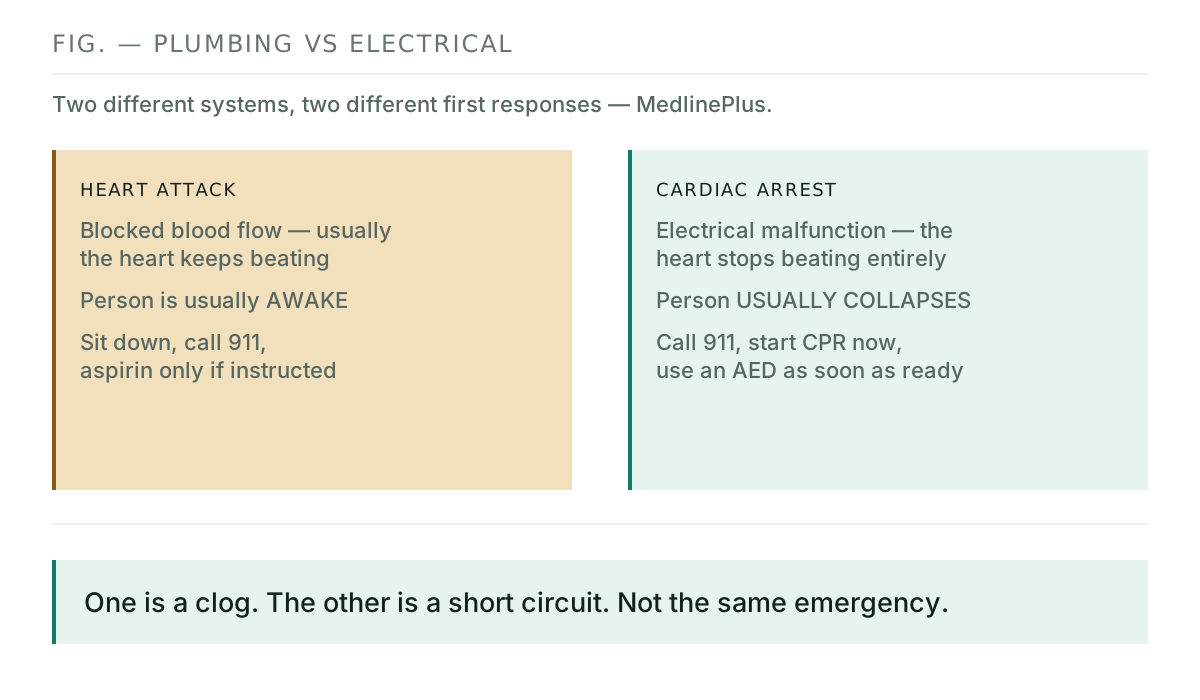
A heart attack is a plumbing problem — blocked blood flow to the heart — and the person is usually awake and in pain. Cardiac arrest is an electrical problem: the heart suddenly stops beating, and the first sign is often collapse. Both need 911 immediately, but cardiac arrest additionally needs CPR and a defibrillator right away, not a wait-and-see approach.
Our chest pain article covered how to sort a symptom that shows up over minutes to hours. This one is about two words people use as if they mean the same thing, in situations where the confusion genuinely costs time — and time is the one resource neither emergency can spare.
A heart attack and a cardiac arrest are different problems, in different parts of the system, and they call for different first moves. Knowing which one you might be looking at — and knowing what to do either way — is worth more than either term alone.
We earn nothing from any of this. No supplement, monitor or clinic is being sold here, which is the only reason this page can walk through two genuinely frightening emergencies without steering the conclusion toward a purchase.
Two different emergencies, one confused vocabulary
MedlinePlus draws the line plainly: "sudden cardiac arrest (SCA) is a condition in which the heart suddenly stops beating," while "a heart attack happens when blood flow to the heart is blocked." The same source adds the detail that resolves most of the confusion: "during a heart attack, the heart usually doesn't suddenly stop beating." One is a blockage. The other is a stoppage. They are related, they can cause each other, and they are not interchangeable words for the same event.
The plumbing problem: heart attack
A heart attack is a supply-chain failure. Blood flow to part of the heart muscle gets blocked, usually by a clot, and that section of muscle starts to die from lack of oxygen if flow isn't restored. It's an urgent, dangerous problem — and it is not the same as the heart's electrical system failing.
Because the heart is usually still beating, the person having a heart attack is usually conscious, and MedlinePlus's first-aid guidance reflects that: "have the person sit down, rest, and try to keep calm," ask about existing chest-pain medication like nitroglycerin, and "call 911 for emergency medical help." On aspirin, the guidance is specific, not blanket: many experts recommend chewing "a full dose aspirin (325 mg, or low dose 81 mg baby aspirin)" after calling 911, but "only do this if you have been instructed by a physician or a 911 operator, are not allergic to aspirin, and do not have any condition that could make taking aspirin dangerous for you."
Two instructions in that same source are worth repeating word for word: "do not leave the person alone except to call for help, if necessary," and "do not allow the person to deny the symptoms and convince you not to call for emergency help." Denial is part of the pattern, not an exception to it.
The electrical problem: sudden cardiac arrest
Cardiac arrest is a wiring failure, not a supply failure. MedlinePlus attributes it to "ventricular fibrillation, a type of arrhythmia where the ventricles" — the heart's lower chambers — "don't beat normally." Instead of a coordinated pump, the heart quivers uselessly, blood flow stops, and "blood stops flowing to the brain and other vital organs." Left untreated, MedlinePlus is direct that SCA "usually causes death within minutes."
The contributing causes go beyond coronary artery disease: physical stress, low potassium or magnesium, major blood loss, oxygen deprivation, inherited heart-rhythm disorders, and structural changes to the heart can all set it off. Warning signs, when they exist at all, are easy to miss — "a racing heartbeat," feeling "dizzy or light-headed," or "chest pain, shortness of breath, nausea, or vomiting in the hour before." But MedlinePlus is blunt about the more common pattern: "usually, the first sign of SCA is loss of consciousness."
The one question that actually sorts them
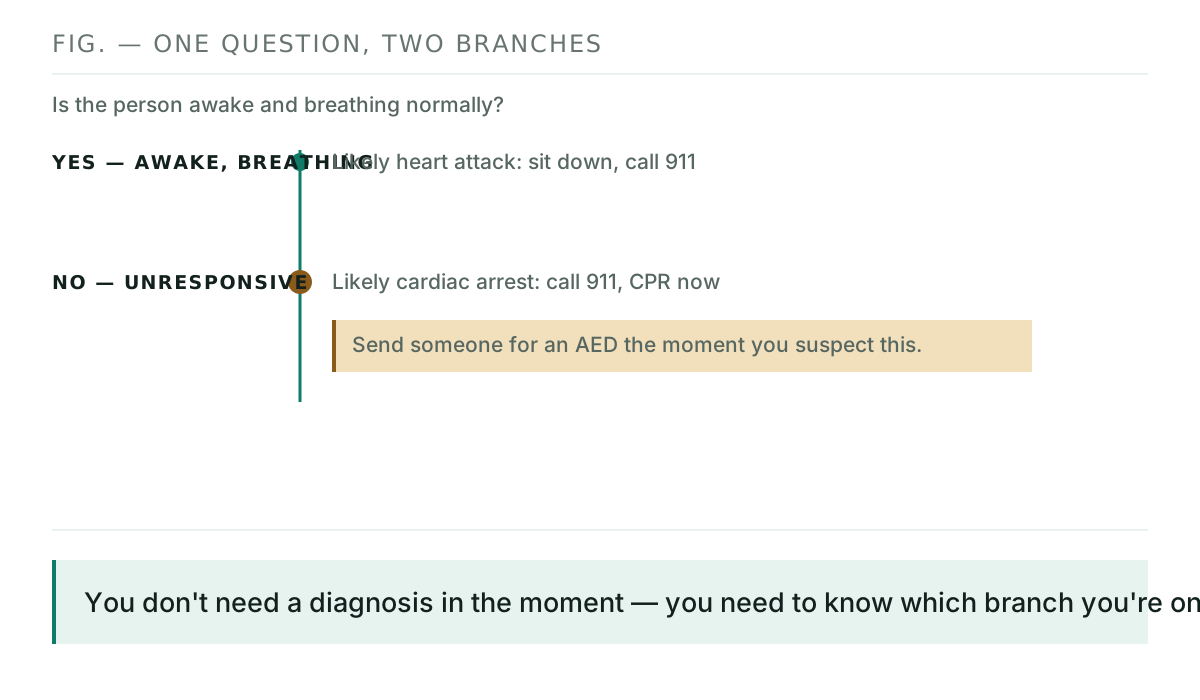
Skip the vocabulary and ask one thing: is the person awake, talking, and breathing normally? If yes, you are almost certainly looking at a heart attack or another non-arrest emergency — sit them down, call 911, follow the steps above. If the person is unresponsive and not breathing normally, treat it as cardiac arrest and move straight to the next section. You do not need a diagnosis to act correctly; you need to know which set of steps to start.
The response that actually saves lives
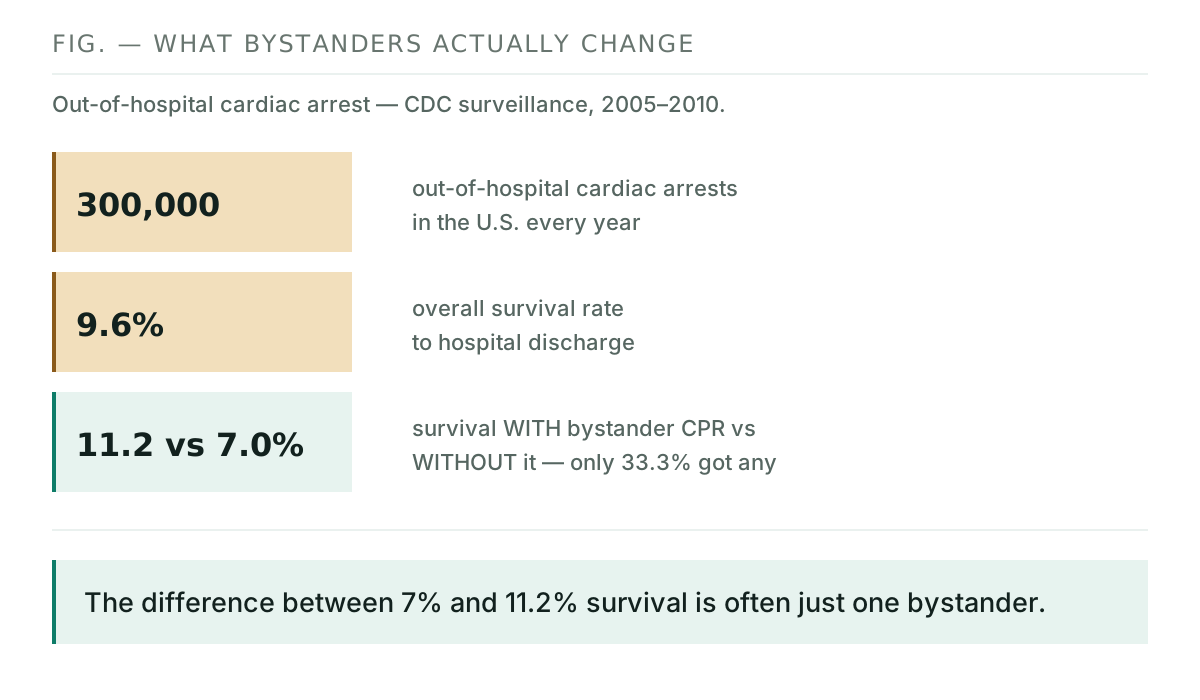
The numbers make the stakes concrete. A CDC surveillance report covering 2005 through 2010 found that roughly 300,000 people in the U.S. experience an out-of-hospital cardiac arrest each year, and the overall survival rate to hospital discharge was 9.6%. Only 33.3% of those patients received bystander CPR — but the ones who did survived at 11.2%, against 7.0% for those who didn't. That gap is real people, and it's produced by bystanders, not paramedics, because paramedics are rarely there in the first minutes.
MedlinePlus states it without qualification: "If you haven't had any CPR training, you can do hands-only CPR for a teen or adult whose heart has stopped beating." That means chest compressions only, no rescue breaths — "push straight down, hard and fast to about 2 inches deep" at "100 to 120 pushes per minute" — while someone else calls 911 and finds an AED. Trained rescuers can add breaths; untrained ones don't need to. MedlinePlus, CPR
One can trigger the other
These are not two unrelated emergencies that happen to share a chapter. MedlinePlus lists a prior heart attack among the risk factors for sudden cardiac arrest, alongside coronary artery disease and heart failure, without spelling out the exact mechanism. It's also possible for the electrical system to fail during a heart attack itself, while the artery is still blocked — which is exactly why an ongoing heart attack is never a symptom to manage quietly at home, waiting to see if it passes.
The one thing that doesn't change either way
Whichever emergency it turns out to be, the first move is identical: call 911, or get someone else to. Not "wait fifteen minutes to see," not "drive there yourself," not "see if it passes." The honest, uncomfortable part of this topic is that acting fast on an ambiguous set of symptoms will sometimes turn out to be an overreaction — and that is a far better outcome than the alternative. Emergency responders would rather be called for chest pain that turns out to be muscular than arrive four minutes late to a cardiac arrest.
What to do with this
- Awake, talking, breathing normally: sit them down and call 911. Loosen tight clothing, ask about existing heart medication, and stay with them.
- Unresponsive, not breathing normally: call 911 and start hands-only CPR immediately. Push hard and fast in the center of the chest, about 100 to 120 times a minute.
- Send someone for an AED the moment you suspect cardiac arrest. Use it as soon as it arrives and follow its instructions.
- Only give aspirin if a 911 operator or physician tells you to. It's not an automatic step, and it's not safe for everyone.
- Don't let denial win. "I'm fine, it'll pass" is one of the most common things said in the minutes before both of these emergencies get worse.
The vocabulary matters less than the instinct it's meant to produce: something is seriously wrong, right now, and the clock is the enemy either way. Get that part right, and which exact term applies can be sorted out by people who show up with a defibrillator and a stretcher.
Key takeaways
- A heart attack is blocked blood flow to the heart muscle — a plumbing problem. Cardiac arrest is the heart's electrical system failing, stopping the beat entirely.
- During a heart attack the person is usually conscious; MedlinePlus states the first sign of cardiac arrest is "usually" loss of consciousness.
- A prior heart attack is itself a risk factor for sudden cardiac arrest — the two are related, not interchangeable.
- CDC data (2005-2010) found 9.6% overall survival for out-of-hospital cardiac arrest, rising to 11.2% with bystander CPR versus 7.0% without.
- Only 33.3% of cardiac arrest patients in that data received bystander CPR at all — most of the survival gap goes unclaimed.
- Hands-only CPR needs no training: push hard and fast, 100 to 120 times a minute, no breaths required.
- Aspirin for suspected heart attack is conditional, not automatic — only if instructed by a physician or 911 operator, and not for everyone.
Where to go from here
This is the fifth article in the heart section, which is now complete. All nine:
- Heart Health After 40: What the Numbers Mean — the pillar guide, covering blood pressure, cholesterol and resting heart rate.
- High Blood Pressure After 40: The Number That Moved — why the definition changed in 2017, and what one reading can't tell you.
- Cholesterol After 40: The Number With No Floor — LDL, HDL and triglycerides, and the trial evidence behind "lower is better."
- Chest Pain After 40: When It's the Heart, and When It's Not — the self-test almost everyone tries, and what it actually proves.
- Heart Palpitations vs AFib: Why a Normal EKG Proves Little — why detection depends on how long anyone is watching.
- Blood Pressure Medication: The First Pill Is a Starting Point — why the same person responds differently to different drug families.
- Statins: The Benefit Is a Share of Your Own Risk — why the same proportional benefit is worth a different amount to different men.
- Fish Oil for Heart Health: The Winning Trial Used a Drug — why the trial everyone quotes was not testing the capsules on the shelf.
Frequently asked questions
What's the actual difference between a heart attack and cardiac arrest?
A heart attack happens when blood flow to the heart is blocked, a plumbing problem, per MedlinePlus. In sudden cardiac arrest, an electrical malfunction makes the heart suddenly stop beating entirely, cutting off blood to the brain and other organs. During a heart attack, MedlinePlus notes, "the heart usually doesn't suddenly stop beating."
How do I know which one is happening?
The clearest sign is consciousness. A heart attack usually leaves someone awake, in pain, and able to describe symptoms. MedlinePlus states that "usually, the first sign" of cardiac arrest "is loss of consciousness" — the person collapses and stops responding, often without warning.
Can a heart attack turn into cardiac arrest?
Yes, in two ways. MedlinePlus lists a prior heart attack as a risk factor for sudden cardiac arrest, without stating the exact mechanism, and the heart's electrical system can also fail during an active heart attack, while the artery is still blocked. That is exactly why a heart attack is never something to wait out at home.
Do I need CPR training to help someone in cardiac arrest?
No. MedlinePlus states plainly: "If you haven't had any CPR training, you can do hands-only CPR for a teen or adult whose heart has stopped beating." Hands-only CPR is chest compressions only, no breaths, pushing hard and fast at 100 to 120 pushes per minute.
Should I give aspirin for a suspected heart attack?
Only if instructed. MedlinePlus says many experts recommend chewing a full dose (325 mg) or low-dose (81 mg) aspirin after calling 911, but adds: "Only do this if you have been instructed by a physician or a 911 operator, are not allergic to aspirin, and do not have any condition that could make taking aspirin dangerous for you."
How many people survive cardiac arrest outside a hospital?
Per a CDC surveillance report covering 2005-2010, the overall survival rate to hospital discharge was 9.6%. Patients who received bystander CPR survived at a significantly higher rate, 11.2%, versus 7.0% for those who did not — though only 33.3% of patients received bystander CPR at all.
Sources
- MedlinePlus (National Library of Medicine, NIH) — Sudden Cardiac Arrest
- MedlinePlus (National Library of Medicine, NIH) — Heart Attack First Aid
- MedlinePlus (National Library of Medicine, NIH) — Heart Attack Warning Signs and Symptoms
- MedlinePlus (National Library of Medicine, NIH) — CPR
- Centers for Disease Control and Prevention (MMWR) — Out-of-Hospital Cardiac Arrest Surveillance, CARES 2005–2010

Male Health Guide Editorial Team
We write about the health problems men over 40 actually search for at 3 a.m. — and we say plainly when the evidence for a popular product is thin. We do not invent credentials and we do not publish sponsored copy as editorial. Read more about how we work.
Medical disclaimer: This article is general information about heart attack and cardiac arrest and is not medical advice. It is not a substitute for emergency medical care or CPR/AED training. If you suspect either emergency, call 911 immediately.