Chest Pain After 40: When It's the Heart, and When It's Not
Short answer
Chest pain that's crushing, spreads to the arm or jaw, or arrives with sweating, nausea or shortness of breath needs a 911 call, not a guess. Pain that worsens when you press on it is a real clue toward a non-cardiac cause — but in one study, about 1 in 14 people having an actual cardiac event still had that "reassuring" result.
Our pillar guide covers the numbers — blood pressure, cholesterol — that quietly build risk over years. Chest pain is different. It shows up in one afternoon, and it forces a decision in real time: is this the emergency room, or is this nothing? Every year, a huge share of people who walk into an ER with chest pain turn out not to be having a heart attack. The problem is that from the inside, in the moment, there is no reliable way to know which kind of afternoon you're having — except by checking it against what's actually been studied.
This article covers the warning signs worth calling 911 over, the home test almost every man tries — pressing on the sore spot — and what the evidence actually says it proves, and the three most common non-cardiac causes of chest pain: costochondritis, heartburn, and panic.
We earn nothing from any of this. No supplement, monitor or clinic is being sold here, which is the only reason this page can walk through a genuinely frightening symptom without steering the conclusion toward a purchase.
When to call 911, not a search engine
MedlinePlus describes the classic pattern directly. Chest discomfort "is often in the center or left side of the chest," usually lasting "more than a few minutes," and it "may go away and come back." It can feel like "pressure, squeezing, fullness, or pain," and it can resemble "heartburn or indigestion" — which is exactly why this symptom is so hard to self-sort.
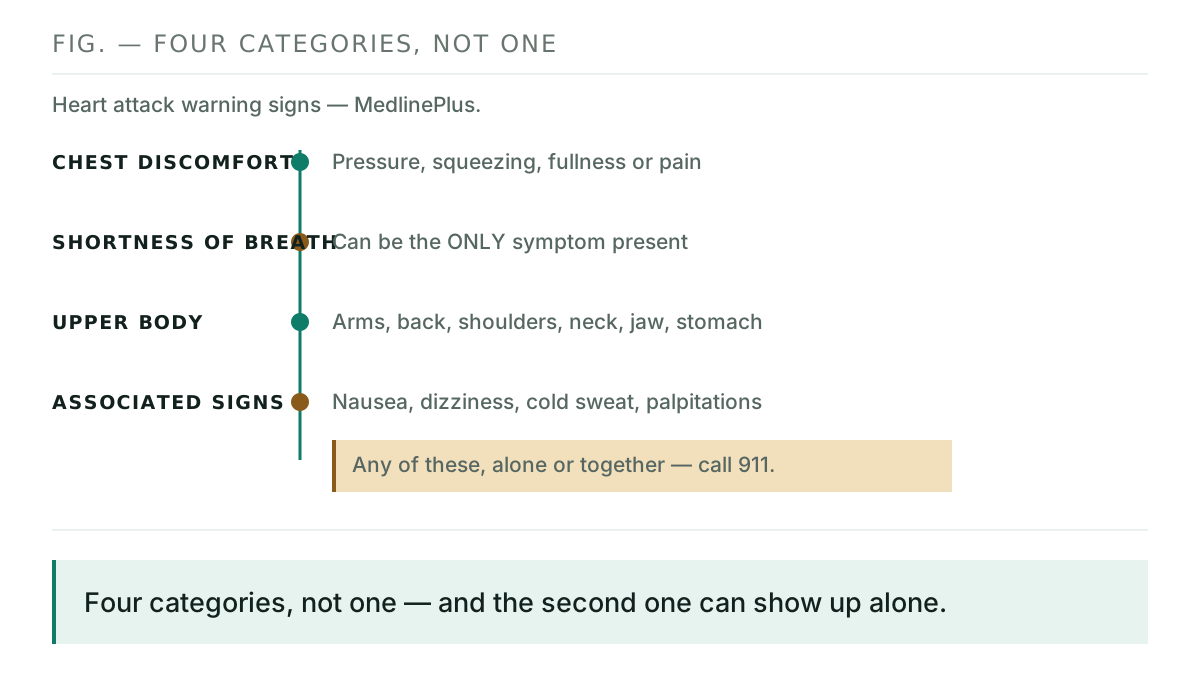
Shortness of breath deserves its own line: "sometimes this is your only symptom," arriving "before or during the chest discomfort." Upper body discomfort can show up almost anywhere — "one or both arms, the back, shoulders, neck, jaw, or upper part of the stomach" — and the associated signs include nausea, vomiting, dizziness, palpitations, and lightheadedness, sometimes with a cold sweat. MedlinePlus also notes a real difference by sex: women "are more likely to feel tired for no reason" as part of the pattern, not just chest pain alone.
Angina: cardiac, but not always an emergency
Not every cardiac chest pain is a heart attack in progress. Angina is the heart muscle asking for more blood than it's getting, usually for a few minutes at a time, and it changes the picture in a specific way: it tends to show up with exertion — climbing stairs, shoveling, a brisk walk — and ease with rest. That pattern, predictable and exertion-linked, is different from a heart attack's pain, which typically does not resolve just because you sit down.
The nuance matters because "it went away when I stopped" can feel like proof nothing serious happened, when it can just as easily mean the opposite: the heart's blood supply is genuinely limited under demand, and rest is what relieves the demand. Angina that's new, worsening, or happening with less and less exertion each time is not something to track quietly at home — it's a reason to get the arteries actually evaluated, even between episodes.
The test almost everyone tries, and what it actually proves
Nearly every man with unexplained chest pain does the same thing without being told to: he presses on the spot. If it hurts more when he pushes, it feels like relief — surely a heart attack wouldn't get worse from a finger. That instinct has real research behind it, and the research is more honest than the instinct.
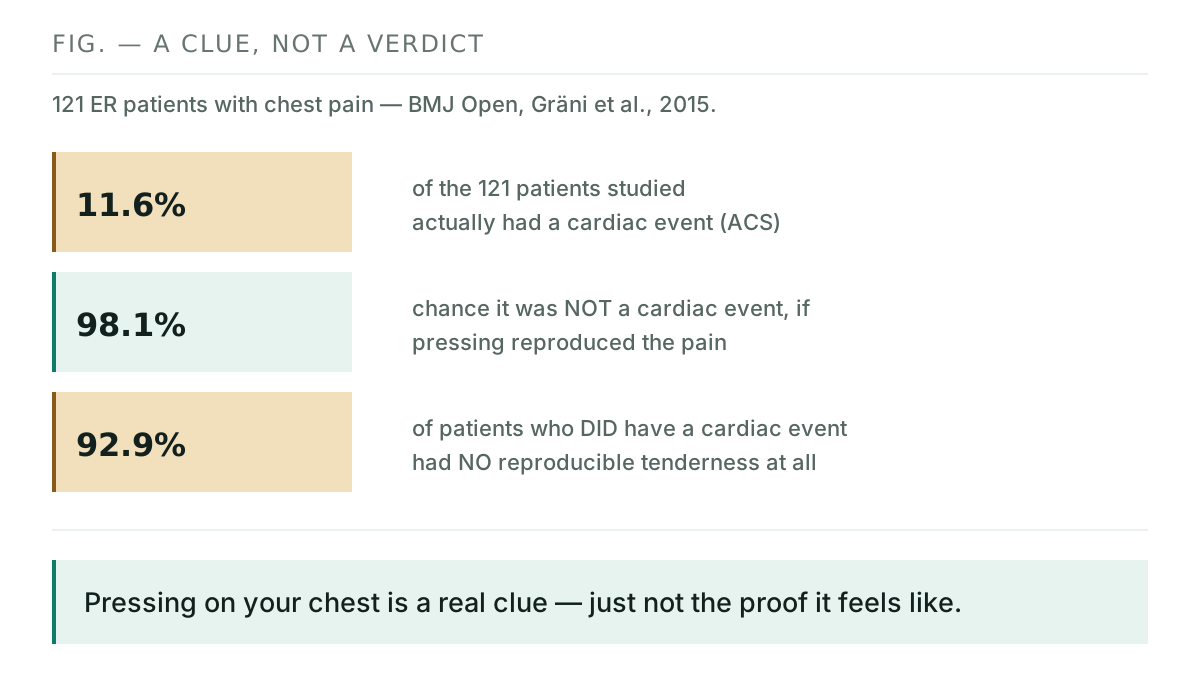
A 2015 study at University Hospital Zurich enrolled 121 emergency-department patients with acute chest pain; 11.6% actually had acute coronary syndrome (ACS). When pressing on the chest reproduced the pain, that finding "ruled out ACS" with a negative predictive value of 98.1% — a genuinely useful signal. But sensitivity ran the other way: among patients who did have ACS, 92.9% did NOT have reproducible tenderness. The study's own conclusion: reproducible tenderness helps rule out ACS early on, but "ACS and other diagnoses should be considered in patients with a negative CWT test." Gräni et al., BMJ Open, 2015
In plain terms: if pressing on your chest reproduces the pain, that's a real, published point in favor of a non-cardiac cause — roughly a 98-in-100 chance, in this particular study. It is not a 100-in-100 chance, and this was a single hospital with 121 patients, not a nationwide trial. The instinct to press and check isn't wrong. Treating a "yes, that's the spot" answer as a substitute for medical evaluation is the part that isn't supported.
Costochondritis, the most common mimic
The condition behind most of that reproducible tenderness has a name: costochondritis, which MedlinePlus describes as inflammation of "the cartilage" connecting the ribs to the breastbone. The pattern is distinct once you know it: "sharp pain at the front of your chest wall, which may move to your back or stomach," "increased pain when you take a deep breath or cough," tenderness "when you press the area where the rib joins the breastbone," and, tellingly, "less pain when you stop moving and breathe quietly."
It often has no identified trigger, but MedlinePlus lists plausible causes: a chest injury, hard exercise or heavy lifting, a viral respiratory infection, strain from coughing, or certain types of arthritis. None of that requires a cardiac workup on its own — but a first episode, in a man over 40, is still worth a real diagnosis rather than a guess, precisely because the reproducible-pain clue above is strong, not absolute.
Heartburn and GERD, the second mimic
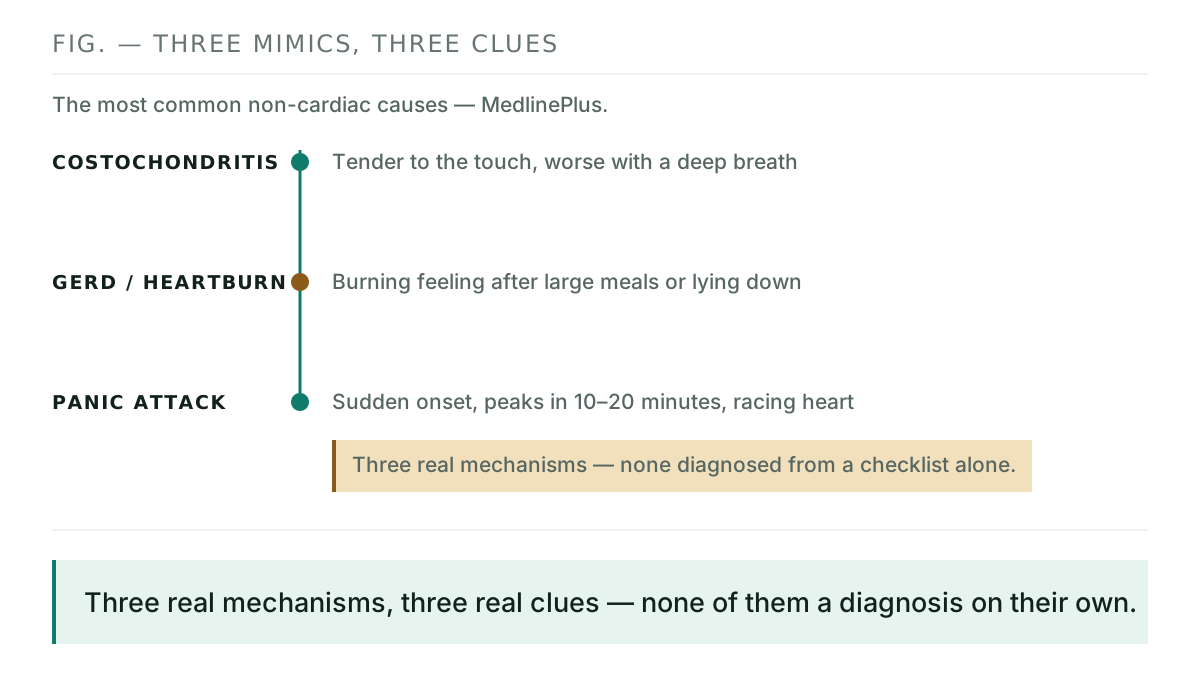
Gastroesophageal reflux disease, or GERD, produces its own chest sensation: heartburn, "a burning feeling in your chest or throat," sometimes with a sour taste, a dry cough, or trouble swallowing. MedlinePlus is specific about what tends to set it off — "eating a large meal or lying down too soon after eating," plus trigger foods like "spicy foods, chocolate, caffeine, or fatty foods." Occasional reflux becomes GERD when it happens "two or more times a week" or damages the esophagus.
The same MedlinePlus page draws its own line, which is worth repeating exactly: seek immediate medical attention for "chest pain with shortness of breath, or pain in your jaw or arm," because those can mean a heart problem rather than reflux. A pattern that fits heartburn on most days doesn't get to skip that rule on the day it doesn't fit.
Panic and anxiety, the third mimic
The third common cause is the one men are least likely to consider first: a panic attack. MedlinePlus lists "chest pain or discomfort" and "palpitations, fast heart rate, or pounding heart" among its physical symptoms, alongside shortness of breath, sweating, and numbness or tingling. It states the overlap plainly: "a panic attack may be mistaken for a heart attack."
The timing is a genuine clue. A panic attack "begins suddenly and most often peaks within 10 to 20 minutes," with some symptoms lasting an hour or more — a different shape than steady exertional chest pressure, though not different enough to self-diagnose from. A first panic attack still deserves the same emergency evaluation as any other unexplained chest pain, both because the symptoms genuinely overlap and because ruling out a cardiac cause is what makes the anxiety diagnosis trustworthy going forward.
What doesn't fit any of these three
MedlinePlus's own list of chest pain causes is longer than the three mimics above: "other heart problems, such as angina," "digestive problems, such as heartburn or esophagus disorders," "sore muscles," "lung diseases, such as pneumonia, pleurisy, or pulmonary embolism," and costochondritis. A pulled muscle from an unfamiliar workout, a lung infection with fever and cough, or a blood clot in the lung can all produce chest pain that doesn't match the three patterns above cleanly. That's the honest limit of any self-sorting checklist, including this one: it narrows the odds, it doesn't replace an exam.
What to do with this
- Call 911 for the classic pattern. Crushing pressure, pain spreading to the arm or jaw, or chest pain with sweating, nausea or shortness of breath is not a wait-and-see situation.
- Don't drive yourself. If a heart attack is genuinely possible, an ambulance can start treatment before you arrive.
- Use the press test as one data point, not a verdict. Reproducible tenderness leans strongly toward non-cardiac — it doesn't clear you outright.
- Get a first episode checked, even if it fits a mimic pattern. Costochondritis, GERD and panic are all common, but the diagnosis is worth confirming rather than assuming.
- Take a first panic attack seriously as a medical visit, not just an anxiety episode. The overlap with cardiac symptoms is real enough that ruling out the heart is part of the diagnosis.
Chest pain earns its reputation honestly — it is genuinely the symptom where guessing wrong costs the most. The goal here isn't to make anyone more confident diagnosing themselves at the kitchen table. It's to make the decision that actually matters — call for help or don't — a little less like a coin flip.
Key takeaways
- Classic warning signs: chest pressure or squeezing lasting more than a few minutes, shortness of breath (sometimes alone), upper body discomfort, and nausea, dizziness or cold sweat — MedlinePlus.
- In a 2015 study of 121 ER patients, reproducible chest wall tenderness had a 98.1% negative predictive value for a cardiac event — a real clue, not proof.
- The same study found 92.9% of patients who did have a cardiac event did NOT have reproducible tenderness — roughly 1 in 14 people who actually had a cardiac event still got that "reassuring" result.
- Costochondritis causes sharp, tender chest wall pain that worsens with deep breathing and eases at rest.
- GERD's own literature warns: chest pain with shortness of breath or arm/jaw pain needs immediate care, not an antacid.
- A panic attack can cause real chest pain and a pounding heart, peaking within 10 to 20 minutes — MedlinePlus states it "may be mistaken for a heart attack."
- Angina — exertional chest pain that eases with rest — is cardiac but not necessarily an emergency; it still needs a real diagnosis.
Where to go from here
This is the fourth article in the heart section, which is now complete. All nine:
- Heart Health After 40: What the Numbers Mean — the pillar guide, covering blood pressure, cholesterol and resting heart rate.
- High Blood Pressure After 40: The Number That Moved — why the definition changed in 2017, and what one reading can't tell you.
- Cholesterol After 40: The Number With No Floor — LDL, HDL and triglycerides, and the trial evidence behind "lower is better."
- Heart Attack vs Cardiac Arrest: Plumbing vs Electrical — two different emergencies, and the one question that actually sorts them.
- Heart Palpitations vs AFib: Why a Normal EKG Proves Little — why detection depends on how long anyone is watching.
- Blood Pressure Medication: The First Pill Is a Starting Point — why the same person responds differently to different drug families.
- Statins: The Benefit Is a Share of Your Own Risk — why the same proportional benefit is worth a different amount to different men.
- Fish Oil for Heart Health: The Winning Trial Used a Drug — why the trial everyone quotes was not testing the capsules on the shelf.
Frequently asked questions
What are the classic warning signs of a heart attack?
MedlinePlus lists chest discomfort (pressure, squeezing, fullness or pain, often center or left chest, lasting more than a few minutes), shortness of breath (sometimes the only symptom), upper body discomfort in the arms, back, shoulders, neck, jaw or upper stomach, and associated nausea, vomiting, dizziness, palpitations or a cold sweat. Women are more likely to also feel tired for no reason.
Does pressing on my chest to see if it hurts tell me anything useful?
It's a real clue, not proof. A 2015 study of 121 emergency patients found that reproducible chest wall tenderness had a 98.1% negative predictive value for acute coronary syndrome. But of the patients who did have a cardiac event, 92.9% did NOT have reproducible tenderness, so a normal press test doesn't rule anything out on its own.
What is costochondritis?
Costochondritis is inflammation of the cartilage connecting the ribs to the breastbone, per MedlinePlus. It causes sharp chest wall pain that worsens with a deep breath or cough, is tender when you press where the rib meets the breastbone, and eases when you stay still and breathe quietly.
How can I tell chest pain from heartburn or GERD?
Heartburn is a burning feeling that tends to follow a large meal or lying down soon after eating, per MedlinePlus. But the same source is explicit: get immediate medical attention for chest pain with shortness of breath, or pain in the jaw or arm, since those can signal a heart problem rather than reflux.
Can a panic attack really feel like a heart attack?
Yes. MedlinePlus states a panic attack can cause chest pain or discomfort and palpitations, fast heart rate or a pounding heart, and notes plainly that "a panic attack may be mistaken for a heart attack." It begins suddenly and most often peaks within 10 to 20 minutes.
When should I call 911 for chest pain?
MedlinePlus advises immediate medical care for chest pain that does not go away, crushing pain or pressure in the chest, or chest pain along with nausea, sweating, dizziness or shortness of breath. New or unexplained chest pain is worth having evaluated even when it seems to fit a less serious pattern.
Sources
- MedlinePlus (National Library of Medicine, NIH) — Heart Attack Warning Signs and Symptoms
- MedlinePlus (National Library of Medicine, NIH) — Chest Pain
- MedlinePlus (National Library of Medicine, NIH) — Costochondritis
- MedlinePlus (National Library of Medicine, NIH) — GERD
- MedlinePlus (National Library of Medicine, NIH) — Panic Attack
- Gräni et al., BMJ Open, 2015 — Diagnostic Performance of Reproducible Chest Wall Tenderness to Rule Out Acute Coronary Syndrome

Male Health Guide Editorial Team
We write about the health problems men over 40 actually search for at 3 a.m. — and we say plainly when the evidence for a popular product is thin. We do not invent credentials and we do not publish sponsored copy as editorial. Read more about how we work.
Medical disclaimer: This article is general information about chest pain and is not medical advice. It is not a diagnosis and not a substitute for emergency medical care. If you suspect a heart attack, call 911.