Heart Palpitations vs AFib: Why a Normal EKG Proves Little
Short answer
A palpitation is a sensation; AFib is a rhythm problem. Most palpitations are harmless — caffeine, stress, exercise. AFib matters because it's associated with about a fivefold higher risk of ischemic stroke, and it can run in brief episodes with no symptoms at all, which is why one normal EKG in a quiet office doesn't settle the question.
Yesterday's article was about two emergencies that get confused. This pair is different: one half is usually nothing, the other half is often silent, and the overlap between them is a sensation almost every man over 40 has felt at some point while lying in bed at night.
The useful question isn't "should I worry about palpitations." It's narrower and more answerable: which specific features turn a fluttering heart from a nuisance into something that needs a test, and why does a clean result from the doctor's office sometimes fail to close the case?
We earn nothing from any of this. No supplement, monitor or clinic is being sold here, which is the only reason this page can discuss heart monitoring without an affiliate link waiting at the end of the paragraph.
Three words that get used as one
A palpitation is a sensation. MedlinePlus defines palpitations as "feelings or sensations that your heart is pounding or racing" — a subjective experience, not a diagnosis. An arrhythmia is the mechanical fact underneath: "a problem with the rate or rhythm of your heartbeat," where the heart "beats too quickly, too slowly, or with an irregular pattern." And AFib is one specific arrhythmia among many, which MedlinePlus calls "one of the most common types of arrhythmias."
The three come apart in both directions, which is the whole reason this article exists. You can have a strong palpitation with no arrhythmia at all — that's most cups of strong coffee. And you can have AFib with no palpitation at all, because MedlinePlus notes that "some people who have AFib don't have any symptoms and don't know they have it."
When palpitations are just palpitations
Start with the reassuring part, because it covers the majority of cases. MedlinePlus states plainly: "palpitations are not serious most of the time." Not all arrhythmias are a problem either — "some arrhythmias are harmless, such as when your heart rate speeds up during exercise and slows down when you sleep."
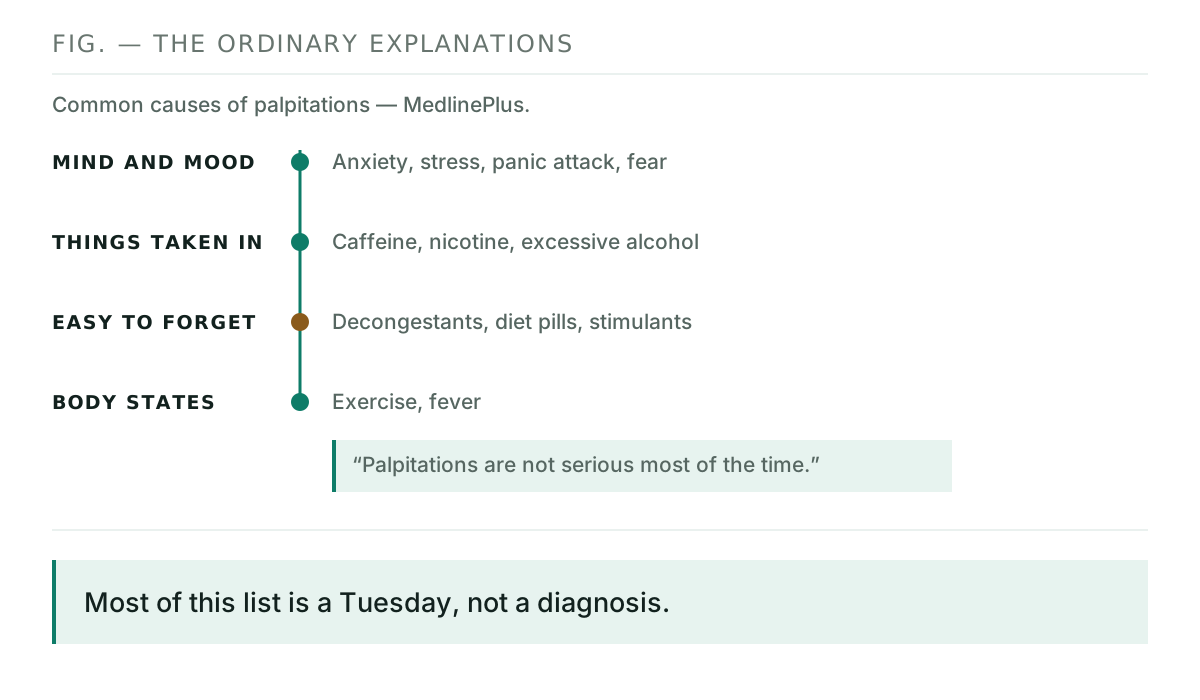
The trigger list from MedlinePlus is mostly made of ordinary life: "anxiety, stress, panic attack, or fear," caffeine, nicotine, "excessive alcohol consumption," exercise, fever, and two categories men often forget they took — "decongestant medications, such as phenylephrine or pseudoephedrine" and "diet pills." A man who had two coffees, a cold tablet and a bad afternoon has a fully sufficient explanation for a fluttering heart that evening.
The specific features that change the answer
MedlinePlus doesn't leave "when to worry" vague, and the specificity is worth having in mind before it's needed. Five things alongside palpitations mean calling 911: loss of consciousness, chest pain, shortness of breath, unusual sweating, and dizziness or lightheadedness.
A separate, lower tier means contacting a provider promptly rather than calling an ambulance: often feeling extra heartbeats, which MedlinePlus quantifies as more than six per minute or coming in groups of three or more; having heart disease or risk factors for it, "such as high cholesterol, diabetes, or high blood pressure"; palpitations that are new or different from your usual ones; a pulse above 100 beats per minute without exercise, anxiety or fever to explain it; and related symptoms like chest pain, shortness of breath or feeling faint. One more, which is easy to miss: MedlinePlus says that if you have never had palpitations before, see your provider — a first episode counts on its own.
That "new or different" criterion does a lot of quiet work. A man who has felt the same harmless skip for fifteen years and suddenly feels a different pattern has a genuine reason to get it checked, even though nothing in the sensation itself is dramatic.
What AFib actually feels like (often, not much)
Here is the detail that surprises most people. Per MedlinePlus, the most common symptom of AFib isn't a pounding heart at all — it's "extreme fatigue, which is the most common symptom." Palpitations come next, described as "the feeling that your heart is skipping a beat, fluttering, pounding, or beating too hard or too fast," followed by trouble breathing, chest pain, dizziness or fainting, and low blood pressure.
Two structural facts matter as much as the symptom list. First, AFib "may happen in brief episodes, or it may be a permanent condition." Second, it can be completely silent. A man running on unexplained exhaustion for months, with no chest symptoms whatsoever, is a plausible AFib presentation — and a man feeling nothing at all is too.
Why AFib matters even when it feels like nothing
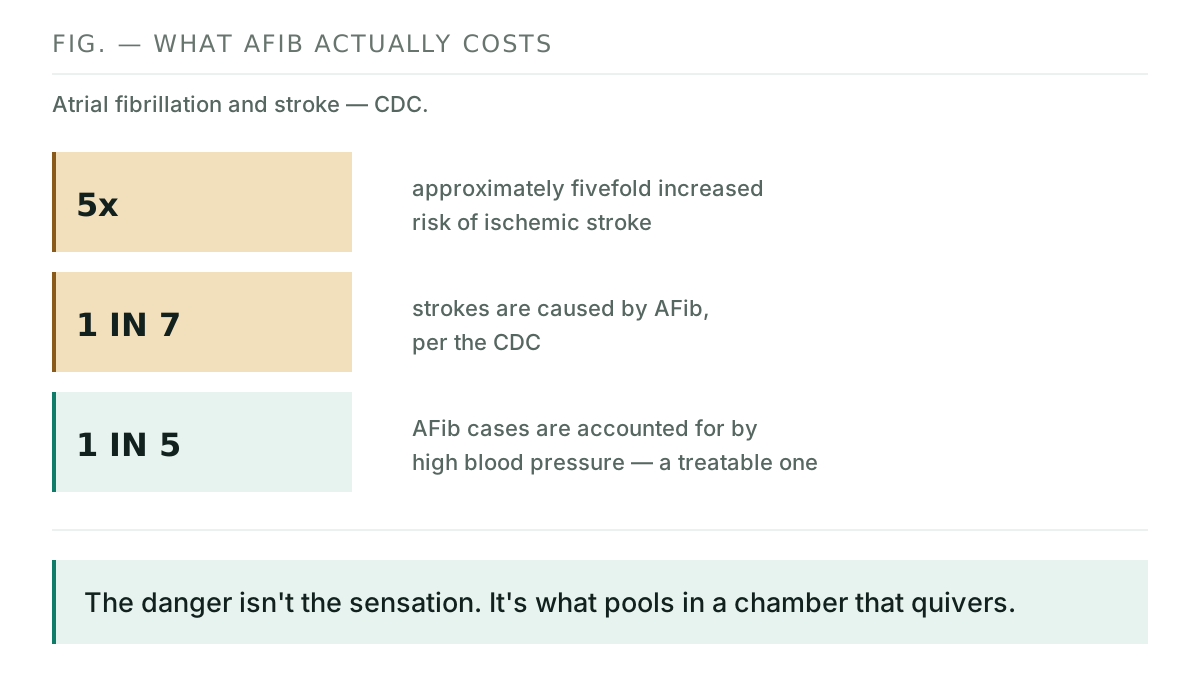
Because the risk it carries isn't about how it feels. Per the CDC, "AFib was associated with an approximately fivefold increased risk of ischemic stroke," and it "causes about 1 in 7 strokes." The mechanism is blood pooling in a chamber that's quivering rather than pumping cleanly, which is also why blood thinners are among the standard treatments MedlinePlus lists, alongside rhythm-control medicines, electrical cardioversion and catheter ablation.
The scale is substantial. CDC figures: more than 454,000 hospitalizations a year in the U.S. with AFib as the primary diagnosis; in 2021, AFib was "mentioned on 232,030 death certificates and was the underlying cause of death in 28,037 of those deaths." There's also a direct link back to the blood pressure article in this section: high blood pressure "accounts for about 1 in 5 cases of AFib," per the CDC.
The watching window, not the heart
Now the part that explains why a normal office EKG can be genuinely reassuring and still not conclusive. An EKG records a rhythm for the seconds it's attached. If the arrhythmia comes in brief episodes, a clean tracing means the heart was behaving during those seconds — which is real information, just not the same as absence.
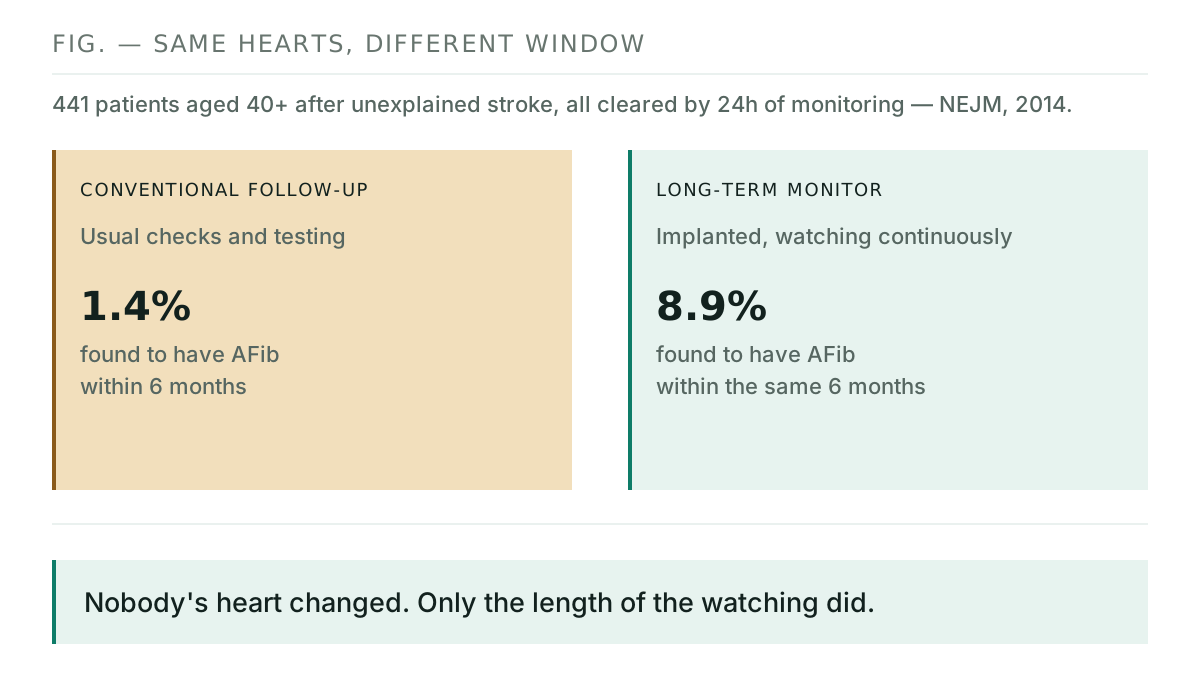
The CRYSTAL AF trial, published in the New England Journal of Medicine in 2014, enrolled 441 patients aged 40 or older who had an unexplained stroke and, critically, "no evidence of atrial fibrillation during at least 24 hours of ECG monitoring." Half got a long-term implanted monitor, half got conventional follow-up. By 6 months, AFib had been found in 8.9% of the monitored group versus 1.4% of the control group (hazard ratio 6.4). By 12 months: 12.4% versus 2.0%. Sanna et al., New England Journal of Medicine, 2014
Nothing about those patients' hearts changed between the two arms of that trial. What changed was the length of the window someone was watching through. That is the single most useful idea in this whole topic: with an intermittent arrhythmia, a negative result carries only as much weight as the monitoring behind it is long.
The honest limits of that finding
CRYSTAL AF is not evidence that every man with palpitations needs an implanted monitor, and it would be dishonest to present it that way. Those 441 people had already had a stroke of unknown cause — a group with a far higher prior probability of hidden AFib than a healthy 40-something who felt a flutter after espresso. The 8.9% figure belongs to that population, not to the general public, and this article's numbers shouldn't be borrowed across that line.
What does transfer is the principle, not the percentage: monitoring duration changes detection. Longer monitoring is already part of ordinary care — among the tests MedlinePlus lists, a provider "may ask you to wear a heart monitor device that records your heart's electrical activity," alongside an EKG and an echocardiogram. Most palpitations still turn out to be nothing. The point is that "the EKG was fine" and "there is no arrhythmia" are two different statements, and only the first one was actually tested.
What to do with this
- Treat the five emergency signs as non-negotiable. Palpitations plus fainting, chest pain, shortness of breath, unusual sweating or dizziness means 911, not a wait-and-see.
- Take "new or different" seriously even when it's mild. A change in a long-familiar pattern is its own reason to get checked, per MedlinePlus.
- Rule out the ordinary triggers honestly before dismissing them. Count the coffee, the cold medicine, the alcohol and the sleep debt — then see whether the pattern still needs explaining.
- Don't ignore unexplained exhaustion as a heart symptom. Extreme fatigue is AFib's most common symptom, and it's the one least likely to get mentioned at an appointment.
- If suspicion is real and the office EKG was normal, ask about longer monitoring. A wearable or event monitor is the standard next step for exactly this reason.
Most fluttering hearts are a story about caffeine and stress, and it would be a disservice to make anyone anxious about a symptom that's usually benign. But AFib is the one arrhythmia in this cluster where the cost of missing it is measured in strokes — and the reason it gets missed is rarely that nobody looked. It's that the looking was too short.
Key takeaways
- A palpitation is a sensation, an arrhythmia is a rhythm problem, and AFib is one specific arrhythmia — the three don't always travel together.
- MedlinePlus: "palpitations are not serious most of the time," with ordinary triggers including caffeine, nicotine, alcohol, exercise, fever, decongestants and diet pills.
- Five signs make palpitations an emergency: loss of consciousness, chest pain, shortness of breath, unusual sweating, dizziness.
- AFib's most common symptom is "extreme fatigue," not palpitations — and it can be completely symptomless.
- CDC: AFib carries "an approximately fivefold increased risk of ischemic stroke" and causes about 1 in 7 strokes; high blood pressure accounts for about 1 in 5 AFib cases.
- CRYSTAL AF (NEJM, 2014): in 441 stroke patients who had already cleared 24 hours of monitoring, long-term monitoring found AFib in 8.9% at 6 months vs 1.4% with conventional follow-up.
- That 8.9% belongs to a high-risk stroke population, not the general public — what transfers is the principle that detection depends on monitoring duration.
Where to go from here
This is the sixth article in the heart section, which is now complete. All nine:
- Heart Health After 40: What the Numbers Mean — the pillar guide, covering blood pressure, cholesterol and resting heart rate.
- High Blood Pressure After 40: The Number That Moved — why the definition changed in 2017, and what one reading can't tell you.
- Cholesterol After 40: The Number With No Floor — LDL, HDL and triglycerides, and the trial evidence behind "lower is better."
- Chest Pain After 40: When It's the Heart, and When It's Not — the self-test almost everyone tries, and what it actually proves.
- Heart Attack vs Cardiac Arrest: Plumbing vs Electrical — two different emergencies, and the one question that sorts them.
- Blood Pressure Medication: The First Pill Is a Starting Point — why the same person responds differently to different drug families.
- Statins: The Benefit Is a Share of Your Own Risk — why the same proportional benefit is worth a different amount to different men.
- Fish Oil for Heart Health: The Winning Trial Used a Drug — why the trial everyone quotes was not testing the capsules on the shelf.
Frequently asked questions
What's the difference between heart palpitations and AFib?
A palpitation is a sensation, which MedlinePlus defines as "feelings or sensations that your heart is pounding or racing." AFib is a specific arrhythmia, an actual problem with the heart's rhythm. Palpitations can be caused by coffee or stress with no arrhythmia at all, and AFib can be present with no palpitations at all.
Are heart palpitations dangerous?
Usually not. MedlinePlus states plainly that "palpitations are not serious most of the time," and lists ordinary triggers including anxiety, caffeine, exercise, fever, nicotine, excessive alcohol, decongestants and diet pills.
When should I call 911 for palpitations?
MedlinePlus lists five emergency signs alongside palpitations: loss of consciousness, chest pain, shortness of breath, unusual sweating, and dizziness or lightheadedness. Any of those turns palpitations into an emergency rather than a nuisance.
What does AFib actually feel like?
Often not like a racing heart at all. Per MedlinePlus, the most common symptom of AFib is "extreme fatigue," followed by palpitations, trouble breathing, chest pain, dizziness or fainting, and low blood pressure. It also notes that "some people who have AFib don't have any symptoms and don't know they have it."
Why does AFib matter if I feel fine?
Because of stroke risk. The CDC states AFib "was associated with an approximately fivefold increased risk of ischemic stroke" and causes about 1 in 7 strokes. In 2021 it was mentioned on 232,030 death certificates and was the underlying cause in 28,037 of them.
Can a normal EKG rule out AFib?
Not on its own, because AFib "may happen in brief episodes," per MedlinePlus. In the CRYSTAL AF trial, 441 stroke patients aged 40+ who had no AFib found during at least 24 hours of monitoring were followed further: a long-term implanted monitor found AFib in 8.9% within 6 months, versus 1.4% with conventional follow-up.
Sources
- MedlinePlus (National Library of Medicine, NIH) — Heart Palpitations
- MedlinePlus (National Library of Medicine, NIH) — Atrial Fibrillation
- MedlinePlus (National Library of Medicine, NIH) — Arrhythmia
- Centers for Disease Control and Prevention — About Atrial Fibrillation
- Sanna et al. (CRYSTAL AF), New England Journal of Medicine, 2014 — Cryptogenic Stroke and Underlying Atrial Fibrillation

Male Health Guide Editorial Team
We write about the health problems men over 40 actually search for at 3 a.m. — and we say plainly when the evidence for a popular product is thin. We do not invent credentials and we do not publish sponsored copy as editorial. Read more about how we work.
Medical disclaimer: This article is general information about heart palpitations and atrial fibrillation and is not medical advice. It is not a diagnosis and not a substitute for a healthcare professional who can order the right test for your situation. If palpitations come with fainting, chest pain, shortness of breath, unusual sweating or dizziness, call 911.