Blood Pressure Medication: The First Pill Is a Starting Point
Short answer
Blood pressure medication comes in families that work by different mechanisms, and the same person can respond well to one family and poorly to another. A 2023 trial that cycled 280 people through four classes found response varied considerably between individuals. Needing a switch, or a second pill, is a normal step rather than a failure.
The blood pressure article in this section covered what the numbers mean and why the definition moved in 2017. This one picks up at the moment that follows for a lot of men over 40: a prescription, a pharmacy bag, and very little explanation of what is supposed to happen next.
The most useful thing to understand up front is the one thing that rarely gets said out loud — the first prescription is an informed starting point, not a verdict. There is real trial evidence for why that is, and it changes how the next few months should feel.
We earn nothing from any of this. No supplement, monitor or clinic is being sold here, which is the only reason this page can discuss prescription medication without a product waiting at the end of the paragraph.
What the prescription actually commits you to
A blood pressure prescription is usually presented as a conclusion: the number was high, here is the fix. In practice it's closer to the opening move in a short sequence. The prescriber picks a reasonable first drug based on your age, your other conditions and your other medicines — then finds out how your body answers, which is information nobody had before you took it.
That distinction matters because it changes what counts as bad news. A drug that lowers your number by less than hoped isn't a sign that medication won't work for you. It's the first real data point about which mechanism your blood pressure responds to, and the next choice is better informed than the first one was.
The families, and what each one actually does
Blood pressure drugs are not variations on one pill. They attack the problem from different directions, and MedlinePlus describes each mechanism in plain terms. ACE inhibitors and ARBs "keep your blood vessels from narrowing as much and allows blood to move through them with less pressure." Calcium channel blockers "prevent calcium from entering the muscle cells of your heart and blood vessels. This allows the blood vessels to relax." Diuretics "remove extra water and sodium (salt) from your body. This lowers the amount of fluid in your blood." And beta blockers "help your heart beat slower and with less force. This means that your heart pumps less blood through your blood vessels."
Different levers: vessel narrowing, fluid volume, and pump force. That variety is exactly why one man's blood pressure can barely move on one drug and drop meaningfully on another.
One caveat belongs right next to that list, because MedlinePlus attaches it directly to the beta blocker entry: "beta blockers are typically used only as a backup option or if you also have certain other conditions." They are on the list, but not on equal footing with the first three as a starting choice.
The trial that gave the same people all four
Most drug trials compare one group on drug A against a different group on drug B. That design can tell you which drug is better on average, but it can't tell you whether individuals differ — because no single person ever tries both. A 2023 trial published in JAMA was built specifically to answer that question. Note that its four classes are not quite the four families above: it tested an ACE inhibitor and an ARB separately, and did not include a beta blocker at all.
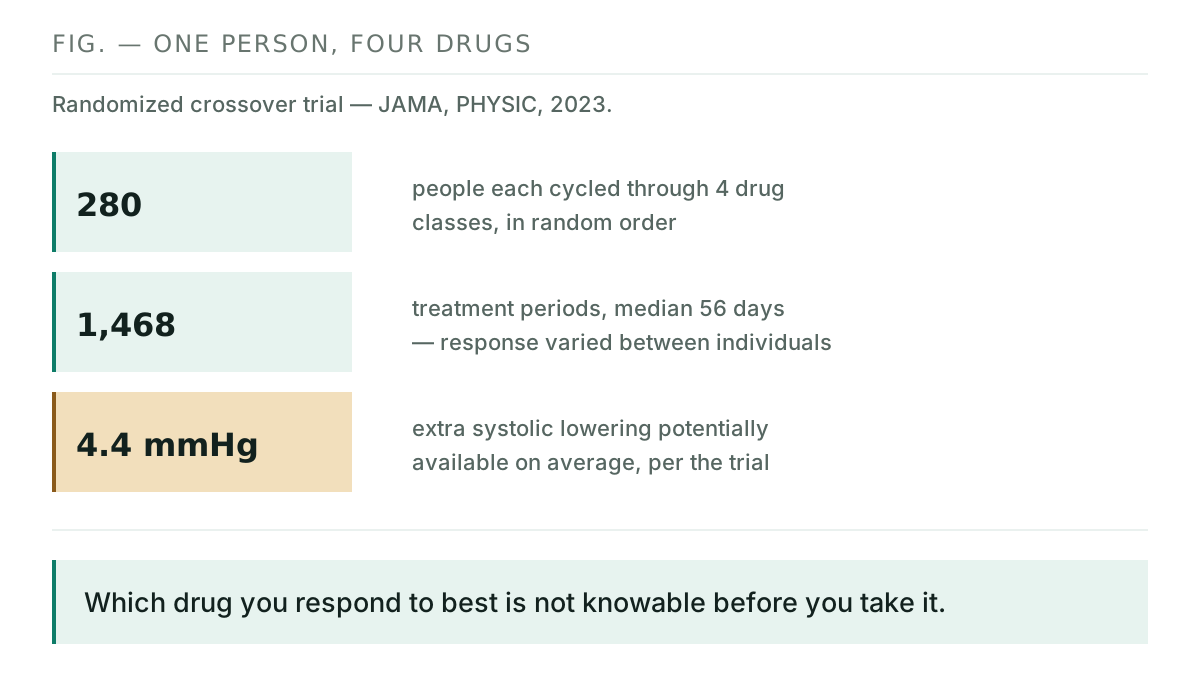
The PHYSIC trial randomized 280 adults with grade 1 hypertension at low cardiovascular risk to cycle through lisinopril (an ACE inhibitor), candesartan (an ARB), hydrochlorothiazide (a thiazide diuretic) and amlodipine (a calcium channel blocker), with two of the classes repeated. That produced 1,468 completed treatment periods, median length 56 days, in 270 participants with usable data. The finding: "the blood pressure response to different treatments varied considerably between individuals." Sundström et al., JAMA, 2023
The practical payoff was quantified too. On average, matching each person to their best-response drug rather than assigning the same one to everybody "had the potential to provide an additional 4.4 mm Hg-lower systolic blood pressure." That is not a trivial number in a condition where the whole debate in the 2017 guideline change was over a 10-point shift in where the line sits.
Which switches matter, and which mostly don't
Here is the part that gets flattened in most coverage, and it's the most useful detail in the whole study. The individual variation didn't show up between every pair of drugs. It showed up specifically for the choices of lisinopril versus hydrochlorothiazide, lisinopril versus amlodipine, candesartan versus hydrochlorothiazide, and candesartan versus amlodipine.
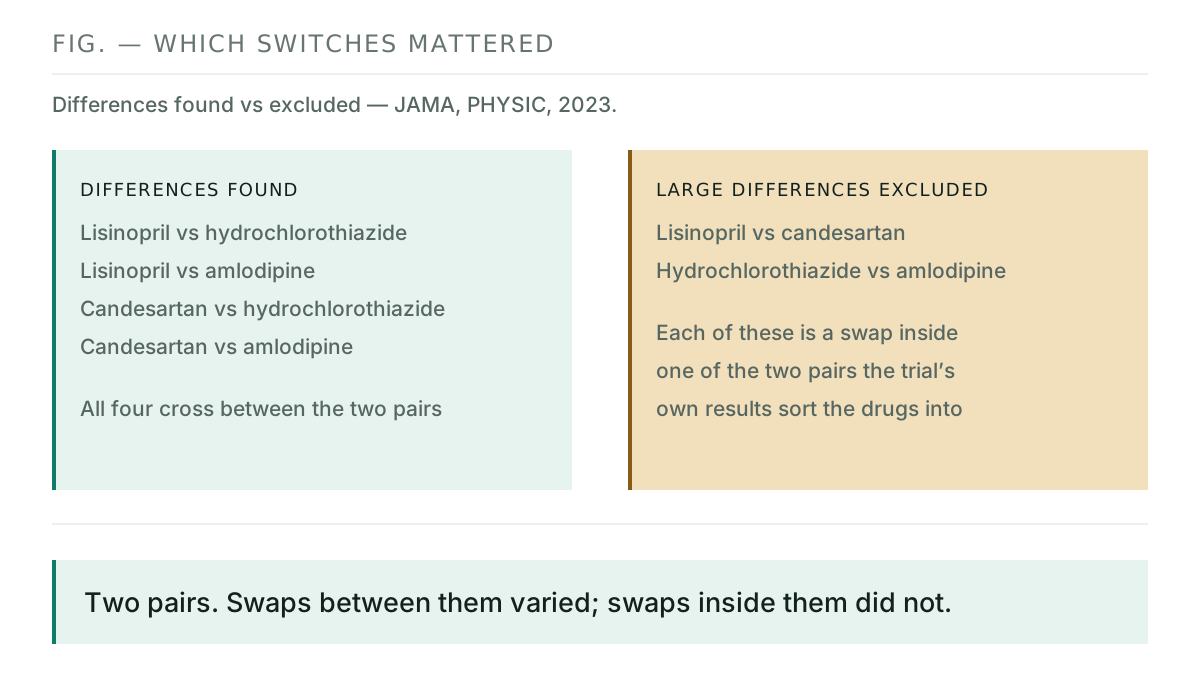
And the reverse: the trial explicitly reported that "large differences were excluded for the choices of lisinopril vs candesartan and hydrochlorothiazide vs amlodipine." Lined up together, those two lists make a clean shape. The four drugs behave like two pairs — lisinopril with candesartan on one side, hydrochlorothiazide with amlodipine on the other. Every comparison that crossed between the pairs showed individual variation; neither comparison inside a pair did.
Worth being precise about what that does and doesn't establish. The trial reported which comparisons varied, not why, and the shape above is a description of its results rather than a mechanism the study set out to prove. In particular, hydrochlorothiazide and amlodipine work by genuinely different routes — fluid volume versus vessel relaxation — and the trial still excluded large individual differences between them. So "different mechanism" on its own does not predict which switches will matter.
Why a second pill is not a bad sign
Men often read a second prescription as evidence that things are getting worse. The sources treat it as ordinary. NHLBI: "to manage high blood pressure, many people need to take two or more medicines." MedlinePlus puts the reasoning plainly: "often, two or more medicines work better than one," and if the current combination isn't lowering the number enough, "your provider may suggest that you take another type of blood pressure medicine."
That fits the mechanism logic above. Two drugs pulling different levers — fluid volume and vessel width, say — can do together what neither does alone, often at lower doses of each.
What doesn't change when the pills start
The lifestyle side doesn't get retired. NHLBI is direct: "keep up your healthy lifestyle changes while taking these medicines. The combination of medicines and heart-healthy lifestyle changes can help control and lower your high blood pressure and prevent heart disease." MedlinePlus says the same: "while taking the medicines, it is still important to keep up with your healthy lifestyle changes."
This is worth stating flatly because the opposite assumption is common and costly: a pill that makes the number look acceptable can create the impression that the salt, the weight and the inactivity have been handled. They haven't. They've been offset.
The honest limits of the personalization finding
The PHYSIC result is genuinely interesting, and it can be overread in two directions, so both are worth naming. First, the population: 280 people in Sweden with grade 1 hypertension and low cardiovascular risk, mean age 64. That is a narrower group than everyone on blood pressure medication, and the 4.4 mmHg figure is an average potential across that group, not a promise to any individual.
Second, and more important: this is not an argument for experimenting on yourself. The trial was a controlled, double-blind, randomized crossover with measured ambulatory readings at the end of each period — not someone deciding a pill "isn't working" after a bad week and stopping. The CDC's instruction on that is unambiguous: "do not stop taking your current medicine without talking to your doctor or pharmacist first," because doing so "could lead to serious health consequences."
There is also a larger problem sitting underneath drug choice entirely. As the blood pressure article covered, CDC data shows only about 1 in 4 adults with high blood pressure have it under control. Optimizing which drug someone takes matters considerably less if the prescription ends up in a drawer.
What to do with this
- Treat the first prescription as a starting point. If it doesn't work well, that is information about you, not a failed treatment plan.
- Report side effects instead of quietly stopping. A switch across drug families is a normal, evidence-backed response — but it's a conversation, not a solo decision.
- Never stop on your own, even when the numbers look good. Per the CDC, that is exactly the move that can have serious consequences.
- Expect the possibility of a second medicine. Per NHLBI, many people need two or more, and combining mechanisms is a deliberate strategy.
- Keep the lifestyle side running. Both NHLBI and MedlinePlus are explicit that medication works alongside those changes, not instead of them.
The most common way blood pressure treatment goes wrong isn't picking the wrong drug. It's a man concluding, after one unremarkable month, that the whole thing doesn't work for him — and quietly dropping out of a process that was only ever designed to take a few adjustments to get right.
Key takeaways
- The main families work by different mechanisms: ACE inhibitors and ARBs (vessel narrowing), calcium channel blockers (vessel relaxation), diuretics (fluid volume), beta blockers (pump force).
- PHYSIC (JAMA, 2023) had 280 people each cycle through four drug classes across 1,468 treatment periods — response "varied considerably between individuals."
- Matching each person to their best-response drug had the potential to provide an additional 4.4 mmHg of systolic lowering on average.
- The four drugs behaved like two pairs — lisinopril with candesartan, hydrochlorothiazide with amlodipine. Variation showed up between the pairs, not inside either one.
- NHLBI: "many people need to take two or more medicines" — a second pill is a normal step, not a worse diagnosis.
- Lifestyle changes continue alongside medication, per both NHLBI and MedlinePlus — the pill offsets them, it doesn't replace them.
- CDC: "do not stop taking your current medicine without talking to your doctor or pharmacist first."
Where to go from here
This is the seventh article in the heart section, which is now complete. All nine:
- Heart Health After 40: What the Numbers Mean — the pillar guide, covering blood pressure, cholesterol and resting heart rate.
- High Blood Pressure After 40: The Number That Moved — why the definition changed in 2017, and what one reading can't tell you.
- Cholesterol After 40: The Number With No Floor — LDL, HDL and triglycerides, and the trial evidence behind "lower is better."
- Chest Pain After 40: When It's the Heart, and When It's Not — the self-test almost everyone tries, and what it actually proves.
- Heart Attack vs Cardiac Arrest: Plumbing vs Electrical — two different emergencies, and the one question that sorts them.
- Heart Palpitations vs AFib: Why a Normal EKG Proves Little — why detection depends on how long anyone is watching.
- Statins: The Benefit Is a Share of Your Own Risk — why the same proportional benefit is worth a different amount to different men.
- Fish Oil for Heart Health: The Winning Trial Used a Drug — why the trial everyone quotes was not testing the capsules on the shelf.
Frequently asked questions
What are the main types of blood pressure medication?
Per MedlinePlus: ACE inhibitors and ARBs, which keep blood vessels from narrowing as much; calcium channel blockers, which let blood vessels relax; diuretics, which remove extra water and sodium from the body; and beta blockers, which help the heart beat slower and with less force.
Why did my doctor switch my blood pressure medication?
Because response varies by person. In a 2023 JAMA trial, 280 people each cycled through four drug classes, and blood pressure response differed considerably between individuals. A switch usually means the first choice is being refined with new information, not that treatment failed.
Is it normal to need more than one blood pressure medicine?
Yes. NHLBI states that "to manage high blood pressure, many people need to take two or more medicines," and MedlinePlus adds that "often, two or more medicines work better than one." Needing a second pill is a common step, not a sign of a worse condition.
Can I stop taking blood pressure medication once my numbers are normal?
Not on your own. The CDC is explicit: "Do not stop taking your current medicine without talking to your doctor or pharmacist first," warning that doing so could lead to serious health consequences. Normal numbers on medication usually mean the medication is working, not that it is no longer needed.
Do I still need lifestyle changes once I'm on medication?
Yes. NHLBI states: "Keep up your healthy lifestyle changes while taking these medicines. The combination of medicines and heart-healthy lifestyle changes can help control and lower your high blood pressure and prevent heart disease." Medication replaces neither diet, activity, nor weight management.
Does switching between similar drugs help?
Sometimes not much. In the 2023 JAMA trial the four drugs behaved like two pairs: large individual differences were excluded both between lisinopril and candesartan, and between hydrochlorothiazide and amlodipine. Every comparison that crossed between those two pairs did show variation.
Sources
- Sundström et al. (PHYSIC), JAMA, 2023 — Heterogeneity in Blood Pressure Response to 4 Antihypertensive Drugs: A Randomized Clinical Trial
- National Heart, Lung, and Blood Institute (NIH) — High Blood Pressure — Treatment
- MedlinePlus (National Library of Medicine, NIH) — High Blood Pressure Medicines
- Centers for Disease Control and Prevention — Living With High Blood Pressure
- Centers for Disease Control and Prevention — High Blood Pressure Facts

Male Health Guide Editorial Team
We write about the health problems men over 40 actually search for at 3 a.m. — and we say plainly when the evidence for a popular product is thin. We do not invent credentials and we do not publish sponsored copy as editorial. Read more about how we work.
Medical disclaimer: This article is general information about blood pressure medication and is not medical advice. It is not a substitute for the prescriber who knows your readings, your other medicines and your history. Never start, stop or change a prescription based on an article.