High Blood Pressure After 40: The Number That Moved
Short answer
A reading of 135/85 was unremarkable in 2016 and is Stage 1 high blood pressure today, because the 2017 ACC/AHA guideline lowered the threshold from 140/90 to 130/80, based on trial evidence that a lower target reduces heart attacks and deaths. One reading still doesn't diagnose anything — that takes at least two, on separate visits.
Our pillar guide already walked through today's five-category scale, from normal to a hypertensive crisis. What it didn't have room for is a genuinely strange fact: a man who got a blood pressure reading of 135 over 85 in 2016 was told it was borderline, nothing urgent. The exact same reading today gets a different name — Stage 1 hypertension — and a more serious conversation. His arteries didn't change. The rule did.
That single fact is a good way into how blood pressure actually works as a diagnosis: not as a fixed line in the sand, but as a moving target based on evidence, applied through a process that is easy to get wrong with a single cuff reading. This article covers why the number moved, what actually supports the change, how a real diagnosis gets made, and who carries more of the risk than average.
We earn nothing from any of this. No blood pressure monitor, supplement or clinic is being sold here, which is the only reason this page can walk through a genuinely contested medical guideline without steering the conclusion toward a purchase.
The number that moved in 2017
For decades, "high blood pressure" in the U.S. generally meant 140/90 or above, under guidance known as JNC7. In 2017, the American College of Cardiology and American Heart Association published a new guideline that lowered the treatment target and, with it, the definition itself — to 130/80.
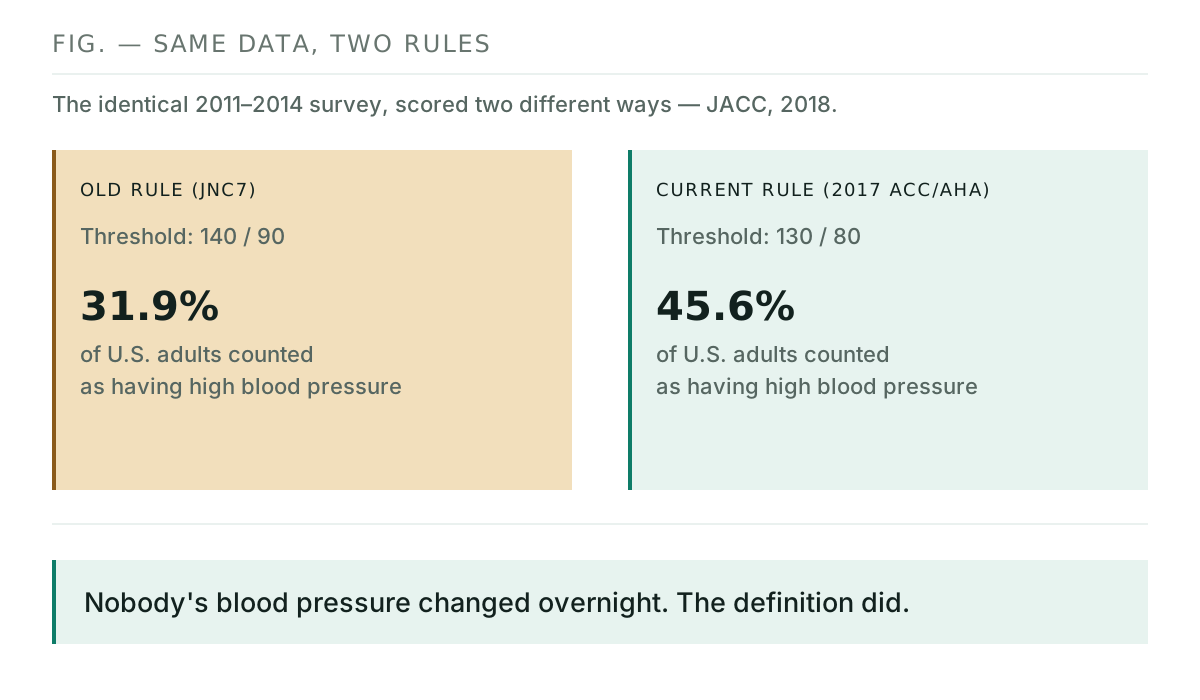
A 2018 study in the Journal of the American College of Cardiology measured exactly what that meant by applying both rules to the same national health survey data (2011–2014, 9,623 adults, blood pressure measured three times per person and averaged). Under the old 140/90 rule, 31.9% of U.S. adults had hypertension. Under the new 130/80 rule, applied to the identical measurements, that number was 45.6%.
Thirteen and seven-tenths points of the population became "hypertensive" without a single reading changing. That is not a data error or a scare headline — it is exactly what happens when a threshold moves and gets applied to a population that didn't move with it.
The trial behind the lower target
A threshold that reclassifies millions of people deserves real evidence, and this one has it. The change followed SPRINT, a randomized trial published in the New England Journal of Medicine in 2015, which is worth understanding on its own terms rather than taking on faith.
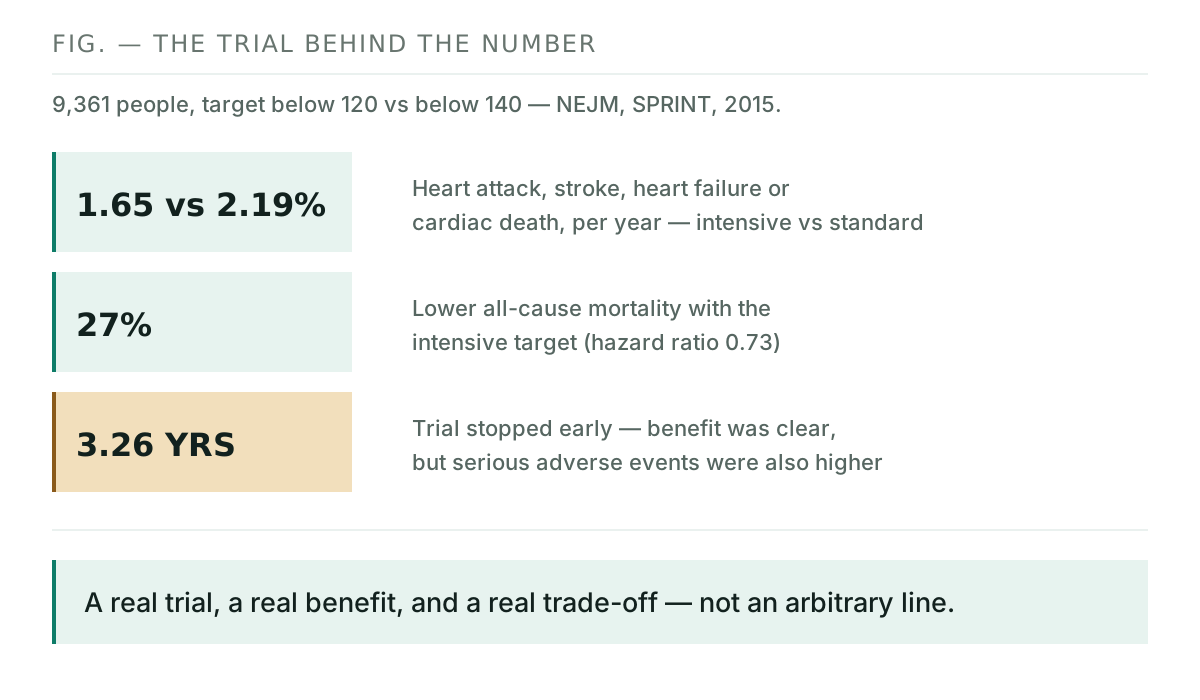
SPRINT randomly assigned 9,361 people at increased cardiovascular risk, without diabetes, to a systolic target below 120 (intensive treatment) or below 140 (standard treatment). The rate of heart attack, stroke, heart failure or cardiovascular death was 1.65% per year in the intensive group versus 2.19% per year in the standard group — a difference large enough that the trial was stopped early, after a median follow-up of just 3.26 years, because continuing would have meant denying the standard group a benefit that was already clear. All-cause mortality was 27% lower with intensive treatment.
The honest half of this result: serious adverse events — low blood pressure episodes, fainting, electrolyte problems and acute kidney injury — were also more common in the intensive group. The 2017 guideline didn't even adopt SPRINT's exact target; it set 130/80 rather than SPRINT's below-120, a middle position between the trial's aggressive goal and the older standard.
What actually changed for most people
Here is the detail that gets lost in "45% of adults are now hypertensive" headlines. The same 2018 study also looked at how many people were newly told to take medication, not just newly labeled. Under the old guideline, medication was recommended for 34.3% of U.S. adults. Under the new one: 36.2%. A small increase, not a doubling.
The study specifically notes that "nonpharmacological intervention is advised for the 9.4% of U.S. adults with hypertension who are not recommended for antihypertensive medication" under the new guideline — lifestyle changes, not a pill, for the bulk of the newly reclassified group. Muntner et al., Journal of the American College of Cardiology, 2018
For a man who fits into that 9.4%, the practical meaning of the 2017 change is smaller than it sounds: a more serious label, a reason to pay attention, and a conversation about diet, weight and activity — not, by itself, a new prescription.
Why one reading in one office visit isn't enough
Separate from which threshold applies, there is a more basic problem: a single number from a single visit is a weak basis for any diagnosis, and NHLBI is explicit about this. "You will need two or more blood pressure readings at separate medical appointments to diagnose high blood pressure."
Two specific failure modes explain why. "White coat hypertension" refers to "blood pressure readings that are higher in a provider's office than readings at home or in a pharmacy" — the appointment itself raises the number. The opposite problem, "masked high blood pressure," is readings that look normal in the office but are actually elevated at home, where "your provider will have difficulty detecting" it at all. Either one, taken from a single office reading, points the wrong direction.
NHLBI's practical guidance folds in home monitoring for exactly this reason: "if you take your own blood pressure at home, use an approved home blood pressure device to make sure the readings are correct." A pattern of readings, in more than one setting, is a genuinely different kind of evidence than one number on one afternoon.
What actually raises the number
Beyond age and genetics, NHLBI names specific medical conditions that can drive blood pressure up: "some tumors," chronic kidney disease, metabolic syndrome, overweight and obesity, sleep apnea, and thyroid problems. Several of those are worth ruling out specifically rather than assuming every high reading is the ordinary, age-related kind.
Medications matter too, and some are easy to overlook because they don't read as heart drugs at all. NHLBI: "antidepressants, decongestants (medicines to relieve a stuffy nose), hormonal birth control pills, and non-steroidal anti-inflammatory drugs such as aspirin or ibuprofen can all raise your blood pressure." A man reflexively reaching for ibuprofen for a joint ache or a decongestant for a cold is, in a small way, also nudging this number.
Who carries more of this than average
High blood pressure is not evenly distributed, and the CDC's own numbers are direct about it. Overall, "nearly half of adults have high blood pressure (48.1%, 119.9 million)."
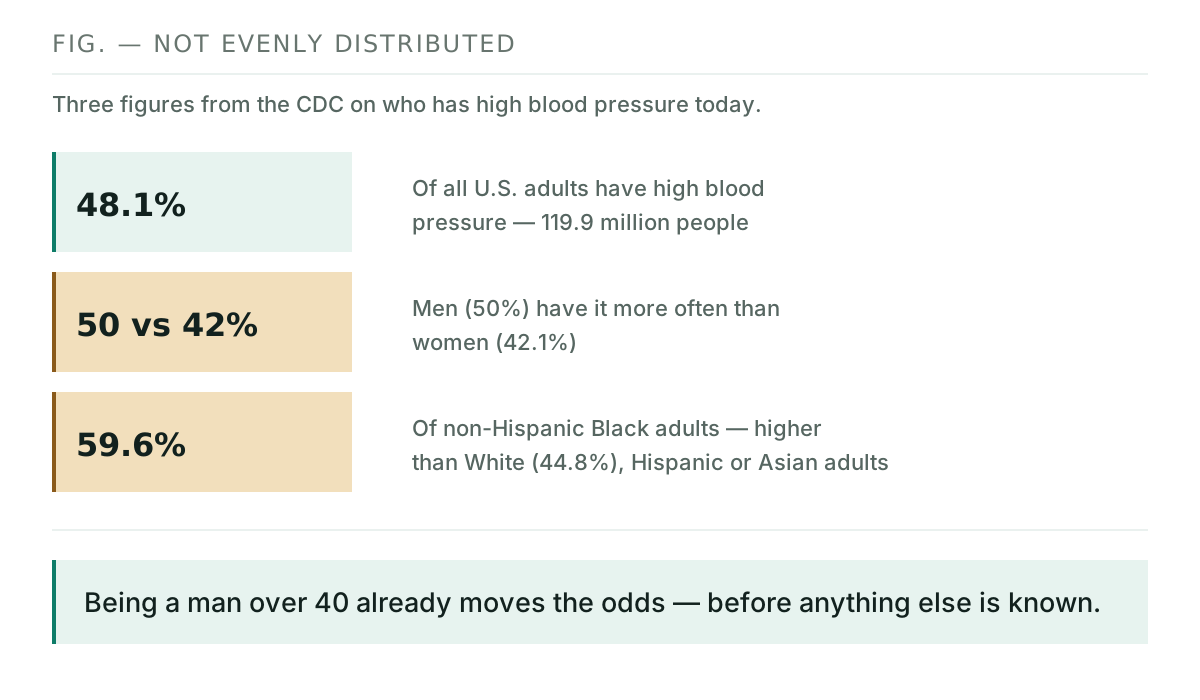
On sex: "a higher percentage of men (50%) have high blood pressure than women (42.1%)." On race and ethnicity: it is "more common in non-Hispanic black adults (59.6%) than in Hispanic adults (44.9%), non-Hispanic white adults (44.8%), or non-Hispanic Asian adults (42.7%)." Being a man reading this article already places you in the higher-risk half of that first split.
The part that undercuts the whole guideline debate
Whichever threshold a person wants to argue about, the number that should worry a reader more is this one: of the 48.1% of adults with high blood pressure, the CDC reports "about 1 in 4 adults with high blood pressure has their blood pressure under control (22.5%, 27.0 million)."
That gap — between being diagnosed and being controlled — is far larger than the gap between the old and new definitions. Arguing about whether the line should sit at 130/80 or 140/90 is a real debate. Whether someone already diagnosed is actually getting their number down is a bigger, quieter problem sitting underneath it.
What to do with this
- Don't dismiss a "borderline" reading from before 2017. A number that was fine under the old rule may not be fine under the current one — worth an actual conversation, not an assumption either way.
- Ask for two or more readings before accepting a label. One number in one office visit, per NHLBI, is not a diagnosis on its own.
- Get a validated home monitor if the number is borderline. It separates white coat readings from masked ones in a way a single office visit cannot.
- Mention every medication, including over-the-counter ones. Regular ibuprofen or a decongestant habit is a real, fixable contributor.
- If you're already diagnosed, ask what "controlled" means for you specifically. Being on the list of the diagnosed is not the same as being in the 22.5% who are actually controlled.
The 2017 change is a genuinely reasonable thing to be skeptical of on first hearing — it moved the goalposts for 13.7 percentage points of the country overnight. It is also, on inspection, backed by a real trial with a real number attached, applied mostly as a lifestyle conversation rather than a new prescription. Both things are true at once.
Key takeaways
- The 2017 ACC/AHA guideline lowered the definition from 140/90 to 130/80, raising measured U.S. prevalence from 31.9% to 45.6% on the same data — JACC, 2018.
- Medication recommendations barely moved (34.3% to 36.2%); most of the newly reclassified group gets lifestyle advice, not a prescription.
- SPRINT (NEJM, 2015) found a target below 120 cut cardiovascular events to 1.65%/year vs 2.19%/year and cut all-cause mortality 27%, but with more serious adverse events.
- A diagnosis requires two or more readings on separate visits — not one office reading — per NHLBI.
- "White coat" and "masked" hypertension can each point a single reading the wrong direction.
- Common medications — NSAIDs, decongestants, antidepressants, hormonal birth control — can raise blood pressure.
- 48.1% of U.S. adults (119.9 million) have high blood pressure; only about 1 in 4 with it have it controlled — CDC.
Where to go from here
This is the second article in the heart section. The rest are being written now, one at a time:
- Heart Health After 40: What the Numbers Mean — the pillar guide, covering blood pressure, cholesterol and resting heart rate.
- Cholesterol after 40 — LDL, HDL and triglycerides, and what to actually do about the number.
- Chest pain after 40 — when it's the heart, and when it usually is not.
- Heart attack vs cardiac arrest — two different emergencies with two different responses.
- Heart palpitations vs AFib — a harmless racing heart or an arrhythmia that needs a test.
- Blood pressure medication — what to expect, and what still depends on lifestyle.
- Statins — what the big trials found, benefit and side effect.
- Fish oil for heart health — what the evidence actually shows.
Frequently asked questions
Why did the definition of high blood pressure change?
In 2017, the American College of Cardiology and American Heart Association lowered the threshold from 140/90 to 130/80. Applied to the same 2011-2014 national survey data, this raised the measured prevalence of hypertension from 31.9% to 45.6% — the reading didn't change, the definition did.
Does everyone newly classified as hypertensive need medication?
No. The same 2018 analysis found medication was recommended for 36.2% of U.S. adults under the new guideline versus 34.3% under the old one — a small increase. Most of the newly classified group is advised on lifestyle changes, not a prescription.
What evidence supports the lower target?
SPRINT, a 9,361-person randomized trial published in the New England Journal of Medicine in 2015, found a systolic target below 120 reduced heart attacks, strokes, heart failure and cardiovascular death to 1.65% per year versus 2.19% with a standard target below 140, and cut all-cause mortality by 27%. Serious adverse events were also higher with the lower target.
Can one blood pressure reading diagnose high blood pressure?
No. NHLBI states you need "two or more blood pressure readings at separate medical appointments" for a diagnosis. A single high reading can also reflect "white coat hypertension," where pressure runs higher in a provider's office than at home.
What causes high blood pressure?
NHLBI lists several conditions that can cause it, including some tumors, chronic kidney disease, metabolic syndrome, overweight and obesity, sleep apnea and thyroid problems. Certain medications can also raise it, including antidepressants, decongestants, hormonal birth control and NSAIDs like ibuprofen.
Who is most likely to have high blood pressure?
Per the CDC, 48.1% of U.S. adults (119.9 million people) have high blood pressure. It's more common in men (50%) than women (42.1%), and more common in non-Hispanic Black adults (59.6%) than in Hispanic (44.9%), White (44.8%) or Asian (42.7%) adults.
Sources
- Muntner et al., Journal of the American College of Cardiology, 2018 — Potential U.S. Population Impact of the 2017 ACC/AHA High Blood Pressure Guideline
- SPRINT Research Group, New England Journal of Medicine, 2015 — A Randomized Trial of Intensive versus Standard Blood-Pressure Control
- National Heart, Lung, and Blood Institute (NIH) — High Blood Pressure — Diagnosis
- National Heart, Lung, and Blood Institute (NIH) — High Blood Pressure — Causes and Risk Factors
- Centers for Disease Control and Prevention — High Blood Pressure Facts

Male Health Guide Editorial Team
We write about the health problems men over 40 actually search for at 3 a.m. — and we say plainly when the evidence for a popular product is thin. We do not invent credentials and we do not publish sponsored copy as editorial. Read more about how we work.
Medical disclaimer: This article is general information about blood pressure guidelines and diagnosis, and is not medical advice. It is not a diagnosis and not a substitute for a healthcare professional who can review your actual readings and history. If you have a blood pressure reading above 180/120, seek emergency care.