Cholesterol After 40: The Number With No Floor
Short answer
Cholesterol isn't one number — LDL, HDL and triglycerides do different jobs, and total cholesterol alone can mislead. The evidence on LDL is unusually clear: across studies of over 170,000 patients, no floor has been found — lower keeps reducing risk, even at levels once considered impossible. Screening and lifestyle come first; medication is a separate, risk-based decision.
Our pillar guide already introduced the three numbers — LDL, HDL and triglycerides — and the basic targets. What it didn't have room for is the strangest fact about cholesterol: unlike almost every other number in medicine, nobody has ever found a floor for it. Blood pressure that goes too low causes dizziness and fainting. Blood sugar that goes too low is a medical emergency. LDL cholesterol, driven down further and further in study after study, keeps producing less heart disease, with no bottom in sight yet.
That single fact reframes the whole topic. This article covers why "cholesterol" is really three different substances wearing one name, what the largest studies on lowering LDL actually found, what those studies don't answer by themselves, what raises the number, and where triglycerides fit into a story that's usually told as if LDL were the only character in it.
We earn nothing from any of this. No supplement, monitor or clinic is being sold here, which is the only reason this page can walk through genuinely large trial data without steering the conclusion toward a purchase.
"Cholesterol" is not one number
A single "total cholesterol" result can hide more than it reveals. MedlinePlus is direct about what each piece actually does: LDL is "often called 'bad' cholesterol because it is the main source of cholesterol buildup and blockage in the arteries." HDL is "often called 'good' cholesterol because it helps remove cholesterol from your arteries." Triglycerides are "another type of fat in your blood that can raise the risk of heart disease, especially in women" — a separate substance from cholesterol entirely, just measured on the same panel.
For men 20 and older, MedlinePlus lists total cholesterol under 200 mg/dL, LDL under 100 mg/dL, HDL at 60 mg/dL or higher, and a fourth number worth knowing: non-HDL cholesterol, simply total minus HDL, targeted under 130 mg/dL. Two men can post the same "total cholesterol" of 195 and be in very different positions — one with LDL 110 and HDL 75, the other with LDL 150 and HDL 35. The single headline number treats them as identical. They aren't.
The number with no floor
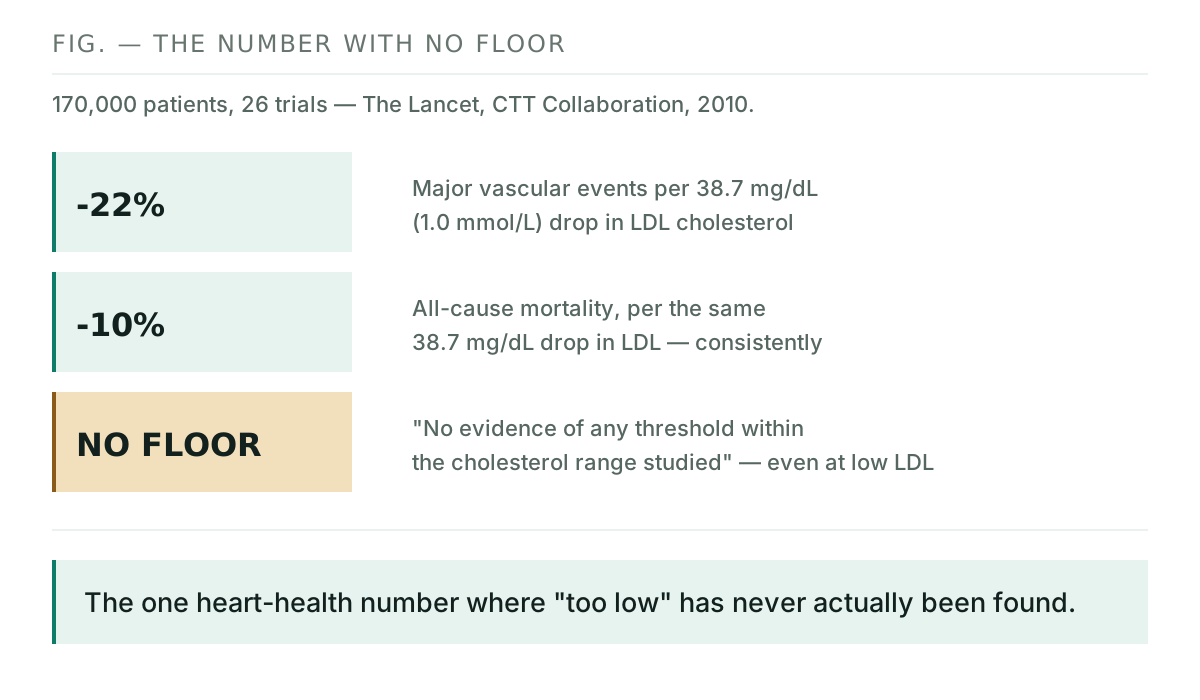
The clearest evidence on LDL comes from the Cholesterol Treatment Trialists' Collaboration, a 2010 meta-analysis in The Lancet that pooled individual patient data from 26 randomized trials — roughly 170,000 people in total. The question wasn't whether statins work; that was already settled. The question was whether lowering LDL further keeps paying off, or runs into diminishing returns at some point.
It didn't find one. Per 1.0 mmol/L (about 38.7 mg/dL) reduction in LDL, the rate of major vascular events — heart attack, stroke, coronary revascularization — fell by 22%, and all-cause mortality fell by 10%, consistently across the range of LDL levels studied. The analysis specifically included patients whose LDL was already below roughly 77 mg/dL (2.0 mmol/L) before any further lowering, and the same proportional benefit held. The paper's own conclusion: "there was no evidence of any threshold within the cholesterol range studied."
How low is too low?
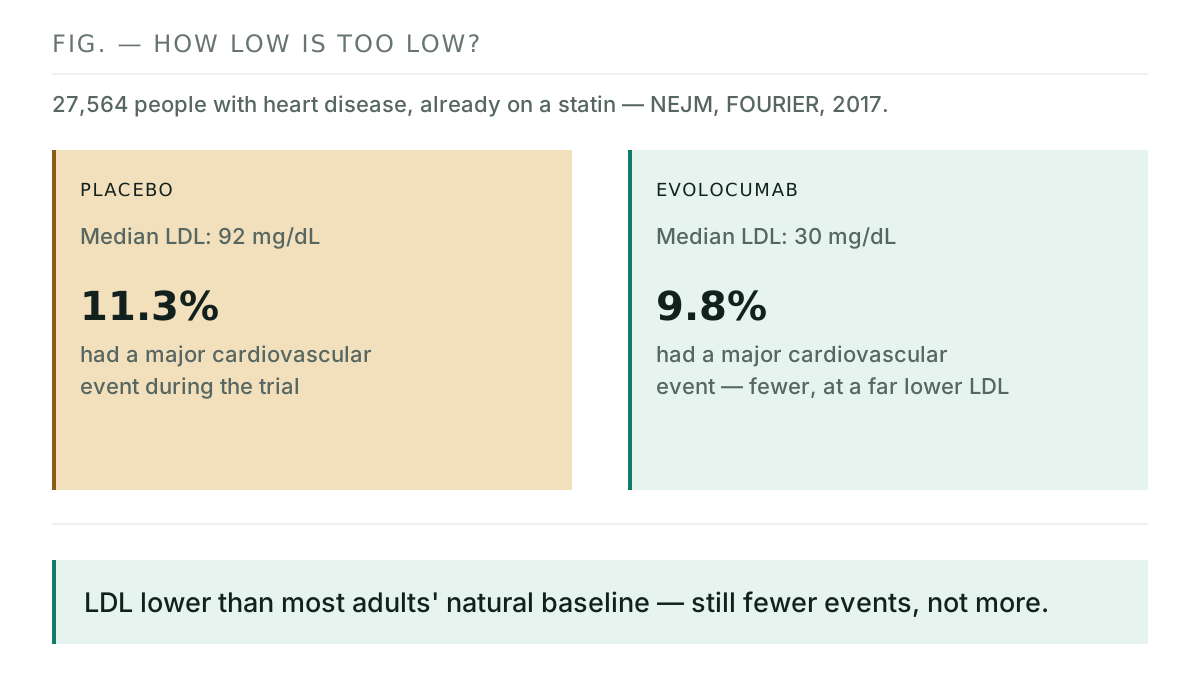
The CTT analysis covered typical statin-era LDL levels. A 2017 trial pushed the question further. FOURIER, published in the New England Journal of Medicine, randomized 27,564 people who already had atherosclerotic cardiovascular disease and an LDL of 70 mg/dL or higher despite statin therapy, to either a PCSK9-inhibiting drug called evolocumab or a placebo.
At 48 weeks, evolocumab cut LDL by 59%, from a median of 92 mg/dL to 30 mg/dL — lower than most adults' natural baseline. The trial's main combined outcome occurred in 9.8% of the evolocumab group versus 11.3% on placebo, and the benefit held even in the subgroup that started with the lowest LDL of all (a median of 74 mg/dL). Sabatine et al., New England Journal of Medicine, 2017
Adverse events were tracked closely, including new-onset diabetes and neurocognitive problems — both raised as theoretical concerns for very low LDL. Neither showed a significant difference between groups. The only meaningfully higher side effect was injection-site reactions (2.1% versus 1.6%), from the drug being a shot rather than a pill.
What these trials don't answer
It would be easy to read the last two sections as "get your LDL as close to zero as you can." That's not quite what the evidence supports, and the honest caveat matters here. Both the CTT meta-analysis and FOURIER were built on people already carrying meaningful cardiovascular risk — FOURIER specifically enrolled people who already had diagnosed atherosclerotic disease, already on a statin, before adding a second drug on top.
"Lower is better, with no floor found so far" is a real relationship, established in people who already needed treatment. It is not, by itself, an argument that every man with a slightly elevated LDL and no other risk factors should be pushed toward the most aggressive medication available. Who actually benefits enough to justify a given drug, at a given level of underlying risk, is a separate question — one that depends on the whole picture, not the LDL number in isolation. That decision belongs to a different article in this series, on statins specifically, still to come.
What actually raises the number
Diet is the most talked-about lever — NHLBI names "eating a lot of foods high in saturated fats" as a direct driver of LDL — but it's far from the only one. Inactivity, heavy alcohol use, chronic stress and poor sleep all show up on NHLBI's list of contributing habits, alongside smoking, which NHLBI says "lowers HDL cholesterol, particularly in women, and raises LDL cholesterol."
Genetics can matter more than any habit. NHLBI names "familial hypercholesterolemia," caused by inherited gene changes, as a distinct cause — one where diet and exercise alone are rarely enough, and where a parent or sibling with early heart disease is a real clue worth mentioning to a doctor. A list of medical conditions can also drive cholesterol up on their own: chronic kidney disease, diabetes, hypothyroidism, lupus, overweight and obesity, PCOS and sleep apnea. Certain medications are on the list too, including some beta-blockers, thiazide diuretics, steroids like prednisone, and immunosuppressants like cyclosporine.
Triglycerides, the other number
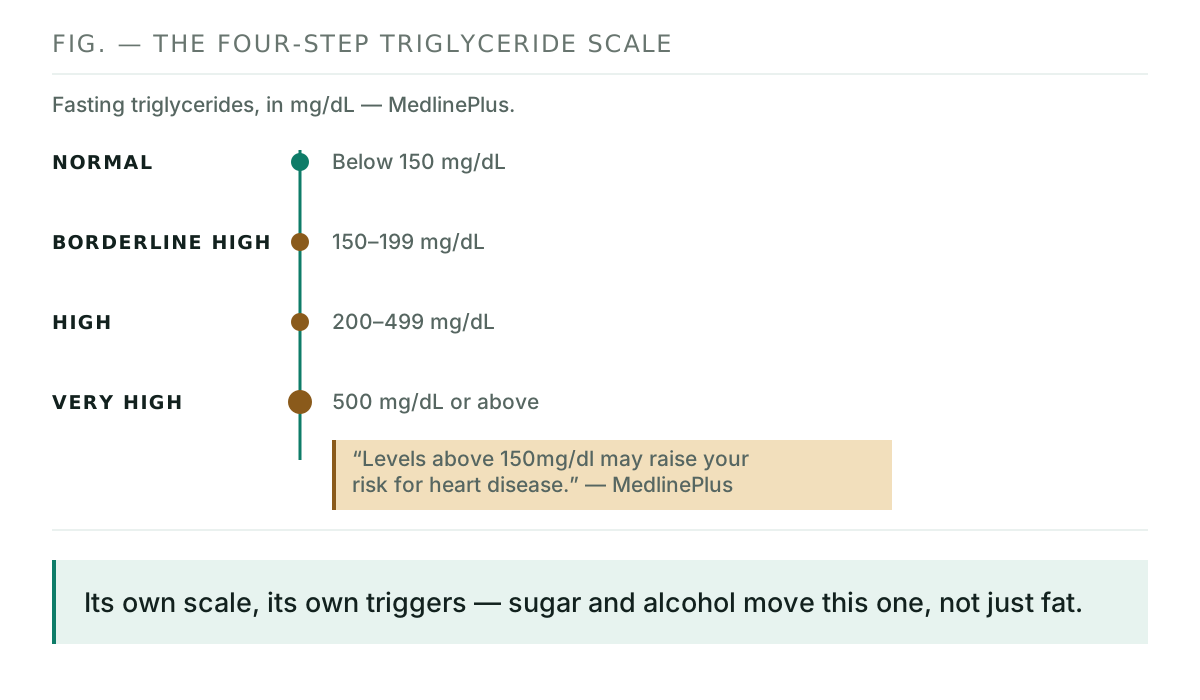
Triglycerides get less attention than LDL, but MedlinePlus is direct that "levels above 150 mg/dl may raise your risk for heart disease" on their own, independent of the LDL/HDL story. The categories run in four steps: normal is under 150 mg/dL, borderline high is 150–199, high is 200–499, and very high is 500 or above.
What raises triglycerides is a genuinely different list than what raises LDL. MedlinePlus points to "regularly eating more calories than you burn off, especially if you eat a lot of sugar," along with being overweight, excessive alcohol use, poorly controlled type 2 diabetes, and certain thyroid, liver or kidney conditions. A man who cuts saturated fat carefully but keeps drinking regularly and eating sugar can still see this number climb — it responds to a different set of triggers than the one most cholesterol advice focuses on.
Who actually has this
High cholesterol is common enough to be closer to typical than rare. The CDC reports that "about 86 million U.S. adults age 20 or older have total cholesterol levels above 200 mg/dL," and "nearly 25 million adults" are above 240 mg/dL, the threshold for "high." In the most recent CDC data, 10% of adults had total cholesterol above 240, and about 17% had HDL below 40 — a low enough "good" cholesterol to be a risk factor on its own.
The honest gap sits in treatment, not detection. CDC data shows "about two thirds of U.S. adults say they have had their cholesterol checked within the last 5 years," so most people know their number. But of those who could benefit from cholesterol medicine, only "54.5%, or 47 million people," are currently taking it. Roughly the same-sized gap shows up here as in blood pressure: knowing the number and acting on it are two different things.
What to do with this
- Ask for the full panel, not just "cholesterol is fine." LDL, HDL and triglycerides tell different stories, and a normal total can still hide a bad split.
- Get non-HDL cholesterol calculated too. It's simple arithmetic — total minus HDL — and folds triglyceride-related risk in with LDL.
- Ask about family history specifically. A parent or sibling with early heart disease is a real clue toward familial hypercholesterolemia, not just bad luck.
- Follow the screening schedule. Every 5 years for most adults 20 to 65, but every 1 to 2 years for men 45 to 65, and every year from 65 on, per MedlinePlus.
- If triglycerides are the outlier, look at sugar and alcohol first. That number often moves on a different lever than LDL does.
- Treat "how aggressively to treat" as its own conversation. The trials behind "lower is better" were run in people already at meaningful risk — the medication decision depends on your whole risk picture, not the LDL number alone.
The headline finding here is genuinely unusual for a health number: more than a decade of large trials, on hundreds of thousands of patients, has yet to find a point where lowering LDL stops helping or starts causing harm. That's not a reason to treat every number aggressively on its own. It's a reason to trust that the target, once a doctor and a patient agree on one, is backed by an unusually deep body of evidence — not a round number someone picked.
Key takeaways
- Cholesterol isn't one number: LDL, HDL and triglycerides do different jobs, and total cholesterol alone can hide the real picture.
- A meta-analysis of roughly 170,000 patients across 26 trials found no LDL threshold below which lowering it stopped helping — The Lancet, 2010.
- Each 38.7 mg/dL (1.0 mmol/L) drop in LDL cut major vascular events by about 22% and all-cause mortality by 10%, consistently.
- FOURIER (NEJM, 2017) pushed LDL to a median of 30 mg/dL and still found a benefit, with no rise in serious adverse events besides injection-site reactions.
- Both trials studied people already at meaningful cardiovascular risk — "lower is better" doesn't by itself decide who needs medication.
- Triglycerides above 150 mg/dL raise heart disease risk on their own, and respond strongly to sugar and alcohol, not just dietary fat.
- 86 million U.S. adults have total cholesterol above 200 mg/dL, but only 54.5% of those who could benefit from medication are taking it — CDC.
Where to go from here
This is the third article in the heart section, which is now complete. All nine:
- Heart Health After 40: What the Numbers Mean — the pillar guide, covering blood pressure, cholesterol and resting heart rate.
- High Blood Pressure After 40: The Number That Moved — why the definition changed in 2017, and what one reading can't tell you.
- Chest Pain After 40: When It’s the Heart, and When It’s Not — the self-test almost everyone tries, and what it actually proves.
- Heart Attack vs Cardiac Arrest: Plumbing vs Electrical — two different emergencies, and the one question that actually sorts them.
- Heart Palpitations vs AFib: Why a Normal EKG Proves Little — why detection depends on how long anyone is watching.
- Blood Pressure Medication: The First Pill Is a Starting Point — why the same person responds differently to different drug families.
- Statins: The Benefit Is a Share of Your Own Risk — why the same proportional benefit is worth a different amount to different men.
- Fish Oil for Heart Health: The Winning Trial Used a Drug — why the trial everyone quotes was not testing the capsules on the shelf.
Frequently asked questions
What do LDL, HDL and triglycerides numbers actually mean?
LDL is often called "bad" cholesterol because it's the main source of buildup and blockage in the arteries. HDL is the "good" version because it helps remove cholesterol from the arteries. Triglycerides are a separate type of blood fat that raises heart disease risk on its own, per MedlinePlus.
Is there a cholesterol level that's too low?
Not one that's been found yet. A 2010 meta-analysis of 170,000 patients found no threshold below which lowering LDL stopped helping, and a 2017 trial pushed LDL to a median of 30 mg/dL with continued benefit and no rise in serious adverse events besides injection-site reactions.
Does everyone with high cholesterol need medication to lower it as much as possible?
No. The strongest evidence for aggressive LDL-lowering comes from trials of people who already had cardiovascular disease or were otherwise at elevated risk. "Lower is better" is a real relationship, but who should be medicated, and how aggressively, is a separate decision based on a person's overall risk, not the LDL number by itself.
What raises cholesterol besides diet?
NHLBI lists inherited gene changes, including familial hypercholesterolemia, along with medical conditions like chronic kidney disease, diabetes, hypothyroidism and sleep apnea. Certain medications, including some beta-blockers, thiazide diuretics, steroids and immunosuppressants, can also raise it.
What raises triglycerides specifically?
MedlinePlus lists regularly eating more calories than you burn, especially from sugar, being overweight, excessive alcohol use, poorly controlled type 2 diabetes, and certain thyroid, liver or kidney conditions. Levels above 150 mg/dL may raise heart disease risk on their own, per MedlinePlus.
How often should cholesterol be checked?
MedlinePlus recommends every 5 years for most adults ages 20 to 65, but men ages 45 to 65 should have it checked every 1 to 2 years, and everyone 65 or older should have it checked every year.
Sources
- MedlinePlus (National Library of Medicine, NIH) — Cholesterol Levels: What You Need to Know
- MedlinePlus (National Library of Medicine, NIH) — Triglycerides
- National Heart, Lung, and Blood Institute (NIH) — Blood Cholesterol — Causes and Risk Factors
- Centers for Disease Control and Prevention — High Cholesterol Facts
- Cholesterol Treatment Trialists' (CTT) Collaboration, The Lancet, 2010 — Efficacy and Safety of More Intensive Lowering of LDL Cholesterol
- Sabatine et al., New England Journal of Medicine, 2017 — Evolocumab and Clinical Outcomes in Patients with Cardiovascular Disease

Male Health Guide Editorial Team
We write about the health problems men over 40 actually search for at 3 a.m. — and we say plainly when the evidence for a popular product is thin. We do not invent credentials and we do not publish sponsored copy as editorial. Read more about how we work.
Medical disclaimer: This article is general information about cholesterol and is not medical advice. It is not a diagnosis and not a substitute for a healthcare professional who can review your actual bloodwork, medications and family history.