Thyroid Nodule: Found by Accident, Rarely Cancer
Short answer
A thyroid nodule is a lump in the thyroid gland, usually found by accident during an exam or scan done for something else. Most are benign and cause no symptoms. MedlinePlus lists specific features that raise cancer suspicion — including being male — even though nodules themselves are more common in women. Ultrasound and a needle biopsy, not the nodule's size alone, are what actually settle the question.
It usually starts with a sentence nobody expects: "I felt something while I was examining your neck." No pain, no symptom you'd noticed yourself, just a lump your doctor found while checking something unrelated. The word "nodule" sounds alarming. Most of the time, it isn't.
This article covers what a thyroid nodule actually is, why most are found by accident, the specific features — including sex — that change how seriously a nodule gets taken, what symptoms (if any) to expect, the Hashimoto's connection, what tests actually confirm anything, and what treatment typically involves.
What a thyroid nodule actually is
MedlinePlus defines a thyroid nodule as a growth, or lump, in the thyroid gland — located at the front of the neck, just above where your collarbones meet. It's caused by an overgrowth of cells in the gland. Nodules can be not cancer (benign), thyroid cancer (malignant), or very rarely another cancer or infection; fluid-filled, meaning a cyst; a single nodule or a group of small ones; and either producing thyroid hormone (a "hot" nodule) or not (a "cold" nodule).
Thyroid nodules are very common, per MedlinePlus, and occur more often in women than men. The chance of developing one increases with age. Only a few are ever due to thyroid cancer.
MedlinePlus also notes that a cause for a given nodule isn't always found, but when one is identified, it can include Hashimoto disease — a reaction of the immune system against the thyroid gland — or a lack of iodine in the diet. MedlinePlus doesn't say how often a cause is actually identified versus never found — just that it isn't always.
How most nodules are actually found
MedlinePlus is direct about this: most thyroid nodules produce no symptoms at all. Health care providers often find them during a routine physical exam, or during imaging tests done for a completely different reason. Only a few people notice a nodule large enough to feel themselves and bring it to their provider's attention.
This pattern — found while looking for something else entirely — is common enough in medicine to have its own informal name: an incidentaloma. It's one of the alternate names MedlinePlus itself lists for a thyroid nodule.
The specific features that raise cancer risk
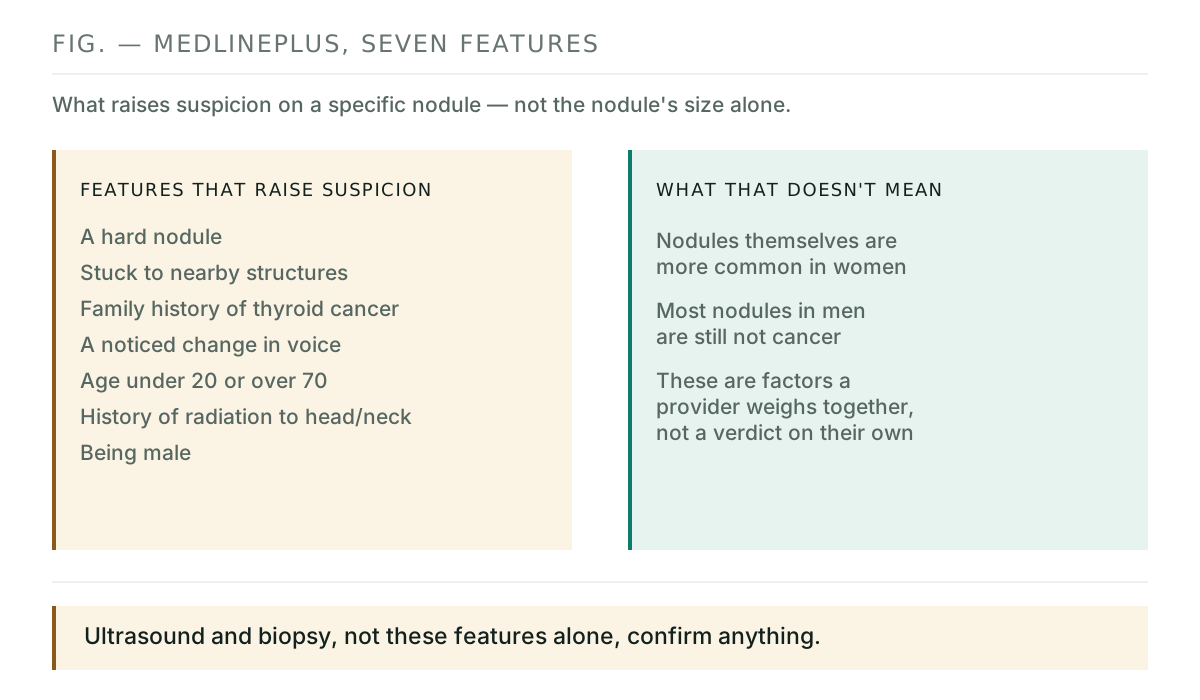
Here is the counterintuitive part for this site's readers. MedlinePlus states thyroid nodules occur more often in women than men — but when it lists the specific features that make a given nodule more likely to be cancer, being male is on that list directly, alongside having a hard nodule, a nodule stuck to nearby structures, a family history of thyroid cancer, a noticed change in voice, being younger than 20 or older than 70, and a history of radiation exposure to the head or neck.
None of this means a nodule in a man is likely to be cancer — most still aren't. It means that when a provider is deciding how closely to investigate a specific nodule, sex is one of several factors genuinely weighed, not an irrelevant detail.
When a nodule does cause symptoms
MedlinePlus lists what large nodules can cause by pressing on nearby neck structures: a visible goiter, hoarseness or a changing voice, neck pain, trouble breathing especially lying flat, and trouble swallowing food.
Nodules that actively produce thyroid hormone (the "hot" type) tend to cause symptoms of an overactive thyroid instead: warm, sweaty skin, a fast pulse and palpitations, increased appetite, nervousness or anxiety, restlessness or poor sleep, skin flushing, more frequent bowel movements, tremor, weight loss, and irregular or lighter menstrual periods. MedlinePlus adds a detail worth knowing: older people with a hormone-producing nodule may have only vague symptoms — fatigue, palpitations, chest pain, or memory loss — easy to write off as ordinary aging rather than connect to the thyroid.
The Hashimoto connection, and why it complicates the picture
MedlinePlus notes that thyroid nodules are sometimes found in people who have Hashimoto disease — an immune-system reaction against the thyroid gland, and the condition covered in depth in this site's own hypothyroidism article. Hashimoto's itself tends to cause underactive-thyroid symptoms: constipation, dry skin, face swelling, fatigue, hair loss, feeling cold, weight gain, and irregular periods.
MedlinePlus doesn't say how often the two combine, but logically, a man with Hashimoto's who also happened to develop a hormone-producing nodule could have overactive-thyroid signals (from the nodule) layered on top of underactive-thyroid signals (from the Hashimoto's itself) at the same time — our own reasoning from the two separate symptom lists above, not something the source describes as a combined scenario. Either way, the blood tests and imaging below are what actually sort out what's happening, not guessing from symptoms alone.
What tests actually confirm it
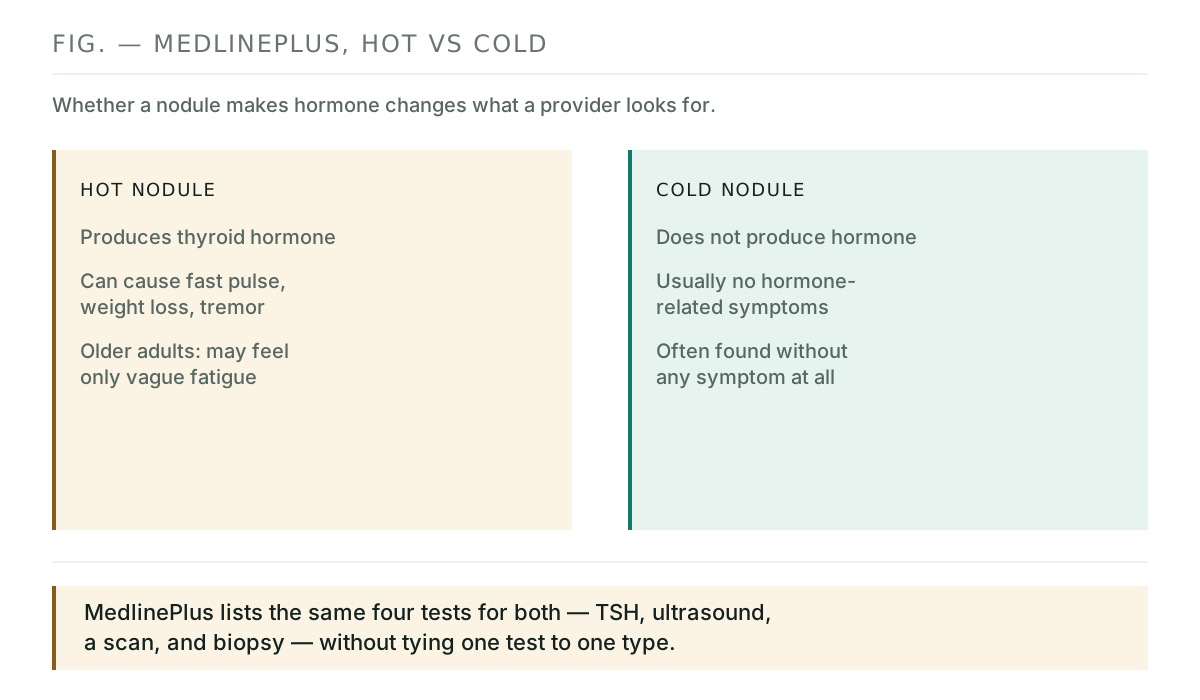
When a provider finds a nodule, or you have symptoms suggesting one, MedlinePlus lists the tests that may follow: a TSH level and other thyroid blood tests, a thyroid ultrasound, a thyroid scan (nuclear medicine), and a fine needle aspiration biopsy of the nodule — sometimes with special genetic testing on the tissue, especially if the first biopsy result is unclear.
Treatment, and what usually happens to most nodules
MedlinePlus lists specific reasons surgery to remove all or part of the thyroid gland might be recommended: the nodule is due to thyroid cancer, it's causing symptoms like swallowing or breathing problems, a biopsy came back inconclusive and cancer can't be ruled out, or the nodule is making too much thyroid hormone.
Nodules making too much hormone may instead be treated with radioiodine therapy, which reduces the nodule's size and activity; MedlinePlus notes this is not given to pregnant women or women who are still breastfeeding. It also notes that both surgery to remove thyroid tissue and radioactive iodine treatment can cause lifelong hypothyroidism, which then needs daily thyroid hormone replacement — a real trade-off worth discussing directly with your provider before either treatment.
For noncancerous nodules causing no symptoms and not growing, MedlinePlus says the best approach may simply be careful follow-up: a physical exam and ultrasound over time, and a repeat biopsy 6 to 12 months after diagnosis, especially if the nodule has grown.
Outlook, and when to call a doctor
MedlinePlus is reassuring here: noncancerous thyroid nodules are not life threatening, and many never need treatment at all — follow-up exams are enough. For thyroid cancer, the outlook depends on the specific type, but for the most common kinds, the outlook after treatment is very good.
MedlinePlus says to contact your provider if you feel or see a lump in your neck, or notice any symptoms described above. If you've had radiation exposure to your face or neck in the past, that's also worth mentioning — a neck ultrasound can check for nodules even without a lump you can feel yourself, since most nodules, as covered above, are never noticed by the person who has them.
Key takeaways
- Most thyroid nodules are found by accident, during an exam or scan done for something else entirely — sometimes called an incidentaloma.
- Nodules are more common in women, but MedlinePlus lists being male as one of the specific features that raises cancer suspicion.
- Most nodules cause no symptoms; large or hormone-producing ones can, including vague fatigue in older adults easy to mistake for ordinary aging.
- Ultrasound and a needle biopsy, not size or a symptom alone, are what actually confirm whether a nodule needs treatment.
- Most noncancerous nodules never need treatment — careful follow-up is often enough.
Where to go from here
If a thyroid nodule is what brought you here, these pages cover related ground:
- Hypothyroidism: The Cutoff Moves, Treating It May Not Help — the Hashimoto connection, and the broader thyroid-function picture.
- Fatigue After 40: Sleepy and Tired Are Not the Same Thing — the guide to this site's energy coverage.
- Brain Fog: Not One Thing, and Not a Diagnosis — another vague symptom worth sorting by cause.
- All energy articles
Frequently asked questions
What exactly is a thyroid nodule?
MedlinePlus defines it as a growth, or lump, in the thyroid gland, caused by an overgrowth of cells. Nodules can be benign, thyroid cancer, or rarely another cancer or infection; fluid-filled (a cyst); a single nodule or a group of small ones; and either hormone-producing (a "hot" nodule) or not (a "cold" nodule).
How are most nodules actually found?
MedlinePlus says most thyroid nodules cause no symptoms at all, and providers often find them during a routine physical exam or during imaging done for a completely different reason — which is why this type of finding is sometimes called an incidentaloma. Only a few people notice a nodule themselves and bring it up.
Does being male change anything?
Yes, in one specific way. MedlinePlus states thyroid nodules occur more often in women than men overall, but lists being male directly among the features that make a nodule more likely to be cancer, alongside a hard nodule, one stuck to nearby structures, a family history of thyroid cancer, a voice change, age under 20 or over 70, and past head or neck radiation exposure.
What symptoms, if any, should I expect?
Most thyroid nodules cause no symptoms. MedlinePlus says large nodules can press on nearby structures, causing a visible goiter, hoarseness, neck pain, trouble breathing lying flat, or trouble swallowing. A hormone-producing nodule can cause overactive-thyroid symptoms like a fast pulse, weight loss, and tremor; older adults with this type may have only vague symptoms such as fatigue, palpitations, or memory loss.
What tests confirm whether it's serious?
MedlinePlus lists a TSH level and other thyroid blood tests, a thyroid ultrasound, a nuclear medicine thyroid scan, and a fine needle aspiration biopsy of the nodule, sometimes with genetic testing on the tissue. Which tests you need depends on what your provider finds on exam and ultrasound.
Will I need surgery?
Not necessarily. MedlinePlus says surgery may be recommended if the nodule is due to thyroid cancer, is causing symptoms like swallowing or breathing problems, was biopsied with an inconclusive result, or is making too much thyroid hormone. For noncancerous nodules causing no symptoms and not growing, careful follow-up with exams and ultrasound, and a repeat biopsy at 6 to 12 months, may be the best approach instead.
Sources
- MedlinePlus (National Library of Medicine) — Thyroid Nodule
- Haugen BR, Alexander EK, Bible KC, et al. — 2015 American Thyroid Association Management Guidelines for Adult Patients With Thyroid Nodules and Differentiated Thyroid Cancer (cited by MedlinePlus)
- Male Health Guide — Hypothyroidism Explained (companion coverage of Hashimoto's and thyroid function)
- Male Health Guide — Fatigue After 40 (companion coverage of vague, hard-to-place tiredness)

Male Health Guide Editorial Team
We write about the health problems men over 40 actually search for at 3 a.m. — and we say plainly when the evidence for a popular product is thin. We do not invent credentials and we do not publish sponsored copy as editorial. Read more about how we work.
Medical disclaimer: This article is general information, not medical advice. We are not doctors, and nothing here diagnoses, treats or cures any condition. Whether a thyroid nodule needs further testing or treatment requires evaluation by a qualified healthcare professional. Please speak to one about your own situation.