Glucosamine for Joint Pain: What the Trials Found
Short answer
Glucosamine research genuinely disagrees, and the disagreement follows how the studies were built. The largest independent trial found no significant benefit over placebo. Trials of one branded prescription preparation were positive, but were mostly funded by its maker. It is generally safe, so a trial with an end date is defensible. A cure is not.
Glucosamine is usually the first supplement suggested to anyone whose joints ache, and almost everything written about it falls into one of two camps: it is a proven cartilage rebuilder, or it is a waste of money. Both camps can point at real studies. That is the actual story, and it is more useful than either verdict.
So this article is built around the disagreement itself. What the biggest independent trial measured, then the three things that separate the positive studies from the negative ones, then what the medical bodies made of the same pile of evidence, and finally what a reasonable person can do with that.
We sell nothing. There is no affiliate link, no brand recommendation and no supplement being promoted on this page, which is the only reason it can report the positive findings and the negative ones at the same weight.
What glucosamine actually is
The rationale is straightforward, which is part of why the idea is so sticky. As the National Center for Complementary and Integrative Health puts it, "glucosamine is a building block for molecules called glycosaminoglycans that are part of the structure of cartilage." It is sold in the US as a dietary supplement, "as either glucosamine sulfate or glucosamine hydrochloride," on its own or combined with chondroitin.
Being a building block of cartilage is not the same as rebuilding cartilage, and that gap is where the whole debate lives. Swallowing a component of a tissue does not automatically deliver it to that tissue in a form that repairs anything.
The biggest trial nobody was selling anything in
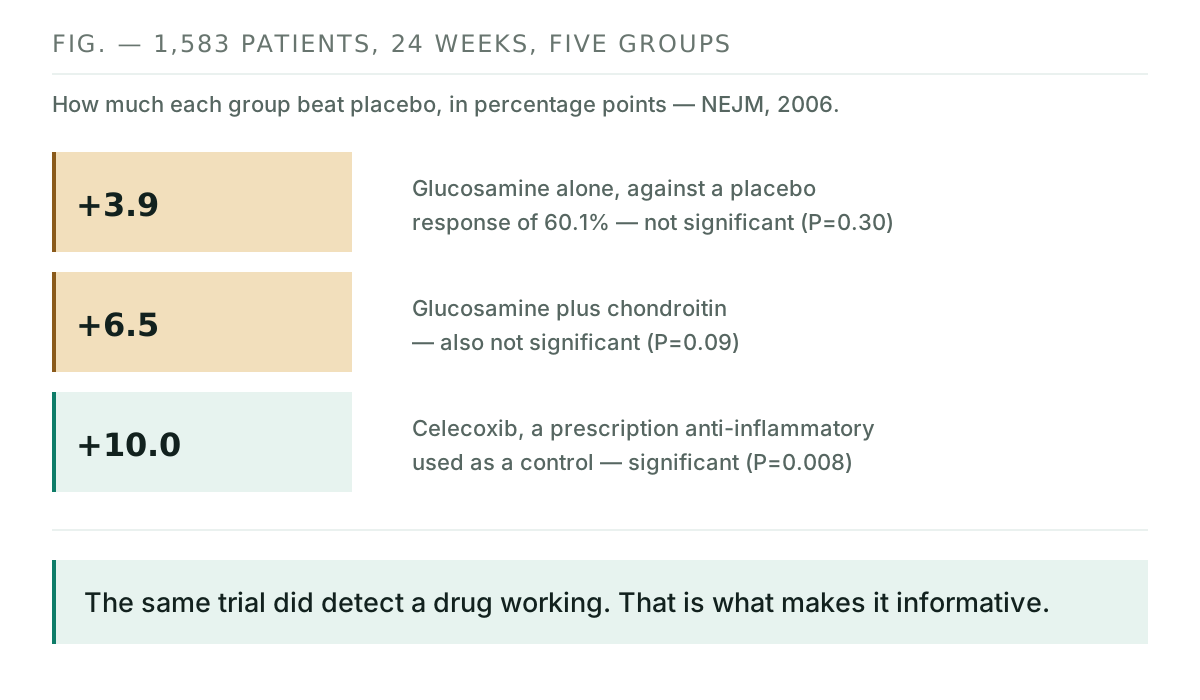
In 2006 the New England Journal of Medicine published the Glucosamine/chondroitin Arthritis Intervention Trial, funded by the US National Institutes of Health. It randomly assigned 1,583 patients with painful knee osteoarthritis to 1,500 mg of glucosamine daily, 1,200 mg of chondroitin sulfate, both together, 200 mg of the prescription anti-inflammatory celecoxib, or placebo, for 24 weeks. The main question was simple: what share of each group got at least a 20% reduction in knee pain?
Placebo answered 60.1%. Against that, glucosamine was 3.9 percentage points higher, which did not reach statistical significance (P=0.30). The combination was 6.5 points higher, also not significant (P=0.09). Celecoxib was 10.0 points higher, and that one was significant (P=0.008).
That last number is what makes the trial worth taking seriously rather than dismissing as underpowered. In the same patients, with the same measuring stick, the trial was perfectly capable of detecting a treatment that worked. The authors' conclusion was that glucosamine and chondroitin, alone or together, "did not reduce pain effectively in the overall group of patients with osteoarthritis of the knee."
One exception inside the trial is quoted constantly, so it deserves stating precisely. Among the 354 patients who started with moderate-to-severe pain, the combination of glucosamine and chondroitin did beat placebo, 79.2% versus 54.3% (P=0.002). The authors labelled this an exploratory analysis. It also belongs to the combination arm, not to glucosamine on its own.
Why the studies reach different answers
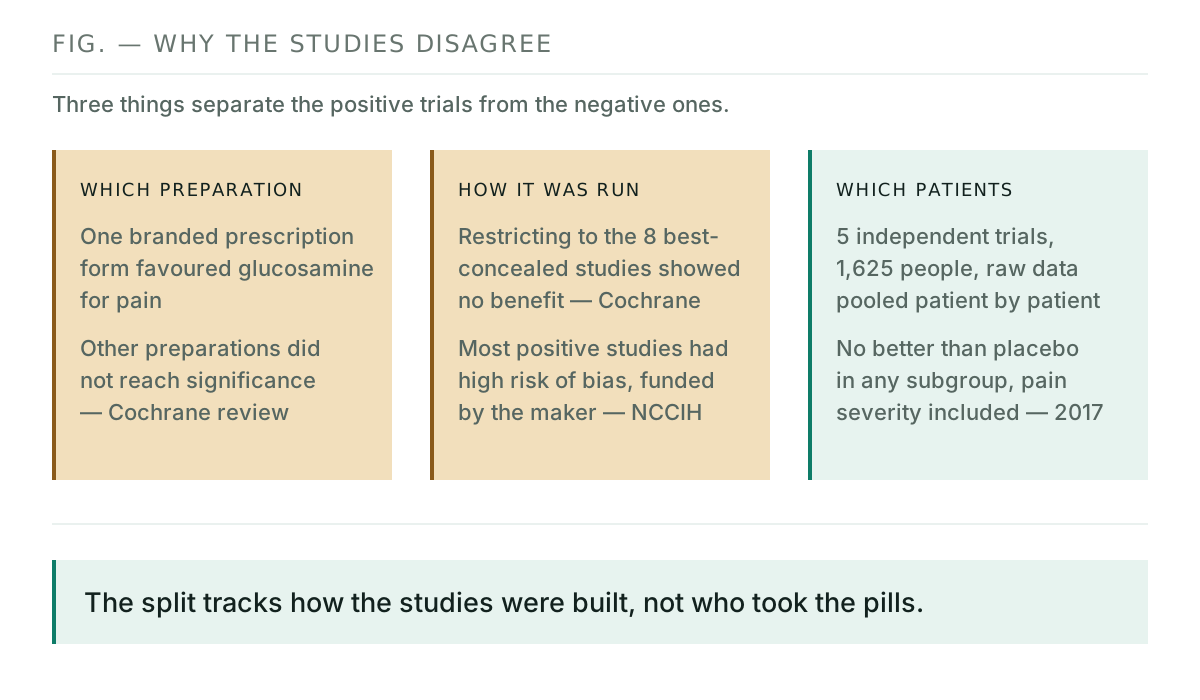
If GAIT were the only evidence, this article would be short. It is not, and the positive studies are real. What is interesting is that the split between positive and negative results is largely predictable from three features of the studies themselves.
First: which preparation was tested
This is the strongest argument in glucosamine's favour, and it should not be waved away. A Cochrane review of 20 trials found that in the 10 studies comparing one specific branded preparation with placebo, glucosamine "was found to be superior for pain," with a large effect size. In studies using other preparations, the pooled results for pain "did not reach statistical significance."
The same review's overall figure belongs here too, because leaving it out would tilt the page: across all 20 trials together, "glucosamine favoured placebo with a 28% (change from baseline) improvement in pain," and a 21% improvement in function on the Lequesne index. The aggregate is positive; it is the best-designed slice of it that is not.
NCCIH reports the same pattern from a different angle: a 2014 analysis of 25 studies of glucosamine taken alone for knee osteoarthritis, covering 3,458 participants, showed "those who used the prescription drug formulation of glucosamine generally had more favorable results than those who did not."
In practical terms, the formulation with the best track record is a prescription product in parts of Europe, not the bottle on a US shelf, and the GAIT trial used glucosamine hydrochloride rather than that preparation. The 2019 ESCEO statement goes further and, per NCCIH, "strongly recommends prescription crystalline glucosamine sulfate for knee osteoarthritis but discourages the use of other glucosamine formulations." Anyone who tells you the evidence is uniformly negative is leaving this out.
Second: how those trials were run
And anyone who stops at the paragraph above is leaving out the next one. The same Cochrane review noted that analysis "restricted to eight studies with adequate allocation concealment failed to show benefit of glucosamine for pain and WOMAC function." Allocation concealment is the safeguard that stops researchers from steering who gets the real pill; when only the studies with it were counted, the effect disappeared.
On the studies of the prescription formulation: "Most of the studies of the prescription drug formulation had a high risk of bias because of weaknesses in their study design, were published more than 20 years ago, and were funded by the pharmaceutical company." National Center for Complementary and Integrative Health
That is not an accusation of fraud, and industry funding does not automatically invalidate a result. It does mean the best evidence for glucosamine comes from older trials, with design weaknesses, run by the company selling the product — while the trials with no commercial interest have not reproduced it.
Third: which patients were studied
The most common rescue of glucosamine is that it works for the right person: worse pain, heavier build, inflamed joint. That claim has now been tested directly. In 2017, researchers pooled individual patient data — not published averages, the raw records — from trials that agreed to share them.
Five placebo-controlled trials, all independent of industry, covering 1,625 people with knee or hip osteoarthritis, about 55% of everyone ever enrolled in published placebo-controlled glucosamine trials. The finding: glucosamine "was no better than placebo for pain or function at short (3 months) and long-term (24 months) follow-up," and "was also no better than placebo among the predefined subgroups" — baseline pain severity, BMI, sex, structural abnormalities and inflammation included.
The authors added a pointed observation about what they could not get: "open trial data are not widely made available for studies of glucosamine for OA, especially those sponsored by industry."
What the guidelines made of all this
Two respected bodies read this evidence and reached opposite conclusions, which is worth knowing before anyone tells you the question is settled in either direction.
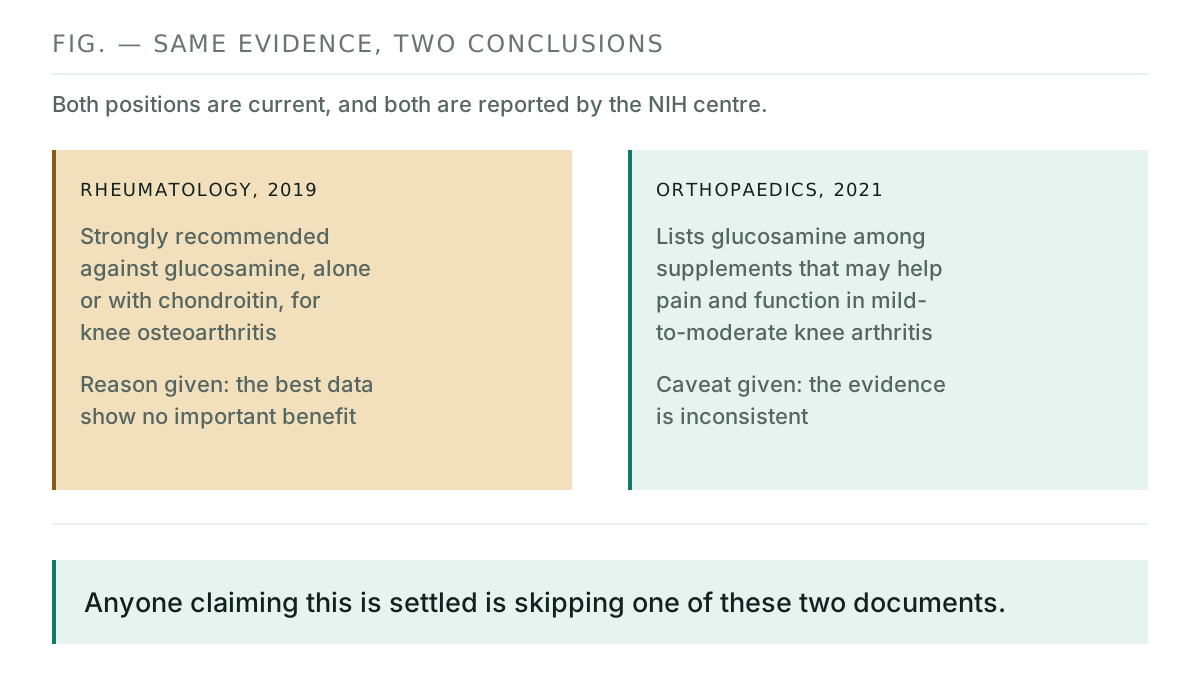
Per NCCIH, the 2019 guideline from the American College of Rheumatology and the Arthritis Foundation "strongly recommended against the use of glucosamine alone or in combination with chondroitin for knee osteoarthritis, stating that the best data do not show any important benefits."
And: "in contrast, the 2021 guideline from the American Academy of Orthopaedic Surgeons (AAOS) includes glucosamine in a list of dietary supplements that may be helpful in reducing pain and improving function in patients with mild-to-moderate knee osteoarthritis, although it cautions that the evidence is inconsistent."
What about safety, and the cartilage claim
On safety the picture is reassuring and short. NCCIH: "no major safety problems have been identified in large studies of glucosamine and chondroitin for osteoarthritis." Two specific cautions do apply. Glucosamine "may cause increases in blood glucose (sugar) levels in some people," which matters if you are diabetic or heading that way. And glucosamine and chondroitin "have been associated with an increased risk of bleeding in people who are taking the anticoagulant warfarin."
The cartilage-rebuilding claim is a separate question from pain relief, and it has been measured. In a two-year arm of the US government trial, with 572 participants, changes in joint space width — the X-ray measure of how much cushion is left in the joint — did not differ from placebo. Pulling the other way, the Cochrane review found two trials of the branded preparation in which glucosamine slowed radiological progression of knee osteoarthritis over three years. NCCIH's own summary of the whole question is the fairest one available: "whether glucosamine and chondroitin actually have an effect on joint structure is uncertain. Studies have had inconsistent results." What no one can honestly claim is that regrowing cartilage has been demonstrated.
So is it worth trying?
Here is the position this site will defend. Glucosamine has not been shown to work in the trials least likely to be wrong, and the trials most favourable to it were run by the people selling it. That is a weak case, and nobody should expect a transformation.
But it carries no identified major safety problem, and it sits inside a live disagreement between two serious medical bodies. If your knees ache and the cost is small enough for you to want to find out whether you personally respond, that is a defensible decision, not a foolish one — provided it is a decision with an end date.
What is not defensible is letting it substitute for what actually has evidence. The pillar guide covers the load side: weight, strength and activity change what goes through the joint, which no capsule does. And if your knee is catching or locking rather than aching, that is a meniscus question, not a supplement one.
What to do with this
- Decide what you are buying. Pain relief is the claim with mixed evidence. Cartilage regrowth is the claim with a negative joint-space measurement behind it.
- Set an end date before you start. The big trial judged its main outcome at 24 weeks, and the pooled independent data looked at 3 months and 24 months. Pick a date in that range, judge it honestly, and stop if nothing changed.
- Check the label for which form it is. The more favourable studies used a specific prescription preparation, not the generic hydrochloride, and those studies had their own weaknesses.
- Flag it if you take warfarin or watch your blood sugar. Those are the two cautions NCCIH names specifically.
- Do not let it replace the boring things. NCCIH puts losing weight and increasing physical activity among the strategies that help people manage osteoarthritis symptoms — those come first, whatever you decide about a capsule.
The honest summary is that glucosamine sits in the small category of supplements where reasonable, unbiased people still disagree — not because the data are missing, but because the best-designed studies and the most favourable studies are not the same studies.
Key takeaways
- In a 1,583-patient NIH-funded trial, glucosamine came 3.9 percentage points above placebo, a gap compatible with chance (P=0.30) — NEJM, 2006.
- The same trial did detect a significant effect for celecoxib, which is why its glucosamine result carries weight.
- A Cochrane review found benefit in trials of one branded preparation, but no benefit when analysis was restricted to the eight studies with adequate allocation concealment.
- NCCIH notes most studies of the prescription formulation had a high risk of bias and were funded by the pharmaceutical company.
- Pooling raw patient data from five industry-independent trials (1,625 people with knee or hip osteoarthritis) found no benefit overall or in any predefined subgroup — Annals of the Rheumatic Diseases, 2017.
- Guidelines disagree: rheumatology strongly recommended against it in 2019; orthopaedic surgeons listed it as possibly helpful in 2021 — NCCIH.
- No major safety problems identified in large studies of glucosamine and chondroitin, with cautions for blood glucose and for people taking warfarin — NCCIH.
Where to go from here
This is the ninth and final article in the joints section. The full set:
- Joint Pain After 40 — the pillar guide, covering osteoarthritis, rheumatoid arthritis and post-traumatic arthritis.
- Knee Pain: What's Different About Where It Hurts — front, outside, behind, or sudden swelling, and what each one usually means.
- Shoulder Pain After 40: What the Arm Can't Do — the ten-second test that separates a weak shoulder from a stiff one.
- Hip Pain Explained: Why It's Often Not the Hip — sudden or gradual, and why it is often felt somewhere other than the hip.
- Osteoarthritis vs Rheumatoid Arthritis: What Differs — how long the stiffness lasts, whether both sides hurt, and why one of the two has a clock on it.
- Rotator Cuff vs Frozen Shoulder: Two Fixes, Not One — one tissue heals on its own, the other does not, and why that changes what waiting buys.
- Knee Replacement: Is It Time, and What Will It Fix? — what to try first, what recovery really takes, and why expectations decide most regret.
- Meniscus Tear: What the Scan Can't Tell You — why a tear on the scan does not prove it is what hurts, and what the surgery trials found.
Frequently asked questions
Does glucosamine work for joint pain?
The evidence is genuinely split. In the largest independent trial, of 1,583 patients, glucosamine came 3.9 percentage points above placebo — a gap compatible with chance (P=0.30), not a win. Some trials of one branded prescription preparation were clearly positive, but those studies were mostly industry-funded and judged to have a high risk of bias.
Does the specific form of glucosamine matter?
It may. NCCIH reports that in a 2014 analysis of 25 studies, people using the prescription drug formulation generally had more favourable results than those who did not — and that is a prescription product in parts of Europe, not a supplement sold over the counter in the US. A 2019 ESCEO statement strongly recommends prescription crystalline glucosamine sulfate for knee osteoarthritis but discourages other glucosamine formulations. NCCIH also notes those favourable studies mostly had a high risk of bias and were funded by the manufacturer.
Do doctors recommend glucosamine?
They disagree. The American College of Rheumatology and Arthritis Foundation guideline of 2019 strongly recommended against glucosamine for knee osteoarthritis. The American Academy of Orthopaedic Surgeons guideline of 2021 lists it among supplements that may be helpful in mild-to-moderate knee osteoarthritis, while cautioning that the evidence is inconsistent.
Is glucosamine safe to take?
According to NCCIH, no major safety problems have been identified in large studies of glucosamine and chondroitin for osteoarthritis. Two cautions are specific: glucosamine may raise blood glucose in some people, and glucosamine and chondroitin have been linked to an increased bleeding risk in people taking the anticoagulant warfarin.
How long should I try glucosamine before deciding?
The major trials measured their main outcome at 24 weeks, and the pooled independent data looked at 3 months and 24 months. If you try it, a defined trial of about three months with an honest before-and-after judgement is more useful than taking it indefinitely out of habit.
Does glucosamine rebuild cartilage?
That claim is not established. Glucosamine is a building block of molecules found in cartilage, which is where the idea comes from, but in the two-year arm of the US government trial, changes in joint space width did not differ from placebo.
Sources
- National Center for Complementary and Integrative Health (NIH) — Glucosamine and Chondroitin for Osteoarthritis: What You Need To Know
- Clegg et al., New England Journal of Medicine, 2006 — Glucosamine, Chondroitin Sulfate, and the Two in Combination for Painful Knee Osteoarthritis
- Runhaar et al., Annals of the Rheumatic Diseases, 2017 — Subgroup Analyses of the Effectiveness of Oral Glucosamine: Individual Patient Data Meta-Analysis
- Towheed et al., Cochrane Database of Systematic Reviews, 2005 — Glucosamine Therapy for Treating Osteoarthritis
- American Academy of Orthopaedic Surgeons (OrthoInfo) — Arthritis of the Knee

Male Health Guide Editorial Team
We write about the health problems men over 40 actually search for at 3 a.m. — and we say plainly when the evidence for a popular product is thin. We do not invent credentials and we do not publish sponsored copy as editorial. Read more about how we work.
Medical disclaimer: This article is general information about the evidence on glucosamine, and is not medical advice. It is not a recommendation to take or to avoid any supplement, and supplements can interact with prescription medicines. Please speak to a qualified healthcare professional about your own situation before starting anything, particularly if you take anticoagulants or manage diabetes.