Knee Replacement: Is It Time, and What Will It Fix?
Short answer
Knee replacement is usually worth considering when arthritis pain limits daily life or persists at rest despite weight loss, physical therapy, medication and injections. It reliably reduces pain, but it does not return a young knee: about one in five patients are not satisfied, and unmet expectations are the strongest reason. Full recovery takes months, not weeks.
By the time a man types "is it time for a knee replacement" into a search bar, he has usually been living with the knee for years. He has taken the pills, done some of the exercises, maybe had an injection or two, and he has started planning his day around stairs. The question underneath the search is simple: is this the thing that finally fixes it?
The honest answer is that it often is — and that the men who end up disappointed are, more than anything else, the ones who expected something different from what the surgery delivers. So instead of walking through the operation step by step, this article is organized around the expectations men bring into the surgeon's office, and checks each one against what the evidence actually shows.
We earn nothing from any of it. There is no clinic, brace, implant brand or supplement being sold on this page, which is the only reason it can say plainly both where surgery clearly wins and where it does not.
Why your expectations matter more than the implant
In 2010, a team in Ontario surveyed patients after 1,703 primary total knee replacements to find out who was satisfied and who was not. Their answer, published in Clinical Orthopaedics and Related Research: "approximately one in five (19%) primary TKA patients were not satisfied with the outcome."
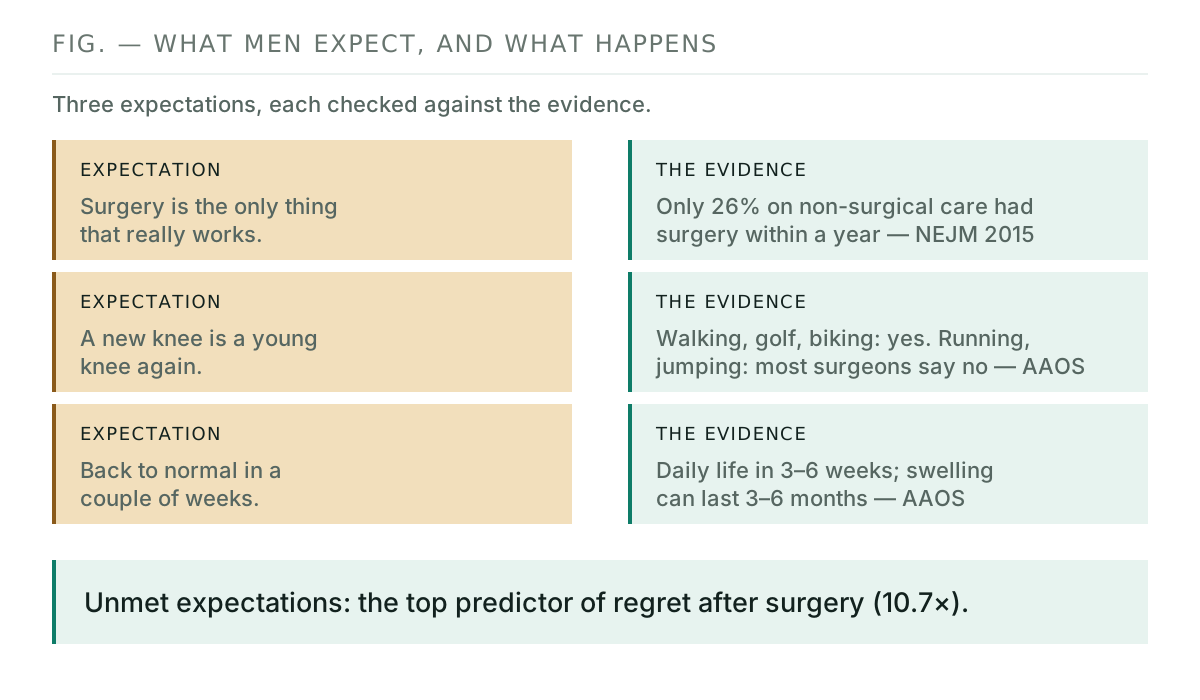
That number alone would be worth knowing. What makes the study genuinely useful is what it found about why. The strongest predictor of dissatisfaction was not the implant, not the surgeon's technique, and not age. It was "expectations not met," which carried a 10.7 times greater risk of being unhappy with the result. Nothing else in the study came close.
Unmet expectations raised the risk of dissatisfaction 10.7-fold. Pain at rest before surgery (2.4-fold), a low function score at one year (2.5-fold) and a complication requiring readmission (1.9-fold) followed well behind. Bourne et al., Clinical Orthopaedics and Related Research, 2010
Put differently: the single most controllable factor in how a knee replacement turns out is whether the man walking into the operating room knows what he is signing up for. That is the thread running through every section below.
Expectation: "Nothing else is going to work"
Most men arrive at the surgery question convinced they have tried everything. Sometimes that is true. Often, what they have tried is a partial version of the list. AAOS describes the non-surgical treatment of knee arthritis in some detail, and it is worth reading as a checklist rather than a brush-off:
- Activity changes. AAOS suggests "switching from high-impact activities (like jogging or tennis) to lower impact activities (like swimming or cycling)."
- Weight loss. "Losing weight can reduce stress on the knee joint, resulting in less pain and increased function."
- Physical therapy. "Specific exercises can help increase range of motion and flexibility, as well as help strengthen the muscles in your leg."
- Support devices. A cane, a brace or a knee sleeve.
- Medication and injections. Over-the-counter pain relievers first, oral anti-inflammatories, which AAOS says "are recommended to improve pain and function in people with knee osteoarthritis," and corticosteroid injections into the joint.
The strongest evidence on how far that list can take someone comes from a 2015 trial in the New England Journal of Medicine. Researchers in Denmark took 100 patients with moderate-to-severe knee osteoarthritis, all eligible for knee replacement, and randomly assigned half to surgery followed by 12 weeks of non-surgical treatment, and half to the 12 weeks of non-surgical treatment alone. That program — "exercise, education, dietary advice, use of insoles, and pain medication" — was delivered by physiotherapists and dietitians, not handed over as a leaflet.
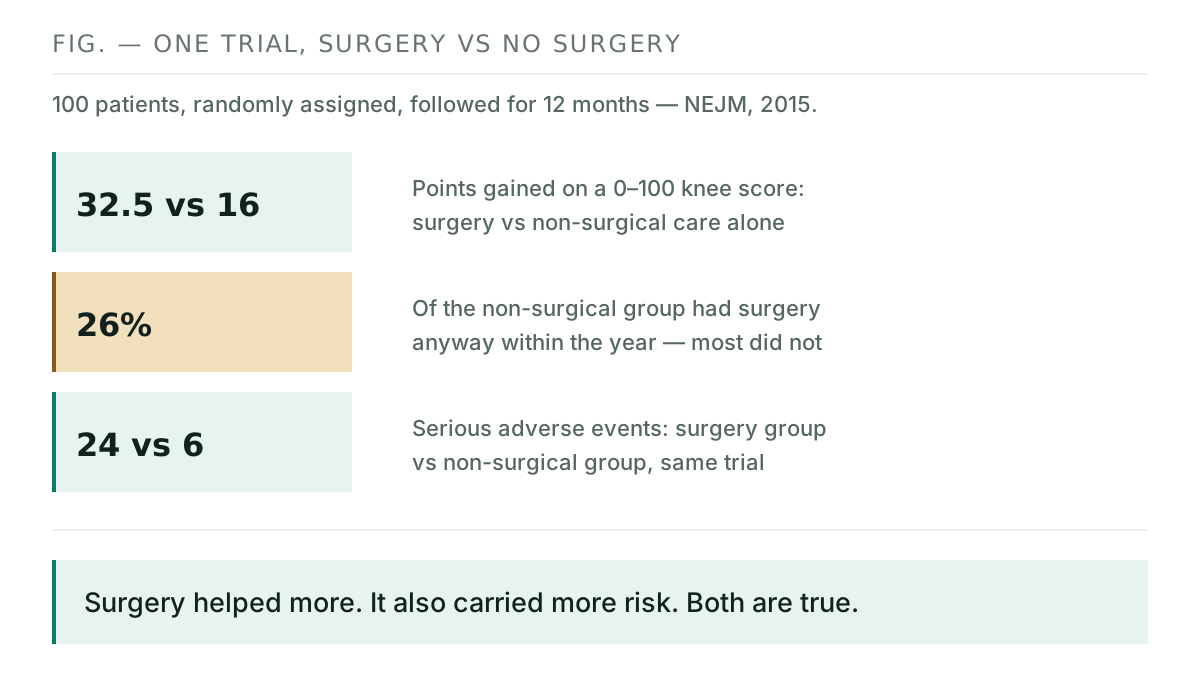
Surgery won on the main measure. On a 0 to 100 knee score covering pain, symptoms, daily activities and quality of life, the surgery group improved by 32.5 points at 12 months, against 16.0 points for non-surgical care alone. That is a real and meaningful difference, and it is fair to state it first.
But two other numbers from the same trial belong right next to it. Only 13 of the patients assigned to non-surgical care — 26% — went on to have a knee replacement before the year was out, which means most people who were eligible for surgery chose not to have it once they had received structured non-surgical treatment. And the surgery group had 24 serious adverse events, against 6 in the non-surgical group.
So the evidence-based version of this expectation is: surgery usually works better than everything else, and a properly done non-surgical program still works well enough for many people to postpone it. The question worth asking a surgeon is not "have I tried everything," but "have I tried the full version of it."
Expectation: "My age or my X-ray decides it"
Men often assume there is an age at which knee replacement becomes appropriate, or a picture on an X-ray that settles the question. AAOS says plainly that "there are no absolute age or weight restrictions for total knee replacement surgery." The decision is driven by what the knee is doing to your life.
The signs AAOS lists are about function and pain, not a number. People who benefit most often have severe knee pain or stiffness that "limits everyday activities, including walking, climbing stairs, and getting in and out of chairs"; "moderate or severe knee pain while resting, either day or night"; swelling that "does not improve with rest or medications"; a knee that has started "bowing in or out"; and a "failure to substantially improve with other treatments," such as anti-inflammatory medication, cortisone or lubricating injections, physical therapy, or other surgeries.
Imaging still matters. AAOS describes the evaluation as a medical history, a physical exam that checks "knee motion, stability, strength, and overall leg alignment," and X-rays to "determine the extent of damage and deformity," with MRI or blood tests only occasionally. But an X-ray shows how worn the joint is, not how much the wear is costing you. Two men with similar pictures can be in completely different places, which is why the list above is written in terms of stairs and chairs rather than millimeters of cartilage.
If the arthritis in question is not wear-and-tear at all, the conversation changes. Inflammatory arthritis is a different disease with its own drugs — the difference is laid out in osteoarthritis vs rheumatoid arthritis — and, as the next section shows, it rules out one of the surgical options entirely.
Expectation: "They replace the whole knee"
The name suggests something more dramatic than what happens. A total knee replacement is closer to resurfacing. AAOS describes four steps: the surgeon "removes the damaged cartilage surfaces at the ends of the femur and tibia, along with a small amount of underlying bone"; replaces them with "metal components that re-create the surface of the joint"; may resurface the underside of the kneecap "with a plastic button"; and inserts "a medical-grade plastic spacer between the metal components to create a smooth gliding surface." Ligaments, muscles and most of the bone stay yours.
For some men, even that is more than needed. In a partial knee replacement, AAOS explains, "only a portion of the knee is resurfaced." To qualify, "your arthritis must be limited to one compartment of your knee," and inflammatory arthritis, significant stiffness or ligament damage can rule it out. The advantages AAOS lists are real: "quicker recovery," "less blood loss," and many patients report it "feels more natural than a total knee replacement."
The trade-off is equally plain. AAOS notes "the potential need for more surgery," because a total knee replacement "may be necessary in the future if arthritis develops in the parts of the knee that have not been replaced." Asking whether you are a candidate for a partial replacement, and why or why not, is a reasonable question at any surgical consultation.
Expectation: "I'll be back to normal in a couple of weeks"
This is where expectations and reality separate most sharply, partly because the first days go faster than many men expect and the next months go slower. AAOS notes that "most patients can begin exercising their knee hours after surgery," and the hospital stay is typically overnight to three days.
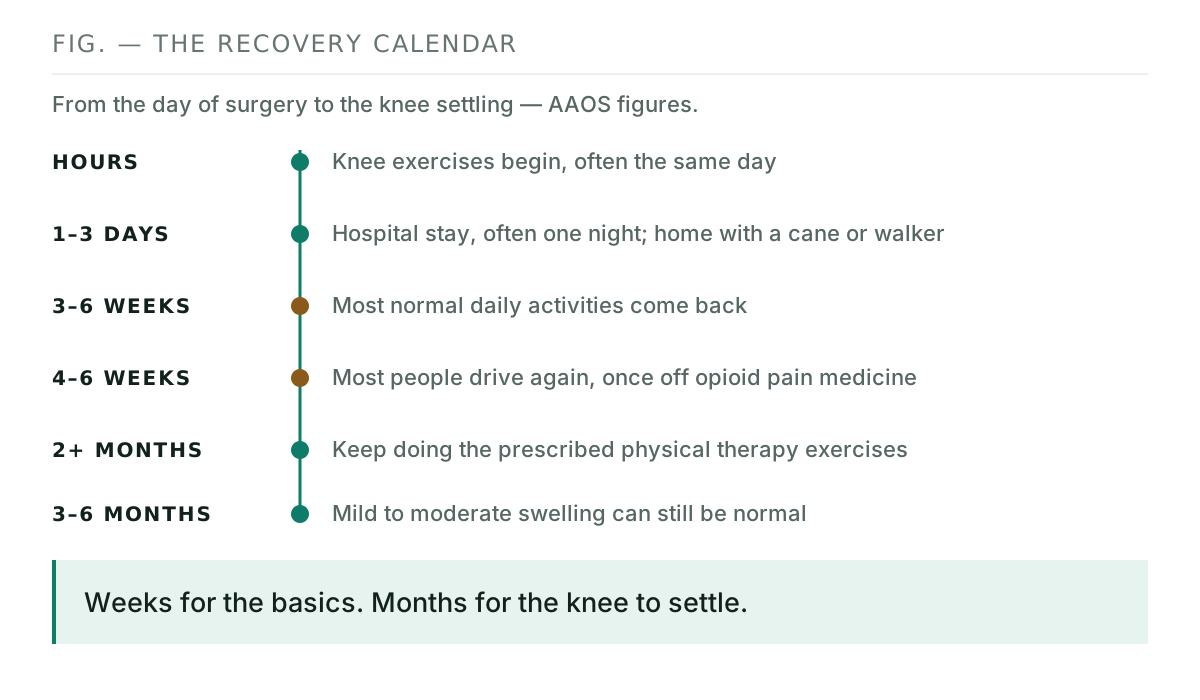
Before discharge, AAOS expects patients to be walking with a cane, walker or crutches on a level surface and able to manage "two or three stairs." From there, the realistic calendar looks like this: most normal daily activities within 3 to 6 weeks; driving at around 4 to 6 weeks, and in any case not until you are "no longer taking opioid pain medication"; the prescribed physical therapy exercises "for at least 2 months"; and "mild to moderate swelling for about 3 to 6 months."
Returning to work, AAOS says, can take "several days to several weeks" depending on the job. A man who sits at a desk and a man who spends his day on a ladder are having different recoveries, even with the same implant.
None of this means the surgery went badly. A knee that is still swollen and stiff at eight weeks is on schedule. The man most likely to feel let down at that point is the one who was told, or who assumed, that he would feel finished by then.
Expectation: "I'll have a young knee again"
A replaced knee is a better knee for most people. It is not the knee they had at 30. AAOS encourages "unlimited walking, swimming, golf, driving, light hiking, biking, ballroom dancing, and other low-impact sports," and its activities guide adds pickleball to the list. But "most surgeons advise against high-impact activities such as running, jogging, jumping, or other high-impact sports."
Two other details are worth knowing in advance, because they surprise people. "Kneeling is sometimes uncomfortable, but it is not harmful." And "most people feel or hear some clicking of the metal and plastic with knee bending or walking. This is normal." Neither is a sign of failure. Both are common reasons men wonder whether something went wrong.
On longevity, the news is good: AAOS states that "more than 90% of modern total knee replacements are still functioning well 15 years after the surgery." Staying low-impact is part of how that number stays high.
Expectation: "It's routine, so it's risk-free"
Knee replacement is routine in the sense that AAOS puts it at "more than 700,000" operations a year in the U.S. It is not risk-free, and AAOS is specific about what can go wrong. The overall complication rate "is low," with serious complications such as joint infection occurring "in fewer than 2% of patients."
Two risks are worth understanding before surgery. Infection "may occur in the wound or deep around the prosthesis," and it can happen "within days or weeks," or "even years later." And "blood clots in the leg veins are one of the most common complications," which "can be life-threatening if they break free and travel to your lungs." Both are why the post-operative instructions — moving early, clot prevention, watching the wound — are not optional extras.
The Danish trial shows the same picture from another angle: 24 serious adverse events in the surgery group versus 6 in the non-surgical group. A low rate per operation is still a higher rate than not operating. That is not an argument against surgery; it is the reason the benefit has to be worth it for your knee specifically.
The part most knee replacement guides leave out
Most patients are satisfied. The Ontario study that found one in five were not also found satisfaction with pain relief ranging from 72% to 86%, and with function from 70% to 84%, depending on the specific daily activity. That is a strong result for a major operation. It is also not a guarantee, and most pre-surgery conversations quietly present it as one.
One finding from that study is easy to miss. Pain at rest before surgery — one of the signs AAOS lists as a reason to consider a replacement — was also linked to a 2.4 times greater risk of being dissatisfied afterward. The study does not explain why, and it would be wrong to read it as a reason to avoid surgery. It is a reason to ask your surgeon directly how much of your particular pain the operation is likely to remove.
And not every knee problem after 40 is arthritis that a replacement fixes. A knee that catches, locks or gives way after a twist may be a meniscus problem, which is a different conversation. Knee pain that sits at the front, the outside or behind the joint has several causes that are not arthritis at all, which is why our knee pain article starts with where it hurts before anything else.
What to do with this
- Audit the non-surgical list honestly. Weight, a real physical therapy program, activity changes, medication and injections. The trial evidence says a structured version works well enough for many people to wait.
- Describe your knee in stairs and chairs. The criteria surgeons weigh are about what you can and cannot do, and pain at rest, not the X-ray alone.
- Ask about a partial replacement. If your arthritis is limited to one compartment, ask whether you qualify and what the trade-off would be.
- Plan for months, not weeks. Three to six weeks for daily life, at least two months of physical therapy, and swelling that can last half a year.
- Say your goal out loud. Tell the surgeon exactly what you expect to do afterward — golf, stairs, a job on your feet, running. If that expectation does not match what the surgery delivers, you want to find out before, not after.
A knee replacement is a reliable operation, and for most men living with severe arthritis it is the right call eventually. The men who get the most out of it are the ones who knew going in exactly what it would and would not change.
Key takeaways
- About one in five patients were not satisfied after knee replacement, and unmet expectations raised that risk 10.7-fold — Bourne et al., 2010.
- In a randomized trial, surgery improved a 0–100 knee score by 32.5 points versus 16.0 for non-surgical care alone — NEJM, 2015.
- In the same trial, only 26% of the non-surgical group had surgery within a year, and the surgery group had more serious adverse events (24 vs 6).
- There are no absolute age or weight restrictions; the decision rests on pain, function and failure of other treatment — AAOS.
- A partial knee replacement can mean a quicker recovery if arthritis is limited to one compartment, with a chance of later surgery — AAOS.
- Most daily activities return in 3 to 6 weeks, but swelling can last 3 to 6 months — AAOS.
- More than 90% of modern knee replacements are still working well at 15 years; most surgeons advise against running and jumping — AAOS.
Where to go from here
This is the seventh article in the joints section. The rest are being written now, one at a time:
- Joint Pain After 40 — the pillar guide, covering osteoarthritis, rheumatoid arthritis and post-traumatic arthritis.
- Knee Pain: What's Different About Where It Hurts — front, outside, behind, or sudden swelling, and what each one usually means.
- Shoulder Pain After 40: What the Arm Can't Do — the ten-second test that separates a weak shoulder from a stiff one.
- Hip Pain Explained: Why It's Often Not the Hip — sudden or gradual, and why it is often felt somewhere other than the hip.
- Osteoarthritis vs Rheumatoid Arthritis: What Differs — how long the stiffness lasts, whether both sides hurt, and why one of the two has a clock on it.
- Rotator Cuff vs Frozen Shoulder: Two Fixes, Not One — one tissue heals on its own, the other does not, and why that changes what waiting buys.
- Meniscus tear — injury or wear, and why imaging can blur the two.
- Glucosamine for joint pain — what the evidence actually shows.
Frequently asked questions
How do I know when it is time for a knee replacement?
AAOS lists the signs surgeons weigh: severe pain or stiffness that limits walking, stairs or getting out of chairs; moderate or severe pain while resting, day or night; swelling that does not improve with rest or medication; a visibly bowed knee; and failure to substantially improve with other treatments such as medication, injections and physical therapy.
Am I too young or too heavy for a knee replacement?
Not automatically. AAOS states there are no absolute age or weight restrictions for total knee replacement. The decision is based on pain and disability rather than a number, although AAOS also notes that losing weight reduces stress on the knee and can ease pain before any surgery.
Does physical therapy work as well as knee replacement surgery?
Not as well on average. In a 2015 randomized trial in the New England Journal of Medicine, surgery plus non-surgical care improved a 0 to 100 knee score by 32.5 points versus 16.0 for non-surgical care alone. But only 26% of the non-surgical group went on to have surgery within a year, and the surgery group had more serious adverse events.
How long does it take to recover from a knee replacement?
According to AAOS, most people resume normal daily activities within 3 to 6 weeks and drive again at about 4 to 6 weeks. Physical therapy exercises continue for at least 2 months, and mild to moderate swelling can last 3 to 6 months.
Can I run or kneel after a knee replacement?
Running is generally discouraged: AAOS says most surgeons advise against running, jogging, jumping and other high-impact sports. Kneeling is different — AAOS says it is sometimes uncomfortable but not harmful. Walking, swimming, golf, biking and other low-impact activities are encouraged.
How long does a knee replacement last?
AAOS states that more than 90% of modern total knee replacements are still functioning well 15 years after surgery. AAOS also notes that lower-impact activities such as golf, biking and pickleball help increase the longevity of the new knee.
Sources
- American Academy of Orthopaedic Surgeons (OrthoInfo) — Total Knee Replacement
- American Academy of Orthopaedic Surgeons (OrthoInfo) — Arthritis of the Knee
- American Academy of Orthopaedic Surgeons (OrthoInfo) — Unicompartmental (Partial) Knee Replacement
- American Academy of Orthopaedic Surgeons (OrthoInfo) — Activities After Knee Replacement
- Skou et al., New England Journal of Medicine, 2015 — A Randomized, Controlled Trial of Total Knee Replacement
- Bourne et al., Clinical Orthopaedics and Related Research, 2010 — Patient Satisfaction after Total Knee Arthroplasty: Who Is Satisfied and Who Is Not?

Male Health Guide Editorial Team
We write about the health problems men over 40 actually search for at 3 a.m. — and we say plainly when the evidence for a popular product is thin. We do not invent credentials and we do not publish sponsored copy as editorial. Read more about how we work.
Medical disclaimer: This article is general information about knee replacement surgery and the evidence around it, and is not medical advice. It is not a recommendation to have or to avoid surgery, and not a substitute for an evaluation by an orthopaedic surgeon who can examine your knee and review your imaging. Please speak to a qualified healthcare professional about your own situation.