Hip Pain Explained: Why It's Often Not the Hip
Short answer
Hip pain sorts less by exact location than by how it started. Sudden pain after a fall, especially if you cannot bear weight on that leg, needs same-day care — it could be a fracture. Pain that built up gradually over weeks is rarely an emergency, and a lot of what gets called hip pain, especially in the buttock, is not the hip joint at all.
A hip rarely announces what it is. It can show up as a stiff groin getting out of the car, a sharp twinge on the outside of the hip after sitting through a long meeting, or an ache running down the back of the leg that has nothing to do with the hip joint itself. Most men assume the joint is the problem before checking.
This is the fourth article in our joints section, after the pillar, the knee and the shoulder. The knee sorts best by where it hurts. The shoulder sorts by what the arm can and cannot do. The hip sorts by something else first: how the pain started, before exactly where it is felt.
We earn nothing from any of this. There is no brace, supplement or clinic being sold here, which is why this page can spend its time on what actually distinguishes these problems rather than steering every reader toward the same purchase.
Sudden, or gradual? Ask this before anything else
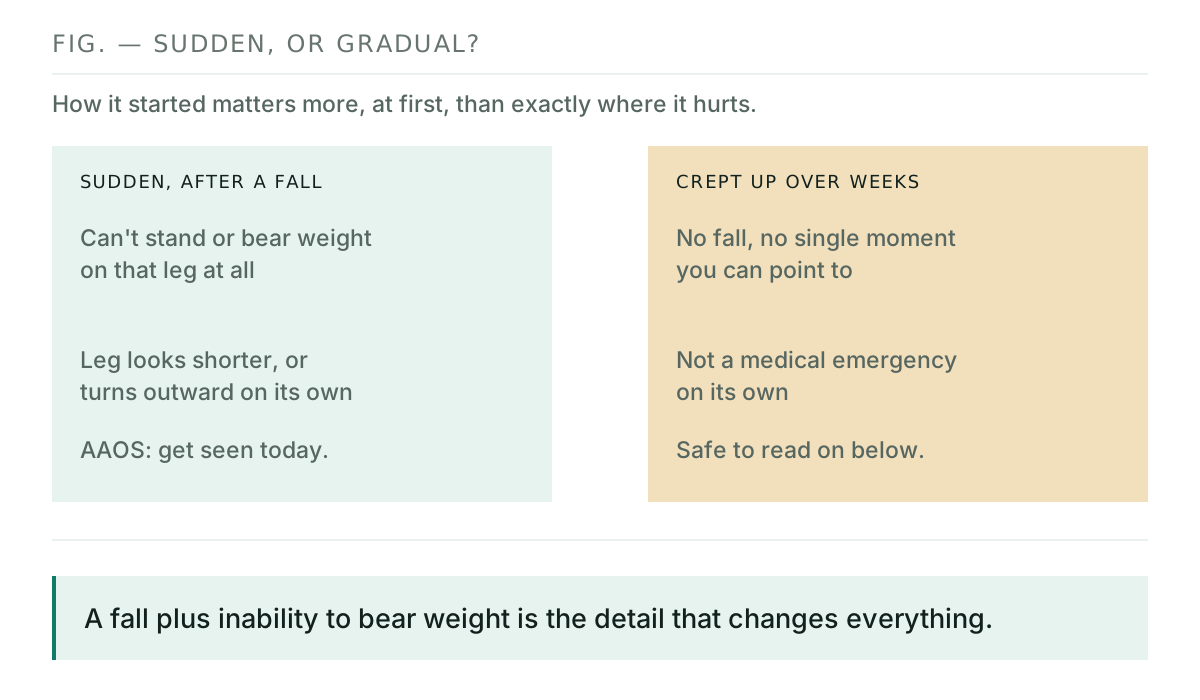
Before worrying about groin, outer hip or buttock, answer one question: did this start suddenly, especially after a fall, or has it built up gradually over days or weeks with no single moment to point to? The American Academy of Orthopaedic Surgeons treats those as two different situations, not two flavors of the same one.
A sudden onset after a fall changes the urgency of everything that follows. A gradual onset does not, and it is safe to work through the rest of this article at your own pace, starting with where exactly it hurts.
Sudden pain after a fall: rule out a fracture first
This is the one situation in this article that is not a "read on when you have time" problem. AAOS is specific about what a hip fracture looks like: "with most hip fractures, you will not be able to stand, bear weight, or move the upper part of your leg." The pain is acutely felt in the groin and the upper thigh, and often, AAOS notes, "the injured leg will appear shorter than the opposite leg and will be twisted or rotated."
That is the figure AAOS gives, and most happen in adults 65 or older after a fall at home or in the community. Surgery within 24 to 48 hours is standard, because getting a patient back on their feet quickly lowers the risk of complications like blood clots and pneumonia. American Academy of Orthopaedic Surgeons
The practical version: a fall followed by an inability to stand or bear weight, especially in a man past 65, is not something to sleep on or wait out with rest and ice. That combination is exactly what AAOS is describing, and it needs same-day medical care.
Groin pain that built up slowly: the joint itself
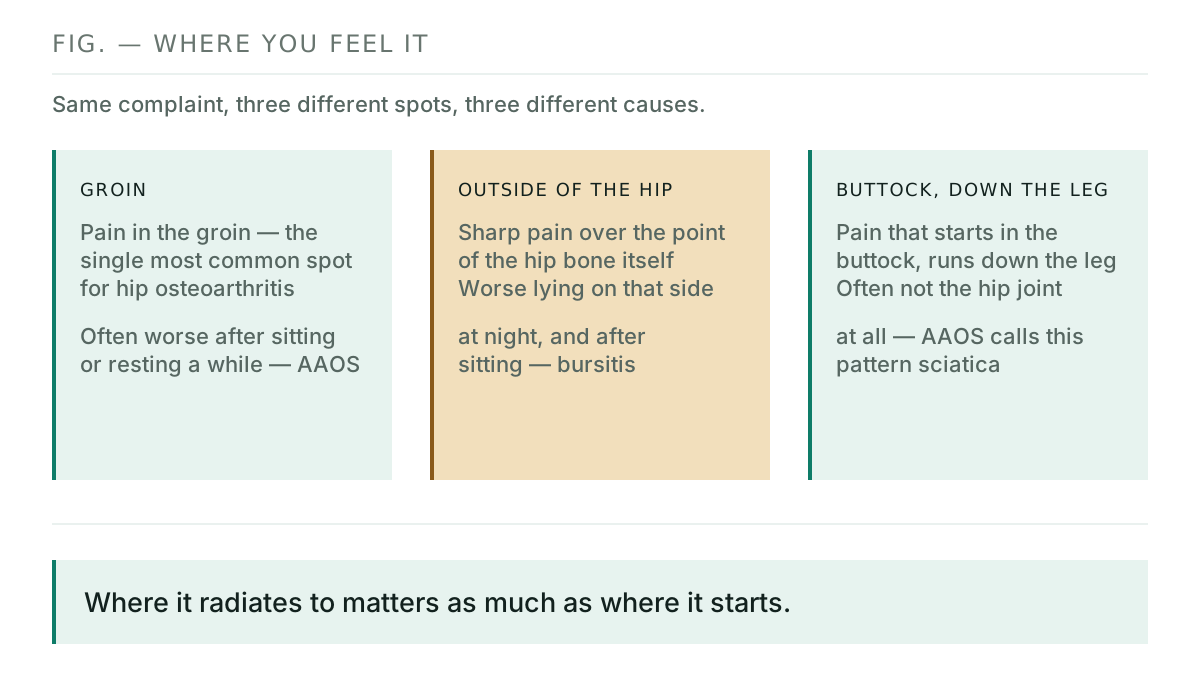
If nothing sudden happened, the next most useful clue is location, and the groin is the one that most directly implicates the hip joint. AAOS lists pain in the groin as the single most common symptom of hip osteoarthritis, sometimes radiating to the thigh or the knee, with stiffness that is often worse in the morning or after sitting for a while.
The activities that suffer first are ordinary ones: "bending over to tie a shoe, rising from a chair, or taking a short walk." Hip osteoarthritis is common, occurring most often in people 50 and older, and the general mechanics of osteoarthritis — what wears, why weight matters, how the morning-stiffness clock separates it from an autoimmune arthritis — are covered in the pillar guide for this section rather than repeated here.
When the conversation turns to a new hip
Hip osteoarthritis has no cure, but AAOS is clear that "early treatment of osteoarthritis of the hip is nonsurgical" — activity modification, physical therapy, and weight loss to reduce the load on the joint come first, for good reason.
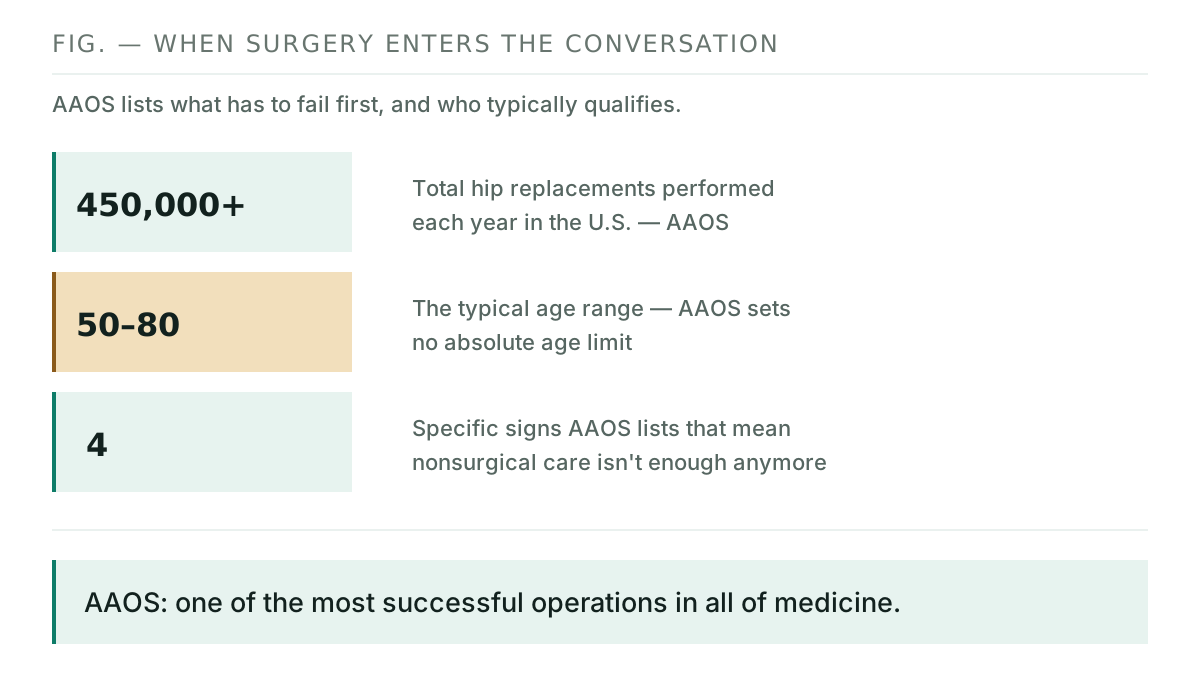
Surgery enters the conversation when it does not hold. AAOS lists four specific signs: hip pain that limits everyday activities such as walking or bending, hip pain that continues while resting, stiffness that limits the ability to move or lift the leg, and inadequate relief from anti-inflammatory drugs, physical therapy, or walking supports.
When that point arrives, the numbers are reassuring rather than alarming. More than 450,000 total hip replacements are performed each year in the U.S., most candidates are between 50 and 80 years old, and AAOS calls it "one of the most successful operations in all of medicine," with most patients getting a dramatic reduction in pain and a real improvement in daily function.
Pain on the outside, worse at night on that side: bursitis
A different complaint entirely sits over the bony point of the hip, on the outside of the thigh. AAOS calls this trochanteric bursitis: "the main symptom of trochanteric bursitis is pain at the point of the hip," sharp and intense early on, later spreading into more of an ache across a larger area.
The pattern that gives it away is timing. AAOS notes the pain is "worse at night, when lying on the affected hip, and when getting up from a chair after being seated for a while," and also worse with prolonged walking, stair climbing, or squatting. Surgery is rarely needed; activity changes, anti-inflammatories, physical therapy and a steroid injection handle most cases.
Buttock pain running down the leg: usually not your hip at all
This is the pattern most worth knowing, because it is the one most likely to send a man searching for "hip pain" over something that is not, strictly, his hip. AAOS describes it directly: "if you suddenly start feeling pain in your lower back or hip that radiates to the back of your thigh and into your leg, you may be experiencing sciatica."
Sciatica is nerve pain, not a diagnosis on its own — AAOS calls it "a very broad term describing nerve pain," with the real diagnosis being whatever is compressing the nerve root in the lower spine. In adults under 40 that is typically a herniated disk; older adults, AAOS notes, "typically experience sciatica due to bone spurs and arthritis" in the spine itself, most often between the ages of 30 and 75. The reassuring part: roughly 80 to 90 percent of people with sciatica improve over time without surgery, often within a few weeks when a herniated disk is the cause.
The part most articles leave out
Two things sit awkwardly on a men's health page, and both are worth saying plainly. First, the outer-hip condition covered above — trochanteric bursitis — is, in AAOS's own words, "more common in women and middle-aged or elderly people," and "less common in younger people and in men." Men over 40 still get it. It is simply not the way to bet first if you are choosing between explanations.
Second, and more useful in practice: the word "hip" in a man's own description is not proof of what is actually wrong. AAOS's own language for sciatica — pain "in your lower back or hip" — shows that patients and clinicians alike use "hip pain" loosely enough to cover a nerve problem in the spine. Where you point is a clue, not a verdict.
What actually helps
The three conditions above do not share one treatment, but they share a starting point: rest from whatever aggravates it, anti-inflammatory medication used sensibly, and physical therapy aimed at the specific structure involved. Weight loss reduces load on an arthritic hip joint the same way it does an arthritic knee. Steroid injections have a real, if time-limited, role for bursitis. None of the three conditions here are treated the same way sciatica is, which is one more reason getting the location and the onset right matters before guessing at treatment.
For hip osteoarthritis specifically, surgery is a later step, reserved for the four AAOS signs above, not a first response to a stiff morning. For a fracture, the sequence runs the other way: surgery quickly is the point, not the last resort.
What to do with this
- Ask "sudden or gradual" first. A fall plus inability to bear weight means same-day care, full stop, especially in a man 65 or older.
- Point at the exact spot. Groin points to the joint, the outer hip points to bursitis, and buttock-to-leg points away from the hip entirely.
- Note what happens lying down. Pain that is worse at night on that side is a bursitis detail worth mentioning at an appointment.
- Notice if it runs down the leg. That pattern is a spine and nerve question, not a hip joint question, and the workup is different.
- Give conservative treatment real time. For arthritis and bursitis alike, nonsurgical care is the documented first step, not a stalling tactic.
A hip is a hard joint to read precisely because it borrows so much of its complaint from its neighbors — the spine above it, the thigh below it. Arriving with the onset, the exact spot and the night pattern already sorted out does most of the work an examination is trying to do anyway.
Key takeaways
- Sudden hip pain after a fall, especially with inability to bear weight, needs same-day care — AAOS.
- More than 300,000 hip fractures happen in the U.S. each year, mostly in adults 65 and older — AAOS.
- Groin pain is the single most common symptom of hip osteoarthritis — AAOS.
- Pain on the outside of the hip, worse at night on that side, points to trochanteric bursitis — AAOS.
- Buttock pain running down the leg is often not the hip joint at all — AAOS calls that pattern sciatica.
- Hip bursitis is more common in women and older adults, and less common in men — AAOS.
- AAOS lists total hip replacement as "one of the most successful operations in all of medicine," with over 450,000 performed yearly in the U.S.
Where to go from here
This is the fourth article in the joints section. The rest are being written now, one at a time:
- Joint Pain After 40 — the pillar guide, covering osteoarthritis, rheumatoid arthritis and post-traumatic arthritis.
- Knee Pain: What's Different About Where It Hurts — front, outside, behind, or sudden swelling, and what each one usually means.
- Shoulder Pain After 40: What the Arm Can't Do — the ten-second test that separates a weak shoulder from a stiff one.
- Osteoarthritis vs Rheumatoid Arthritis: What Differs — how long the stiffness lasts, whether both sides hurt, and why one of the two has a clock on it.
- Rotator Cuff vs Frozen Shoulder: Two Fixes, Not One — one tissue heals on its own given time, the other does not, and surgery means opposite things for each.
- Knee replacement — what gets tried first, and what recovery involves.
- Meniscus tear — injury or wear, and why imaging can blur the two.
- Glucosamine for joint pain — what the evidence actually shows.
Frequently asked questions
How can I tell if hip pain from a fall is a fracture?
Two details matter most. AAOS says that with most hip fractures you will not be able to stand, bear weight, or move the upper part of the leg, and the injured leg often looks shorter than the other and turned or rotated. Either sign after a fall is reason to get seen the same day.
Why does my hip hurt more when I lie on that side at night?
That pattern fits trochanteric bursitis. AAOS lists the pain as worse at night when lying on the affected hip, and worse getting up from a chair after sitting a while, from inflammation of the bursa over the point of the hip bone.
Is hip bursitis something men actually get, or mostly a women's problem?
Both, but unevenly. AAOS states hip bursitis can affect anyone but is more common in women and in middle-aged or elderly people, and less common in younger people and in men. Men over 40 still get it, just at a lower rate.
Why does my hip pain run down into my leg?
That pattern is usually not the hip joint at all. AAOS describes sciatica as pain in the lower back or hip that radiates to the back of the thigh and into the leg, caused by a compressed nerve in the spine rather than the hip joint itself.
What's the most common symptom of hip osteoarthritis?
Groin pain. AAOS lists pain in the groin as the most common complaint, sometimes spreading to the thigh or the knee, and often worse after sitting or resting for a while.
When does hip pain turn into a hip replacement conversation?
AAOS points to four signs: pain limiting everyday activities like walking or bending, pain that continues at rest or at night, stiffness that limits moving or lifting the leg, and not enough relief from anti-inflammatory drugs, physical therapy or walking supports.
Sources
- American Academy of Orthopaedic Surgeons (OrthoInfo) — Osteoarthritis of the Hip
- American Academy of Orthopaedic Surgeons (OrthoInfo) — Hip Bursitis
- American Academy of Orthopaedic Surgeons (OrthoInfo) — Hip Fractures
- American Academy of Orthopaedic Surgeons (OrthoInfo) — Sciatica
- American Academy of Orthopaedic Surgeons (OrthoInfo) — Total Hip Replacement

Male Health Guide Editorial Team
We write about the health problems men over 40 actually search for at 3 a.m. — and we say plainly when the evidence for a popular product is thin. We do not invent credentials and we do not publish sponsored copy as editorial. Read more about how we work.
Medical disclaimer: This article is general information about common causes of hip pain, and is not medical advice. It is not a diagnosis, not a recommendation to start or stop any treatment, and not a substitute for an examination by someone who can see and test the hip in question. Please speak to a qualified healthcare professional about your own situation.