Lower Back Pain After 40: Why Bed Rest Is the Wrong Move
Short answer
Most sudden lower back pain comes from strained muscles and ligaments, and MedlinePlus says most people improve or recover within 4 to 6 weeks. Bed rest is not recommended: reduce activity for a couple of days, then move again. Scans usually wait 4 to 6 weeks unless certain symptoms are present, and some signs, like leg weakness, mean calling right away.
It usually starts with something ordinary. Lifting a bag of soil, turning to grab something from the back seat, standing up after a long drive. Then the lower back locks, and the first instinct for most men is to lie down and wait for it to pass — which turns out to be close to the opposite of what the evidence-based guidance recommends.
This article covers how back pain is classified by duration, why it gets more common after 40, what usually causes it, why bed rest is the wrong move, what to actually do in the first weeks, why a scan is usually not the first step, the warning signs that mean calling right away, and what changes when the pain becomes long-term.
Three windows: acute, subacute, chronic
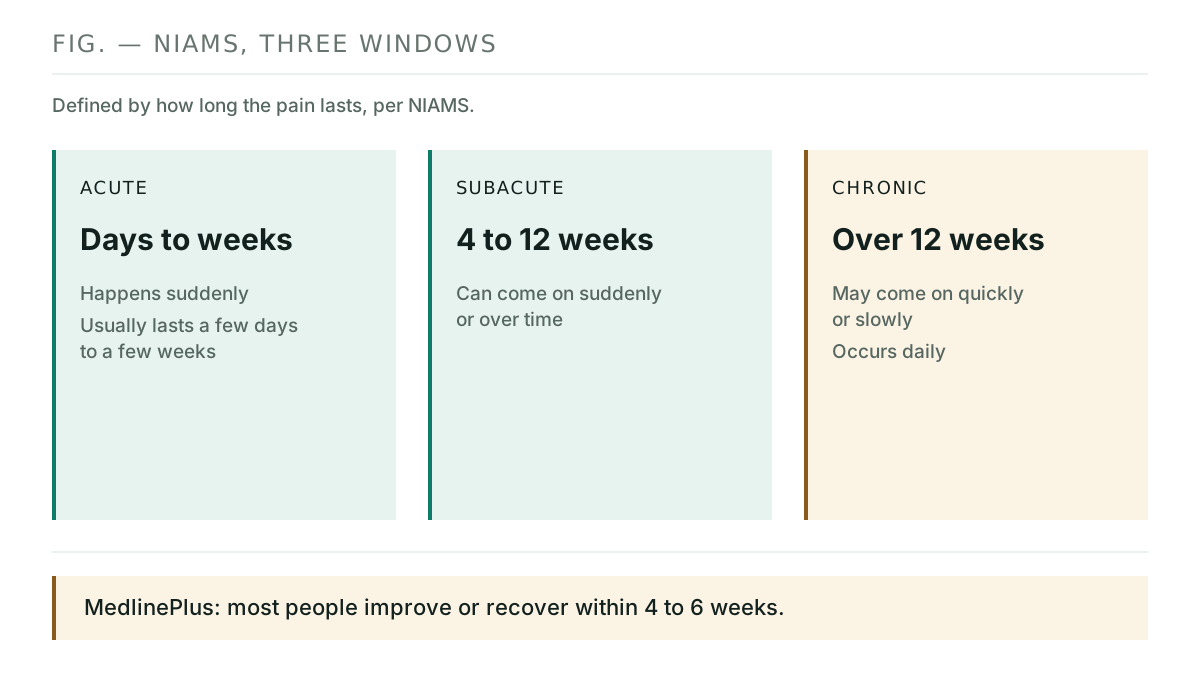
The National Institute of Arthritis and Musculoskeletal and Skin Diseases (NIAMS) sorts back pain by how long it lasts. Acute back pain happens suddenly and usually lasts a few days to a few weeks. Subacute back pain can come on suddenly or over time and lasts 4 to 12 weeks. Chronic back pain may come on quickly or slowly, lasts longer than 12 weeks, and occurs daily.
That framing matters because it changes the question. A back that seized up yesterday is in the first window, and the realistic expectation is recovery: MedlinePlus states that many people feel better within 1 week, and that after another 4 to 6 weeks the back pain should be completely gone. The longer windows are a different conversation, covered further down.
Why it gets more common after 40
NIAMS is specific about age: back pain becomes more common with age, particularly after the age of 45. It also names fitness level as a factor — weak back and stomach muscles may not properly support the spine — and notes back pain is more likely if you exercise too strenuously after being inactive for a while. Chronic poor sleep, depression or anxiety can make back pain more frequent and more severe, according to NIAMS.
MedlinePlus's list of risk factors for chronic low back pain overlaps and adds a few: being over age 30, being overweight, not exercising, feeling stressed or depressed, smoking, and having a job that involves heavy lifting, bending and twisting, or whole-body vibration, with truck driving and using a sandblaster given as examples. NIAMS adds that a desk job may also play a role, especially with poor posture or an uncomfortable chair.
What usually causes it
MedlinePlus states that acute low back pain is most often caused by a sudden injury to the muscles and ligaments supporting the back — muscle spasms, or a strain or tear. It notes you will usually first feel the pain just after lifting a heavy object, moving suddenly, sitting in one position for a long time, or after an injury or accident. The lower back takes the brunt because it supports most of your body's weight.
Its full list of causes of sudden low back pain is longer: compression fractures of the spine (often due to osteoporosis), cancer involving the spine, a fractured spine bone, muscle spasm, a ruptured or herniated disk, sciatica, spinal stenosis (narrowing of the spinal canal), spine curvatures such as scoliosis or kyphosis, and strains or tears to the muscles or ligaments. For chronic pain, MedlinePlus adds that often the exact cause cannot be found, and that a single event may not have caused it — lifting the wrong way for a long time, followed by one simple movement, can be what finally sets it off.
MedlinePlus also lists other things low back pain may be due to, and some of them sit outside the spine entirely: a leaking abdominal aortic aneurysm, kidney infection or kidney stones, and problems with the gallbladder or pancreas. The same list includes infection of the spine and arthritic conditions such as osteoarthritis, psoriatic arthritis and rheumatoid arthritis. The arthritic group is covered in more depth in this site's osteoarthritis vs rheumatoid arthritis article.
Why bed rest is the wrong move
This is the point most men get backwards, and MedlinePlus addresses it head-on. It describes the idea that you need to rest and avoid activity for a long time as a common misbelief, and states plainly: bed rest is not recommended. If you have no sign of a serious cause — such as loss of bowel or bladder control, arm or leg weakness, weight loss or fever — you should stay as active as possible.
The reason it gives is muscular: it is important to prevent your back and abdominal muscles from becoming too weak. So the guidance is to reduce activity only for the first couple of days, and then slowly start your usual activities again. That is a very different plan from a week on the couch, and the difference is the point.
"Stay active" applies when there is no sign of a serious cause. MedlinePlus gives examples of such signs — loss of bowel or bladder control, arm or leg weakness, weight loss, or fever — introduced with "such as," so they are examples rather than a complete list. Its separate list of signs that mean contacting a provider right away is further down this page.
What to do in the first weeks
MedlinePlus lays out a practical sequence. Stop or reduce normal physical activity for the first few days, which helps relieve symptoms and reduce swelling. Apply heat or ice; one approach it gives is ice for the first 48 to 72 hours, then heat. Take an over-the-counter pain reliever such as ibuprofen or acetaminophen, following the package instructions and never taking more than the recommended amount.
For sleep, it suggests lying in a curled-up, fetal position with a pillow between your legs, or, if you usually sleep on your back, a pillow or rolled towel under your knees. Avoid heavy lifting or twisting your back for the first 6 weeks after the pain began. After 2 to 3 weeks, gradually start exercising again with light aerobic activity — walking, a stationary bicycle and swimming are the examples MedlinePlus gives. It says these activities can improve blood flow to the back and promote healing, and that they also strengthen stomach and back muscles.
MedlinePlus says you may benefit from physical therapy, and that a provider decides whether you need it. MedlinePlus adds a caution worth noting: stretching and strengthening exercises are important, but starting them too soon after an injury can make the pain worse, which is part of what a physical therapist is for. If the pain lasts longer than a month, a primary provider may refer you to a physiatrist (rehabilitation specialist) or an orthopedist.
MedlinePlus's back pain pages list ibuprofen and naproxen among the over-the-counter options. Its separate heart failure page lists ibuprofen and naproxen among medicines that may make heart failure worse, and tells people with heart failure not to take any other medicines or herbs without first asking their provider. Putting the pages side by side is our observation, not something either page says on its own — but if you have heart failure, ask before taking any pain reliever, acetaminophen included. Background is in this site's heart failure article.
Why a scan usually isn't the first step
Many men expect an X-ray or MRI on the first visit. MedlinePlus says otherwise: a provider usually won't order any tests of the spine during the first visit, or for 4 to 6 weeks, unless you have certain symptoms. MedlinePlus also notes that most people with back pain improve or recover within 4 to 6 weeks, and often much sooner than that.
Instead, the first visit focuses on the location of the pain, how often it happens, how severe it is, and how it affects your movement, with the provider trying to judge whether it is likely to get better quickly with simple measures such as ice, mild painkillers, physical therapy and proper exercises. MedlinePlus states that most of the time, back pain gets better using these methods. When tests are needed, the list includes blood tests such as a complete blood count or erythrocyte sedimentation rate, an X-ray, and a CT scan or MRI of the lower spine.
The signs that mean calling right away
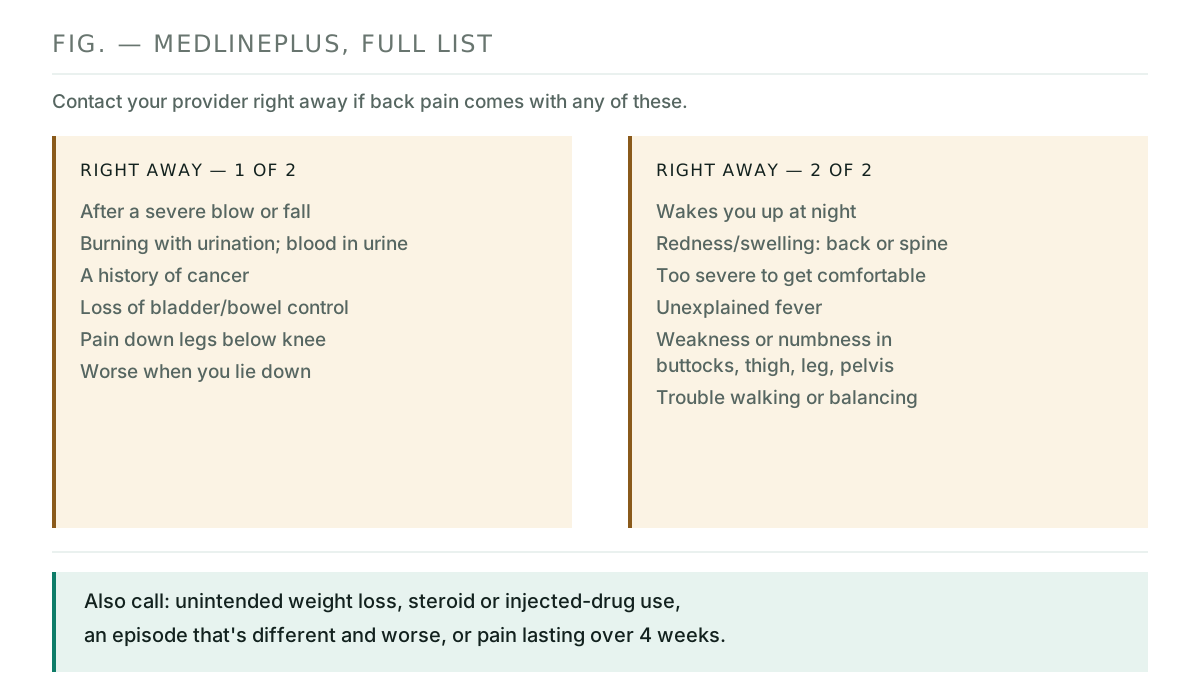
MedlinePlus gives a specific list of reasons to contact your provider right away: back pain after a severe blow or fall; burning with urination or blood in your urine; a history of cancer; loss of control over urine or stool; pain traveling down your legs below the knee; pain that is worse when you lie down; pain that wakes you up at night; redness or swelling on the back or spine; severe pain that does not allow you to get comfortable; unexplained fever with back pain; weakness or numbness in your buttocks, thigh, leg or pelvis; and difficulty walking or maintaining your balance.
It also lists four reasons to contact your provider that are not in the "right away" group: you have been losing weight unintentionally; you use steroids or inject drugs; you have had back pain before, but this episode is different and feels worse; or this episode has lasted longer than 4 weeks. NIAMS adds a similar set of reasons to see a doctor, including numbness and tingling, severe pain that does not improve with medication, and back pain together with trouble urinating.
When it runs down the leg
Pain traveling down the legs below the knee is on MedlinePlus's right-away list. NIAMS lists pain that radiates away from the back into the buttocks, leg or hip, and numbness or weakness in the legs or feet, among the symptoms back pain can bring, and separately notes that a herniated or ruptured disc can compress and irritate nearby nerves. This site's hip pain article covers the related pattern in its own section: the American Academy of Orthopaedic Surgeons says that pain in your lower back or hip that radiates to the back of your thigh and into your leg may be sciatica, nerve pain coming from the lower spine rather than the hip joint — which is why many men first feel it as hip pain and assume the joint is the problem.
When it becomes long-term
MedlinePlus is direct that chronic back pain may not go away completely, or may get more painful at times, which is why its emphasis shifts to caring for your back at home and preventing repeat episodes. It notes many people with chronic back pain have arthritis, or extra wear and tear on the spine from heavy work or sports use, injuries or surgery. When disks dry out and become thinner and more brittle, movement can be lost over time; when the spaces around the spinal nerves narrow, spinal stenosis can result.
The treatment options it lists include a back brace, cold packs and heat, traction, physical therapy with stretching and strengthening, and counseling to learn ways to understand and manage the pain. Massage, acupuncture and spinal manipulation are also listed. Medicines range from over-the-counter aspirin, naproxen or ibuprofen to low doses of prescription medicines and, if needed, narcotics or opioids when the pain is severe. If those do not help, an epidural injection may be suggested. Spinal surgery, MedlinePlus says, is considered only if you have nerve damage or bone damage that is causing the back pain and does not heal after a long time. And its outlook is reassuring: most back problems get better on their own.
Preventing the next episode
MedlinePlus puts exercise first: it improves posture, strengthens the back, improves flexibility, helps with weight loss and helps avoid falls. Its lifting advice is concrete — get help if an object is too heavy or awkward, spread your feet for a wide base, stand close to the object, bend at the knees rather than the waist, tighten your stomach muscles, hold the object close to your body, lift with your legs, and do not twist while bending, lifting or carrying.
For long drives, it suggests stopping to walk around every hour, bringing the seat forward to avoid bending, a small pillow or rolled towel behind the lower back, and not lifting heavy objects right after a long ride. It also lists quitting smoking, losing weight, regular core-strengthening exercise, and learning to relax with methods such as yoga, tai chi or massage. None of these guarantees the back never goes again, but each one is on the source's own prevention list.
Key takeaways
- NIAMS sorts back pain into acute (days to weeks), subacute (4 to 12 weeks) and chronic (over 12 weeks, daily), and says it gets more common after 45.
- Most sudden lower back pain comes from strained muscles and ligaments; MedlinePlus says most people improve or recover within 4 to 6 weeks.
- Bed rest is not recommended. Reduce activity for a couple of days, then slowly return to normal, and avoid heavy lifting or twisting for 6 weeks.
- A provider usually won't order spine tests for 4 to 6 weeks unless you have certain symptoms.
- Leg weakness or numbness, loss of bladder or bowel control, fever, or pain after a serious fall mean calling right away.
Where to go from here
If your back is what brought you here, these pages cover the surrounding ground:
- Hip Pain Explained — including the sciatica pattern, when pain runs down the leg.
- Joint Pain After 40 — the guide to the section this article belongs to.
- Osteoarthritis vs Rheumatoid Arthritis — two of the arthritic causes MedlinePlus lists.
- Heart Failure Explained — why the painkiller question matters for some men.
- All joint articles
Frequently asked questions
Should I rest in bed when my lower back hurts?
No. MedlinePlus calls the idea that you need to rest and avoid activity for a long time a common misbelief, and states that bed rest is not recommended. If there is no sign of a serious cause, it advises reducing activity only for the first couple of days, then slowly returning to your usual activities.
Do I need an X-ray or MRI for back pain?
Usually not at first. MedlinePlus says a provider usually won't order tests of the spine during the first visit, or for 4 to 6 weeks, unless you have certain symptoms. Most people with back pain improve or recover within 4 to 6 weeks, and often much sooner than that.
How long does lower back pain usually last?
NIAMS describes three windows: acute back pain usually lasts a few days to a few weeks, subacute back pain lasts 4 to 12 weeks, and chronic back pain lasts longer than 12 weeks and occurs daily. MedlinePlus adds that many people with acute pain feel better within 1 week.
When should back pain mean calling right away?
MedlinePlus says to contact your provider right away for back pain after a severe blow or fall, burning or blood with urination, a history of cancer, loss of control over urine or stool, pain traveling below the knee, pain worse lying down or that wakes you at night, redness or swelling on the back or spine, severe pain with no comfortable position, unexplained fever, weakness or numbness in the buttocks, thigh, leg or pelvis, or difficulty walking or keeping your balance.
Why does back pain get more common after 40?
NIAMS states that back pain becomes more common with age, particularly after the age of 45. MedlinePlus lists being over age 30, being overweight, not exercising, feeling stressed or depressed, smoking, and jobs involving heavy lifting, twisting or whole-body vibration among the things that raise your risk.
Is it safe to take ibuprofen for back pain?
MedlinePlus's back pain guidance lists over-the-counter ibuprofen or acetaminophen, taken as the package directs. Its separate heart failure page lists ibuprofen and naproxen among medicines that may make heart failure worse, and says not to take other medicines or herbs without first asking your provider. Putting the two together is our observation; if you have heart failure, ask before taking any of them.
Sources
- MedlinePlus (National Library of Medicine) — Low back pain - acute
- MedlinePlus (National Library of Medicine) — Low back pain - chronic
- National Institute of Arthritis and Musculoskeletal and Skin Diseases (NIH) — Back Pain
- MedlinePlus (National Library of Medicine) — Heart failure (medicines that may make heart failure worse)
- Male Health Guide — Hip Pain Explained (companion coverage of sciatica)

Male Health Guide Editorial Team
We write about the health problems men over 40 actually search for at 3 a.m. — and we say plainly when the evidence for a popular product is thin. We do not invent credentials and we do not publish sponsored copy as editorial. Read more about how we work.
Medical disclaimer: This article is general information, not medical advice. We are not doctors, and nothing here diagnoses, treats or cures any condition. Back pain can have causes that are not muscular, and some need urgent care. Please speak to a qualified healthcare professional about your own situation, and seek care right away if any of the warning signs above apply to you.