Heart Failure: It Doesn't Mean Your Heart Has Stopped
Short answer
Heart failure means the heart can't pump enough blood for the body's needs. NHLBI is explicit that it does not mean the heart has stopped. It comes in two main types, a weak squeeze or a stiff heart that won't fill, and men often develop it younger than women. It has no cure, but treatment helps many people live better.
Few diagnoses sound as final as "heart failure." Most men who hear it for the first time picture a heart that is about to give out entirely. The National Heart, Lung, and Blood Institute (NHLBI) corrects that picture directly — and the correction changes how the rest of the diagnosis is worth understanding.
This article covers what heart failure actually is, the two main types and how they differ between men and women, what causes it, who is most at risk, the symptoms, how it is diagnosed, the daily self-monitoring that keeps people out of the hospital, the medicines and devices involved, and the specific signs that mean calling a provider or 911.
What heart failure actually is
NHLBI defines heart failure, also known as congestive heart failure, as a condition that develops when your heart doesn't pump enough blood for your body's needs. That can happen if the heart can't fill up with enough blood, or when the heart is too weak to pump properly. Then comes the sentence the whole article hangs on: "The term 'heart failure' does not mean that your heart has stopped." NHLBI follows it immediately with the other half — heart failure is a serious condition that needs medical care.
The condition where the heart actually stops beating is cardiac arrest, a separate emergency covered in this site's heart attack vs cardiac arrest article. NHLBI does list sudden cardiac arrest among the conditions heart failure can lead to, alongside pulmonary hypertension, irregular heartbeat and heart valve disease, and notes it can damage the liver or kidneys.
It is common. NHLBI cites the Centers for Disease Control and Prevention: more than 6 million adults in the United States have heart failure. It can develop suddenly (acute) or over time as the heart gets weaker (chronic), and MedlinePlus notes it is most often a long-term condition. It can affect one or both sides of the heart; NHLBI states left-sided heart failure is more common, and that left-sided heart failure is the main cause of right-sided heart failure.
The two main types, and the male pattern
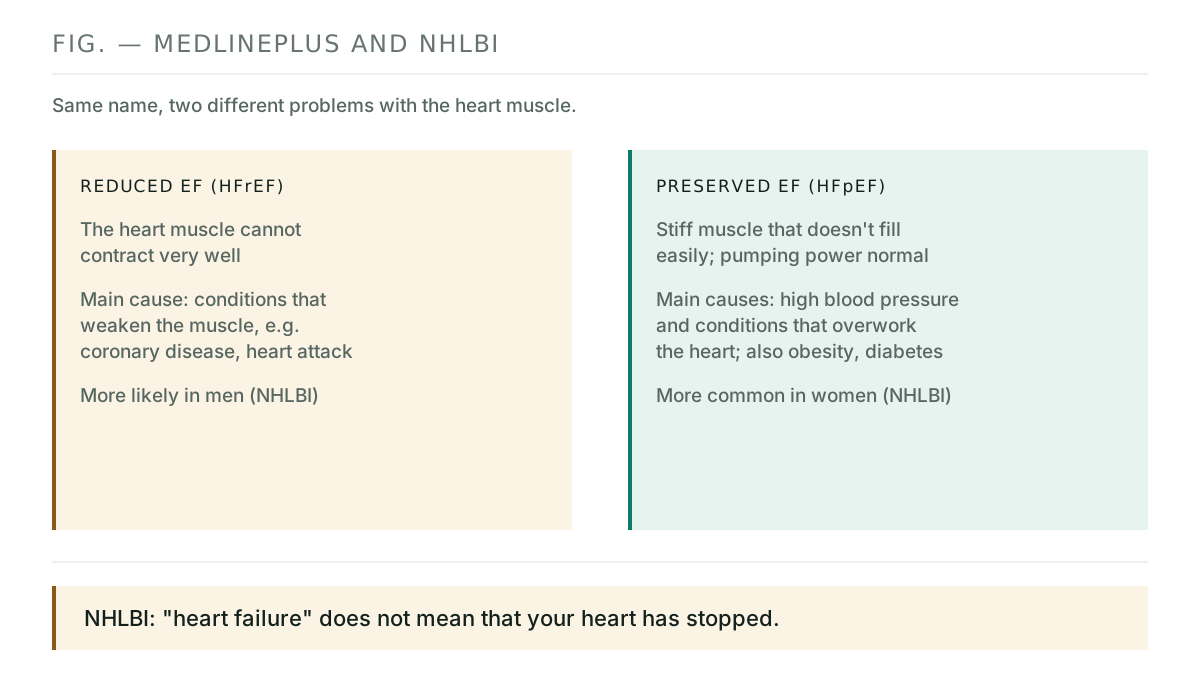
MedlinePlus describes two different problems with the heart muscle. In one, the muscle cannot contract very well — systolic heart failure, or heart failure with a reduced ejection fraction (HFrEF). In the other, the muscle is stiff and does not fill up with blood easily even though pumping power is normal — diastolic heart failure, or heart failure with a preserved ejection fraction (HFpEF). Ejection fraction is the measurement of how well the heart pumps, according to NHLBI.
This is where the male angle sits, and NHLBI states it directly: heart failure is common in both men and women, although men often develop heart failure at a younger age than women. Women more commonly have heart failure with preserved ejection fraction, while men are more likely to have heart failure with reduced ejection fraction. NHLBI also notes that women often have worse symptoms than men — a reminder that "younger" and "worse" are not the same measure.
The causes split along the same line. NHLBI names chronic conditions that damage or weaken the heart muscle as the main cause of HFrEF — coronary heart disease or a heart attack can prevent the heart muscle from getting enough oxygen — along with faulty heart valves, an irregular heartbeat, and heart diseases that are inherited or present from birth. For HFpEF, it names high blood pressure and other conditions that make the heart work harder as the main causes, plus conditions such as obesity and diabetes that stiffen the heart's chambers; over time the muscle thickens to adapt, which makes it stiffer.
What causes it
MedlinePlus names the two most common causes plainly: coronary artery disease, a narrowing or blockage of the arteries that supply the heart, which can weaken the muscle over time or suddenly; and high blood pressure that is not well controlled, which leads to stiffness of the heart muscle or eventually to weakening. Blood pressure has its own article in this section, the high blood pressure page, and the arteries themselves come up in the cholesterol article.
Its list of other heart problems that may cause heart failure includes congenital heart disease, heart attack, leaky or narrowed heart valves, an infection that weakens the heart muscle, and some types of abnormal heart rhythm. It also lists other diseases that can cause or contribute: amyloidosis, emphysema, an overactive or underactive thyroid, sarcoidosis, severe anemia, and too much iron in the body, usually due to hereditary hemochromatosis. Thyroid disease and anemia each have their own article on this site, in the hypothyroidism and anemia pages.
Who is most at risk
NHLBI is clear that some risk factors can be controlled and many cannot. Age is the first one it lists: aging can weaken and stiffen the heart, and people 65 or older have a higher risk. It adds that older adults are also more likely to have other health conditions that cause heart failure. A family history of heart failure raises risk, and genetics may play a role.
Its list of controllable and medical risk factors is long: an unhealthy diet, smoking, cocaine or other illegal drugs, heavy alcohol use and lack of physical activity; obesity, high blood pressure, diabetes, sleep apnea, chronic kidney disease, anemia, thyroid disease and iron overload; heart or blood vessel conditions; serious lung disease; infections such as HIV or SARS-CoV-2; and cancer treatments such as radiation and chemotherapy. NHLBI also names atrial fibrillation, a common irregular heart rhythm, as a cause. Two of those have their own articles here: sleep apnea and atrial fibrillation. NHLBI adds that risk goes up if you have more than one of them. Among the factors outside anyone's control, NHLBI also lists race and ethnicity: Black and African American people are more likely to have heart failure than people of other races, often have more serious cases, and experience it at a younger age.
The symptoms, and the two that happen at night
MedlinePlus notes that symptoms often begin slowly. At first they may only appear when you are very active; over time, breathing problems and other symptoms can show up even at rest. They can also appear suddenly after the heart is damaged by a heart attack or another problem. NHLBI adds that heart failure may not cause symptoms right away.
The common symptoms MedlinePlus lists are: cough; fatigue, weakness or faintness; loss of appetite; needing to urinate at night; a pulse that feels fast or irregular, or palpitations; shortness of breath when active or after lying down; a swollen liver or abdomen; swollen feet and ankles; waking up from sleep after a couple of hours because of shortness of breath; and weight gain. Two of those happen at night, and both are easy to blame on something else — this site's waking up to pee at night article covers the first from the prostate side, which is exactly why it is worth knowing the heart is on the list too.
How it's diagnosed
MedlinePlus lists what a provider looks for on exam: fast or difficult breathing, leg swelling (edema), neck veins that stick out, crackles from fluid in the lungs heard through a stethoscope, swelling of the liver or abdomen, and an uneven or fast heartbeat with abnormal heart sounds. Then it is specific about the testing order: after an electrocardiogram (ECG), an echocardiogram is most often the best first test when heart failure is being evaluated, and the provider uses it to guide treatment.
What actually happens during that test is covered step by step in this site's echocardiogram article. MedlinePlus adds that other imaging tests can show how well the heart pumps and how much muscle damage there is, and that many blood tests may also be used to help diagnose and monitor heart failure, identify risks for various types of heart disease, look for possible causes or problems that may make it worse, and monitor for side effects of medicines.
The daily monitoring that matters
MedlinePlus says follow-up visits happen at least every 3 to 6 months, sometimes much more often, and that knowing your own body and the symptoms that mean heart failure is getting worse helps keep people healthier and out of the hospital. At home, it says to watch for changes in heart rate, pulse, blood pressure and weight.
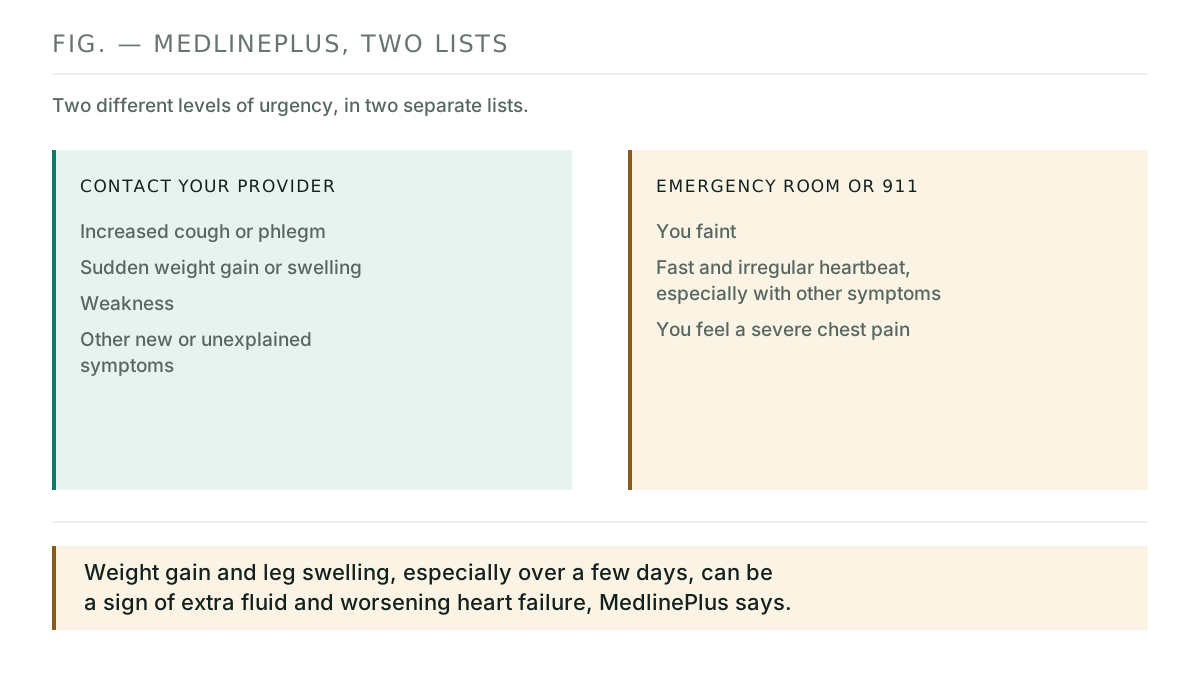
Weight is the one it singles out: weight gain and leg swelling, especially over a few days, can be a sign that the body is holding on to extra fluid and the heart failure is getting worse. It advises talking to your provider about what you should do if your weight goes up or you develop more symptoms. The lifestyle list that goes with it is specific — limit salt, possibly limit fluids, ask how much alcohol is allowed, do not smoke or use tobacco, stay active with walking or a stationary bicycle, lose weight if overweight, lower cholesterol, and get enough rest. One instruction stands out: do not exercise on days when your weight has gone up from fluid or you are not feeling well.
Medicines, and the painkillers to ask about
MedlinePlus states that heart failure medicines treat the symptoms, prevent heart failure from getting worse, and help people live longer. Depending on the person, they may help the heart muscle pump better, keep blood from clotting, lower cholesterol, open blood vessels or slow the heart rate so the heart does not work as hard, reduce damage to the heart, lower the risk of abnormal rhythms, replace potassium, or rid the body of excess fluid and salt. It is emphatic about taking them as directed, and about not taking any other medicines or herbs without asking first.
MedlinePlus names two medicines that may make heart failure worse: ibuprofen (Advil, Motrin) and naproxen (Aleve, Naprosyn). Both are among the first things many men reach for when their back or knees hurt — this site's lower back pain article covers that side. With heart failure, ask your provider before taking either.
For some people, surgery or a device may be recommended. MedlinePlus lists coronary bypass surgery or angioplasty with or without stenting to improve blood flow to the heart muscle, heart valve surgery when a valve is causing the heart failure, a pacemaker to treat slow heart rates or help both sides of the heart contract together, and a defibrillator to stop life-threatening abnormal rhythms. For severe heart failure that no longer responds to treatment, it lists options such as a ventricular assist device or a total artificial heart, while waiting for or instead of a heart transplant.
Supplements come up often in this area, and this site has looked at two of them separately: the CoQ10 evidence and a study on melatonin and heart failure. MedlinePlus's instruction is not to take any other medicines or herbs without first asking your provider, so either is worth raising with the provider managing the heart failure before starting it.
When to call, and when to call 911
MedlinePlus separates the two. Contact your provider if you develop increased cough or phlegm, sudden weight gain or swelling, weakness, or other new or unexplained symptoms. Go to the emergency room or call 911 if you faint, if you have a fast and irregular heartbeat (especially if you also have other symptoms), or if you feel a severe chest pain.
It also names what can make heart failure suddenly worse: lack of blood flow to the heart muscle, eating high-salt foods, a heart attack, infections or other illnesses, not taking medicines correctly, and new abnormal heart rhythms. Several of those are within a person's control, which is part of why the daily monitoring above carries so much weight.
The honest outlook
NHLBI does not soften it: currently, heart failure is a serious condition that has no cure. But it is equally clear that treatment — healthy lifestyle changes, medicines, some devices and procedures — can help many people have a higher quality of life. MedlinePlus puts it similarly: often you can control heart failure by taking medicine, changing your lifestyle, and treating the condition that caused it, though some people develop severe heart failure that no longer responds to treatment.
On prevention, the two sources point the same way. MedlinePlus states that most cases of heart failure can be prevented by living a healthy lifestyle and reducing the risk of heart disease. NHLBI lists a heart-healthy lifestyle, limiting or avoiding alcohol, avoiding illegal drugs, and working with a provider to manage diabetes, high blood pressure and obesity — and adds that the sooner you start, the better your chances of preventing or delaying the condition. For a man in his 40s, that last line is the practical one.
Key takeaways
- NHLBI: heart failure means the heart can't pump enough blood for the body's needs — it does not mean the heart has stopped.
- Two main types: a weak squeeze (HFrEF) or a stiff heart that won't fill (HFpEF); men are more likely to have HFrEF and often develop heart failure younger than women.
- The most common causes are coronary artery disease and poorly controlled high blood pressure.
- Weight gain and leg swelling, especially over a few days, can be a sign of extra fluid and worsening heart failure, per MedlinePlus — so weight is worth watching at home.
- MedlinePlus lists ibuprofen and naproxen among medicines that may make heart failure worse; fainting, a fast irregular heartbeat or severe chest pain mean calling 911.
Where to go from here
If heart failure is what brought you here, these pages cover the surrounding ground:
- What Happens at an Echocardiogram — after an ECG, most often the best first test, per MedlinePlus.
- High Blood Pressure After 40 — one of the two most common causes.
- Heart Attack vs Cardiac Arrest — the emergency where the heart actually stops.
- Melatonin and Heart Failure — what one study did and didn't show.
- Cardiomyopathy Explained — when the heart muscle itself is the problem; many people with it have heart failure.
- All heart articles
Frequently asked questions
Does heart failure mean the heart has stopped?
No. The National Heart, Lung, and Blood Institute states that the term heart failure does not mean that your heart has stopped. It means the heart doesn't pump enough blood for your body's needs, either because it can't fill up with enough blood or because it is too weak to pump properly. It is still a serious condition that needs medical care.
What are the two main types of heart failure?
MedlinePlus describes heart failure with a reduced ejection fraction (HFrEF), where the heart muscle cannot contract very well, and heart failure with a preserved ejection fraction (HFpEF), where the muscle is stiff and does not fill with blood easily even though pumping power is normal. NHLBI notes men are more likely to have HFrEF and women more commonly have HFpEF.
Do men get heart failure at a younger age?
Yes, according to NHLBI: heart failure is common in both men and women, although men often develop heart failure at a younger age than women. NHLBI also states that people 65 or older have a higher risk, and that aging can weaken and stiffen the heart.
What are the symptoms of heart failure?
MedlinePlus lists cough, fatigue, weakness or faintness, loss of appetite, needing to urinate at night, a fast or irregular pulse or palpitations, shortness of breath when active or after lying down, a swollen liver or abdomen, swollen feet and ankles, waking after a couple of hours of sleep short of breath, and weight gain. It notes symptoms often begin slowly.
What is the first test for heart failure?
MedlinePlus states that after an electrocardiogram (ECG), an echocardiogram is most often the best first test when heart failure is being evaluated, and that the provider uses it to guide treatment. Other imaging tests and many blood tests may also be used.
When should someone with heart failure call 911?
MedlinePlus says to go to the emergency room or call 911 if you faint, have a fast and irregular heartbeat (especially with other symptoms), or feel a severe chest pain. Contact your provider for increased cough or phlegm, sudden weight gain or swelling, weakness, or other new or unexplained symptoms.
Sources
- National Heart, Lung, and Blood Institute (NIH) — What Is Heart Failure?
- National Heart, Lung, and Blood Institute (NIH) — Heart Failure: Causes and Risk Factors
- MedlinePlus (National Library of Medicine) — Heart failure
- Male Health Guide — What Happens at an Echocardiogram (companion coverage of the first imaging test)
- Male Health Guide — Melatonin and Heart Failure (companion coverage of one supplement study)

Male Health Guide Editorial Team
We write about the health problems men over 40 actually search for at 3 a.m. — and we say plainly when the evidence for a popular product is thin. We do not invent credentials and we do not publish sponsored copy as editorial. Read more about how we work.
Medical disclaimer: This article is general information, not medical advice. We are not doctors, and nothing here diagnoses, treats or cures any condition. Heart failure needs ongoing care from a qualified healthcare professional. Never change or stop a heart medicine, or add a new medicine or supplement, without talking to the provider managing your care, and call 911 for fainting, a fast irregular heartbeat or severe chest pain.