Melatonin and Heart Failure: What a New Study Found
Short answer
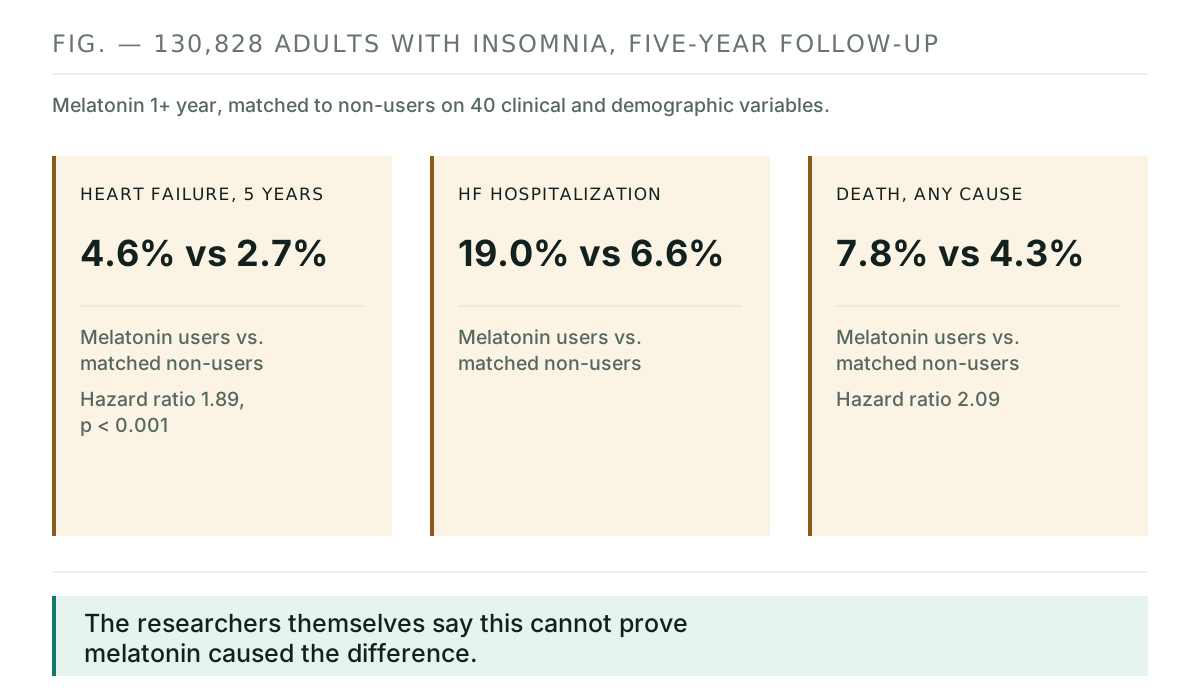
Melatonin and heart failure became linked in the news in late 2025, when a large study found that adults with insomnia on melatonin for a year or more had a 90 percent higher rate of heart failure, more hospitalizations and higher mortality than closely matched non-users. It is not yet peer-reviewed and cannot prove melatonin caused the difference, but it is reason enough to stop treating nightly melatonin as risk-free.
Melatonin has spent years as the supplement nobody worries about — sold without a prescription, marketed as a hormone your own body already makes, taken nightly by millions of people who would never touch a sleeping pill. In November 2025, a large study presented at the American Heart Association's Scientific Sessions put a number on a question almost nobody had been asking: what happens to the heart after years of that habit.
This article covers exactly what the study found, who it actually studied, why it is not proof of cause and effect, and one limitation specific to how melatonin is sold in the United States that changes how seriously to take the result.
What the study actually found
Researchers led by Ekenedilichukwu Nnadi, MD, a chief resident in internal medicine at SUNY Downstate/Kings County Primary Care, used the TriNetX Global Research Network, a large multinational health-records database, to review five years of records from 130,828 adults diagnosed with insomnia. Of those, 65,414 had been prescribed melatonin at least once and reported taking it for at least a year; patients with prior heart failure, or who were on other prescription sleep medications, were excluded from the start.
Those 65,414 melatonin users were matched, one for one, against 65,414 non-users using propensity score matching — a statistical method that balances two groups across many variables at once. The American Heart Association's own release on the study says the groups were matched on 40 factors in total, including age, sex, race/ethnicity, heart and nervous system diseases and their medications, blood pressure and body mass index; the American College of Cardiology's more technical summary adds that this covered 15 separate comorbidities, cardiometabolic medications, lab results, vital signs and healthcare utilization, until the two groups looked alike on paper.
Over five years, incident heart failure occurred in 4.6% of the melatonin group versus 2.7% of the matched control group — about a 90% higher relative risk (hazard ratio 1.89, p<0.001). Heart failure hospitalization occurred in 19.0% of melatonin users versus 6.6% of controls, and all-cause mortality was 7.8% versus 4.3% (hazard ratio 2.09).
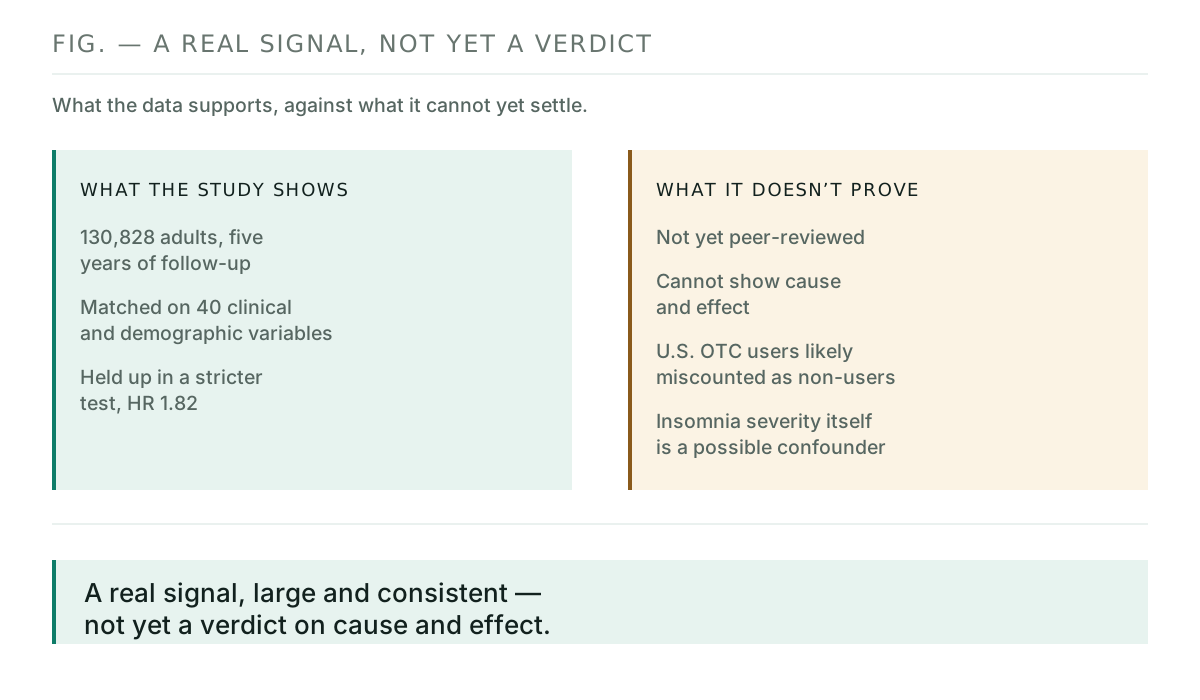
Nnadi et al., “Long-Term Use of Melatonin Supplements to Support Sleep May Have Negative Health Effects,” American Heart Association Scientific Sessions 2025, Abstract MP2306A sensitivity analysis that required at least two melatonin prescriptions filled 90 or more days apart — a stricter definition meant to rule out people who filled one prescription and quietly stopped — produced a nearly identical result, a hazard ratio of 1.82. The finding held up when the researchers tried to poke a hole in their own definition of a long-term user.
Who this is actually about
It matters precisely who was in this study, because the finding does not generalize to everyone who has ever taken melatonin. The average participant was 55.7 years old, and 61.4% were women. Every single person in both groups already had a diagnosed insomnia — this is not a study of healthy sleepers who occasionally take melatonin, it is a study of people whose sleep was already disrupted enough to carry a diagnosis.
And within that group, the melatonin users were specifically the ones who kept taking it for 12 months or longer. A few nights of melatonin around a long flight, or during a rough week, is a different pattern of use than what this study measured, and nothing here speaks directly to that.
Why this isn't proof melatonin causes heart failure
The researchers themselves are the clearest voice on this point. As quoted by Cardiovascular Business, lead author Ekenedilichukwu Nnadi said: “While the association we found raises safety concerns about the widely used supplement, our study cannot prove a direct cause-and-effect relationship.” That is not false modesty — it is a description of what this type of study can and cannot establish.
Two things specifically limit how far the finding can be pushed. First, this is a research abstract presented at a conference, not yet a peer-reviewed publication — an earlier and less scrutinized stage than a paper that has been checked by independent reviewers before release. Second, even excellent statistical matching cannot rule out confounding by indication: people whose insomnia was severe and persistent enough that they kept taking melatonin for a full year or more may differ from matched non-users in ways that 40 variables did not fully capture — including the severity of the sleep disruption itself, which has its own documented links to cardiovascular strain, independent of anything melatonin did.
The catch that matters most in the U.S.
There is a more specific limitation, and it cuts directly against American readers trusting this result too literally. The study identified melatonin users by looking for a prescription in the TriNetX records. In the United States, melatonin is sold over the counter as a dietary supplement — most people who take it every night never have that use entered anywhere as a prescription. An unknown number of long-term OTC melatonin users were almost certainly sitting inside the study's “non-user” comparison group the entire time, something the researchers cannot rule out and the data cannot correct for after the fact.
Marie-Pierre St-Onge, PhD, a Columbia University professor of nutritional medicine who chairs the American Heart Association's own 2025 scientific statement on sleep health, was not involved in this study — her comment is outside corroboration, not another voice from the same research team. As reported by Cardiovascular Business, she said: “I'm surprised that physicians would prescribe melatonin for insomnia and have patients use it for more than 365 days, since melatonin, at least in the U.S., is not indicated for the treatment of insomnia. In the U.S., melatonin can be taken as an over-the-counter supplement and people should be aware that it should not be taken chronically without a proper indication.”
That second sentence is worth sitting with regardless of what the heart failure numbers turn out to mean once peer review runs its course. The caution against years of nightly use was already there before this study, for a simpler reason: melatonin was never actually approved for that use in the first place.
This isn't new advice — it's a new reason for it
This site's own melatonin for sleep coverage already notes that information on long-term safety is lacking, and that current evidence does not support recommending melatonin for chronic, every-night insomnia. The NIH's National Center for Complementary and Integrative Health (NCCIH) says the same thing independently: “Short-term use of melatonin supplements appears to be safe for most people, but information on the long-term safety of supplementing with melatonin is lacking.” This new study does not contradict that caution. It gives it a concrete, if still preliminary, reason: a real association between years of use and a serious cardiovascular outcome, found in a dataset large enough that it is unlikely to be pure chance, even if it cannot yet prove cause and effect.
What this actually means for you
This is not a reason to panic over a bottle of melatonin in the medicine cabinet, and it is not grounds to stop a supplement abruptly without talking to anyone. It is a reason to re-examine a habit that may have quietly become permanent. If melatonin has gone from an occasional aid to something taken nightly for a year, two years, longer — the honest question is whether the underlying sleep problem was ever actually diagnosed and treated, or whether the supplement became the whole plan by default.
Men already managing blood pressure, cholesterol or other cardiovascular risk factors, covered throughout this site's heart section, have a slightly stronger reason to bring this up soon rather than at some vague future appointment, simply because they are already in the population where an added cardiovascular signal, even an unproven one, carries more practical weight.
What to ask your doctor
- Why am I still taking this most nights? If the honest answer is “I never stopped,” that alone is worth discussing.
- Was my insomnia ever actually diagnosed and treated, or did melatonin become the default? A real sleep disorder deserves a real evaluation, not just a supplement.
- Have my cardiovascular risk factors been checked recently? Blood pressure and cholesterol matter here regardless of what melatonin turns out to do.
- What's your read on this specific study? It is new, not yet peer-reviewed, and a clinician who follows cardiology literature will have more nuance than a headline can carry.
What heart failure actually means, briefly
Heart failure is not the same event as a heart attack, a distinction covered in more depth in this site's heart attack vs cardiac arrest article. It describes a heart that is still beating but has become less efficient at pumping or filling with blood over time, which can cause shortness of breath, fatigue and fluid buildup rather than a single dramatic event. That gradual, cumulative nature is exactly why a study looking at five years of follow-up, rather than a single incident, is the right kind of study to even ask this question in the first place.
Key takeaways
- In a 2025 study of 130,828 adults with insomnia, those on melatonin a year or more had heart failure at 4.6% versus 2.7% for matched non-users (HR 1.89) — plus more hospitalizations and higher mortality.
- The study's own authors say it cannot prove melatonin caused the difference, and it is not yet peer-reviewed.
- Melatonin users were identified by prescription records — in the U.S., over-the-counter use likely went uncounted on both sides of the comparison.
- An independent AHA expert noted melatonin is not FDA-indicated for insomnia and was never meant for daily, year-after-year use.
- This doesn't mean panic or quitting cold — it means bringing long-term use up with your doctor, especially alongside other heart risk factors.
Where to go from here
If melatonin and heart failure brought you here, these pages cover the surrounding ground:
- Heart Health After 40: What the Numbers Mean — the guide to the whole section.
- Melatonin for Sleep: What the Evidence Actually Supports — the original caution about chronic use, before this study existed.
- Heart Attack vs Cardiac Arrest: Plumbing vs Electrical — how heart failure differs from a sudden cardiac event.
- The Insomnia Treatment That Works Better Than Pills — the non-drug option worth asking about first.
- All heart articles — blood pressure, cholesterol and the rest of the numbers.
Frequently asked questions
What exactly did this melatonin study find?
Among 130,828 adults with insomnia, the 65,414 who had been prescribed melatonin and took it for a year or more had heart failure within five years at a rate of 4.6%, versus 2.7% for 65,414 closely matched non-users, about a 90% relative increase. They were also hospitalized for heart failure more often, 19.0% versus 6.6%, and died of any cause more often, 7.8% versus 4.3%.
Does this mean melatonin causes heart failure?
Not proven. The study's own authors state plainly that the association raises safety concerns but cannot prove a direct cause-and-effect relationship. It is also a conference research abstract, not yet peer-reviewed, which is an earlier and less scrutinized stage of evidence than a published, reviewed study.
Does this apply to occasional melatonin use, like for jet lag?
No. The study specifically looked at adults with a diagnosed insomnia who had used melatonin for 12 months or longer. It says nothing about taking it for a few nights around travel or an occasional rough patch of sleep, which is a different pattern of use entirely.
Why does it matter that melatonin is sold over the counter in the U.S.?
Because the study identified melatonin users through prescription records in a health-records database. In the U.S., most people buy melatonin over the counter without a prescription ever being entered, so an unknown number of long-term OTC users may have been counted among the study's non-users, which the researchers cannot rule out.
Should I stop taking melatonin?
That is a decision for you and your doctor, not something this article can tell you. What the evidence does support is not treating nightly, year-after-year melatonin as an automatically safe habit, and bringing up long-term use at your next appointment, especially if you have other heart risk factors.
What should I ask my doctor if I've been taking melatonin for a long time?
Ask why you still need it most nights, whether your insomnia has an underlying cause that was never actually treated, and whether your other cardiovascular risk factors have been checked recently. Ask specifically about this study if you want your doctor's read on it, since the evidence is still new and not yet peer-reviewed.
Sources
- American Heart Association Newsroom — Long-Term Use of Melatonin Supplements to Support Sleep May Have Negative Health Effects (Nnadi et al., AHA Scientific Sessions 2025, Abstract MP2306)
- American College of Cardiology, reporting on Nnadi et al. — Research Suggests Long-Term Melatonin Use For Insomnia Increases HF Risk
- Cardiovascular Business — Is Long-Term Melatonin Use Safe? New Study Highlights Heart Risks
- MedlinePlus (National Library of Medicine) — Heart Failure
- National Center for Complementary and Integrative Health (NIH) — Melatonin: What You Need To Know

Male Health Guide Editorial Team
We write about the health problems men over 40 actually search for at 3 a.m. — and we say plainly when the evidence for a popular product is thin. We do not invent credentials and we do not publish sponsored copy as editorial. Read more about how we work.
Medical disclaimer: This article is general information, not medical advice. We are not doctors, and nothing here diagnoses, treats or cures any condition. The study discussed here is preliminary and not yet peer-reviewed. Please speak to a qualified healthcare professional about your own melatonin use, your own heart health, and never start, stop or change any medication or supplement based on what you read online.