Neck Pain After 40: Stiff Neck Causes and When to Worry
Short answer
A common cause of neck pain is muscle strain, most often from everyday posture, desk work or sleeping position; the NHS says most neck pain lasts a few weeks. Call 911 for a fever and headache with a neck too stiff to touch your chin to your chest. Neck pain with heart attack symptoms needs medical help right away.
A stiff neck in the morning is one of those problems most men shrug off, and most of the time that is the right call: the NHS opens its page by saying most neck pain only lasts a few weeks. As men get older, though, the picture changes: MedlinePlus says the major risk factor for the neck wear it calls a common cause of chronic neck pain is aging. And a few warning signs are worth knowing before you shrug it off.
This article covers what neck pain is, the everyday causes, the wear that comes with age, what it means when pain travels into the arm, other causes, the link to the heart, what helps at home, where the agencies disagree, how to sleep with it, and when to see a doctor. It sits in this site's Joints section because MedlinePlus lists the neck's joints among the structures that neck pain can come from.
What neck pain actually is
MedlinePlus defines neck pain as discomfort in any of the structures in the neck: the muscles, nerves, bones (vertebrae), joints, and the discs between the bones. When your neck is sore, it says, you may have difficulty moving it, such as turning to one side, and many people describe this as having a stiff neck.
It adds one detail worth remembering from the start: if neck pain involves compression of your nerves, you may feel numbness, tingling or weakness in your arm or hand. That symptom changes the advice, and it comes up again below.
The everyday causes
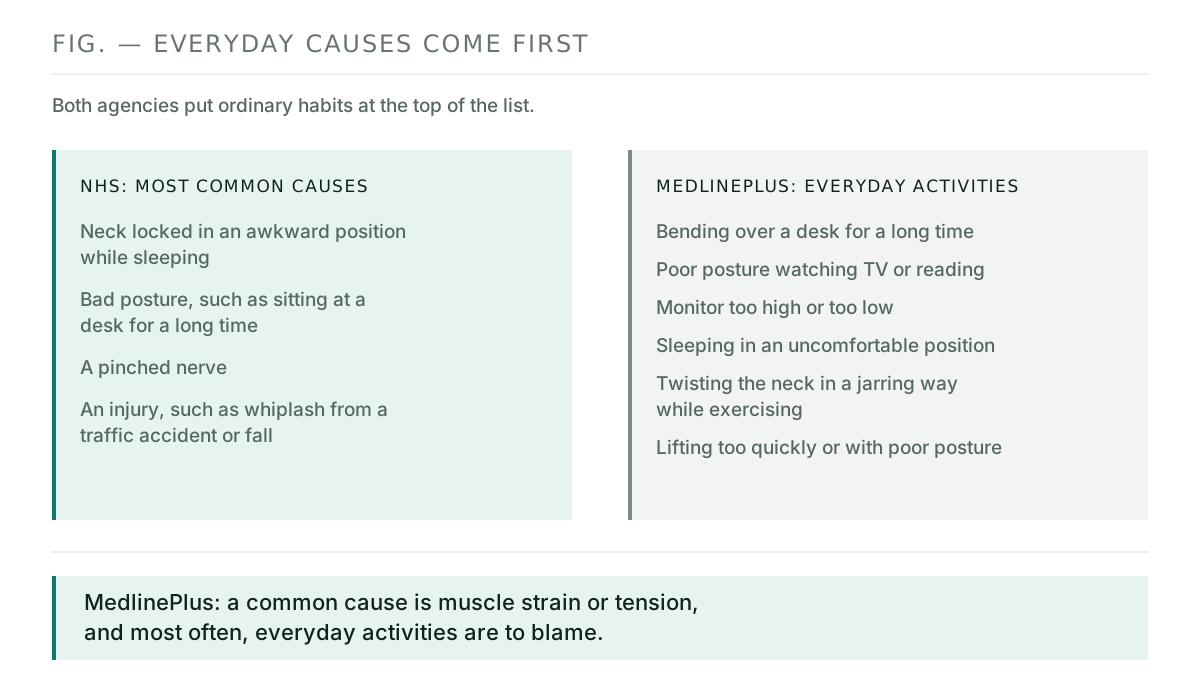
The NHS lists the most common causes of neck pain as the neck becoming locked in an awkward position while sleeping; bad posture, for example when sitting at a desk for a long time; a pinched nerve; and an injury, for example whiplash from a traffic accident or fall.
MedlinePlus says a common cause of neck pain is muscle strain or tension, and that most often everyday activities are to blame. Its examples: bending over a desk for a long time (often an hour or more); poor posture while watching TV or reading; a computer monitor positioned too high or too low; sleeping in an uncomfortable position; twisting and turning your neck in a jarring manner while exercising; and lifting things too quickly or with poor posture.
In our reading, the two lists point at the same thing: for most men, the first suspect is how the neck spends its day and its night, not a disease. That is good news, because those are the causes you can change.
The wear that comes with age
MedlinePlus describes cervical spondylosis as a disorder in which there is wear on the cartilage (disks) and bones and joints of the neck, and calls it a common cause of chronic neck pain. It is caused by aging and chronic wear on the cervical spine, and there may be abnormal growths or spurs on the bones. Its alternative names include cervical osteoarthritis, neck arthritis and degenerative disk disease.
The major risk factor, it says, is aging: by age 60, most people show signs of cervical spondylosis on x-ray. Other factors that make it more likely include being overweight and not exercising, a job that requires heavy lifting or a lot of bending and twisting, a past neck injury (often several years before), past spine surgery, a ruptured or slipped disk, and severe arthritis.
Symptoms often develop slowly over time, but may start or get worse suddenly. MedlinePlus says the pain may be felt over the shoulder blade and may spread to the upper arm, forearm, or fingers (in rare cases). It can get worse after standing or sitting, at night, when you sneeze, cough or laugh, and when you bend your neck backward, twist your neck, or walk more than a few yards. Other common symptoms include neck stiffness that gets worse over time, numbness or abnormal sensations in the shoulders or arms, and headaches, especially in the back of the head.
In our reading, the outlook is more reassuring than the description. MedlinePlus says most people with cervical spondylosis have some long-term symptoms, but most of these improve with non-surgical treatment and do not need surgery, and many people are able to maintain an active life. It also says some people will have to live with chronic (long-term) pain. Wear in other joints is covered in this site's osteoarthritis vs rheumatoid arthritis article.
When the pain travels into the arm
MedlinePlus explains that in cervical spondylosis, the changes in the spine can press on one or more of the nerve roots over time, and in advanced cases the spinal cord becomes involved, which can affect your arms, legs and balance. It notes that muscle weakness is sometimes not noticed until a provider examines you; in other cases you notice a hard time lifting your arm, squeezing tightly with one hand, or clumsiness of your hand.
On its main neck pain page, MedlinePlus lists numbness, tingling or weakness in your arm or hand as a reason to contact your provider. The NHS gives a similar reason to see a GP: other symptoms, like pins and needles or a cold arm, which it says could be something more serious. If the ache sits mostly around the shoulder itself, the shoulder's own causes are covered in this site's shoulder pain article.
Other causes
Beyond everyday strain, MedlinePlus lists other causes of neck pain: medical conditions such as fibromyalgia; cervical arthritis or spondylosis; a ruptured disk; small fractures to the spine from osteoporosis; spinal stenosis (narrowing of the spinal canal); sprains; infection of the spine; torticollis; and cancer that involves the spine. It also notes that accidents or falls can cause severe neck injuries, such as vertebral fractures, whiplash, blood vessel injury, and even paralysis.
In our reading, the warning signs in the section on seeing a doctor are the practical reason to know this list. Several of the signs MedlinePlus lists, such as a lump in the neck, pain that gets worse when you lie down or wakes you at night, or trouble walking and balancing, are on its list of reasons to contact your provider.
Neck pain and the heart
In our reading, this is the section worth remembering from the whole article. MedlinePlus's neck pain page tells you to seek medical help right away if you have symptoms of a heart attack, such as shortness of breath, sweating, nausea, vomiting, or arm or jaw pain.
If neck pain comes with shortness of breath, sweating, nausea, vomiting, or pain in the arm or jaw, MedlinePlus says to seek medical help right away. Do not wait to see whether it passes. The signs that mean calling 911 are covered in this site's chest pain after 40 article.
What helps at home
For minor, common causes, MedlinePlus suggests over-the-counter pain relievers such as ibuprofen or acetaminophen, and heat or ice on the painful area: ice for the first 48 to 72 hours, then heat after that, using warm showers, warm compresses or a heating pad. To prevent injury to your skin, it says not to fall asleep with a heating pad or ice bag in place. It also suggests slow range-of-motion exercises (up and down, side to side, and from ear to ear) to gently stretch the neck muscles, and having a partner gently massage the sore areas.
The NHS list is similar: take paracetamol (called acetaminophen in the US) or ibuprofen, or use ibuprofen gel on your neck; use a low, firm pillow; put heat or cold packs on your neck; and try neck flexibility exercises. Its practical version of heat and cold is a pack of frozen peas wrapped in a tea towel for 5 minutes, 3 times a day, or a hot water bottle wrapped in a tea towel for 20 minutes, 2 to 3 times a day.
One NHS warning is easy to miss: do not do anything that could be dangerous because you cannot move your neck, for example driving or cycling. In our reading, that applies to any man who cannot turn his head far enough to check a blind spot.
The collar question: the sources disagree
The two agencies give different advice on rest and on neck collars, and it is more honest to show that than to pick one. The NHS says not to wear a neck collar, because it is better to keep your neck moving (unless a doctor tells you not to). MedlinePlus says to ask your health care provider about using a soft neck collar to relieve discomfort, but warns that using a collar for a long time can weaken neck muscles, and to take it off from time to time to allow the muscles to get stronger.
On activity, MedlinePlus suggests stopping normal physical activity for the first few days to calm symptoms and reduce inflammation, while also recommending slow range-of-motion exercises. Both sources, then, keep some gentle movement in the plan, and neither suggests a collar as a long-term fix. If a collar seems tempting, it is a question for your provider. Gentle movement also comes up in this site's lower back pain article.
Sleeping with a sore neck, and preventing the next one
Since a night in an awkward position is on both lists of common causes, the bed is worth a look. MedlinePlus suggests a firm mattress with a pillow that supports your neck, and says you may want a special neck pillow. The NHS prevention advice is specific: when sleeping, make sure your head is the same height as the rest of your body; have a firm mattress; do not sleep on your front; and do not twist your neck when you're in bed.
For the day, the NHS says to sit upright, roll your shoulders back gently and bring your neck back, and not to keep your neck in the same position for a long time, for example when sitting at a desk. MedlinePlus's list of everyday causes adds the monitor: one positioned too high or too low is on it.
MedlinePlus's guide to good posture explains why sitting posture matters: it lists neck, shoulder and back pain among the things slouching or slumping over can cause, and says your head should be above your shoulders. For sitting, it suggests switching sitting positions often, taking brief walks around your office or home, and gently stretching your muscles every so often to help relieve muscle tension. It also suggests making sure work surfaces are at a comfortable height for you.
When to see a doctor
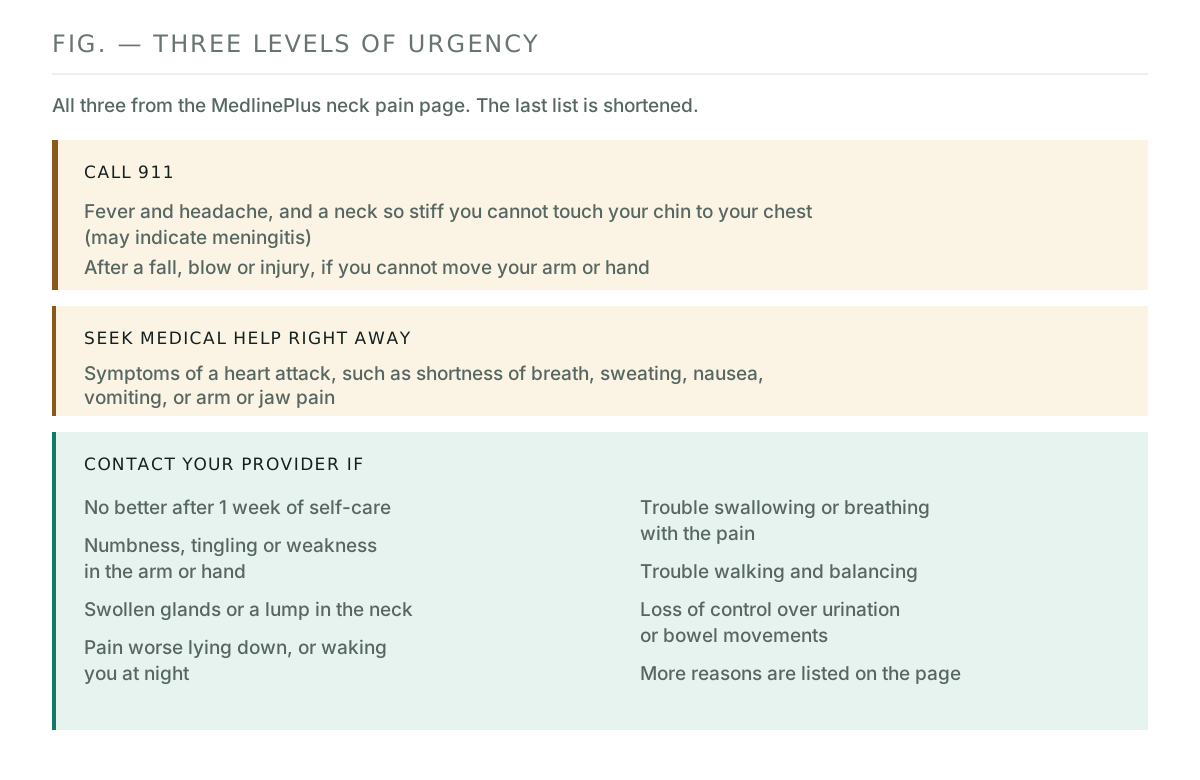
MedlinePlus says to seek medical help right away if you have a fever and headache and your neck is so stiff that you cannot touch your chin to your chest, which may indicate meningitis: call 911 or get to a hospital. It also lists symptoms of a heart attack under seeking medical help right away. If neck pain was caused by a fall, blow or injury and you cannot move your arm or hand, it says to have someone call 911.
It says to contact your provider if symptoms do not go away in 1 week with self-care; you have numbness, tingling or weakness in your arm or hand; your neck pain was caused by a fall, blow or injury; you have swollen glands or a lump in your neck; your pain does not go away with regular doses of over-the-counter pain medicine; you have difficulty swallowing or breathing along with the neck pain; the pain gets worse when you lie down or wakes you up at night; your pain is so severe that you cannot get comfortable; you lose control over urination or bowel movements; or you have trouble walking and balancing.
MedlinePlus's page on cervical spondylosis says to call your provider right away if you lose control of your bladder or bowels, and explains that this can happen if there is pressure on the spinal cord.
The NHS classes its list as non-urgent advice: see a GP if neck pain or stiffness does not go away after a few weeks, if painkillers like paracetamol or ibuprofen have not worked, if you're worried about the pain, or if you have other symptoms, like pins and needles or a cold arm.
What the doctor will do
MedlinePlus says your provider will perform a physical exam and ask about your neck pain, including where you feel it, how often it occurs and how much it hurts. Your provider will probably not order any tests during the first visit. Tests are only done if you have symptoms or a medical history that suggests a tumor, infection, fracture or serious nerve disorder; then they may include x-rays, a CT scan, blood tests or an MRI of the neck.
If the pain is due to muscle spasm or a pinched nerve, it says your provider may prescribe a muscle relaxant or a more powerful pain reliever, and adds that over-the-counter medicines often work as well as prescription medicines. For cervical spondylosis, MedlinePlus describes referral to physical therapy for stretches and strengthening exercises, cold packs and heat during flare-ups, and cognitive behavioral therapy if the pain is having a serious impact on your life. Surgery is considered if the pain does not respond to these treatments, or if there is a loss of movement or feeling.
Key takeaways
- The NHS says most neck pain only lasts a few weeks; MedlinePlus says to contact your provider if it does not go away in 1 week with self-care.
- MedlinePlus says a common cause is muscle strain or tension, most often from everyday activities such as long hours at a desk or sleeping in an uncomfortable position.
- Cervical spondylosis, the wear of the neck's disks and joints with age, is a common cause of chronic neck pain; by age 60 most people show signs of it on x-ray.
- Neck pain with shortness of breath, sweating, nausea, vomiting, or arm or jaw pain needs medical help right away, per MedlinePlus.
- A fever and headache with a neck too stiff to touch your chin to your chest means calling 911, because it may indicate meningitis.
Where to go from here
If neck pain is what brought you here, these pages cover the surrounding ground:
- Shoulder Pain in Men Over 40 — when the ache moves down toward the shoulder.
- Lower Back Pain After 40 — the other end of the spine.
- Chest Pain After 40 — the 911 signs to know.
- Joint Pain After 40 — the map of what is actually wearing down.
- All joints articles
Frequently asked questions
How long does neck pain usually last?
The NHS says most neck pain only lasts a few weeks, and to see a GP if pain or stiffness does not go away after a few weeks. MedlinePlus is stricter: it says to contact your provider if symptoms do not go away in 1 week with self-care.
Should I use ice or heat for neck pain?
MedlinePlus says to use ice for the first 48 to 72 hours and heat after that, and not to fall asleep with a heating pad or ice bag in place. The NHS suggests either a wrapped pack of frozen peas for 5 minutes, 3 times a day, or a wrapped hot water bottle for 20 minutes, 2 to 3 times a day.
Should I wear a neck collar?
The sources disagree. The NHS says not to wear a neck collar, because it is better to keep your neck moving, unless a doctor tells you otherwise. MedlinePlus says to ask your provider about a soft collar for discomfort, but warns that wearing one for a long time can weaken the neck muscles.
What is cervical spondylosis?
MedlinePlus describes cervical spondylosis as wear on the disks, bones and joints of the neck, caused by aging and chronic wear, and calls it a common cause of chronic neck pain. It says the major risk factor is aging and that by age 60 most people show signs of it on x-ray.
When is neck pain an emergency?
MedlinePlus says to call 911 if you have a fever and headache and your neck is so stiff you cannot touch your chin to your chest, which may indicate meningitis. It says to seek medical help right away for neck pain with symptoms of a heart attack, and to have someone call 911 if neck pain follows an injury and you cannot move your arm or hand.
Do I need an x-ray or MRI for neck pain?
Usually not at first. MedlinePlus says your provider will probably not order any tests during the first visit, and that tests are only done if your symptoms or medical history suggest a tumor, infection, fracture or serious nerve disorder.
Sources
- MedlinePlus (National Library of Medicine) — Neck pain
- NHS — Neck pain
- MedlinePlus (National Library of Medicine) — Cervical spondylosis
- MedlinePlus (National Library of Medicine) — Guide to Good Posture

Male Health Guide Editorial Team
We write about the health problems men over 40 actually search for at 3 a.m. — and we say plainly when the evidence for a popular product is thin. We do not invent credentials and we do not publish sponsored copy as editorial. Read more about how we work.
Medical disclaimer: This article is general information, not medical advice. We are not doctors, and nothing here diagnoses, treats or cures any condition. Call 911 for a fever and headache with a neck too stiff to touch your chin to your chest, or if you cannot move your arm or hand after an injury. Seek medical help right away for neck pain with heart attack symptoms.