Bursitis: The Swelling That Comes From Kneeling and Leaning
Short answer
Bursitis is swelling and irritation of a bursa, a small fluid-filled cushion between bone and soft tissue. It commonly affects the shoulder, knee, elbow and hip. Constant kneeling and leaning on the elbows raise the risk, and the AAOS names plumbers and roofers. An infected bursa, which at the kneecap can bring fever and chills, needs more urgent care, the AAOS says.
A swollen lump on the point of the elbow, or a soft puffy kneecap after a weekend of laying floor tile, is often the first time a man hears the word bursitis. It sounds like a disease of the joint. It isn't, quite: it is a problem with a small cushion that sits next to the joint, and the reasons it gets irritated are often written into the way a man works or trains.
This article covers what a bursa is, where bursitis shows up, why certain trades and workouts raise the risk, the other causes, the symptoms, how to tell when a bursa may be infected, how it is diagnosed and treated, when to see a provider, and how to prevent it. Several of the joints involved already have their own articles in this site's Joints section, linked below.
What a bursa is, and what bursitis is
MedlinePlus defines bursitis as the swelling and irritation of a bursa, and a bursa as a fluid-filled sac that acts as a cushion between muscles, tendons and bones. The American Academy of Orthopaedic Surgeons (AAOS) describes bursae as small, jelly-like sacs located throughout the body, including around the shoulder, elbow, hip, knee and heel. They contain a small amount of fluid and sit between bones and soft tissues, acting as cushions to help reduce friction.
The AAOS explanation of elbow bursitis shows what changes when one goes wrong. Normally, it says, the olecranon bursa at the tip of the elbow is flat. If it becomes irritated or inflamed, more fluid accumulates in the bursa, and bursitis develops. That extra fluid is the swelling men notice, and as the bursa stretches, the pain follows.
Where it shows up
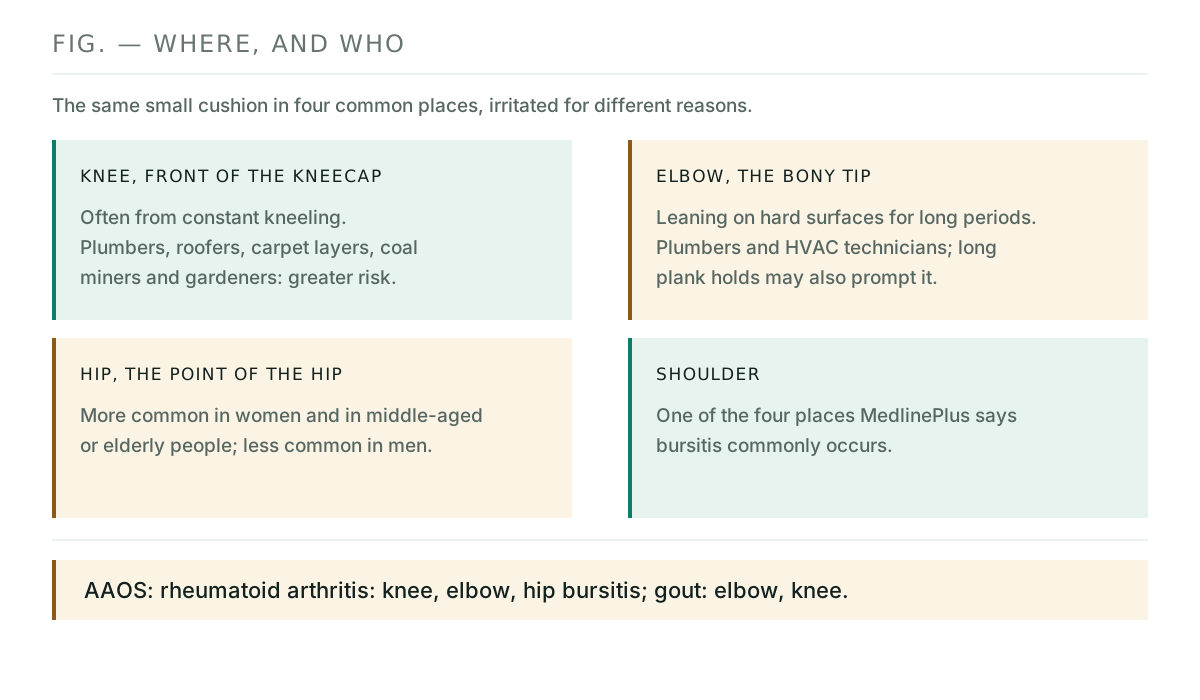
MedlinePlus says bursitis commonly occurs in the shoulder, knee, elbow and hip, and that other areas that may be affected include the area around the Achilles tendon and the foot. Some locations have their own names. MedlinePlus lists alternative names that include student's elbow and olecranon bursitis (the elbow), housemaid's knee and prepatellar bursitis (the front of the kneecap), and weaver's bottom.
In the hip, the AAOS describes two major bursae that typically become irritated: one over the bony point of the hip (the greater trochanter), whose inflammation is called trochanteric bursitis, and the iliopsoas bursa on the groin side, which it says is not as common. Hip pain on the outside of the hip has a section in this site's hip pain article, and shoulder bursitis appears among the shoulder problems covered in the shoulder pain article.
Kneeling trades, leaning, and the plank
This is where the AAOS gets specific about who is at risk, and much of it describes physical work. Prepatellar (kneecap) bursitis, it says, is often caused by pressure from constant kneeling: plumbers, roofers, carpet layers, coal miners and gardeners have a greater risk. A direct blow to the front of the knee can also cause it, and athletes in sports where blows or falls on the knee are common, such as football, wrestling or basketball, have a greater risk.
For the elbow, the AAOS describes prolonged pressure: leaning on the tip of the elbow for long periods on hard surfaces, such as a tabletop or the armrest in a car or truck, may cause the bursa to swell, typically over several months. It says people in certain occupations are especially vulnerable, particularly plumbers or heating and air conditioning technicians who crawl on their knees in tight spaces and lean on their elbows. And it notes that certain athletic activities may also prompt elbow bursitis, such as long holds of the plank position.
The hip is the honest exception. The AAOS says hip bursitis can affect anyone, but it is more common in women and in middle-aged or elderly people, and less common in younger people and in men. In our reading, that puts the knee and the elbow at the center of the occupational risks the AAOS describes, though its hip list also includes standing for long periods.
The other causes
MedlinePlus says bursitis is often a result of overuse. It can also be caused by a change in activity level, such as training for a marathon, or by being overweight. Other causes it lists are trauma, rheumatoid arthritis, gout and infection — and it adds that sometimes the cause can't be found.
The AAOS says rheumatoid arthritis and gout are associated with elbow bursitis, and that people with them are among those more vulnerable to kneecap bursitis. Gout has its own article on this site, gout after 40, and the difference between the two main kinds of arthritis is covered in osteoarthritis vs rheumatoid arthritis. For the hip, the AAOS lists further risk factors, including repetitive stress from running, stair climbing, bicycling or standing for long periods, a hip injury, spine disease, a tight iliotibial band, a difference in leg length, rheumatoid arthritis, previous hip surgery, and bone spurs or calcium deposits.
The symptoms
MedlinePlus says symptoms may include joint pain and tenderness when you press around the joint, stiffness and aching when you move it, swelling, warmth or redness over the joint, pain during movement and rest, and pain that may spread to nearby areas.
The details shift by location. At the elbow, the AAOS says the first symptom is often swelling, and because the skin on the back of the elbow is loose, a small amount may not be noticed right away; pain follows as the bursa stretches, often worse with direct pressure or bending. At the kneecap, it lists pain with activity but not usually at night, rapid swelling on the front of the kneecap, and tenderness and warmth. For trochanteric bursitis at the hip, it says the pain is typically worse at night, when lying on the affected hip, and when getting up from a chair after being seated for a while.
When the bursa may be infected
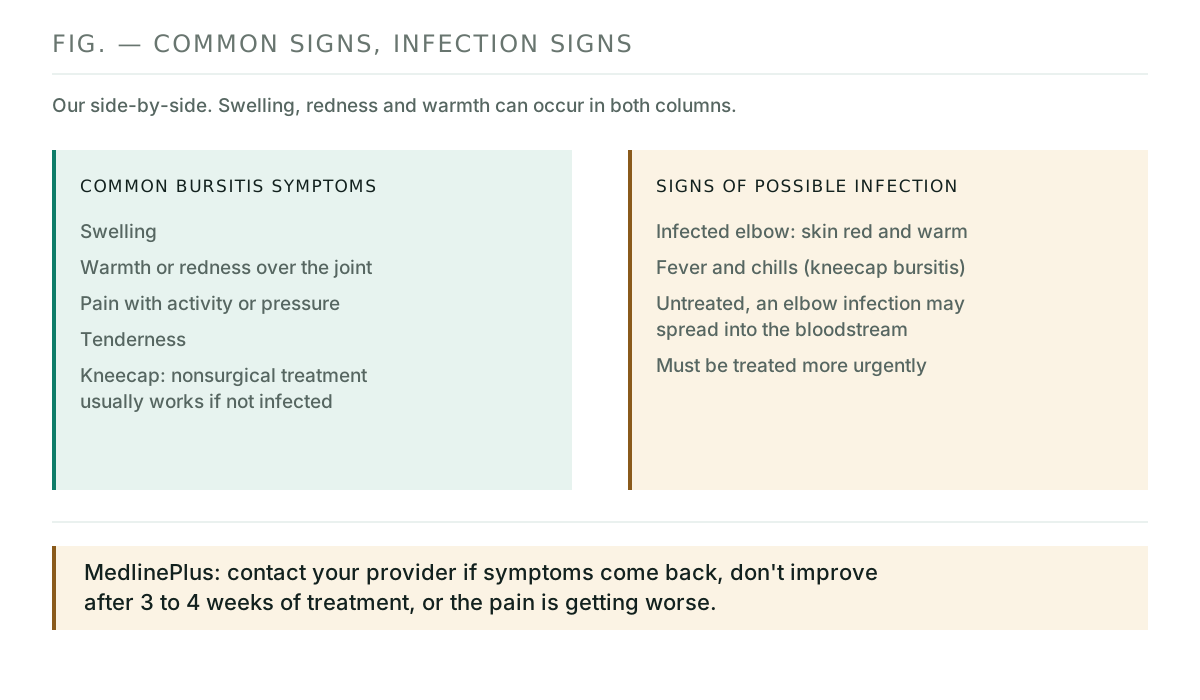
Redness and warmth on their own are not proof of infection: MedlinePlus lists swelling, warmth or redness over the joint among ordinary bursitis symptoms. What the AAOS describes is how infection gets in. If an injury breaks the skin over the elbow or knee, such as an insect bite, scrape or puncture wound, bacteria may get inside the bursa and cause an infection; for the elbow, it adds that occasionally the bursa can become infected without an obvious injury to the skin.
The signs it describes: at the elbow, the skin becomes red and warm, and if the infection is not treated right away, it may spread to other parts of the arm or move into the bloodstream, which can cause serious illness. At the knee, bursitis caused by infection may produce fluid and redness, as well as fever and chills. The AAOS says infectious bursitis is less common but more serious, and must be treated more urgently, though not always with surgery.
The AAOS says kneecap bursitis caused by infection may produce fever and chills, that an untreated elbow infection may spread into the bloodstream, and that infectious bursitis must be treated more urgently. MedlinePlus says an infected bursa becomes more inflamed and painful and often requires antibiotics or surgery. In our reading, fever or chills with a swollen bursa, or redness and warmth that keep getting worse, with or without a visible break in the skin, are reasons to see a provider promptly rather than resting it at home.
How it's diagnosed
MedlinePlus says the provider will ask about your history and perform a physical exam. Tests that may be ordered include lab tests to check for infection, ultrasound, MRI, and, rarely, removing fluid from the bursa for analysis, including a culture of the fluid.
The AAOS adds detail by joint. For the elbow, X-rays may look for a foreign body or a bone spur, which it says is often found on the tip of the elbow bone in people who have had repeated bursitis, and a small sample of bursal fluid may show whether the cause is infection or gout. For the knee, it says the diagnosis is usually made on physical examination, with X-rays to rule out a fracture and aspiration if infection is a concern. For the hip, the exam looks for tenderness over the point of the hip, with imaging used to rule out other problems.
Treatment, from ice to the needle
MedlinePlus's tips for bursitis pain include using ice 3 to 4 times a day for the first 2 or 3 days, for 15 minutes at a time with a towel between the ice and the skin, and resting the joint. When sleeping, do not lie on the side that has bursitis. For bursitis around the hips, knees or ankle, it suggests not standing for long periods, standing on a soft, cushioned surface with equal weight on each leg, placing a pillow between the knees when lying on your side, and wearing flat, cushioned shoes. It adds that losing weight may help if you are overweight, and to avoid repetitive movements when possible.
Other treatments it lists include nonsteroidal anti-inflammatory drugs (NSAIDs) such as ibuprofen and naproxen, physical therapy, a brace or splint, home exercises to build strength and keep the joint mobile as pain goes away, and removing fluid from the bursa and getting a corticosteroid shot. In rare cases, it says, surgery is done. For the elbow, the AAOS mentions elbow pads, and it says a steroid injection may be recommended if swelling and pain do not respond after 3 to 6 weeks.
Two cautions from the AAOS hip page are worth knowing. It advises using NSAIDs cautiously and for limited periods, and notes they may have adverse side effects if you have certain medical conditions or take certain medications; the AAOS kneecap page notes that acetaminophen can be used as an alternative if you cannot take NSAIDs. And it is important to limit the number of corticosteroid injections, because using them for a long time may damage the surrounding tissues. Which pain relievers are a concern for men with heart failure is covered in this site's heart failure article.
Surgery, when it is needed, can mean removing the bursa or, for an infected kneecap bursa, draining it. The AAOS says removal of the hip bursa does not hurt the hip, which can function normally without it, and that after surgery for an infected elbow bursa, the bursa usually grows back as a non-inflamed, normally functioning bursa over several months. For an infected kneecap bursa, the AAOS says treatment starts with antibiotics, with surgical drainage if the infection does not respond; for an infected elbow bursa, it describes removing fluid with a needle and antibiotics, and says surgery to remove the bursa may be needed if those do not work.
When to see a provider
MedlinePlus says to contact your provider if symptoms come back or do not improve after 3 to 4 weeks of treatment, or if the pain is getting worse. It says most people do well with treatment, but when the cause cannot be corrected, you may have long-term pain.
In our reading, the infection signs above run on a different timeline: fever and chills with a swollen bursa, or redness and warmth that keep getting worse, with or without a break in the skin, are not something to give 3 to 4 weeks, since the AAOS says infectious bursitis must be treated more urgently. Elbow pain on the outside of the joint, without a swollen tip, is often a different problem: the tendon pain of tennis elbow has its own article.
Prevention for men who work on their knees
MedlinePlus's prevention advice is to avoid activities with repetitive movements of any body part when possible, to be aware of your posture during activities, and to strengthen your muscles and work on your balance, which it says may help decrease the risk.
The AAOS advice for the knee is practical for the trades it names: wear kneepads if you work on your knees or play contact sports such as football, basketball or wrestling; rest your knees regularly by stopping to stretch your legs; consider switching activities regularly to avoid prolonged stress on your knees; and apply ice and elevate your knees after a workout. The elbow page has no prevention section, though among its treatments for a swollen elbow it mentions elbow pads and avoiding direct pressure. For the hip, the AAOS says hip bursitis cannot always be prevented, but lists things that can keep the inflammation from getting worse: avoiding repetitive activities that stress the hips, losing weight if needed, a shoe insert for a leg-length difference, and keeping hip muscles strong and flexible.
Key takeaways
- Bursitis is swelling and irritation of a bursa, a fluid-filled cushion between muscles, tendons and bones; it commonly occurs in the shoulder, knee, elbow and hip.
- The AAOS links kneecap bursitis to constant kneeling (plumbers, roofers, carpet layers, coal miners, gardeners) and elbow bursitis to leaning on hard surfaces, and says long plank holds may also prompt it.
- Hip bursitis is less common in men, per the AAOS; overuse, a change in activity level, being overweight, gout and rheumatoid arthritis are among other causes.
- Redness and warmth are common bursitis symptoms. The AAOS says an infected bursa, which can bring fever and chills at the kneecap, must be treated more urgently.
- MedlinePlus says to contact your provider if symptoms come back, don't improve after 3 to 4 weeks of treatment, or the pain is getting worse.
Where to go from here
If bursitis is what brought you here, these pages cover the surrounding ground:
- Hip Pain Explained — outer-hip pain and the other causes it can be confused with.
- Knee Pain: Causes and Relief — the wider picture for the knee.
- Tennis Elbow Explained — the elbow pain that is a tendon problem, not a bursa.
- Gout After 40 — one of the conditions the AAOS associates with bursitis.
- All joints articles
Frequently asked questions
What is bursitis?
MedlinePlus defines bursitis as the swelling and irritation of a bursa, a fluid-filled sac that acts as a cushion between muscles, tendons, and bones. It says bursitis commonly occurs in the shoulder, knee, elbow, and hip.
Which jobs raise the risk of bursitis?
The American Academy of Orthopaedic Surgeons says plumbers, roofers, carpet layers, coal miners, and gardeners have a greater risk of kneecap bursitis from constant kneeling. For elbow bursitis, it names plumbers and heating and air conditioning technicians who crawl on their knees in tight spaces and lean on their elbows.
How do I know if bursitis is infected?
The American Academy of Orthopaedic Surgeons says an infected elbow bursa makes the skin red and warm, and kneecap bursitis from infection may produce fever and chills. It says infectious bursitis is more serious and must be treated more urgently, and that an untreated elbow infection may spread to the bloodstream.
How long does bursitis take to get better?
MedlinePlus does not give a recovery time. It says most people do well with treatment, and to contact your provider if symptoms come back or do not improve after 3 to 4 weeks of treatment, or if the pain is getting worse. When the cause cannot be corrected, it says you may have long-term pain.
What is the treatment for bursitis?
MedlinePlus lists ice, rest, and avoiding repetitive movements, along with treatments such as anti-inflammatory medicines, physical therapy, a brace or splint, home exercises, and removing fluid from the bursa and getting a corticosteroid shot. It says surgery is done in rare cases.
Is hip bursitis common in men?
Less so. The American Academy of Orthopaedic Surgeons says hip bursitis can affect anyone but is more common in women and in middle-aged or elderly people, and less common in younger people and in men.
Sources
- MedlinePlus (National Library of Medicine) — Bursitis
- American Academy of Orthopaedic Surgeons, OrthoInfo — Prepatellar (Kneecap) Bursitis
- American Academy of Orthopaedic Surgeons, OrthoInfo — Elbow (Olecranon) Bursitis
- American Academy of Orthopaedic Surgeons, OrthoInfo — Hip Bursitis

Male Health Guide Editorial Team
We write about the health problems men over 40 actually search for at 3 a.m. — and we say plainly when the evidence for a popular product is thin. We do not invent credentials and we do not publish sponsored copy as editorial. Read more about how we work.
Medical disclaimer: This article is general information, not medical advice. We are not doctors, and nothing here diagnoses, treats or cures any condition. A swollen bursa with fever or chills, or redness and warmth that keep getting worse, needs prompt care from a qualified healthcare professional, and anti-inflammatory medicines are not right for everyone — ask before taking them if you have heart, kidney or stomach problems or take other medicines.