Tennis Elbow Explained: Grip Pain, Treatment and Recovery
Short answer
Tennis elbow is a painful condition involving tendons on the outside of the elbow, often aggravated by gripping or wrist activity. Management can include adjusting aggravating tasks, symptom relief and individualized rehabilitation. Persistent pain needs assessment. A brace or injection is not proof of tendon healing or a guaranteed cure.
A sore elbow can turn an ordinary morning into a series of negotiations: lifting the coffee pot, carrying a work bag, opening a stubborn door. Tennis elbow is one possible explanation for pain on the outside of the elbow, even if you have never owned a racket. The useful question is what the arm needs next, rather than whether the name sounds like your lifestyle.
For men balancing manual work, workouts and jobs around the house, simply being told to rest leaves several questions unanswered. Which tasks should change? Does a strap help? Is an injection a shortcut? This guide separates those decisions, explains the limits of the evidence, and helps you prepare for an assessment without diagnosing yourself from a list.
What is tennis elbow, and why can gripping hurt?
Tennis elbow, also called lateral epicondylitis or lateral elbow tendinopathy, affects the tendon attachment on the outside of the elbow. Forearm muscles that help extend and stabilize the wrist attach there. Gripping, lifting and twisting can provoke pain, but the location alone cannot confirm the diagnosis or exclude another problem.
The American Academy of Orthopaedic Surgeons explains the anatomy: a commonly involved tendon belongs to the extensor carpi radialis brevis, a forearm muscle involved in wrist function. That helps explain why an elbow complaint may show up during a task you think of as a hand movement.
The word tendinopathy is useful because it describes a tendon problem without implying that inflammation is the entire explanation. A painful tendon is not the same thing as worn-out joint cartilage. That distinction matters when you read advertisements aimed at every kind of joint pain.
Our complete guide to joint pain after 40 provides the broader framework. This article narrows the conversation to the outside of the elbow. Think of the two guides as different starting questions: where does the pain seem to be, and what type of problem needs investigating?
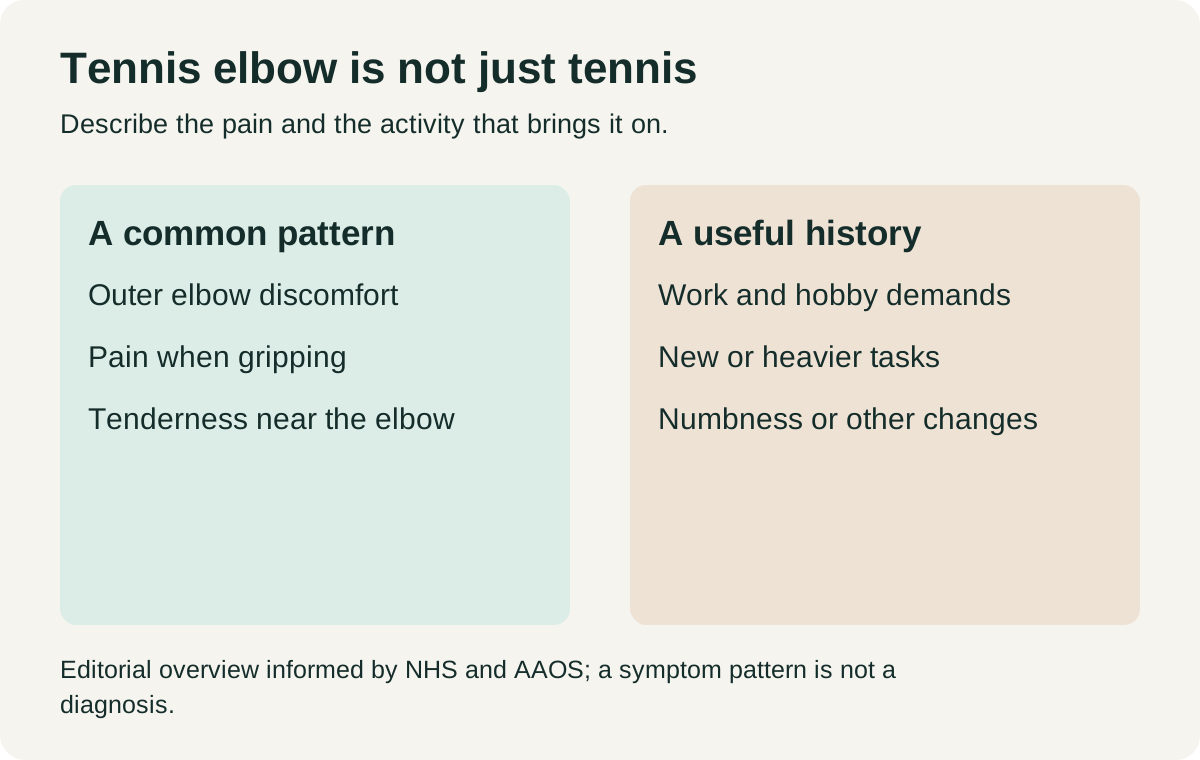
For an appointment, a concrete description is more helpful than a confident label. You might say that carrying a pan hurts near the outer elbow, but resting the arm feels different. Include what happens, where you feel it, and what you have stopped doing. Those observations are useful even if the eventual diagnosis is not tennis elbow.
Can work or lifting cause tennis elbow without tennis?
Yes. Repetitive or forceful forearm activity at work, during home projects or in sport can contribute to tennis elbow. Sometimes no clear trigger is identified. Reviewing grip demands, task duration and recent changes can help a clinician understand the problem without assuming that one movement or one workout caused it.
The American Orthopaedic Society for Sports Medicine describes the role of repetitive stress and activities involving the wrist and forearm. Repeated wrist activity and demanding use of the forearm are relevant; a racket is not required. However, a plausible explanation is not a proven cause in an individual person. Avoid turning a memory of one busy weekend into a diagnosis.
Our practical suggestion is to make a task inventory before buying equipment or abandoning exercise. Divide a typical day into work, travel, household tasks and recreation. Record the tasks that actually provoke symptoms rather than guessing which activities ought to be responsible.
- Grip: what are you holding, and can the task be done differently?
- Duration: is it one brief effort or a long sequence without a break?
- Change: have your tools, workload, schedule or training recently changed?
- Consequence: does the task affect sleep, work or the ability to manage daily routines?
For example, a home repair project and a gym session may belong in the same account even though you consider only one of them exercise. This is a way to organize the conversation, not a formula that calculates a safe workload. A therapist can help turn the account into appropriate adjustments.
Keep the goal specific. Saying you want to return to carrying your normal work equipment gives a rehabilitation conversation a clearer target than saying you want a stronger arm. The target can be revised after an examination, especially if the clinician identifies a different explanation for the pain.
How is tennis elbow assessed rather than guessed?
Assessment combines your symptom history with an examination of the elbow and relevant arm movements. A clinician may consider nerve, neck or joint problems as alternative explanations. Imaging or nerve testing is selected when it answers a clinical question; an online movement test cannot reliably establish what is causing your pain.
AAOS describes questions about work, sport, previous injury and where symptoms occur, followed by examination. Additional tests may be used to investigate alternative causes. A scan is a tool for a question, not an automatic requirement before someone can take your symptoms seriously.
Prepare a short history: when the problem began, whether there was an injury, which tasks are difficult, and whether you have noticed symptoms elsewhere. Bring details of previous treatment, including injections and medicines. There is no need to deliberately repeat a painful maneuver to make your story more convincing.
Location and associated symptoms guide further questions, but they are not diagnostic shortcuts. Our carpal tunnel syndrome guide explains a different nerve-related complaint involving the hand. It is useful background for a discussion about hand symptoms, not a reason to assign all tingling to carpal tunnel or all elbow pain to a tendon.
Likewise, our guide to shoulder pain in men over 40 can help you describe a separate shoulder complaint. Mention both areas instead of deciding in advance that one must explain the other. The examiner can assess whether the problems are related.
A useful closing question is: what finding supports this diagnosis, and what would make us reconsider it? That invites an explanation of the plan. It also establishes a way back if symptoms change rather than leaving you to repeat the same self-care indefinitely.
Should you rest completely or try an elbow brace?
Reducing activities that aggravate symptoms can help, but rest should come with a practical plan rather than an indefinite ban on using the arm. A forearm strap or wrist brace may ease symptoms for some people. Ask about fit, task changes and reassessment; a brace is not evidence that continued heavy loading is safe.
The NHS tennis elbow guidance includes reducing aggravating activities, simple movement and trying a forearm strap or brace among self-care options. It also advises seeking assessment when pain persists despite initial self-care. AOSSM likewise distinguishes reducing activity from complete inactivity. These are starting points, not a personalized rehabilitation prescription.
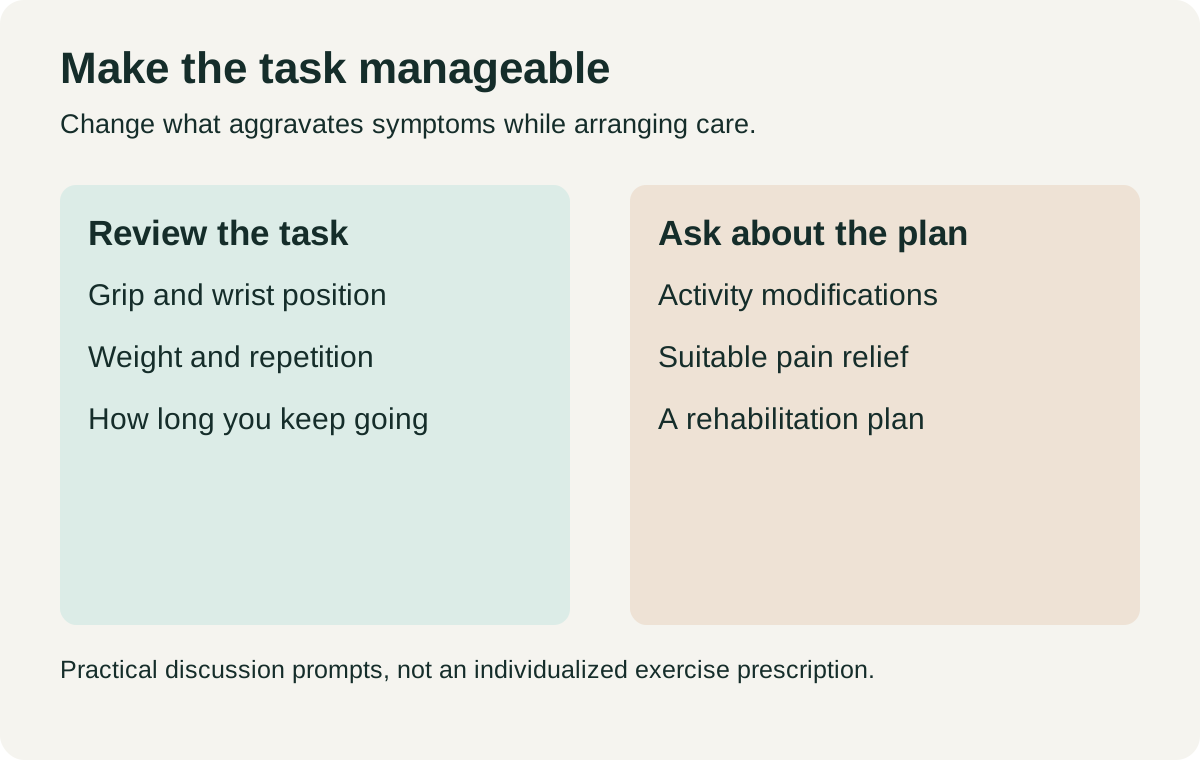
Our suggestion is to ask for task-specific advice. For someone whose income depends on tools, an instruction to avoid every arm activity may be impossible to follow. Ask which duties could be modified, what help occupational health can provide, and when the plan should be reviewed.
A brace also needs a defined purpose. If you try one, identify the activity you hope it will make more comfortable and ask a pharmacist or therapist how it should fit. Follow the product instructions. Do not improvise a tighter fit to compensate for an activity that remains painful.
| Decision | Useful question | What it cannot establish |
|---|---|---|
| Reduce a task | Which part of this task should change? | The original cause of the pain |
| Try a strap or brace | Does it fit and serve a clear purpose? | That the tendon has healed |
| Resume a demanding activity | What progression does the clinician recommend? | Safety simply because pain is briefly lower |
This table is an editorial planning aid, not a treatment comparison from a trial. Its purpose is to keep a purchase from becoming the entire care plan. If a device is uncomfortable or symptoms change while using it, stop and seek advice about fit and whether it is appropriate.
What can physical therapy realistically do for tennis elbow?
Physical therapy can provide assessment, advice and an individualized plan for movement and loading. However, research does not support promising that a particular exercise or hands-on technique will cure tennis elbow. Benefits vary, and some trial findings are small or uncertain. Agree on functional goals and review progress rather than chasing a universal routine.
A 2024 Cochrane review of manual therapy and exercise found low-certainty evidence of small improvements in pain and disability compared with minimal or no intervention. The benefits might not be clinically important and were not sustained at longer follow-up. That is more cautious than an advertisement promising permanent recovery from one exercise.
The review also recognizes potential value in a therapist's education, advice and ongoing support. This distinction is useful: attending therapy is not only about receiving a technique, and a specific technique should still have an explanation of what it is expected to accomplish.
Before starting, ask what the therapist wants to change and how you will know whether it is helping. Does the plan address your actual work or recreational goal? What should you do if a session leaves symptoms worse? Which movements are intended for your current situation rather than copied from a generic video?
Our practical suggestion is to choose one meaningful activity to discuss at each review. Perhaps it is preparing dinner, completing a work task or returning to a particular sport. Describe whether the task is easier, unchanged or harder. That gives the conversation more substance than comparing a succession of exercise names.
Do not borrow a stranger's repetition count or resistance level as your prescription. Your assessment may lead to a different starting point or a different diagnosis. If the plan is not helping, ask for a review of the assumptions and next steps rather than increasing the workload to prove that you have tried hard enough.
Do painkillers, steroid injections or PRP solve the problem?
Pain medicines can relieve symptoms, but suitability depends on your health and other treatments. Steroid injections can offer short-term relief without better long-term outcomes, and recurrence is a concern. Evidence also does not establish a meaningful benefit for PRP over placebo. Discuss expected benefit, uncertainty, risks and alternatives before choosing an injection.
The NHS ibuprofen guide explains why an over-the-counter medicine still needs a safety check. Previous stomach ulcers, kidney or heart conditions and interactions with medicines such as anticoagulants can matter. Follow the label and ask a pharmacist or clinician about suitability; do not combine ibuprofen with another NSAID such as naproxen.
A randomized trial published in JAMA in 2013 studied adults with persistent lateral elbow symptoms. The corticosteroid injection group had more recurrence and poorer recovery outcomes at one year than the placebo injection group. The result does not predict your individual outcome, but it challenges the assumption that rapid pain relief necessarily means a better recovery.
Short-term relief and lasting recovery are different outcomes. Ask which outcome a proposed treatment has actually been shown to improve.
Source: Coombes and colleagues, JAMA randomized trial, 2013.
For platelet-rich plasma, or PRP, a 2021 Cochrane review of blood and PRP injections found little or no clinically important benefit in pain or function compared with placebo. The idea of using your own blood is not, by itself, evidence that the treatment works.
Bring a written list of questions if an injection is proposed: what is the expected benefit, how long might it last, what are the risks, and what happens if it does not help? Ask about the total cost and follow-up as well. Paying more or receiving a newer procedure does not resolve uncertainty in the evidence.
If you are also considering supplements, our glucosamine evidence guide addresses a separate joint-health question. Evidence concerning a different condition should not be transferred to an elbow tendon problem. Mention supplements at the appointment so the clinician has a complete treatment list.
How long can recovery take, and when should you seek care?
Recovery varies, and tennis elbow can persist for months or longer. Arrange assessment if symptoms continue despite initial self-care or interfere with daily life. Severe pain after injury, deformity, numbness or a swollen elbow with fever needs urgent attention. Sudden arm pain with chest pressure requires emergency care, not tendon exercises.
The NHS notes that symptoms can sometimes last over a year. This is not a forecast for your arm, and it is not a reason to wait a year before seeking help. Persistent symptoms deserve a clear plan, particularly when they are disrupting work or sleep.
The NHS guide to elbow and arm pain distinguishes ordinary assessment from urgent warning signs. Obtain urgent care for severe pain with difficulty moving the arm, injury with a snap or changed shape, new numbness or tingling, or swelling accompanied by fever or feeling unwell. Arm pain brought on by exertion and relieved by rest also warrants urgent medical advice.
Seek emergency help for sudden arm pain with chest pressure, heaviness or squeezing. In the United States, call 911. Do not try to settle whether it is tennis elbow before getting help.
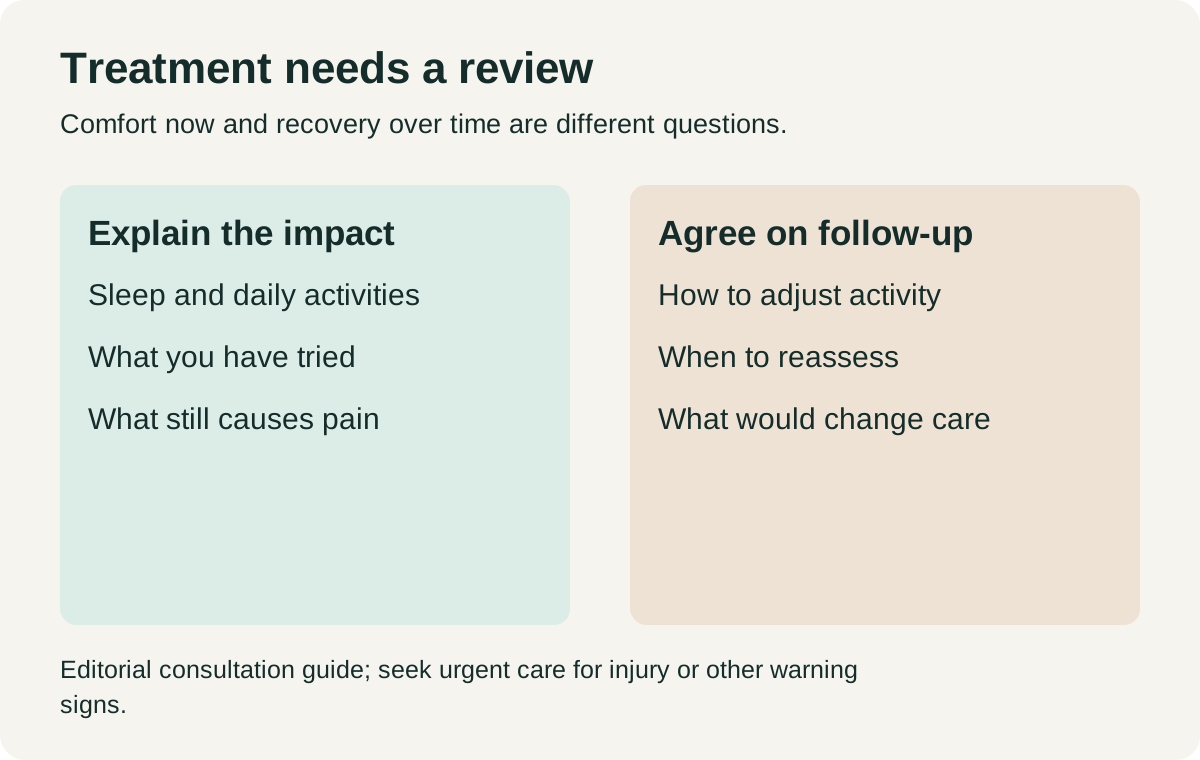
For a nonurgent review, our suggestion is to bring examples of what remains difficult rather than only saying that the elbow still hurts. Have you had to stop a task, ask someone to take over or change your work? What happened after the adjustments you tried? This makes it easier to discuss whether the current plan remains appropriate.
Ask when to return and what changes should trigger earlier contact. Recovery should not become a contest between your calendar and someone else's online testimonial. A planned review provides a place to discuss a slow course without treating every difficult day as failure or every comfortable day as clearance for unrestricted activity.
Where to go from here with elbow pain?
Start with an assessment when pain persists, a record of aggravating tasks and a clear goal for daily function. Use related guides to prepare questions about other symptoms, not to diagnose yourself. A useful next step connects what you can safely do now with when the treatment plan will be reviewed.
Our joint pain after 40 guide is the cluster starting point if several areas are bothering you. For pain that appears localized to the outer elbow, take the task inventory and treatment questions from this article to the clinician rather than collecting several unrelated treatment plans.
If your concern includes broader stiffness or swollen joints, our osteoarthritis versus rheumatoid arthritis explainer introduces differences worth discussing. It cannot tell you whether either condition explains your elbow symptoms. The purpose of the link is to improve the questions you bring, not to replace the examination.
Before you leave an appointment, try to have three practical answers: what is the working explanation, what is the next step, and when should we reconsider? If your job makes the advice difficult to follow, say so. A plan that acknowledges your circumstances is easier to discuss and review than one that remains vague.
Finally, separate information gathering from treatment shopping. A strap, a supplement, a therapy package and an injection each raise different questions. You do not need to buy something from every category to demonstrate commitment. Start with the problem that has actually been assessed and the next decision that needs making.
Key takeaways
- Tennis elbow concerns tendons near the outer elbow; the name does not require a history of tennis.
- Record gripping demands, task duration and changes at work or home to support assessment.
- A brace may ease symptoms, but it does not confirm healing or make every activity safe.
- Physical therapy and injections need realistic goals and a discussion of evidence limits.
- Persistent pain deserves review; injury warning signs, fever, numbness or chest symptoms change the urgency.
Where to go from here
Frequently asked questions
Can you get tennis elbow without playing tennis?
Yes. Tennis elbow can occur with repetitive or forceful forearm activity at work, around the home or during other sports. Sometimes there is no obvious trigger. Describe your activities and symptoms to a clinician rather than assuming the name excludes you or proves what caused your elbow pain.
Should I wear a brace for tennis elbow?
A forearm strap or wrist brace may ease symptoms for some people. Ask about an appropriate type and fit, and follow its instructions. A brace should have a clear purpose within your plan; it does not establish that the tendon has healed or permit unrestricted activity despite pain.
Can I keep lifting weights with tennis elbow?
That depends on the assessment, the movements involved and your symptoms. Reduce activities that aggravate pain and ask a clinician or physical therapist about appropriate modifications and progression. Do not use a brace or pain medicine as clearance to continue the same workout when the elbow remains troublesome.
Are steroid injections a permanent cure for tennis elbow?
No injection guarantees a permanent cure. Steroid injections may relieve pain in the short term, but a randomized trial found greater recurrence and poorer recovery at one year than placebo injection. Discuss the expected duration of benefit, risks and alternatives with the clinician before deciding on a procedure.
Does PRP have strong evidence for tennis elbow?
A 2021 Cochrane review found little or no clinically important improvement in pain or function from autologous blood or PRP injections compared with placebo. That does not predict every individual experience, but it argues against guaranteed healing claims. Ask about the evidence, costs, risks and alternatives before treatment.
When is elbow pain urgent rather than routine tennis elbow?
Severe pain with limited movement after injury, deformity, new numbness or a swollen elbow with fever needs urgent assessment. Sudden arm pain with chest pressure or heaviness requires emergency help. Persistent symptoms also deserve review, even without those warning signs; an online guide cannot confirm that tennis elbow is the cause.
Sources
- AAOS OrthoInfo: Tennis Elbow (Lateral Epicondylitis)
- American Orthopaedic Society for Sports Medicine: Tennis Elbow
- NHS: Tennis elbow
- NHS: Elbow and arm pain
- NHS: Ibuprofen for adults
- Wallis et al., Cochrane, 2024: Manual therapy and exercise for lateral elbow pain
- Coombes et al., JAMA, 2013: Effect of corticosteroid injection, physiotherapy, or both on clinical outcomes in patients with unilateral lateral epicondylalgia: a randomized controlled trial
- Karjalainen et al., Cochrane, 2021: Autologous blood and platelet-rich plasma injection therapy for lateral elbow pain
How we prepared this guide. We compared the named sources listed above on October 25, 2026. Practical suggestions for organizing a consultation are labeled as ours; they are not results of a clinical trial. This article is not medically reviewed, and no personal treatment experience is claimed.

Male Health Guide Editorial Team
We write about the health problems men over 40 actually search for at 3 a.m. — and we say plainly when the evidence for a popular product is thin. We do not invent credentials and we do not publish sponsored copy as editorial. Read more about how we work.
Medical disclaimer: This article is general information, not individual medical advice. We are not doctors. A qualified clinician should assess your symptoms, test results and treatment. Seek urgent care for severe or sudden symptoms.