Gout After 40: What the Blood Test Can Miss
Short answer
Gout is a sudden, severe joint attack caused by uric acid crystals, most often starting in the big toe. The blood test doctors use to confirm it can be misleading: in the largest trials of acute gout, about 1 in 7 men had a completely normal reading during the attack itself. A normal result mid-flare does not rule gout out — it needs to be rechecked later.
It usually starts at night, in a joint that was perfectly fine twelve hours earlier. By morning the big toe is swollen, hot to the touch, and so tender that a bedsheet resting on it is unbearable. Men who have never had a reason to think about their joints before suddenly find themselves searching “why does my toe feel like it's on fire” at 3 a.m.
This article covers what a gout attack actually is, why the blood test everyone expects to confirm it can come back deceptively normal, how much diet really controls it versus how much it doesn't, and the one red flag that means this isn't gout at all and needs same-day care.
What a gout attack actually feels like
Gout is a type of arthritis that occurs when uric acid builds up in the blood and forms sharp crystals in the fluid around a joint, triggering sudden inflammation. MedlinePlus describes the onset in terms most men who have had one will recognize immediately.
The pain starts suddenly, often during the night. Pain is often severe, described as throbbing, crushing, or excruciating. The joint appears warm and red. It is most often very tender and swollen.
MedlinePlus, National Library of MedicineThe big toe, knee and ankle are the most commonly affected joints, and most attacks involve only one joint at a time, at least at first. Left untreated, the pain can resolve on its own within days to a couple of weeks — but without addressing the underlying uric acid level, it tends to come back, often within six to twelve months, and repeated attacks can eventually involve more than one joint.
The blood test that can lie to you mid-attack
The standard advice is to get a uric acid blood test when a joint flares up red and hot. What rarely gets mentioned is how often that exact test comes back looking unremarkable during the attack it's supposed to confirm.
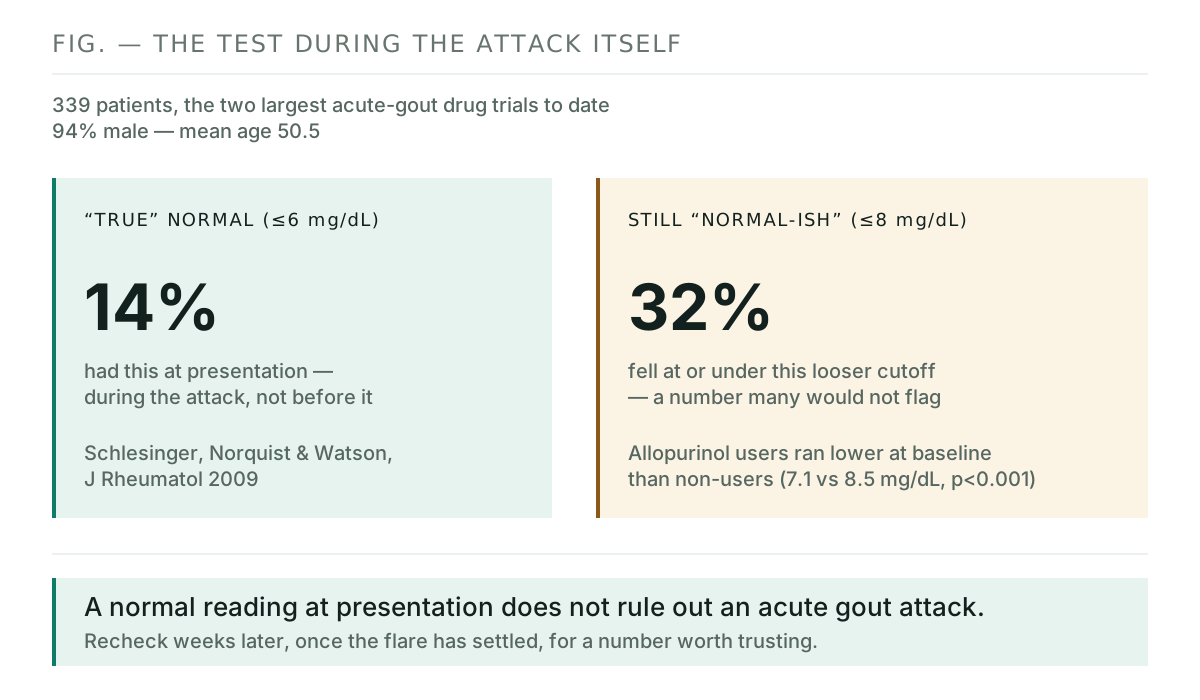
A 2009 analysis combined data from the two largest randomized trials of acute gout treatment to date — 339 patients, 94% of them men, with a mean age of 50.5. Everyone enrolled had an active, confirmed gout attack. Here is what their uric acid levels actually looked like at that exact moment.
At baseline, 14% of patients had a “true” normal SU (≤6 mg/dl) and 32% had SU≤8 mg/dl during acute gout. A normal SU level at presentation does not exclude an acute gouty attack.
Schlesinger, Norquist & Watson, Journal of Rheumatology, 2009The authors' own explanation is specific rather than mysterious: during an attack, some uric acid gets pulled out of the bloodstream and deposited as crystals in and around the joint, including into existing tophi, which can temporarily lower what shows up in a blood draw even while the joint itself is in the middle of a crystal-driven attack.
A normal reading taken during an active flare is not the same as a normal reading taken after things calm down. If gout is still suspected, the level is worth rechecking two to four weeks after the attack has settled, once the body isn't mid-crystal-formation — that number is the one worth trusting.
Why gout happens in the first place
Gout develops when the body makes too much uric acid, can't clear it efficiently through the kidneys, or both. Past a certain concentration, uric acid stops staying dissolved in the blood and starts forming needle-shaped crystals, usually in a cooler joint like the big toe, which the immune system then attacks as if it were an infection — producing the same heat, swelling and pain a real infection would.
MedlinePlus lists several of the risk factors plainly: being male, having a family history of gout, being overweight, drinking alcohol, advanced age, and having diabetes or kidney disease. Diet heavy in purine-rich food adds to the risk too, through a separate mechanism covered in detail below. Certain medications matter as well — diuretics (“water pills”) prescribed for blood pressure are a specifically recognized trigger, which is worth mentioning to whoever prescribes yours if gout becomes a recurring problem.
How gout is actually diagnosed
Given how misleading a blood test can be mid-attack, the test that actually confirms gout is a different one: drawing fluid directly from the swollen joint and examining it under a microscope for needle-shaped uric acid crystals. It is the same procedure that rules out a joint infection at the same time, which is exactly why it is the standard for a first-ever attack rather than a blood draw alone.
A blood uric acid level above 7.2 mg/dL is generally considered high, and doctors may also order joint X-rays to check for damage from repeated attacks, or a urine test to see how much uric acid the kidneys are clearing. None of these replace the joint fluid test when the diagnosis genuinely isn't clear — they add context around it.
Diet matters less than the folklore says
Red meat, organ meat, shellfish and beer carry gout's worst reputation, and the reputation is not undeserved — but the actual math behind it surprises most men who assume diet alone can fix a high number.
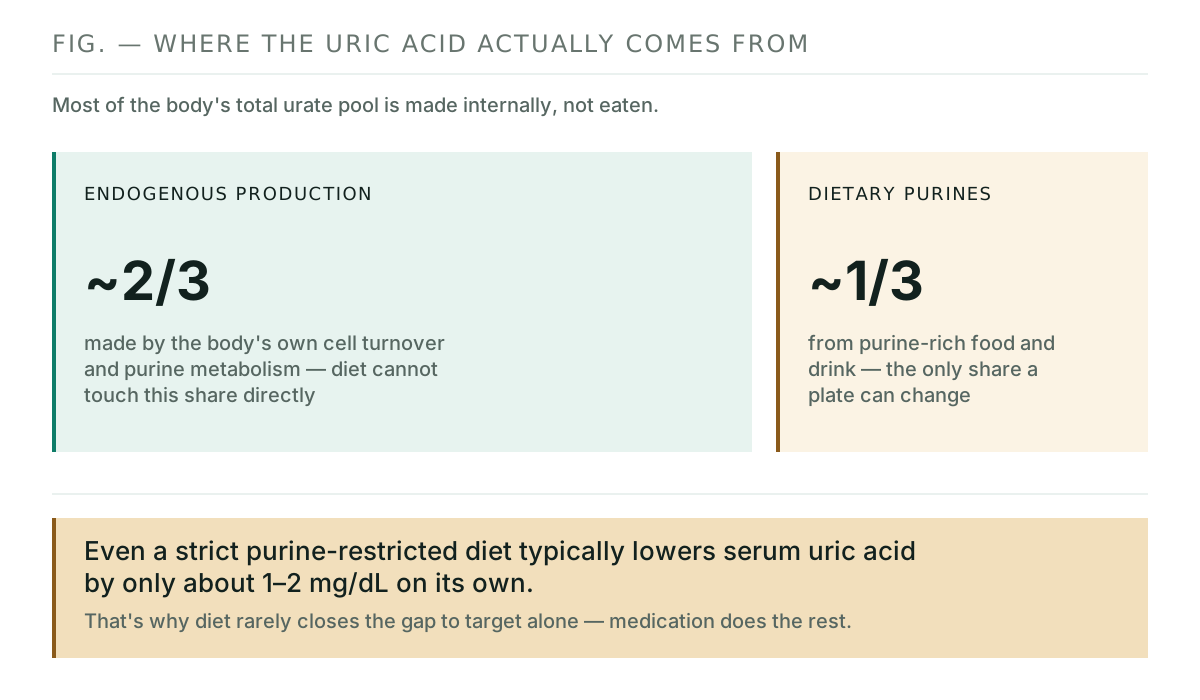
About two-thirds of the body's total uric acid pool comes from the body's own cell turnover and purine metabolism; only about one-third comes from food and drink. That ratio is the reason even a genuinely strict, purine-restricted diet typically moves serum uric acid by only around 1–2 mg/dL on its own — rarely enough, by itself, to bring a high number down to the treatment target.
That doesn't make diet pointless. One specific finding is worth knowing on its own: in a 12-year study of over 46,000 men with no gout history, drinking two or more sugar-sweetened soft drinks a day was linked to an 85% higher risk of developing gout compared with men who rarely drank them, and the men in the highest fifth of fructose intake overall had roughly double the risk of those in the lowest fifth.
The multivariate relative risk of gout for…two or more servings a day was 1.85 (1.08 to 3.16; P for trend=0.002)…Diet soft drinks were not associated with risk of gout (P for trend=0.99).
Choi & Curhan, BMJ, 2008Notably, diet soda showed no association at all — it's specifically the sugar, not the carbonation or the habit of drinking soda, doing the damage. The same study found that fruit juice and fructose-rich fruits like apples and oranges were also linked to higher risk, which surprises men who assume “healthy” automatically means “safe for gout.”
Put together: cutting sugary drinks is one of the higher-leverage diet changes available, beer and spirits are worth moderating more than wine, and weight loss helps — but none of it replaces medication for a man whose number needs to come down and stay there.
How a gout attack actually gets treated
Treatment splits cleanly into two different jobs: calming down the attack that's happening right now, and lowering the uric acid level so the next one is less likely.
| Goal | What's typically used | What it does |
|---|---|---|
| Calm the current attack | NSAIDs, colchicine, or a short course of a steroid (oral, injected, or into the joint) | Reduces inflammation within days; does not lower uric acid |
| Lower uric acid long-term | Allopurinol (first choice), or febuxostat | Started low and raised gradually, aiming for a level under 6 mg/dL |
| Bridge the gap when starting #2 | Low-dose colchicine or an NSAID for 3–6 months | Prevents the flare that starting urate-lowering therapy can itself trigger |
That third row surprises men who assume the “fixing” medication should only make things better right away. It can temporarily do the opposite: a falling uric acid level can mobilize crystals out of existing deposits and trigger a flare — exactly why guidelines pair it with a few months of flare-prevention medication, rather than treating that early flare as a sign the new drug isn't working.
The American College of Rheumatology recommends a treat-to-target strategy: starting allopurinol at a low dose (no more than 100 mg/day, lower still with kidney disease) and raising it gradually, guided by repeat blood tests, until uric acid is reliably under 6 mg/dL — not a one-time prescription and done.
When it isn't gout: the red flag that changes everything
Everything above assumes the hot, swollen joint actually is gout. There is one look-alike that cannot wait for a scheduled appointment, and the two conditions can be hard to tell apart by symptoms alone.
- Fever, chills, or feeling generally unwell alongside the joint symptoms
- A joint that is intensely painful, worse with any movement, and swelling that came on fast
- A known risk factor — an artificial joint, diabetes, a weakened immune system, IV drug use, or a recent joint injury, injection or surgery
Based on MedlinePlus (National Library of Medicine) guidance on septic arthritis
A bacterial joint infection — septic arthritis — produces a strikingly similar picture: a hot, swollen, intensely painful joint that comes on quickly, often with fever. The uncomfortable fact is that fever is common to both and is not a dependable way to tell them apart on its own. Unlike a gout flare, an untreated joint infection is a genuine emergency that risks lasting damage to the joint, and the two can even occur together in the same joint.
The good news is that the same test used to diagnose gout — drawing fluid from the joint and examining it — is also how an infection gets ruled in or out, by looking for bacteria alongside the uric acid crystals. This is precisely why a first-ever hot, swollen joint, especially with any of the signs above, belongs in urgent care or an emergency room rather than treated as “probably gout” on a guess.
Living with gout after the first attack
Not every man who has one gout attack needs to start daily medication immediately. Guidelines generally reserve ongoing urate-lowering therapy for men with frequent flares, visible uric acid deposits under the skin (tophi), kidney stones linked to uric acid, or joint damage already showing on imaging — a single, first-ever attack is often treated and then watched rather than medicated for life on the spot.
That calculus changes quickly once attacks repeat. Each flare is also a reasonable prompt to review muscle and joint strength generally, which connects to the broader picture covered in our guide to joint pain after 40, since an inflamed big toe changes how a man walks for days afterward, and that altered gait has its own knock-on effects on the knee and hip above it.
If you've had more than one attack, ask directly whether you're a candidate for daily urate-lowering therapy, what your actual target number is, and whether your blood pressure medication (specifically a diuretic) could be contributing — all three are reasonable, specific questions that move the conversation past “here's something for the pain.”
Key takeaways
- A normal uric acid blood test during an active attack does not rule out gout — in the largest trials, 14% of confirmed cases had a truly normal reading at that exact moment.
- About two-thirds of the body's uric acid is produced internally, not eaten; even strict diet changes typically move the number by only 1–2 mg/dL.
- Sugar-sweetened soft drinks are specifically linked to higher gout risk (85% higher at two or more a day); diet soda is not.
- Treating the current attack and lowering uric acid long-term are two different jobs, and starting urate-lowering therapy can itself trigger a short-term flare — which is expected, not a failure.
- Fever plus a hot, swollen joint needs same-day care, because septic arthritis can look identical to gout and can destroy a joint within days if missed.
Where to go from here
If gout is what brought you here, these pages cover the ground around it:
- Joint Pain After 40: What's Actually Wearing Down — the complete guide to the three different things joint pain can mean.
- Osteoarthritis vs Rheumatoid Arthritis: What Differs — the other two conditions a hot, swollen joint sometimes turns out to be.
- Knee Pain: What's Different About Where It Hurts — for when gout lands in the knee instead of the toe.
- Glucosamine for Joint Pain: What the Trials Found — a different joint problem, and a supplement question worth reading honestly.
- Plantar Fasciitis: Why the First Step Hurts Most — another lower-body problem where the obvious suspect, a heel spur, almost never explains the pain.
Frequently asked questions
Is gout the same as arthritis?
Gout is one specific type of arthritis, caused by uric acid crystals forming in a joint, not a separate condition from it. It is distinct from osteoarthritis and rheumatoid arthritis, which have different causes and are covered in our guide to osteoarthritis vs rheumatoid arthritis.
Can my uric acid blood test be normal and I still have gout?
Yes, and this catches a lot of men off guard. In the two largest trials of acute gout treatment, 14% of patients had a completely normal reading at presentation, and 32% were still at or under a looser cutoff many clinicians wouldn't flag as alarming. A normal result during the attack itself does not rule gout out; it needs to be rechecked weeks later.
Will cutting out red meat and beer cure my gout?
It helps, but it is not the whole answer. About two-thirds of the body's uric acid is produced internally rather than eaten, so even strict diet changes typically lower the level by only 1-2 mg/dL. Most men who need their number controlled also need medication.
What's the difference between a gout flare and a joint infection?
Fever plus a single hot, swollen joint can be either one, and fever alone does not reliably tell them apart. A joint infection is a same-day emergency that can destroy the joint within days, so any new hot, swollen joint with fever needs to be seen immediately, not assumed to be gout.
Do I need daily medication after just one gout attack?
Not automatically. Guidelines reserve daily urate-lowering therapy for men with frequent flares, visible uric acid deposits called tophi, or joint damage already visible on imaging - a single attack is usually treated and watched, not immediately put on lifelong medication.
Why did my gout flare up right after I started losing weight?
Rapid changes in uric acid levels, in either direction, can trigger a flare even when the number is heading somewhere better long-term. It is a recognized, temporary side effect of the body adjusting, not a sign that the weight loss or new medication is failing.
Sources
- MedlinePlus (National Library of Medicine) — Gout
- MedlinePlus (National Library of Medicine) — Septic (bacterial) arthritis
- FitzGerald J.D. et al., American College of Rheumatology — 2020 American College of Rheumatology Guideline for the Management of Gout, Arthritis Care & Research, 2020
- Schlesinger N., Norquist J.M., Watson D.J. — Serum urate during acute gout, Journal of Rheumatology, 2009
- Choi H.K., Curhan G. — Soft drinks, fructose consumption, and the risk of gout in men: prospective cohort study, BMJ, 2008

Male Health Guide Editorial Team
We write about the health problems men over 40 actually search for at 3 a.m. — and we say plainly when the evidence for a popular product is thin. We do not invent credentials and we do not publish sponsored copy as editorial. Read more about how we work.
Medical disclaimer: This article is general information, not medical advice. We are not doctors, and nothing here diagnoses, treats or cures any condition. A hot, swollen joint always needs to be evaluated by a qualified healthcare professional who can see your own results and history. Please speak to one about your own situation rather than acting on what you read online, and seek emergency care for the warning signs described above.