Plantar Fasciitis: Why the First Step Hurts Most
Short answer
Plantar fasciitis is one of the most common causes of heel pain in adults — overuse damage and microtearing in the tissue band that supports the arch, not a heel spur, which research shows most people who have one never actually feel. More than 90% of cases improve with stretching, supportive shoes and time, usually without ever needing a cortisone shot or surgery.
It shows up the same way almost every time: the first steps out of bed feel like stepping on a tack, it eases off after a few minutes of walking, and then it comes back worse that evening after a long day on your feet. Most men assume a bone spur is digging into the heel. It almost never is.
Plantar fasciitis is one of the most common causes of pain on the bottom of the heel, and the American Academy of Orthopaedic Surgeons (AAOS) treats roughly 2 million patients for it every year. This article covers what is actually happening in the foot, why the morning pain pattern is so distinctive, why the spur gets blamed wrongly, and what the evidence — including a guideline update from 2025 — says actually helps.
What's actually tearing in there
The plantar fascia is a long, thin ligament that lies directly beneath the skin on the bottom of the foot. It connects the heel to the front of the foot and supports the arch, and it is built to absorb the stress of every step you take. Plantar fasciitis happens when too much pressure damages or tears that tissue, and the body's response to the injury — inflammation — produces the heel pain and stiffness, according to AAOS.
MedlinePlus describes the same process from the other direction: swelling occurs when the band of tissue on the bottom of the foot is overstretched or overused, which makes walking more painful. Interestingly, MedlinePlus also lists “plantar fasciosis” and “plantar fasciopathy” as alternate names for the same condition — terms that point more toward tissue breakdown than toward classic inflammation. That distinction is part of why rest and ice alone rarely fix it for good: the tissue needs to be stretched and strengthened, not just calmed down.
Why the first step hurts worst
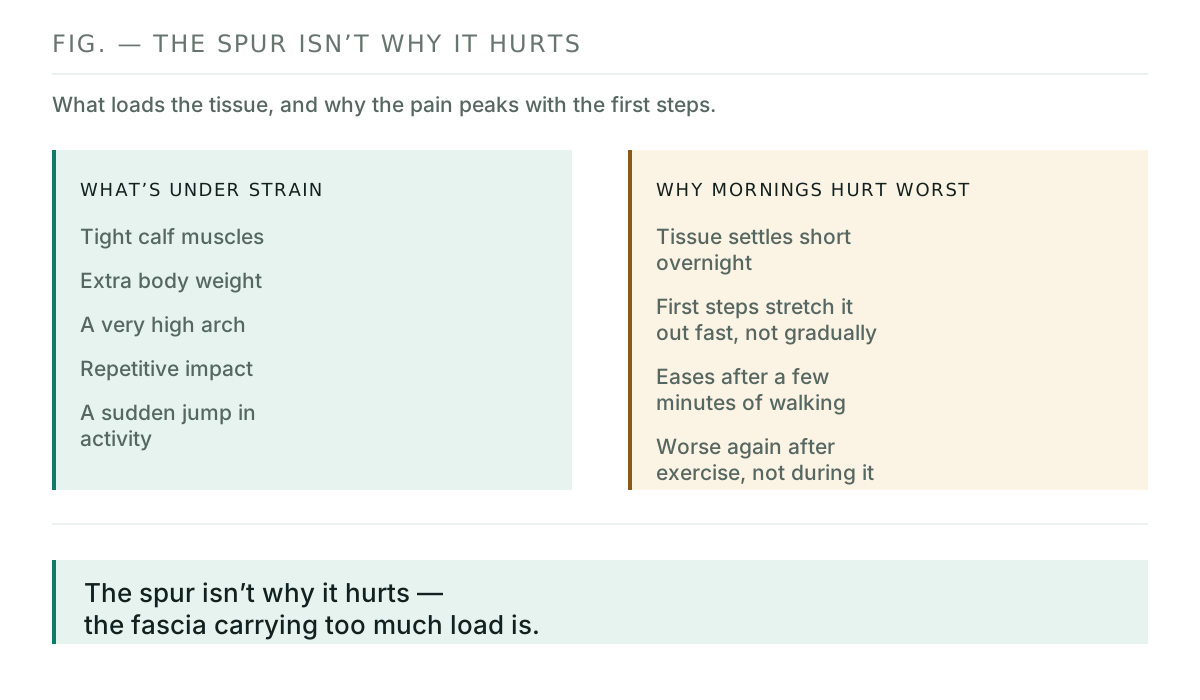
AAOS and MedlinePlus both describe the same unmistakable pattern: pain with the first few steps after getting out of bed, or after any long period of rest such as a car ride, that eases after a few minutes of walking — and pain that is worse after exercise, not during it.
The likely mechanical reason follows directly from what the tissue is doing. A plantar fascia with small tears in it partially settles, and shortens slightly, while you are off your feet. The first steps of the day pull that shortened, partially healed tissue back out to its full length all at once, which is sharper than the ache that returns gradually later from ordinary use. It is also why a night splint, covered further down, works on exactly this mechanism by keeping the fascia stretched while you sleep instead of letting it shorten.
Who gets it, and why
MedlinePlus lists the main risk factors: foot arch problems — both flat feet and very high arches — running long distances or on uneven ground, being obese or gaining weight suddenly, a tight Achilles tendon, shoes with poor arch support or soft soles, and any change in activity level. AAOS adds tight calf muscles specifically, since they make it harder to flex the foot and bring the toes up toward the shin, and notes that in most cases, plantar fasciitis develops without any single identifiable reason.
None of that is exotic. It is a few extra pounds, an Achilles tendon that has quietly gotten tighter with years of sitting at a desk, and a sudden burst of weekend activity after a slow winter — exactly the combination a lot of men run into for the first time somewhere around 40, not because the foot is wearing out on a schedule, but because the risk factors pile up at that point in life.
The heel spur myth
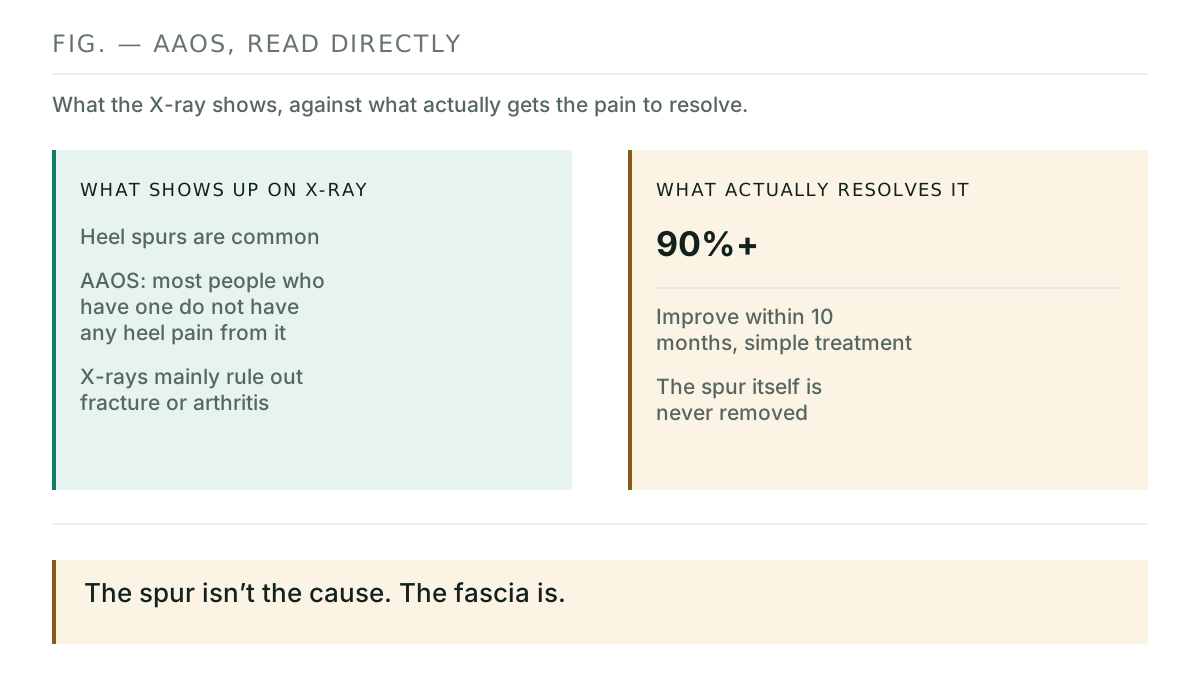
This is the part almost every patient gets told wrong by instinct, if not by a clinician: that a bone spur is the cause of the pain, and that removing it would fix things. AAOS is direct about it — a heel spur can form from longstanding tension where the plantar fascia attaches to the heel bone, and although many people with plantar fasciitis have one, AAOS states plainly that most people who have bone spurs on their heels do not have heel pain. Because the spur is not the cause, the pain can be treated without ever removing it.
MedlinePlus independently confirms the same point: plantar fasciitis was commonly thought to be caused by a heel spur, but research has found that this is not the case — on X-ray, heel spurs are seen in people with the condition and in people without it. X-rays are still useful, but mainly to rule out a fracture or arthritis, not to find the explanation for the pain. MRI and ultrasound are not routinely ordered; AAOS reserves them for cases where the pain does not respond to initial treatment.
What actually works, in order
The good news buried in all of this: more than 90% of patients improve within 10 months of starting simple treatment, according to AAOS, and MedlinePlus puts the realistic timeline at several months to two years, with most people feeling better within 6 to 18 months. Neither source is promising an overnight fix, but both agree that surgery is rarely where this ends up.
The standard first steps, per AAOS: rest from the activities that make it worse; rolling the foot over a cold water bottle or ice for 20 minutes, 3 to 4 times a day; an over-the-counter anti-inflammatory such as ibuprofen or naproxen, reviewed with a doctor if used past a month; and stretching, both the calf and the plantar fascia itself, which AAOS calls the most effective way to relieve the pain this condition causes.
A 2025 guideline summary in American Family Physician, drawn from the American Physical Therapy Association, adds a genuinely useful update to that advice. Stretching the plantar fascia and the calf muscles is backed by low- to moderate-quality evidence — real, but not overwhelming — while strengthening exercises for the toe flexors, the muscles that turn the ankle in and out, and the calf muscle improve pain and function more than stretching alone. In plain terms: the stretch most men already know about helps, but adding a few minutes of toe-curl and ankle-resistance work on top of it is the upgrade most self-treatment plans are missing.
Supportive shoes and orthotics matter for a specific mechanical reason: every heel strike puts tension on the fascia, and a cushioned shoe or insert reduces that tension and the microtrauma it causes with every single step, per AAOS. Night splints work the opposite angle — because most people sleep with their feet pointed down, which relaxes the fascia and is part of why the morning is worse, a splint holds the fascia stretched overnight instead.
Cortisone shots: the catch
Cortisone is a genuinely effective anti-inflammatory, and a shot into the plantar fascia can reduce pain fast. The catch is in the fine print: AAOS warns that your doctor may limit how many you can have, because multiple steroid injections can cause the plantar fascia itself to rupture, which can lead to a flattened foot and chronic pain — a worse problem than the one the shot was treating. One injection, used carefully as part of a broader plan, is a different decision than returning for a shot every time the pain flares.
When a boot, shockwave or surgery enters the picture
If the standard steps do not work, MedlinePlus lists the next tier: a removable boot cast, worn for 3 to 6 weeks, that looks like a ski boot and can come off for bathing; custom-made shoe inserts; and steroid injections. AAOS also covers extracorporeal shockwave therapy (ESWT), a noninvasive option that uses high-energy impulses to try to stimulate healing — it has not shown consistent results and is not commonly performed, but its low risk makes it something some clinicians try before surgery is discussed.
AAOS is explicit that surgery is considered only after about 12 months of aggressive nonsurgical treatment. Of the two options, lengthening the calf muscle carries a specific, documented risk — nerve damage and calf weakness, per AAOS — while partially cutting the fascia itself is the more involved procedure of the two. AAOS notes plainly that because surgery overall can result in chronic pain and dissatisfaction, it is recommended only once every nonsurgical option has genuinely been exhausted, not as a shortcut past months of stretching.
When this probably isn't plantar fasciitis
A few patterns point somewhere else, and are worth mentioning to a doctor rather than stretching through:
- Burning, tingling or numbness, rather than a dull ache. MedlinePlus describes a different condition, tarsal tunnel syndrome, caused by compression of the tibial nerve — sometimes by a bone spur or a ganglion cyst pressing on the nerve itself, or by flat feet or a high arch. The sensation runs along the nerve's path and can include weakness, not just pain.
- A sudden pop or snap, followed by bruising or swelling. That pattern suggests an actual tear of the fascia or Achilles tendon, not gradual overuse, and is worth a prompt exam rather than a stretching routine.
- Both heels at once, with stiffness in other joints too. Mechanical overuse is usually one-sided or clearly tied to one foot's activity. Pain in both heels alongside other joint symptoms is worth describing to a doctor as its own pattern, not assumed to be ordinary plantar fasciitis twice over.
- Fever, redness, warmth, or an inability to bear weight after an injury. Those point toward infection or a possible fracture, and deserve a same-week visit rather than a wait-and-see approach.
Key takeaways
- Plantar fasciitis is overuse damage and microtearing in the ligament supporting the arch — AAOS treats about 2 million cases a year.
- The heel spur gets blamed, but AAOS states most people who have one do not have heel pain from it — confirmed independently by MedlinePlus.
- More than 90% of patients improve within 10 months of simple treatment: rest, ice, NSAIDs and stretching (AAOS).
- A 2025 guideline update found strengthening exercises for the toe flexors and ankle beat stretching alone for pain and function.
- Cortisone shots work but are limited on purpose — repeated injections can rupture the fascia itself.
Where to go from here
If heel pain is what brought you here, these pages cover the surrounding ground:
- Joint Pain After 40: What's Actually Wearing Down — the guide to the whole cluster.
- Knee Pain: What's Different About Where It Hurts — the same sort-by-location approach, one joint up.
- Hip Pain Explained: Why It's Often Not the Hip — another case where the obvious suspect usually isn't the real one.
- Glucosamine for Joint Pain: What the Trials Found — the supplement question, for a different tissue.
- Gout After 40: What the Blood Test Can Miss — another foot problem with its own myth about what proves it.
Frequently asked questions
What is plantar fasciitis, exactly?
Plantar fasciitis is irritation and microscopic tearing of the plantar fascia, the band of tissue that runs from the heel to the front of the foot and supports the arch. The American Academy of Orthopaedic Surgeons treats about 2 million patients for it every year, making it one of the most common causes of pain on the bottom of the heel.
Do I need an X-ray or MRI to confirm it?
Usually not. Doctors diagnose plantar fasciitis by examining the foot and asking about symptoms. X-rays are mainly used to rule out a fracture or arthritis. MRI and ultrasound are not routinely used and are reserved for cases where the pain does not respond to initial treatment.
Will a heel spur need to be removed?
Almost never. The American Academy of Orthopaedic Surgeons states that most people who have bone spurs on their heels do not have heel pain. Because the spur is not the cause of plantar fasciitis, the pain can be treated without removing it.
Are cortisone shots a good idea?
They can relieve pain, but doctors limit how many you get. The American Academy of Orthopaedic Surgeons warns that multiple steroid injections can cause the plantar fascia to rupture, which can lead to a flattened foot and chronic pain. One shot used carefully is a different decision than repeated shots as a maintenance plan.
Is surgery ever necessary?
Rarely, and only after about 12 months of aggressive nonsurgical treatment has failed. More than 90% of patients improve with rest, stretching, supportive shoes and time, according to the American Academy of Orthopaedic Surgeons, and surgery carries its own risk of nerve damage and chronic pain.
When should I see a doctor instead of waiting it out?
See a doctor sooner if the pain came on suddenly with a pop or visible bruising, if you have burning, tingling or numbness rather than a dull ache, if both heels hurt along with stiffness in other joints, or if you have fever, redness or cannot bear weight at all. Those patterns point away from ordinary plantar fasciitis.
Sources
- American Academy of Orthopaedic Surgeons (AAOS), OrthoInfo — Plantar Fasciitis and Bone Spurs
- MedlinePlus (National Library of Medicine) — Plantar Fasciitis
- MedlinePlus (National Library of Medicine) — Tarsal Tunnel Syndrome
- American Family Physician, summarizing American Physical Therapy Association guidelines — Plantar Fasciitis: Guidelines From the APTA (2025)

Male Health Guide Editorial Team
We write about the health problems men over 40 actually search for at 3 a.m. — and we say plainly when the evidence for a popular product is thin. We do not invent credentials and we do not publish sponsored copy as editorial. Read more about how we work.
Medical disclaimer: This article is general information, not medical advice. We are not doctors, and nothing here diagnoses, treats or cures any condition. Heel pain needs evaluation by a qualified healthcare professional who can examine your own foot and history. Please speak to one about your own situation, and never start, stop or change a prescribed treatment based on what you read online.