Testosterone and Erectile Dysfunction: Is Low T the Cause?
Short answer
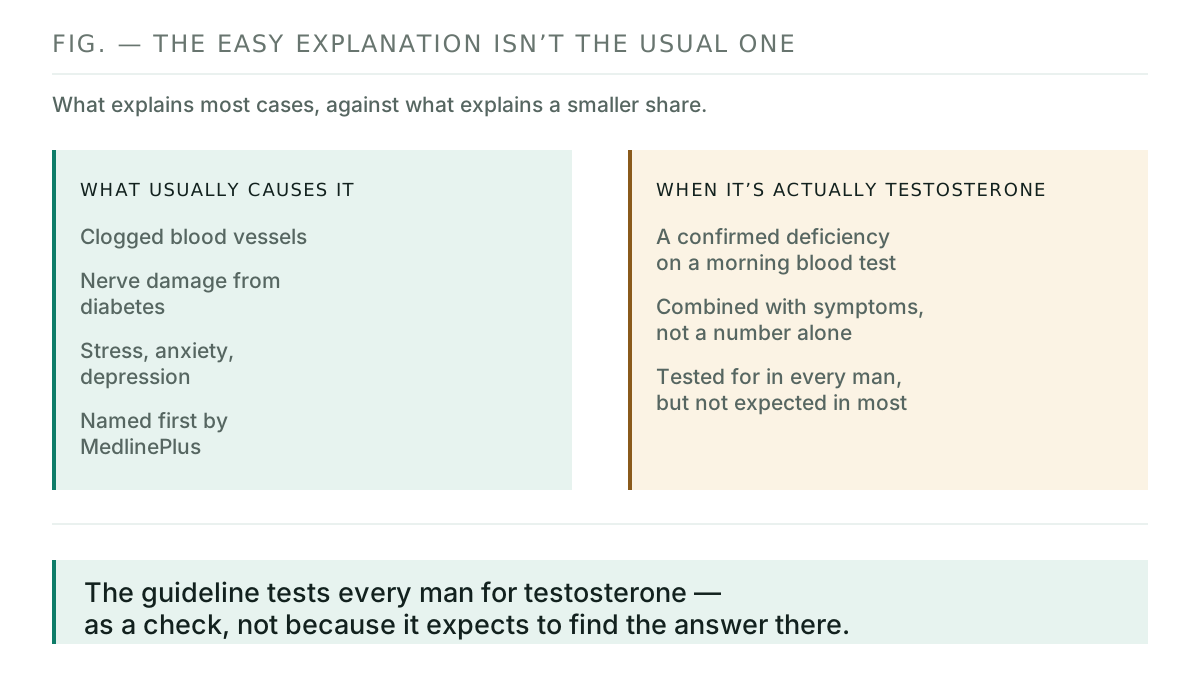
Testosterone and erectile dysfunction are often assumed to be the same problem, but most ED has a different cause entirely — usually blood flow, nerve function or a combination with diabetes, not hormones. The guideline still asks for a testosterone test in every case, and treats the two together only when a deficiency is actually confirmed, not assumed from symptoms alone.
It is the explanation almost every man reaches for first, because it is the one that sounds least embarrassing and most fixable: low testosterone. One blood test, one prescription, back to normal.
The actual evidence does not cooperate with that story. This article sets out what the American Urological Association's erectile dysfunction guideline actually says about testosterone — when to test for it, when it is genuinely the answer, when raising it will not help, and the one finding in the same guideline that most men never hear about at all.
Why it is tempting to blame the hormone
Testosterone is linked to sex drive, and sex drive feels adjacent to sexual function, so the logic seems to connect cleanly. It mostly does not. Desire and mechanical function are separate systems that happen to share a neighborhood, which this site's low testosterone symptoms article covers from the hormone side: reduced erectile function is one of only three symptoms found to have a real, syndromic relationship with the testosterone level in the European Male Ageing Study, and it is listed alongside low sexual desire and poor morning erections — not alongside the mechanical reliability of an erection once it starts.
What usually causes it
MedlinePlus is direct about where to look first. Describing the common causes, it notes that erectile dysfunction may mean your blood vessels are clogged, or that you have nerve damage from diabetes — two mechanical and vascular explanations that have nothing to do with hormone levels.
Add psychological contributors — stress, anxiety about performance, depression — and medication side effects, and the honest picture is that testosterone sits well down a list headed by the circulatory system, the nervous system and diabetes. That ordering is why a guideline built from evidence still spends most of its attention on those three.
What the guideline actually says
The AUA's erectile dysfunction guideline does not skip testosterone. It asks for it to be checked in every man, precisely because it is treatable when genuinely low — not because it is expected to be the answer.
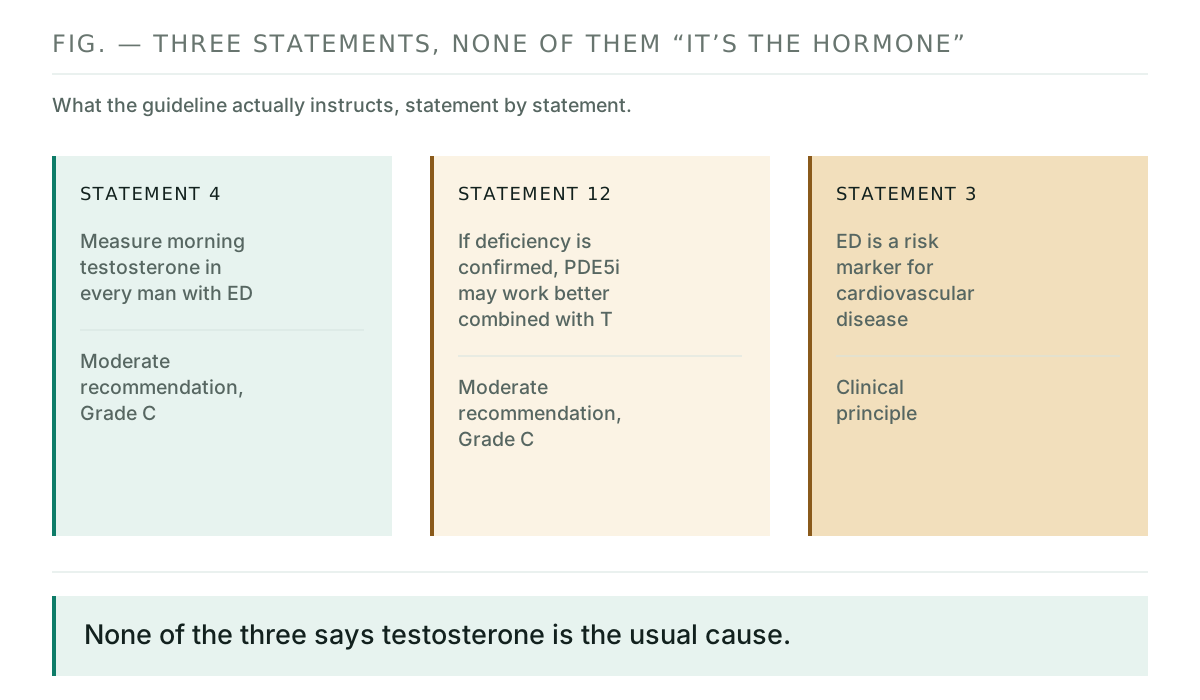
In men with Erectile Dysfunction, morning serum total testosterone levels should be measured.
AUA Erectile Dysfunction Guideline, Statement 4 — Moderate Recommendation, Evidence Grade CNotice what grade that statement carries. A moderate recommendation at evidence grade C is real guidance, not the guideline's strongest category — the kind of grading reserved for a test worth doing on everyone, not a smoking gun expected in most of them.
The ED guideline itself does not spell out the exact number that counts as deficient; for that, it defers to the companion testosterone deficiency guideline, the same one covered elsewhere on this site. That separation matters in practice: a clinician treating ED is instructed to measure the number, not to interpret it against a different, looser standard just because the question started with a sexual symptom rather than fatigue or low desire.
When testosterone actually is the answer
A confirmed deficiency is a specific finding, not a feeling. It means a morning blood draw that actually meets the threshold used elsewhere on this site in low testosterone after 40 — together with symptoms, not a number alone, and not a reading that merely sits on the low end of a wide reference range covered in normal testosterone levels by age. A man who clears that bar is in a genuinely different situation from one whose number is simply unremarkable.
Why the guideline pairs it with treatment, not instead of it
Even once a deficiency is confirmed, the guideline does not swap testosterone in for the standard treatment. It adds it alongside.
Men with Erectile Dysfunction and testosterone deficiency who are considering ED treatment with a PDE5 inhibitor should be informed that a PDE5 inhibitor may be more effective if combined with testosterone therapy.
AUA Erectile Dysfunction Guideline, Statement 12 — Moderate Recommendation, Evidence Grade CRead the sentence precisely. It is about improving how well a PDE5 inhibitor — the standard drug class — works, in men who already have a confirmed deficiency. It is not a statement that testosterone alone treats erectile dysfunction, and it says nothing about men whose level is normal.
Testosterone monotherapy for a man with ED and a normal testosterone level has no support in this guideline. If a clinic offers to start testosterone before confirming it is actually low, that is the moment to ask what the number was and what threshold it was measured against.
The warning most men never hear
Of the three statements covered here, this is the one with the least to do with hormones and the most practical weight.
Men should be counseled that ED is a risk marker for underlying cardiovascular disease and other health conditions that may warrant evaluation and treatment.
AUA Erectile Dysfunction Guideline, Statement 3 — Clinical PrincipleThe mechanical reason is straightforward: the arteries supplying the penis are smaller than the coronary arteries supplying the heart, so narrowing from atherosclerosis tends to produce a noticeable symptom there first. A new erectile problem, particularly in a man with other cardiovascular risk factors, is treated in the guideline as a reason to ask about the heart, not only about the hormone. This is also why erectile dysfunction appears, in passing, in the site's own nuclear stress test coverage — the two questions share plumbing.
What getting tested actually involves
If testosterone has not been checked, the process is the same one covered in the testosterone test that actually tells you something: an early morning sample, because levels fall across the day, and ideally a second one to confirm before anything is treated as a diagnosis. A single afternoon reading is not the basis the guideline is describing.
Alongside it, a clinician working through ED properly will typically also look at the vascular and metabolic side — blood pressure, blood sugar, cholesterol — because those are where most of the explanatory weight actually sits, and because the cardiovascular question above cannot be skipped just because a hormone test was ordered too.
What to ask before starting any treatment
Whether the next step is a prescription, a referral, or a testosterone trial, a short list of questions keeps the decision honest.
- Was testosterone actually measured, on an early morning sample? Not assumed, not guessed from symptoms.
- Did it meet the threshold for deficiency, or just sit on the low end of normal? The two are treated very differently by the guideline.
- If testosterone is being added, is it alongside a PDE5 inhibitor or instead of one? The evidence supports the former, not the latter.
- Has anyone raised the cardiovascular question? If not, ask it directly — it is a clinical principle in the same guideline, not an optional extra.
- What are the vascular and diabetic contributors, and is anything being done about them? They outrank the hormone in most men.
None of this is a reason to avoid testosterone therapy when it is genuinely indicated — it is a reason to make sure “genuinely indicated” was actually established before it starts.
Key takeaways
- Most erectile dysfunction is vascular, neurologic or diabetes-related, not hormonal — MedlinePlus names clogged blood vessels and diabetic nerve damage first.
- The AUA guideline still asks for a morning testosterone test in every man with ED (Statement 4, moderate recommendation) — as a check, not an assumption.
- Testosterone therapy is only paired with PDE5 inhibitors when deficiency is confirmed (Statement 12, moderate recommendation) — never as a standalone cure, and not for a normal level.
- ED is a clinical-principle risk marker for cardiovascular disease (Statement 3) — the penile arteries are smaller and narrow first.
- A low-normal reading is usually not the explanation; ask whether a true deficiency was confirmed before any hormone treatment begins.
Where to go from here
If testosterone and ED are what brought you here, these pages cover the surrounding ground:
- Low Testosterone After 40: The Number and What It Means — the guide to the whole diagnosis.
- Low Testosterone Symptoms: Which Ones Actually Point at It — where erectile function fits among the real symptoms.
- The Testosterone Test That Actually Tells You Something — how the sample has to be taken.
- Testosterone Replacement Therapy: What Each Form Does — what treatment actually involves once confirmed.
- Normal Testosterone Levels by Age: What the Chart Hides — why low-normal is not the same as deficient.
- What a Nuclear Stress Test Actually Involves — one path the cardiovascular question can lead to.
Frequently asked questions
Is erectile dysfunction usually caused by low testosterone?
Usually not. Most erectile dysfunction comes from vascular problems, nerve damage from diabetes, or a mix of physical and psychological factors. Testosterone is still tested in every man with ED because it is a treatable piece when it is genuinely low, not because it is the most common explanation.
Does the ED guideline recommend testing testosterone?
Yes. The AUA's erectile dysfunction guideline states that in men with ED, morning serum total testosterone levels should be measured, a moderate recommendation. It does not say testosterone is the likely cause; it says the question should be answered rather than assumed either way.
Does testosterone therapy cure erectile dysfunction?
Only when a deficiency is actually confirmed. The guideline states that men with ED and confirmed testosterone deficiency who are considering treatment with a PDE5 inhibitor should be told that the drug may work better combined with testosterone therapy. It does not recommend testosterone alone, and it does not apply to men whose level is normal.
Can erectile dysfunction be a sign of heart disease?
Yes. The same guideline states that men should be counseled that ED is a risk marker for underlying cardiovascular disease and other health conditions that may warrant evaluation and treatment, a clinical principle. The blood vessels serving the penis are smaller than the coronary arteries, so narrowing can show up there first.
If my testosterone is low-normal, will raising it fix ED?
Not reliably. The guideline's combination statement applies specifically to confirmed testosterone deficiency, not to a level that sits on the lower end of normal. A low-normal reading with ED is more often explained by the same vascular or diabetic factors that cause most cases.
What should I ask for before starting testosterone for ED?
Ask whether your testosterone has actually been measured on an early morning sample and whether it meets the threshold for deficiency, not just the low end of a wide reference range. Ask what the plan is for the vascular, diabetic and cardiovascular causes that affect most men with ED, since those do not go away if a hormone is added.
Sources
- American Urological Association — Erectile Dysfunction Guideline (Statements 3, 4, 12)
- MedlinePlus (National Library of Medicine) — Erectile Dysfunction
- American Urological Association — Testosterone Deficiency Guideline
- MedlinePlus (National Library of Medicine) — Testosterone Levels Test

Male Health Guide Editorial Team
We write about the health problems men over 40 actually search for at 3 a.m. — and we say plainly when the evidence for a popular product is thin. We do not invent credentials and we do not publish sponsored copy as editorial. Read more about how we work.
Medical disclaimer: This article is general information, not medical advice. We are not doctors, and nothing here diagnoses, treats or cures any condition. Erectile dysfunction and testosterone levels both need evaluation by a qualified healthcare professional who can see your own results and history. Please speak to one about your own situation, and never start, stop or change a prescribed medication based on what you read online.